第5章弾力性
Elasticity and Tax Incidence弾力性と租税の帰着
The example of cigarette taxes demonstrated that because demand is inelastic, taxes are not effective at reducing the equilibrium quantity of smoking, and they are mainly passed along to consumers in the form of higher prices. The analysis, or manner, of how a tax burden is divided between consumers and producers is called tax incidence. Typically, the tax incidence, or burden, falls both on the consumers and producers of the taxed good. However, if one wants to predict which group will bear most of the burden, all one needs to do is examine the elasticity of demand and supply. In the tobacco example, the tax burden falls on the most inelastic side of the market.
英語のヒント
たばこ税の例は、需要が非弾力的なため、税は均衡喫煙量を減らすのに有効ではなく、主に値上がりという形で消費者へ転嫁されることを示した。税負担が消費者と生産者にどう分かれるか、その分析や分かれ方を租税の帰着と呼ぶ。通常、課税された財の消費者と生産者の両方が負担する。どちらが大部分を負担するかを予測したければ、需要と供給の弾力性を調べればよい。たばこの例では、税負担は市場のうち最も非弾力的な側にかかる。
If demand is more inelastic than supply, consumers bear most of the tax burden, and if supply is more inelastic than demand, sellers bear most of the tax burden.
英語のヒント
需要が供給より非弾力的なら、消費者が税の大部分を負担する。供給が需要より非弾力的なら、売り手が大部分を負担する。
The intuition for this is simple. When the demand is inelastic, consumers are not very responsive to price changes, and the quantity demanded reduces only modestly when the tax is introduced. In the case of smoking, the demand is inelastic because consumers are addicted to the product. The government can then pass the tax burden along to consumers in the form of higher prices, without much of a decline in the equilibrium quantity.
英語のヒント
直感的な理由は簡単だ。需要が非弾力的なら、消費者は価格変化にあまり反応せず、税を導入しても需要量はわずかしか減らない。喫煙の場合は、消費者が製品に依存しているため需要が非弾力的である。政府は、均衡数量をあまり減らさずに、値上がりという形で税負担を消費者へ転嫁できる。
Similarly, when a government introduces a tax in a market with an inelastic supply, such as, for example, beachfront hotels, and sellers have no alternative than to accept lower prices for their business, taxes do not greatly affect the equilibrium quantity. The tax burden now passes on to the sellers. If the supply was elastic and sellers had the possibility of reorganizing their businesses to avoid supplying the taxed good, the tax burden on the sellers would be much smaller. The tax would result in a much lower quantity sold instead of lower prices received. Figure 5.10 illustrates this relationship between the tax incidence and elasticity of demand and supply.
英語のヒント
同様に、海辺のホテルなど供給が非弾力的な市場で政府が課税し、売り手が低い受取価格を受け入れるほかに選択肢がなければ、均衡数量はあまり変わらない。今度は税負担が売り手へ移る。供給が弾力的で、売り手が事業を組み替えて課税対象の財を供給せずに済むなら、売り手の負担ははるかに小さくなる。税は、受取価格の下落の代わりに、大幅な販売量の減少をもたらす。図5.10は、租税の帰着と需要・供給の弾力性の関係を示す。
Elasticity and Tax Incidence弾力性と租税の帰着
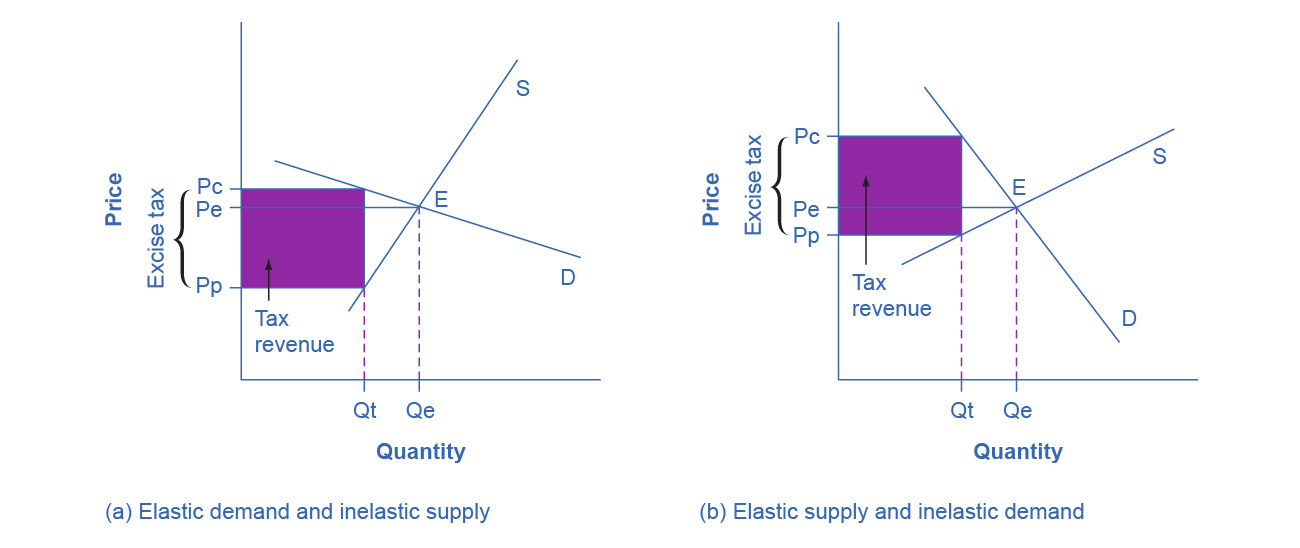

Figure 5.10図 5.10
An excise tax introduces a wedge between the price paid by consumers (Pc) and the price received by producers (Pp). The vertical distance between Pc and Pp is the amount of the tax per unit. Pe is the equilibrium price prior to introduction of the tax. (a) When the demand is more elastic than supply, the tax incidence on consumers Pc – Pe is lower than the tax incidence on producers Pe – Pp. (b) When the supply is more elastic than demand, the tax incidence on consumers Pc – Pe is larger than the tax incidence on producers Pe – Pp. The more elastic the demand and supply curves, the lower the tax revenue.
英語のヒント
物品税は、消費者の支払価格Pcと生産者の受取価格Ppの間にくさびを打ち込む。PcとPpの縦の距離が1単位当たりの税額で、Peは課税前の均衡価格である。(a)需要が供給より弾力的なら、消費者の税負担Pc−Peは、生産者の負担Pe−Ppより小さい。(b)供給が需要より弾力的なら、消費者の負担Pc−Peは、生産者の負担Pe−Ppより大きい。需要曲線と供給曲線が弾力的なほど、税収は少なくなる。
In Figure 5.10 (a), the supply is inelastic and the demand is elastic, such as in the example of beachfront hotels. While consumers may have other vacation choices, sellers can’t easily move their businesses. By introducing a tax, the government essentially creates a wedge between the price paid by consumers Pc and the price received by producers Pp. In other words, of the total price paid by consumers, part is retained by the sellers and part is paid to the government in the form of a tax. The distance between Pc and Pp is the tax rate. The new market price is Pc, but sellers receive only Pp per unit sold, as they pay Pc-Pp to the government. Since we can view a tax as raising the costs of production, this could also be represented by a leftward shift of the supply curve, where the new supply curve would intercept the demand at the new quantity Qt. For simplicity, Figure 5.10 omits the shift in the supply curve.
英語のヒント
図5.10(a)では、海辺のホテルの例のように、供給は非弾力的で需要は弾力的だ。消費者には別の休暇の選択肢があっても、売り手は容易に事業を移せない。課税により政府は実質的に、消費者の支払価格Pcと生産者の受取価格Ppの間にくさびを作る。消費者が払う総額の一部は売り手の手元に残り、一部は税として政府に支払われる。PcとPpの差が税率である。新しい市場価格はPcだが、売り手は政府にPc−Ppを払うため、販売1単位当たりPpしか受け取らない。税は生産費用の増加と見なせるので、供給曲線の左方シフトでも表せる。新しい供給曲線は、数量Qtで需要曲線と交わる。簡単にするため、図5.10では供給曲線のシフトを省略している。
The tax revenue is given by the shaded area, which we obtain by multiplying the tax per unit by the total quantity sold Qt. The tax incidence on the consumers is given by the difference between the price paid Pc and the initial equilibrium price Pe. The tax incidence on the sellers is given by the difference between the initial equilibrium price Pe and the price they receive after the tax is introduced Pp. In Figure 5.10 (a), the tax burden falls disproportionately on the sellers, and a larger proportion of the tax revenue (the shaded area) is due to the resulting lower price received by the sellers than by the resulting higher prices paid by the buyers. Figure 5.10 (b) describes the example of the tobacco excise tax where the supply is more elastic than demand. The tax incidence now falls disproportionately on consumers, as shown by the large difference between the price they pay, Pc, and the initial equilibrium price, Pe. Sellers receive a lower price than before the tax, but this difference is much smaller than the change in consumers’ price. From this analysis one can also predict whether a tax is likely to create a large revenue or not. The more elastic the demand curve, the more likely that consumers will reduce quantity instead of paying higher prices. The more elastic the supply curve, the more likely that sellers will reduce the quantity sold, instead of taking lower prices. In a market where both the demand and supply are very elastic, the imposition of an excise tax generates low revenue.
英語のヒント
税収は色付きの領域で示され、1単位当たりの税額と総販売量Qtの積で求まる。消費者の税負担は、支払価格Pcと当初の均衡価格Peの差である。売り手の負担は、当初の均衡価格Peと課税後の受取価格Ppの差だ。図5.10(a)では、負担が売り手側に偏る。税収を表す色付きの領域のうち、買い手の支払価格上昇による部分より、売り手の受取価格下落による部分のほうが大きい。図5.10(b)は、供給が需要より弾力的なたばこ物品税の例だ。支払価格Pcと当初の均衡価格Peの大きな差が示すように、今度は負担が消費者側に偏る。売り手の受取価格も課税前より低いが、その差は消費者価格の変化よりはるかに小さい。この分析から、税が多くの収入を生むかどうかも予測できる。需要曲線が弾力的なほど、消費者は高い価格を払うより購入量を減らしやすい。供給曲線が弾力的なほど、売り手は低い価格を受け入れるより販売量を減らしやすい。需要と供給の両方が非常に弾力的な市場では、物品税を課しても税収は少ない。
Some believe that excise taxes hurt mainly the specific industries they target. For example, the medical device excise tax, which was implemented in 2013, has been controversial for it can delay industry profitability and therefore hamper start-ups and medical innovation. The tax was repealed in late 2019. However, whether the tax burden falls mostly on the medical device industry or on the patients depends simply on the elasticity of demand and supply.
英語のヒント
物品税は主に対象産業を傷付けると考える人もいる。例えば、2013年に導入された医療機器物品税には議論があった。産業の収益化を遅らせ、起業や医療の革新を妨げうるためだ。この税は2019年末に廃止された。しかし、負担の大部分が医療機器産業にかかるか、患者にかかるかは、需要と供給の弾力性だけで決まる。