第5章弾力性
Can Businesses Pass Costs on to Consumers?企業は費用を消費者に転嫁できるか
Most businesses face a day-to-day struggle to figure out ways to produce at a lower cost, as one pathway to their goal of earning higher profits. However, in some cases, the price of a key input over which the firm has no control may rise. For example, many chemical companies use petroleum as a key input, but they have no control over the world market price for crude oil. Coffee shops use coffee as a key input, but they have no control over the world market price of coffee. If the cost of a key input rises, can the firm pass those higher costs along to consumers in the form of higher prices? Conversely, if new and less expensive ways of producing are invented, can the firm keep the benefits in the form of higher profits, or will the market pressure them to pass the gains along to consumers in the form of lower prices? The price elasticity of demand plays a key role in answering these questions.
英語のヒント
多くの企業は、利益を増やすという目標への道の一つとして、低コストで生産する方法を日々懸命に探している。しかし、企業に制御できない主要な投入物の価格が上がることもある。例えば、多くの化学企業は石油を主要な投入物として使うが、世界市場の原油価格は制御できない。喫茶店もコーヒーを主要な投入物として使うが、世界市場のコーヒー価格は制御できない。主要な投入物の費用が上がったら、企業は値上げという形で、その費用を消費者に転嫁できるだろうか。逆に、新しい低コストの生産方法が発明されたら、企業は利益増という形で恩恵を保持できるだろうか。それとも市場の圧力により、値下げという形で消費者に還元することになるだろうか。これらへの答えには、需要の価格弾力性が重要な役割を果たす。
Imagine that as a consumer of legal pharmaceutical products, you read a newspaper story that a technological breakthrough in the production of aspirin has occurred, so that every aspirin factory can now produce aspirin more cheaply. What does this discovery mean to you? Figure 5.8 illustrates two possibilities. In Figure 5.8 (a), the demand curve is highly inelastic. In this case, a technological breakthrough that shifts supply to the right, from S0 to S1, so that the equilibrium shifts from E0 to E1, creates a substantially lower price for the product with relatively little impact on the quantity sold. In Figure 5.8 (b), the demand curve is highly elastic. In this case, the technological breakthrough leads to a much greater quantity sold in the market at very close to the original price. Consumers benefit more, in general, when the demand curve is more inelastic because the shift in the supply results in a much lower price for consumers.
英語のヒント
合法的な医薬品の消費者として、アスピリン製造の技術革新により、どの工場でも従来より安く生産できるようになったという新聞記事を読んだとしよう。この発見は、あなたにとって何を意味するか。図5.8は二つの可能性を示す。図5.8(a)では需要曲線が極めて非弾力的だ。この場合、技術革新で供給がS0からS1へ右にシフトし、均衡がE0からE1へ移ると、販売量への影響は比較的小さいまま、製品価格が大幅に下がる。図5.8(b)では需要曲線が非常に弾力的だ。この場合、技術革新によって、元の価格に非常に近い価格で、はるかに多く売れるようになる。一般に、需要曲線がより非弾力的なほうが、供給のシフトで消費者価格が大きく下がるため、消費者の利益は大きい。
Passing along Cost Savings to Consumers費用削減を消費者へ還元する
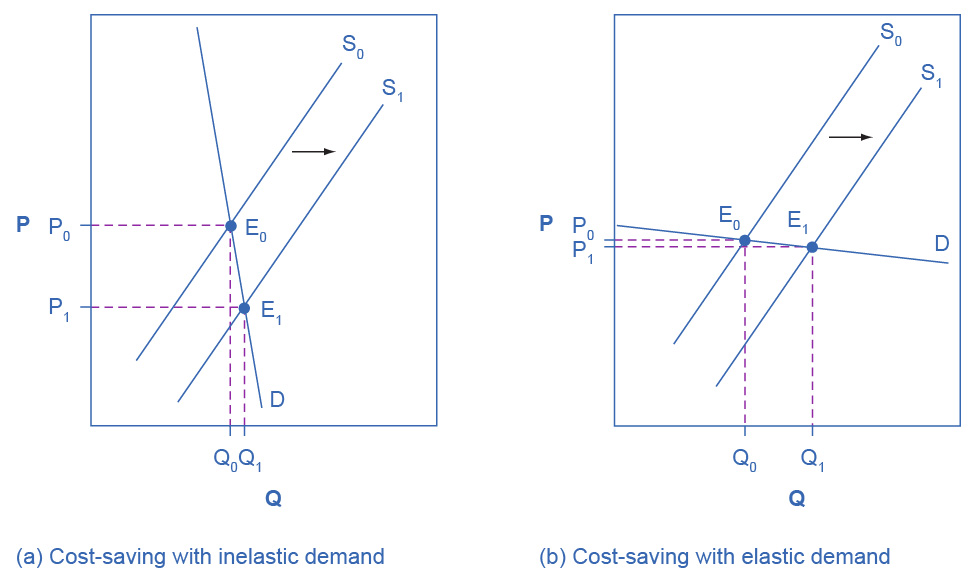
Figure 5.8図 5.8
Cost-saving gains cause supply to shift out to the right from S0 to S1; that is, at any given price, firms will be willing to supply a greater quantity. If demand is inelastic, as in (a), the result of this cost-saving technological improvement will be substantially lower prices. If demand is elastic, as in (b), the result will be only slightly lower prices. Consumers benefit in either case, from a greater quantity at a lower price, but the benefit is greater when demand is inelastic, as in (a).
英語のヒント
費用削減による利益は、供給をS0からS1へ右にシフトさせる。各価格で、企業がより多く供給しようとするということだ。(a)のように需要が非弾力的なら、費用を節約する技術改善は大幅な値下がりをもたらす。(b)のように需要が弾力的なら、値下がりはわずかになる。どちらでも消費者は低い価格で多く購入できるが、(a)のように需要が非弾力的なほうが利益は大きい。
Aspirin producers may find themselves in a nasty bind here. The situation in Figure 5.8, with extremely inelastic demand, means that a new invention may cause the price to drop dramatically while quantity changes little. As a result, the new production technology can lead to a drop in the revenue that firms earn from aspirin sales. However, if strong competition exists between aspirin producers, each producer may have little choice but to search for and implement any breakthrough that allows it to reduce production costs. After all, if one firm decides not to implement such a cost-saving technology, other firms that do can drive them out of business.
英語のヒント
ここでアスピリン生産者は、厄介な板挟みに陥るかもしれない。需要が極めて非弾力的な図5.8の状況では、新発明により、数量がほとんど変わらないまま価格が大幅に下がる。その結果、新しい生産技術が、アスピリン販売から得る企業の収入を減らしうる。しかし、生産者間の競争が激しければ、各生産者は生産費用を下げる革新を探して導入する以外に、ほとんど選択肢がない。ある企業が費用削減技術を導入しないと決めても、導入したほかの企業によって事業から追い出されかねないからだ。
Since demand for food is generally inelastic, farmers may often face the situation in Figure 5.8 (a). That is, a surge in production leads to a severe drop in price that can actually decrease the total revenue that farmers receive. Conversely, poor weather or other conditions that cause a terrible year for farm production can sharply raise prices so that the total revenue that the farmer receives increases. The Clear It Up box discusses how these issues relate to coffee.
英語のヒント
食料需要は一般に非弾力的なので、農家はしばしば図5.8(a)の状況に直面する。増産が大幅な価格下落を引き起こし、実際には農家の総収入を減らすことがある。逆に、悪天候などによる不作は価格を急上昇させ、農家の総収入を増やすことがある。次の「疑問を解く」では、この問題とコーヒーの関係を考える。
Elasticity also reveals whether firms can pass higher costs that they incur on to consumers. Addictive substances, for which demand is inelastic, are products for which producers can pass higher costs on to consumers. For example, the demand for cigarettes is relatively inelastic among regular smokers who are somewhat addicted. Economic research suggests that increasing cigarette prices by 10% leads to about a 3% reduction in the quantity of cigarettes that adults smoke, so the elasticity of demand for cigarettes is 0.3. If society increases taxes on companies that produce cigarettes, the result will be, as in Figure 5.9 (a), that the supply curve shifts from S0 to S1. However, as the equilibrium moves from E0 to E1, governments mainly pass along these taxes to consumers in the form of higher prices. These higher taxes on cigarettes will raise tax revenue for the government, but they will not much affect the quantity of smoking.
英語のヒント
弾力性は、企業が増加した費用を消費者に転嫁できるかどうかも明らかにする。需要が非弾力的な依存性物質は、生産者が費用増を消費者に転嫁できる製品である。例えば、ある程度依存している常習喫煙者のたばこ需要は比較的非弾力的だ。経済研究によれば、たばこが10%値上がりすると、成人の喫煙量は約3%減る。したがって需要の弾力性は0.3である。社会がたばこ生産企業への課税を増やすと、図5.9(a)のように、供給曲線がS0からS1へシフトする。しかし、均衡がE0からE1へ移る際、政府は主に値上がりという形で税を消費者へ転嫁する。この増税は政府の税収を増やすが、喫煙量にはあまり影響しない。
If the goal is to reduce the quantity of cigarettes demanded, we must achieve it by shifting this inelastic demand back to the left, perhaps with public programs to discourage cigarette use or to help people to quit. For example, anti-smoking advertising campaigns have shown some ability to reduce smoking. However, if cigarette demand were more elastic, as in Figure 5.9 (b), then an increase in taxes that shifts supply from S0 to S1 and equilibrium from E0 to E1 would reduce the quantity of cigarettes smoked substantially. Youth smoking seems to be more elastic than adult smoking—that is, the quantity of youth smoking will fall by a greater percentage than the quantity of adult smoking in response to a given percentage increase in price.
英語のヒント
たばこの需要量を減らすことが目的なら、この非弾力的な需要を左へシフトさせなければならない。例えば、たばこの使用を抑えたり禁煙を支援したりする公的な取り組みが考えられる。禁煙広告キャンペーンには、喫煙を減らす一定の効果が認められている。しかし、図5.9(b)のように需要がより弾力的なら、増税によって供給がS0からS1へ、均衡がE0からE1へ移ると、喫煙量は大幅に減る。若者の喫煙は成人より弾力的なようだ。つまり、同じ割合の値上がりに対して、若者の喫煙量は成人より大きい割合で減る。
Passing along Higher Costs to Consumers費用増を消費者へ転嫁する
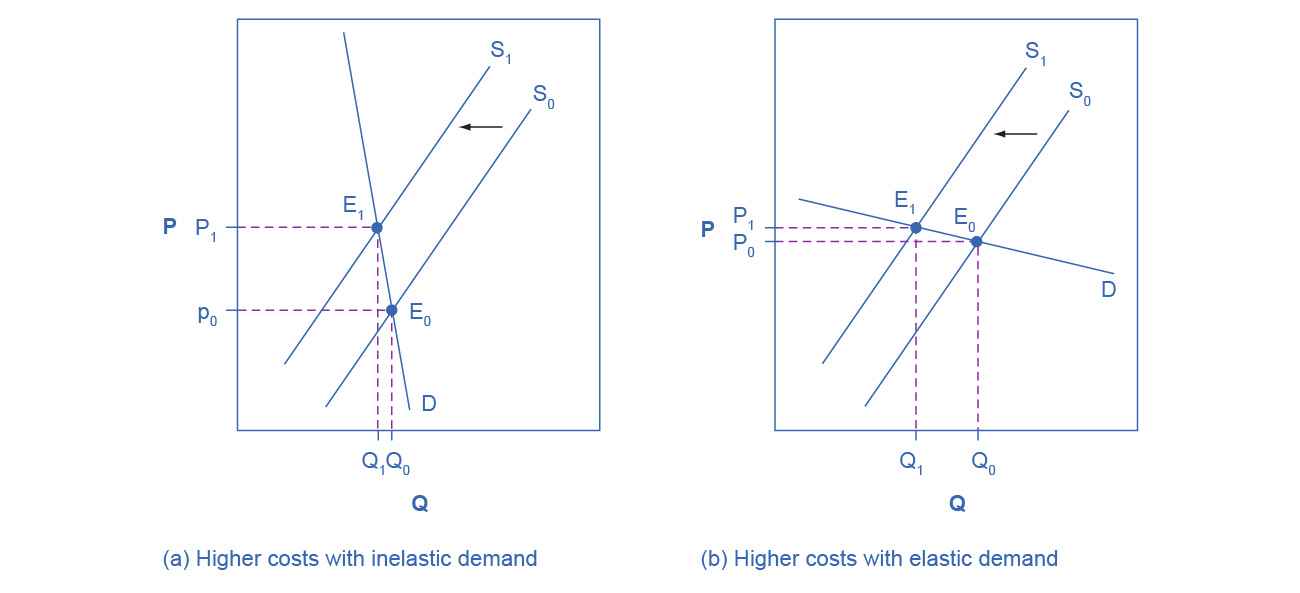


Figure 5.9図 5.9
Higher costs, like a higher tax on cigarette companies for the example we gave in the text, lead supply to shift to the left. This shift is identical in (a) and (b). However, in (a), where demand is inelastic, companies largely can pass the cost increase along to consumers in the form of higher prices, without much of a decline in equilibrium quantity. In (b), demand is elastic, so the shift in supply results primarily in a lower equilibrium quantity. Consumers do not benefit in either case, but in (a), they pay a higher price for the same quantity, while in (b), they must buy a lower quantity (and presumably needing to shift their consumption elsewhere).
英語のヒント
本文のたばこ企業への増税のように、費用が増えると供給は左へシフトする。シフトは(a)と(b)で同じだ。しかし、需要が非弾力的な(a)では、企業は均衡数量をあまり減らさず、費用増の大部分を値上げで消費者に転嫁できる。需要が弾力的な(b)では、供給のシフトは主に均衡数量の減少をもたらす。どちらでも消費者は得をしない。(a)では同じ数量に高い価格を払い、(b)では購入量を減らさなければならず、おそらく消費を別のものへ移す必要がある。