Calculating the Price Elasticity of Supply供給の価格弾力性の計算
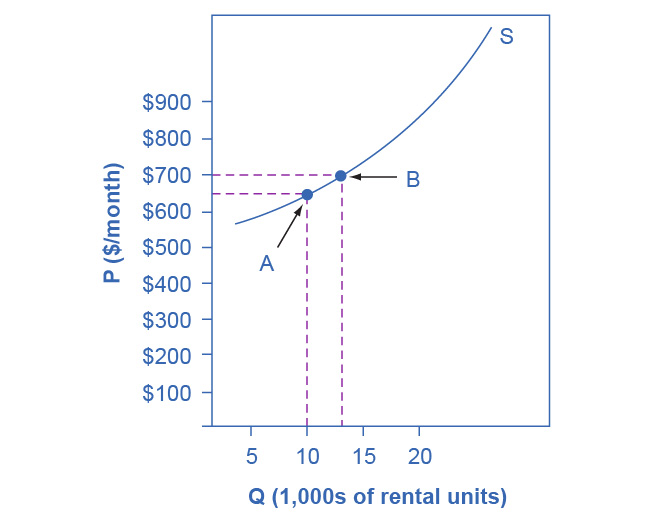
Assume that an apartment rents for $650 per month and at that price the landlord rents 10,000 units as Figure 5.3 shows. When the price increases to $700 per month, the landlord supplies 13,000 units into the market. By what percentage does apartment supply increase? What is the price sensitivity?
Copyright Rice University, OpenStax, under CC-BY 4.0 license. · CC BY 4.0 · Source出典
Figure 5.3図 5.3
We calculate the price elasticity of supply as the percentage change in quantity divided by the percentage change in price.
英語のヒント
供給の価格弾力性は、数量の変化率を価格の変化率で割って計算する。
Using the Midpoint Method,
英語のヒント
中点法を使うと、
Again, as with the elasticity of demand, the elasticity of supply is not followed by any units. Elasticity is a ratio of one percentage change to another percentage change—nothing more—and we read it as an absolute value. In this case, a 1% rise in price causes an increase in quantity supplied of 3.5%. The greater than one elasticity of supply means that the percentage change in quantity supplied will be greater than a one percent price change. If you're starting to wonder if the concept of slope fits into this calculation, read the following Clear It Up box.
Price elasticity measures the responsiveness of the quantity demanded or supplied of a good to a change in its price. We compute it as the percentage change in quantity demanded (or supplied) divided by the percentage change in price. We can describe elasticity as elastic (or very responsive), unit elastic, or inelastic (not very responsive). Elastic demand or supply curves indicate that quantity demanded or supplied respond to price changes in a greater than proportional manner. An inelastic demand or supply curve is one where a given percentage change in price will cause a smaller percentage change in quantity demanded or supplied. A unitary elasticity means that a given percentage change in price leads to an equal percentage change in quantity demanded or supplied.