第25章ケインズ派の視点
25.2 The Building Blocks of Keynesian Analysis25.2 ケインズ派の分析の基本要素
Learning Objectives学習目標
Learning Objectives学習目標
By the end of this section, you will be able to:
英語のヒント
この節を学ぶと、次のことができるようになる。
- Evaluate the Keynesian view of recessions through an understanding of sticky wages and prices and the importance of aggregate demand
英語のヒント
賃金と価格の硬直性および総需要の重要性を理解して、景気後退に関するケインズ派の見方を評価する - Explain the coordination argument, menu costs, and macroeconomic externality
英語のヒント
調整の議論、メニューコスト、マクロ経済的外部性を説明する - Analyze the impact of the expenditure multiplier
英語のヒント
支出乗数の影響を分析する
Now that we have a clear understanding of what constitutes aggregate demand, we return to the Keynesian argument using the model of aggregate demand/aggregate supply (AD/AS). (For a similar treatment using Keynes’ income-expenditure model, see the appendix on The Expenditure-Output Model.)
英語のヒント
何が総需要を構成するかを明確に理解したので、総需要・総供給(AD/AS)モデルを使ったケインズ派の議論に戻ろう。(ケインズの所得・支出モデルによる同様の扱いは、付録「支出・生産モデル」を参照。)
Keynesian economics focuses on explaining why recessions and depressions occur and offering a policy prescription for minimizing their effects. The Keynesian view of recession is based on two key building blocks. First, aggregate demand is not always automatically high enough to provide firms with an incentive to hire enough workers to reach full employment. Second, the macroeconomy may adjust only slowly to shifts in aggregate demand because of sticky wages and prices, which are wages and prices that do not respond to decreases or increases in demand. We will consider these two claims in turn, and then see how they are represented in the AD/AS model.
英語のヒント
ケインズ経済学は、景気後退や恐慌が起きる理由を説明し、その影響を最小にする政策処方を示すことに焦点を当てる。景気後退に関するケインズ派の見方は、二つの重要な基本要素に基づく。第1に、総需要は、企業に完全雇用に達するだけの労働者を雇う誘因を与えるほど、常に自動的に高くなるわけではない。第2に、需要の減少や増加に反応しない硬直的な賃金や価格のため、総需要のシフトに対するマクロ経済の調整は、ゆっくりとしか進まないことがある。この二つの主張を順に考え、その後AD/ASモデルでどう表されるかを見る。
The first building block of the Keynesian diagnosis is that recessions occur when the level of demand for goods and services is less than what is produced when labor is fully employed. In other words, the intersection of aggregate supply and aggregate demand occurs at a level of output less than the level of GDP consistent with full employment. Suppose the stock market crashes, as in 1929, or suppose the housing market collapses, as in 2008. In either case, household wealth will decline, and consumption expenditure will follow. Suppose businesses see that consumer spending is falling or face restrictions from a pandemic that curtail their operations. That will reduce expectations of the profitability of investment, so businesses will decrease investment expenditure.
英語のヒント
ケインズ派の診断の第1の基本要素は、財・サービスへの需要水準が、労働が完全雇用されるときの生産量を下回ると、景気後退が起きるということである。言い換えると、総供給と総需要の交点が、完全雇用に対応するGDP水準より低い生産水準にある。1929年のように株式市場が暴落するか、2008年のように住宅市場が崩壊したとしよう。どちらの場合も家計の富は減り、消費支出もそれに続く。企業が消費支出の減少を目にしたり、パンデミックによる活動制限に直面したりするとしよう。それは投資収益性の予想を低下させるため、企業は投資支出を減らす。
This seemed to be the case during the Great Depression, since the physical capacity of the economy to supply goods did not alter much. No flood or earthquake or other natural disaster ruined factories in 1929 or 1930. No outbreak of disease decimated the ranks of workers. No key input price, like the price of oil, soared on world markets. The U.S. economy in 1933 had just about the same factories, workers, and state of technology as it had had four years earlier in 1929—and yet the economy had shrunk dramatically. This also seems to be what happened in 2008.
英語のヒント
大恐慌中はそうであったように見える。経済の財を供給する物理的能力はあまり変わっていなかったからである。1929年や1930年に洪水、地震、その他の自然災害が工場を破壊したわけではない。病気の発生が労働者を激減させたわけでもない。石油の価格のような重要な投入価格が、世界市場で急騰したわけでもない。1933年の米国経済には、4年前の1929年とほぼ同じ工場、労働者、技術水準があったのに、経済は劇的に縮小していた。2008年にも同じことが起きたように見える。
As Keynes recognized, the events of the Depression contradicted Say’s law that “supply creates its own demand.” Although production capacity existed, the markets were not able to sell their products. As a result, real GDP was less than potential GDP.
英語のヒント
ケインズが認識したように、大恐慌の出来事は「供給はそれ自らの需要を生み出す」というセイの法則に反していた。生産能力は存在したが、市場は製品を売れなかった。その結果、実質GDPは潜在GDPを下回った。
Additional Resources追加教材
Wage and Price Stickiness賃金と価格の硬直性
Keynes also pointed out that although AD fluctuated, prices and wages did not immediately respond as economists often expected. Instead, prices and wages are “sticky,” making it difficult to restore the economy to full employment and potential GDP. Keynes emphasized one particular reason why wages were sticky: the coordination argument. This argument points out that, even if most people would be willing—at least hypothetically—to see a decline in their own wages in bad economic times as long as everyone else also experienced such a decline, a market-oriented economy has no obvious way to implement a plan of coordinated wage reductions. Unemployment proposed a number of reasons why wages might be sticky downward, most of which center on the argument that businesses avoid wage cuts because they may in one way or another depress morale and hurt the productivity of the existing workers.
英語のヒント
ケインズはまた、ADは変動するものの、価格と賃金は経済学者がよく予想するように即座には反応しないと指摘した。むしろ価格と賃金は「硬直的」で、そのため経済を完全雇用と潜在GDPに戻すことが難しくなる。ケインズは賃金が硬直的である一つの特別な理由、調整の議論を強調した。この議論は、景気の悪いとき、他の全員も同様に賃金が下がるなら、大半の人は少なくとも仮定上、自分の賃金低下を受け入れるとしても、市場志向の経済には協調的な賃下げ計画を実行する明白な方法がないと指摘する。「失業」では、賃金が下方に硬直的となりうる理由をいくつか示した。その多くは、賃下げが何らかの形で既存労働者の士気と生産性を損ないうるため、企業が賃下げを避けるという議論を中心としている。
Some modern economists have argued in a Keynesian spirit that, along with wages, other prices may be sticky, too. Many firms do not change their prices every day or even every month. When a firm considers changing prices, it must consider two sets of costs. First, changing prices uses company resources: managers must analyze the competition and market demand and decide the new prices, they must update sales materials, change billing records, and redo product and price labels. Second, frequent price changes may leave customers confused or angry—especially if they discover that a product now costs more than they expected. These costs of changing prices are called menu costs—like the costs of printing a new set of menus with different prices in a restaurant. Prices do respond to forces of supply and demand, but from a macroeconomic perspective, the process of changing all prices throughout the economy takes time.
英語のヒント
現代の一部の経済学者は、ケインズの考えに沿って、賃金だけでなく他の価格も硬直的かもしれないと論じてきた。多くの企業は、毎日、あるいは毎月さえ価格を変えない。価格の変更を検討する企業は、二組の費用を考えなければならない。第1に、価格変更は会社の資源を使う。管理者は競争と市場需要を分析して新価格を決め、販売資料を更新し、請求記録を変え、商品表示と価格札を作り直さなければならない。第2に、頻繁な価格変更は顧客を混乱させたり怒らせたりすることがある。特に、製品が予想より高くなっていると知った場合がそうである。こうした価格変更の費用をメニューコストと呼ぶ。飲食店で、価格を変えた新しいメニューを印刷する費用のようなものである。価格は確かに需要と供給の力に反応するが、マクロ経済の観点からは、経済全体のすべての価格が変わる過程には時間がかかる。
To understand the effect of sticky wages and prices in the economy, consider Figure 25.4 (a) illustrating the overall labor market, while Figure 25.4 (b) illustrates a market for a specific good or service. The original equilibrium (E0) in each market occurs at the intersection of the demand curve (D0) and supply curve (S0). When aggregate demand declines, the demand for labor shifts to the left (to D1) in Figure 25.4 (a) and the demand for goods shifts to the left (to D1) in Figure 25.4 (b). However, because of sticky wages and prices, the wage remains at its original level (W0) for a period of time and the price remains at its original level (P0).
英語のヒント
As a result, a situation of excess supply—where the quantity supplied exceeds the quantity demanded at the existing wage or price—exists in markets for both labor and goods, and Q1 is less than Q0 in both Figure 25.4 (a) and Figure 25.4 (b). When many labor markets and many goods markets all across the economy find themselves in this position, the economy is in a recession; that is, firms cannot sell what they wish to produce at the existing market price and do not wish to hire all who are willing to work at the existing market wage. The Clear It Up feature discusses this problem in more detail.
英語のヒント
Sticky Prices and Falling Demand in the Labor and Goods Market労働市場と財市場における硬直的価格と需要減少
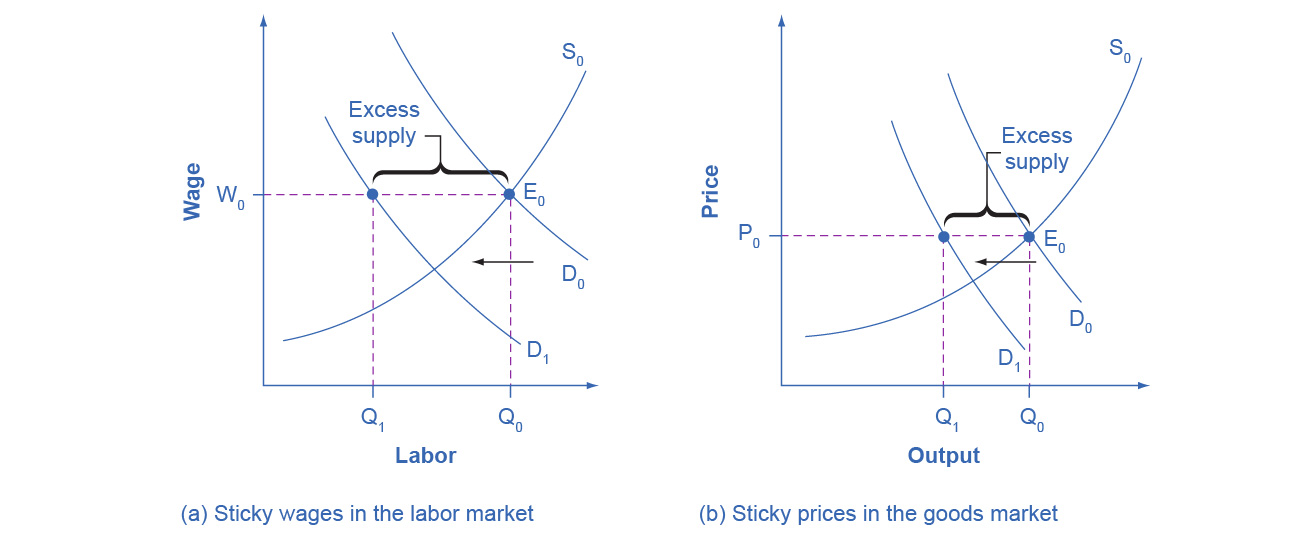

Figure 25.4図 25.4
In both (a) and (b), demand shifts left from D0 to D1. However, the wage in (a) and the price in (b) do not immediately decline. In (a), the quantity demanded of labor at the original wage (W0) is Q0, but with the new demand curve for labor (D1), it will be Q1. Similarly, in (b), the quantity demanded of goods at the original price (P0) is Q0, but at the new demand curve (D1) it will be Q1. An excess supply of labor will exist, which we call unemployment. An excess supply of goods will also exist, where the quantity demanded is substantially less than the quantity supplied. Thus, sticky wages and sticky prices, combined with a drop in demand, bring about unemployment and recession.
英語のヒント
(a)でも(b)でも、需要はD0からD1へ左にシフトする。しかし(a)の賃金と(b)の価格はすぐには下がらない。(a)では、元の賃金W0での労働需要量はQ0だが、新しい労働需要曲線D1ではQ1となる。同様に(b)では、元の価格P0での財の需要量はQ0だが、新しい需要曲線D1ではQ1となる。労働の供給超過が生じ、これを失業と呼ぶ。財の供給超過も生じ、需要量は供給量を大きく下回る。したがって、賃金と価格の硬直性が需要減少と組み合わさると、失業と景気後退をもたらす。