第25章ケインズ派の視点
The Two Keynesian Assumptions in the AD/AS ModelAD/ASモデルの二つのケインズ派の仮定
Figure 25.6 is the AD/AS diagram which illustrates these two Keynesian assumptions—the importance of aggregate demand in causing recession and the stickiness of wages and prices. Note that because of the stickiness of wages and prices, the aggregate supply curve is flatter than either supply curve (labor or specific good). In fact, if wages and prices were so sticky that they did not fall at all, the aggregate supply curve would be completely flat below potential GDP, as Figure 25.6 shows. This outcome is an important example of a macroeconomic externality, where what happens at the macro level is different from what happens at the micro level. For example, a firm should respond to a decrease in demand for its product by cutting its price to increase sales. However, as already noted, menu costs may lead to sticky prices, and sticky prices in the aggregate prevent aggregate demand from rebounding (which we would show as a movement along the AD curve in response to a lower price level). Similarly, the coordination argument may lead to sticky wages, and sticky wages will lead to a flat SRAS curve and GDP less than potential.
英語のヒント
図25.6は、景気後退の発生における総需要の重要性と、賃金・価格の硬直性という二つのケインズ派の仮定を示すAD/AS図である。賃金と価格の硬直性のため、総供給曲線はどちらの供給曲線(労働または特定の財)より平坦であることに注意しよう。実際、賃金と価格がまったく下がらないほど硬直的なら、図25.6のように、潜在GDPを下回る部分の総供給曲線は完全に水平になる。この結果は、マクロの水準で起こることがミクロの水準と異なる、マクロ経済的外部性の重要な例である。例えば企業は、自社製品の需要減少に対し、価格を下げて販売を増やすべきである。しかし、すでに述べたように、メニューコストが価格の硬直性を生み、全体としての硬直的価格が総需要の回復を妨げることがある(価格が下がれば、それに反応するAD曲線上の移動として示される)。同様に、調整の議論が賃金の硬直性を生み、硬直的賃金が平坦なSRAS曲線と潜在水準を下回るGDPにつながりうる。
The original equilibrium of this economy occurs where the aggregate demand function (AD0) intersects with AS. Since this intersection occurs at potential GDP (Yp), the economy is operating at full employment. When aggregate demand shifts to the left, all the adjustment occurs through decreased real GDP. There is no decrease in the price level. Since the equilibrium occurs at Y1, the economy experiences substantial unemployment.
英語のヒント
この経済の元の均衡は、総需要関数AD0とASの交点にある。この交点は潜在GDP(Yp)にあるため、経済は完全雇用で動いている。総需要が左へシフトすると、調整はすべて実質GDPの減少を通じて起こる。物価水準は下がらない。均衡はY1にあるため、経済には多くの失業が生じる。
A Keynesian Perspective of Recession景気後退のケインズ派の見方
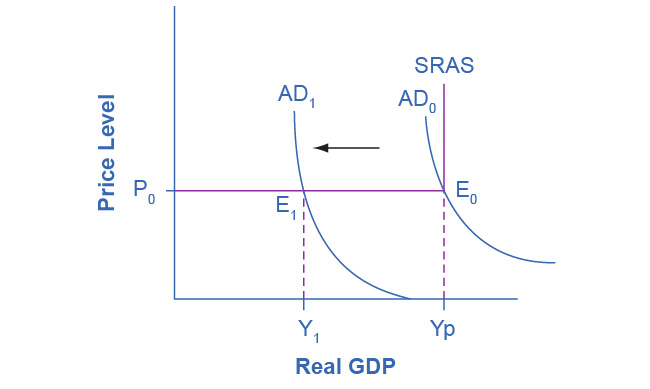

Figure 25.6図 25.6
This figure illustrates the two key assumptions behind Keynesian economics. A recession begins when aggregate demand declines from AD0 to AD1. The recession persists because of the assumption of fixed wages and prices, which makes the SRAS flat below potential GDP. If that were not the case, the price level would fall also, raising GDP and limiting the recession. Instead the intersection E1 occurs in the flat portion of the SRAS curve where GDP is less than potential.
英語のヒント
この図はケインズ経済学の二つの主要な仮定を示す。総需要がAD0からAD1へ減ると、景気後退が始まる。賃金と価格が固定されるという仮定によって、潜在GDPを下回る部分のSRASは平坦となり、景気後退が続く。そうでなければ物価水準も下がり、GDPを増やして景気後退を抑えるだろう。実際には交点E1がSRAS曲線の平坦な部分にあり、GDPは潜在水準を下回る。
The Expenditure Multiplier支出乗数
A key concept in Keynesian economics is the expenditure multiplier. The expenditure multiplier is the idea that not only does spending affect the equilibrium level of GDP, but that spending is powerful. More precisely, it means that, theoretically, a change in spending causes a more than proportionate change in GDP.
英語のヒント
ケインズ経済学の重要な概念は支出乗数である。支出乗数とは、支出がGDPの均衡水準に影響するだけでなく、強力な効果を持つという考えである。より正確には、理論上、支出の変化が比例以上のGDPの変化を起こすことを意味する。
The reason for the expenditure multiplier is that one person’s spending becomes another person’s income, and given certain conditions, this leads to additional spending and additional income so that the cumulative impact on GDP is larger than the initial increase in spending. (Research has shown that some expenditure multipliers are less than one. For example, tax cuts for the wealthy have an expenditure multiplier of less than one.) The appendix on The Expenditure-Output Model provides the details of the multiplier process, but the concept is important enough for us to summarize here. While the multiplier is important for understanding the effectiveness of fiscal policy, it occurs whenever any autonomous increase in spending occurs. Additionally, the multiplier operates in a negative as well as a positive direction. Thus, when investment spending collapsed during the Great Depression, it caused a much larger decrease in real GDP. The size of the multiplier is critical and was a key element in discussions of the effectiveness of the Obama administration’s fiscal stimulus package, officially titled the American Recovery and Reinvestment Act of 2009.
英語のヒント
支出乗数が生じる理由は、ある人の支出が別の人の所得となり、一定の条件では、それが追加的な支出と所得につながるためである。その結果、GDPへの累積効果は、最初の支出増加より大きくなる。(研究では、1より小さい支出乗数もあると示されている。例えば富裕層への減税の支出乗数は1未満である。)付録「支出・生産モデル」で乗数過程を詳しく説明するが、この概念はここで要約するほど重要である。乗数は財政政策の有効性を理解するうえで重要だが、どのような自律的な支出増加でも生じる。また、乗数は正の方向だけでなく負の方向にも働く。したがって、大恐慌中に投資支出が崩壊したとき、実質GDPはそれよりはるかに大きく減った。乗数の大きさは決定的に重要であり、正式名称を2009年米国再生・再投資法というオバマ政権の財政刺激策の有効性をめぐる議論でも、主要な要素だった。
Key Concepts and Summary重要概念とまとめ
Keynesian economics is based on two main ideas: (1) aggregate demand is more likely than aggregate supply to be the primary cause of a short-run economic event like a recession; (2) wages and prices can be sticky, and so, in an economic downturn, unemployment can result. The latter is an example of a macroeconomic externality. While surpluses cause prices to fall at the micro level, they do not necessarily at the macro level. Instead the adjustment to a decrease in demand occurs only through decreased quantities. One reason why prices may be sticky is menu costs, the costs of changing prices. These include internal costs a business faces in changing prices in terms of labeling, recordkeeping, and accounting, and also the costs of communicating the price change to (possibly unhappy) customers. Keynesians also believe in the existence of the expenditure multiplier—the notion that a change in autonomous expenditure causes a more than proportionate change in GDP.
英語のヒント
ケインズ経済学は二つの主な考えに基づく。(1)景気後退のような短期の経済的出来事の主因になるのは、総供給より総需要である可能性が高い。(2)賃金と価格は硬直的になりうるため、景気の落ち込みによって失業が生じうる。後者はマクロ経済的外部性の例である。ミクロの水準では供給超過によって価格が下がるが、マクロの水準では必ずしもそうならない。むしろ、需要減少への調整は数量の減少だけを通じて起きる。価格が硬直的となりうる一つの理由は、価格変更の費用であるメニューコストである。これには、表示、記録管理、会計に関して企業が価格変更時に直面する内部費用と、顧客(不満を抱くかもしれない)に価格変更を伝える費用が含まれる。ケインズ派は、支出乗数、つまり自律的支出の変化がGDPに比例以上の変化を起こすという考えの存在も信じている。