第25章ケインズ派の視点
The Instability of the Phillips Curveフィリップス曲線の不安定性
During the 1960s, economists viewed the Phillips curve as a policy menu. A nation could choose low inflation and high unemployment, or high inflation and low unemployment, or anywhere in between. Economies could use fiscal and monetary policy to move up or down the Phillips curve as desired. Then a curious thing happened. When policymakers tried to exploit the tradeoff between inflation and unemployment, the result was an increase in both inflation and unemployment. What had happened? The Phillips curve shifted.
英語のヒント
1960年代、経済学者はフィリップス曲線を政策のメニューと見ていた。国は、低インフレ・高失業、高インフレ・低失業、またはその間のどこでも選べた。財政政策と金融政策を使い、望むようにフィリップス曲線を上がったり下がったりできた。すると奇妙なことが起きた。政策立案者がインフレと失業のトレードオフを利用しようとしたところ、インフレも失業も増えたのである。何が起きたのか。フィリップス曲線がシフトした。
The U.S. economy experienced this pattern in the deep recession from 1973 to 1975, and again in back-to-back recessions from 1980 to 1982. Many nations around the world saw similar increases in unemployment and inflation. This pattern became known as stagflation. (Recall from The Aggregate Demand/Aggregate Supply Model that stagflation is an unhealthy combination of high unemployment and high inflation.) Perhaps most important, stagflation was a phenomenon that traditional Keynesian economics could not explain.
英語のヒント
米国経済は、1973~1975年の深い景気後退と、1980~1982年の連続する景気後退で、このパターンを経験した。世界の多くの国でも、失業とインフレが同様に増えた。このパターンはスタグフレーションとして知られるようになった。(「総需要・総供給モデル」で学んだように、スタグフレーションは高失業と高インフレの不健全な組み合わせである。)おそらく最も重要なのは、スタグフレーションが伝統的なケインズ経済学では説明できない現象だったことである。
Economists have concluded that two factors cause the Phillips curve to shift. The first is supply shocks, like the mid-1970s oil crisis, which first brought stagflation into our vocabulary. The second is changes in people’s expectations about inflation. In other words, there may be a tradeoff between inflation and unemployment when people expect no inflation, but when they realize inflation is occurring, the tradeoff disappears. Both factors (supply shocks and changes in inflationary expectations) cause the aggregate supply curve, and thus the Phillips curve, to shift.
英語のヒント
経済学者は、二つの要因がフィリップス曲線をシフトさせると結論づけている。第1は、スタグフレーションという言葉を初めて使わせた1970年代半ばの石油危機のような供給ショックである。第2は、人々のインフレ予想の変化である。言い換えると、人々がインフレを予想していないときには、インフレと失業のトレードオフがありうるが、インフレが起きていると気づくと、そのトレードオフは消える。供給ショックとインフレ予想の変化のどちらも、総供給曲線を、したがってフィリップス曲線をシフトさせる。
In short, we should interpret a downward-sloping Phillips curve as valid for short-run periods of several years, but over longer periods, when aggregate supply shifts, the downward-sloping Phillips curve can shift so that unemployment and inflation are both higher (as in the 1970s and early 1980s) or both lower (as in the early 1990s or first decade of the 2000s).
英語のヒント
要するに、右下がりのフィリップス曲線は数年間の短期には有効だと解釈すべきである。しかし、より長い期間には、総供給がシフトすると、右下がりのフィリップス曲線もシフトし、1970年代と1980年代初めのように失業とインフレが両方高くなったり、1990年代初めや2000年代の最初の10年間のように両方低くなったりする。
Keynesian Policy for Fighting Unemployment and Inflation失業とインフレに対処するケインズ派の政策
Keynesian macroeconomics argues that the solution to a recession is expansionary fiscal policy, such as tax cuts to stimulate consumption and investment, or direct increases in government spending that would shift the aggregate demand curve to the right. For example, if aggregate demand was originally at ADr in Figure 25.11, so that the economy was in recession, the appropriate policy would be for government to shift aggregate demand to the right from ADr to ADf, where the economy would be at potential GDP and full employment.
英語のヒント
ケインズ派のマクロ経済学は、景気後退の解決策は拡張的財政政策であると論じる。消費と投資を刺激する減税や、総需要曲線を右へシフトさせる政府支出の直接的増加などである。例えば、図25.11で総需要が最初ADrにあり、経済が景気後退中なら、適切な政策は政府が総需要をADrからADfへ右にシフトさせることである。そこでは経済が潜在GDPと完全雇用に達する。
Keynes noted that while it would be nice if the government could spend additional money on housing, roads, and other amenities, he also argued that if the government could not agree on how to spend money in practical ways, then it could spend in impractical ways. For example, Keynes suggested building monuments, like a modern equivalent of the Egyptian pyramids. He proposed that the government could bury money underground, and let mining companies start digging up the money again. These suggestions were slightly tongue-in-cheek, but their purpose was to emphasize that a Great Depression is no time to quibble over the specifics of government spending programs and tax cuts when the goal should be to pump up aggregate demand by enough to lift the economy to potential GDP.
英語のヒント
ケインズは、政府が住宅、道路、その他の公共施設に追加支出できればよいと述べたが、実際的な使途に合意できないなら、非実際的な使途に支出してもよいとも論じた。例えば、現代版のエジプトのピラミッドのような記念建造物を建てることを提案した。政府がお金を地中に埋め、鉱山会社にそれを掘り出させてもよいと提案したのである。これらは多少冗談めいた提案だったが、その目的は、潜在GDPへ経済を引き上げるだけ総需要を膨らませるべき大恐慌の時期に、政府支出計画や減税の細部にこだわっている場合ではないと強調することだった。
Fighting Recession and Inflation with Keynesian Policyケインズ派の政策による景気後退とインフレへの対処
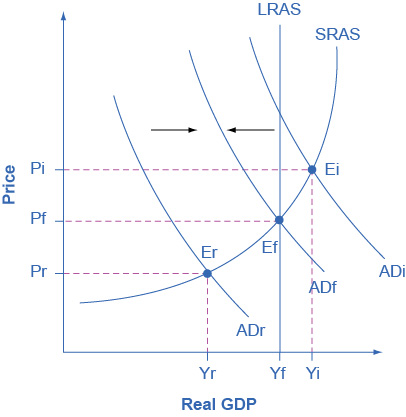

Figure 25.11図 25.11
If an economy is in recession, with an equilibrium at Er, then the Keynesian response would be to enact a policy to shift aggregate demand to the right from ADr toward ADf. If an economy is experiencing inflationary pressures with an equilibrium at Ei, then the Keynesian response would be to enact a policy response to shift aggregate demand to the left, from ADi toward ADf.
英語のヒント
均衡がErにあり経済が景気後退中なら、ケインズ派の対応は、総需要をADrからADfへ右にシフトさせる政策を実施することである。均衡がEiにあり経済にインフレ圧力があるなら、ケインズ派の対応は、総需要をADiからADfへ左にシフトさせる政策を実施することである。
The other side of Keynesian policy occurs when the economy is operating above potential GDP. In this situation, unemployment is low, but inflationary rises in the price level are a concern. The Keynesian response would be contractionary fiscal policy, using tax increases or government spending cuts to shift AD to the left. The result would be downward pressure on the price level, but very little reduction in output or very little rise in unemployment. If aggregate demand was originally at ADi in Figure 25.11, so that the economy was experiencing inflationary rises in the price level, the appropriate policy would be for government to shift aggregate demand to the left, from ADi toward ADf, which reduces the pressure for a higher price level while the economy remains at full employment.
英語のヒント
ケインズ派の政策のもう一方は、経済が潜在GDPを上回って動いているときに現れる。この状況では失業は少ないが、インフレ的な物価上昇が懸念となる。ケインズ派の対応は緊縮的財政政策で、増税や政府支出削減によってADを左へシフトさせる。その結果、物価水準には下押し圧力がかかるが、生産の減少や失業の増加はごく小さい。図25.11で総需要が最初ADiにあり、経済がインフレ的な物価上昇を経験しているなら、適切な政策は政府が総需要をADiからADfへ左にシフトさせることである。これは、完全雇用を維持しつつ、物価水準の上昇圧力を減らす。
In the Keynesian economic model, too little aggregate demand brings unemployment and too much brings inflation. Thus, you can think of Keynesian economics as pursuing a “Goldilocks” level of aggregate demand: not too much, not too little, but looking for what is just right.
英語のヒント
ケインズ派の経済モデルでは、総需要が少なすぎると失業が生じ、多すぎるとインフレが生じる。したがって、ケインズ経済学は総需要の「ゴルディロックス」の水準を追求していると考えられる。多すぎず少なすぎず、ちょうどよいものを探しているのである。