第27章貨幣と銀行制度
27.2 Measuring Money: Currency, M1, and M227.2 貨幣の測定:現金通貨、M1、M2
Learning Objectives学習目標
Learning Objectives学習目標
By the end of this section, you will be able to:
英語のヒント
この節を学ぶと、次のことができるようになる。
- Contrast M1 money supply and M2 money supply
英語のヒント
M1貨幣供給とM2貨幣供給を対比する - Classify monies as M1 money supply or M2 money supply
英語のヒント
貨幣をM1貨幣供給とM2貨幣供給に分類する
Cash in your pocket certainly serves as money; however, what about checks or credit cards? Are they money, too? Rather than trying to state a single way of measuring money, economists offer broader definitions of money based on liquidity. Liquidity refers to how quickly you can use a financial asset to buy a good or service. For example, cash is very liquid. You can use your $10 bill easily to buy a hamburger at lunchtime. However, $10 that you have in your savings account is not so easy to use. You must go to the bank or ATM machine and withdraw that cash to buy your lunch. Thus, $10 in your savings account is less liquid.
英語のヒント
ポケットの現金が貨幣として機能することは確かだが、小切手やクレジットカードはどうだろうか。これらも貨幣なのだろうか。経済学者は、貨幣を測る方法を一つに限定せず、流動性に基づいて、より広い貨幣の定義を示す。流動性とは、金融資産を財やサービスの購入にどれほど素早く使えるかを指す。たとえば、現金の流動性は非常に高い。10ドル紙幣なら昼食時にハンバーガーを簡単に買える。しかし貯蓄口座にある10ドルは、それほど簡単には使えない。昼食を買うには銀行やATMに行って現金を引き出す必要がある。したがって、貯蓄口座にある10ドルの流動性は低い。
The Federal Reserve Bank, which is the central bank of the United States, is a bank regulator and is responsible for monetary policy and defines money according to its liquidity. There are two definitions of money: M1 and M2 money supply. Historically, M1 money supply included those monies that are very liquid such as cash, checkable (demand) deposits, and traveler’s checks, while M2 money supply included those monies that are less liquid in nature; M2 included M1 plus savings and time deposits, certificates of deposits, and money market funds. Beginning in May 2020, the Federal Reserve changed the definition of both M1 and M2. The biggest change is that savings moved to be part of M1. M1 money supply now includes cash, checkable (demand) deposits, and savings. M2 money supply is now measured as M1 plus time deposits, certificates of deposits, and money market funds.
英語のヒント
アメリカの中央銀行である連邦準備銀行は、銀行の規制と金融政策を担い、流動性に応じて貨幣を定義する。貨幣供給には、M1とM2という二つの定義がある。従来、M1には現金、小切手振出可能な要求払預金、トラベラーズチェックなど、流動性の非常に高い貨幣が含まれていた。M2には、より流動性の低い貨幣が含まれ、M1に加えて貯蓄預金、定期預金、譲渡性預金、マネー・マーケット・ファンドが含まれていた。2020年5月から、連邦準備制度はM1とM2の両方の定義を変更した。最大の変更は、貯蓄預金をM1に移したことである。現在のM1貨幣供給には、現金、小切手振出可能な要求払預金、貯蓄預金が含まれる。現在のM2貨幣供給は、M1に定期預金、譲渡性預金、マネー・マーケット・ファンドを加えたものとして測定される。
M1 money supply includes coins and currency in circulation—the coins and bills that circulate in an economy that the U.S. Treasury does not hold at the Federal Reserve Bank, or in bank vaults. Closely related to currency are checkable deposits, also known as demand deposits. These are the amounts held in checking accounts. They are called demand deposits or checkable deposits because the banking institution must give the deposit holder his money “on demand” when the customer writes a check or uses a debit card. These items together—currency, and checking accounts in banks—comprise the definition of money known as M1, which the Federal Reserve System measures daily.
英語のヒント
M1貨幣供給には、流通している硬貨と紙幣が含まれる。つまり、連邦準備銀行や銀行の金庫に米国財務省が保有しているものを除き、経済内を流通する硬貨と紙幣である。現金通貨と密接に関係するのが、小切手振出可能預金、別名、要求払預金である。これは当座預金口座に保有される金額を指す。要求払預金または小切手振出可能預金と呼ばれるのは、顧客が小切手を振り出したりデビットカードを使ったりしたとき、銀行が預金者の「要求に応じて」その金を渡さなければならないからである。現金通貨と銀行の当座預金口座を合わせたものが、M1という貨幣の定義を構成し、連邦準備制度が毎日測定している。
As mentioned, M1 now includes savings deposits in banks, which are bank accounts on which you cannot write a check directly, but from which you can easily withdraw the money at an automatic teller machine or bank.
英語のヒント
すでに述べたように、現在のM1には銀行の貯蓄預金も含まれる。これは、直接小切手を振り出すことはできないが、ATMや銀行で容易に資金を引き出せる口座である。
A broader definition of money, M2 includes everything in M1 but also adds other types of deposits. Many banks and other financial institutions also offer a chance to invest in money market funds, where they pool together the deposits of many individual investors and invest them in a safe way, such as short-term government bonds. Another ingredient of M2 are the relatively small (that is, less than about $100,000) certificates of deposit (CDs) or time deposits, which are accounts that the depositor has committed to leaving in the bank for a certain period of time, ranging from a few months to a few years, in exchange for a higher interest rate. In short, all these types of M2 are money that you can withdraw and spend, but which require a greater effort to do so than the items in M1. Figure 27.3 should help in visualizing the relationship between M1 and M2. Note that M1 is included in the M2 calculation.
英語のヒント
より広い貨幣の定義であるM2は、M1のすべてに加え、ほかの種類の預金も含む。多くの銀行や金融機関は、マネー・マーケット・ファンドへの投資機会も提供する。このファンドでは多くの個人投資家の預金をまとめ、短期国債などに安全な方法で投資する。M2のもう一つの構成要素は、比較的小口、すなわち約10万ドル未満の譲渡性預金(CD)や定期預金である。これは、高い金利と引き換えに、数か月から数年までの一定期間、銀行に資金を預けたままにすると預金者が約束した口座である。つまり、これらのM2はどれも引き出して使える貨幣だが、M1の項目より手間がかかる。図27.3はM1とM2の関係を視覚的に理解するのに役立つだろう。M2の計算にはM1が含まれることに注意しよう。
The Relationship between M1 and M2 MoneyM1貨幣とM2貨幣の関係
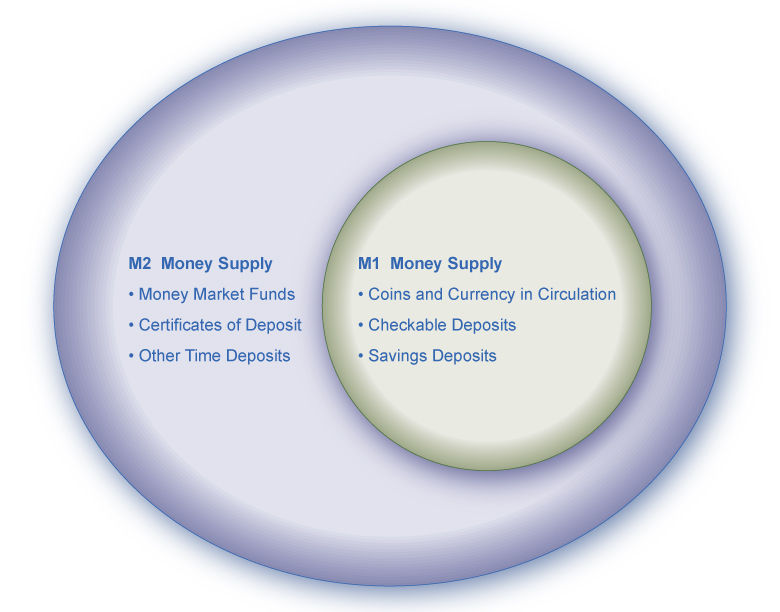

Figure 27.3図 27.3
M1 and M2 money have several definitions, ranging from narrow to broad. M1 = coins and currency in circulation + checkable (demand) deposit + savings deposits. M2 = M1 + money market funds + certificates of deposit + other time deposits.
英語のヒント
貨幣にはM1やM2など、狭いものから広いものまで複数の定義がある。M1=流通する硬貨・紙幣+小切手振出可能な要求払預金+貯蓄預金。M2=M1+マネー・マーケット・ファンド+譲渡性預金+その他の定期預金。
The Federal Reserve System is responsible for tracking the amounts of M1 and M2 and prepares a weekly release of information about the money supply. To provide an idea of what these amounts sound like, according to the Federal Reserve Bank’s measure of the U.S. money stock, at the end of November 2021, M1 in the United States was $20.3 trillion, while M2 was $21.4 trillion. Table 27.1 provides a breakdown of the portion of each type of money that comprised M1 and M2 in November 2021, as provided by the Federal Reserve Bank.
英語のヒント
連邦準備制度はM1とM2の金額を把握する責任を負い、貨幣供給に関する情報を毎週公表する。どの程度の規模なのかを示すと、連邦準備銀行のアメリカのマネーストック測定によれば、2021年11月末のM1は20.3兆ドル、M2は21.4兆ドルだった。表27.1は、連邦準備銀行が示した2021年11月のM1とM2を構成する各種類の貨幣の内訳である。
Components of M1 in the U.S. (November 2021, Seasonally Adjusted) アメリカのM1の構成要素(2021年11月、季節調整済み) |
$ billions 10億ドル |
Currency 現金通貨 |
$2,114.6 |
Demand deposits 要求払預金 |
$4,764.1 |
Savings and other liquid deposits 貯蓄預金とその他の流動性預金 |
$13,466.3 |
Total M1 M1合計 |
$20,345 (or $21.4 trillion) 20,345(または21.4兆ドル) |
Components of M2 in the U.S. (November 2021, Seasonally Adjusted) アメリカのM2の構成要素(2021年11月、季節調整済み) |
$ billions 10億ドル |
M1 money supply M1貨幣供給 |
$19,221 |
Small-denomination time deposits 小口定期預金 |
$120 |
Retail money market fund balances 個人向けマネー・マーケット・ファンド残高 |
$1,027 |
Total M2 M2合計 |
$20,368 (or $20 trillion) 20,368(または20兆ドル) |
The lines separating M1 and M2 can become a little blurry. Sometimes businesses do not treat elements of M1 alike. For example, some businesses will not accept personal checks for large amounts, but will accept traveler’s checks or cash. Changes in banking practices and technology have made the savings accounts in M2 more similar to the checking accounts in M1. For example, some savings accounts will allow depositors to write checks, use automatic teller machines, and pay bills over the internet, which has made it easier to access savings accounts. As with many other economic terms and statistics, the important point is to know the strengths and limitations of the various definitions of money, not to believe that such definitions are as clear-cut to economists as, say, the definition of nitrogen is to chemists.
英語のヒント
M1とM2を分ける境界は、多少曖昧になることがある。企業がM1の構成要素を同じように扱わない場合もある。たとえば、個人の高額小切手は受け入れず、トラベラーズチェックや現金なら受け入れる企業もある。銀行業務や技術の変化によって、M2の貯蓄口座はM1の当座口座に似てきた。たとえば、一部の貯蓄口座では預金者が小切手を振り出し、ATMを使い、インターネットで請求書の代金を支払うことができるようになり、預金を利用しやすくなった。他の多くの経済用語や統計と同様に、重要なのは貨幣のさまざまな定義の長所と限界を知ることである。経済学者にとってこれらの定義が、たとえば化学者にとっての窒素の定義ほど明確だと思い込むことではない。
Where does “plastic money” like debit cards, credit cards, and smart money fit into this picture? A debit card, like a check, is an instruction to the user’s bank to transfer money directly and immediately from your bank account to the seller. It is important to note that in our definition of money, it is checkable deposits that are money, not the paper check or the debit card. Although you can make a purchase with a credit card, the financial institution does not consider it money but rather a short term loan from the credit card company to you. When you make a credit card purchase, the credit card company immediately transfers money from its checking account to the seller, and at the end of the month, the credit card company sends you a bill for what you have charged that month. Until you pay the credit card bill, you have effectively borrowed money from the credit card company. With a smart card, you can store a certain value of money on the card and then use the card to make purchases. Some “smart cards” used for specific purposes, like long-distance phone calls or making purchases at a campus bookstore and cafeteria, are not really all that smart, because you can only use them for certain purchases or in certain places.
英語のヒント
デビットカード、クレジットカード、スマートマネーのような「プラスチックの貨幣」は、この説明のどこに位置づけられるだろうか。デビットカードは小切手と同じく、利用者の銀行口座から売り手へ資金を直接かつ即座に振り替えるよう、銀行に指示するものである。ここでの貨幣の定義では、貨幣なのは小切手振出可能預金であり、紙の小切手やデビットカードではない点が重要である。クレジットカードで買い物はできるが、金融機関はそれを貨幣とは考えず、カード会社から利用者への短期融資とみなす。クレジットカードで買い物をすると、カード会社は自社の当座預金口座から売り手へ直ちに送金し、月末にその月の利用額を利用者に請求する。カードの請求額を支払うまで、利用者は実質的にカード会社から金を借りている。スマートカードには一定額の貨幣価値を記録し、そのカードで買い物ができる。長距離電話や学内の書店・食堂での買い物など、特定の目的に使われる「スマートカード」の中には、それほど賢くないものもある。特定の買い物や特定の場所でしか使えないからである。
In short, credit cards, debit cards, and smart cards are different ways to move money when you make a purchase. However, having more credit cards or debit cards does not change the quantity of money in the economy, any more than printing more checks increases the amount of money in your checking account.
英語のヒント
要するに、クレジットカード、デビットカード、スマートカードは、購入時に貨幣を移動させる別々の方法である。しかし、クレジットカードやデビットカードを増やしても、経済内の貨幣量は変わらない。小切手を多く印刷しても、当座預金口座の金額が増えないのと同じである。
One key message underlying this discussion of M1 and M2 is that money in a modern economy is not just paper bills and coins. Instead, money is closely linked to bank accounts. The banking system largely conducts macroeconomic policies concerning money. The next section explains how banks function and how a nation’s banking system has the power to create money.
英語のヒント
M1とM2についてのこの議論の根底にある重要な点は、現代経済の貨幣は紙幣と硬貨だけではないということである。貨幣は銀行口座と密接に結びついている。貨幣に関わるマクロ経済政策は、主に銀行制度を通じて実施される。次の節では、銀行がどのように機能するか、そして一国の銀行制度がどのように貨幣を創造する力をもつかを説明する。