第27章貨幣と銀行制度
Commodity versus Fiat Money商品貨幣と不換貨幣
Money has taken a wide variety of forms in different cultures. People have used gold, silver, cowrie shells, cigarettes, and even cocoa beans as money. Although we use these items as commodity money, they also have a value from use as something other than money. For example, people have used gold throughout the ages as money although today we do not use it as money but rather value it for its other attributes. Gold is a good conductor of electricity and the electronics and aerospace industry use it. Other industries use gold too, such as to manufacture energy efficient reflective glass for skyscrapers and is used in the medical industry as well. Of course, gold also has value because of its beauty and malleability in creating jewelry.
英語のヒント
貨幣は文化によってさまざまな形をとってきた。金、銀、タカラガイの貝殻、たばこ、さらにはカカオ豆まで貨幣として使われてきた。これらは商品貨幣として使われるが、貨幣以外の用途にも価値がある。たとえば金は古くから貨幣として使われてきたが、今日では貨幣としてではなく、その他の性質に価値が認められている。金は電気をよく通すため、電子産業や航空宇宙産業で利用される。その他の産業でも利用され、たとえば高層ビルの省エネルギー型の反射ガラスの製造に使われるほか、医療分野でも使われる。もちろん、その美しさや、宝飾品を作る際の展性にも価値がある。
As commodity money, gold has historically served its purpose as a medium of exchange, a store of value, and as a unit of account. Commodity-backed currencies are dollar bills or other currencies with values backed up by gold or other commodities held at a bank. During much of its history, gold and silver backed the money supply in the United States. Interestingly, antique dollars dated as late as 1957, have “Silver Certificate” printed over the portrait of George Washington, as Figure 27.2 shows. This meant that the holder could take the bill to the appropriate bank and exchange it for a dollar’s worth of silver.
英語のヒント
商品貨幣として、金は歴史的に、交換手段、価値の貯蔵手段、計算単位という役割を果たしてきた。商品に裏付けられた通貨とは、銀行が保有する金やその他の商品によって価値が裏付けられたドル紙幣などの通貨である。アメリカではその歴史の大部分において、金と銀が貨幣供給を裏付けていた。興味深いことに、図27.2のように、1957年という比較的新しい年号の古いドル紙幣にも、ジョージ・ワシントンの肖像の上に「Silver Certificate(銀兌換券)」と印刷されている。これは、保有者がその紙幣を指定の銀行に持っていけば、1ドル相当の銀と交換できることを意味していた。
A Silver Certificate and a Modern U.S. Bill銀兌換券と現代のアメリカ紙幣
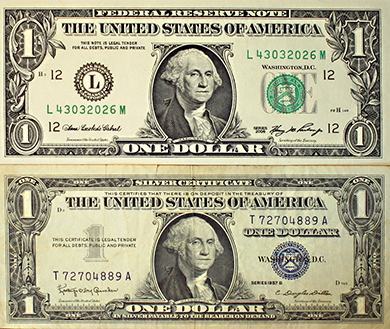
Until 1958, silver certificates were commodity-backed money—backed by silver, as indicated by the words “Silver Certificate” printed on the bill. Today, The Federal Reserve backs U.S. bills, but as fiat money (inconvertible paper money made legal tender by a government decree). (Credit: "One Dollar Bills" by “The.Comedian”/Flickr Creative Commons, CC BY 2.0) · CC BY 2.0 · Source出典

Figure 27.2図 27.2
Until 1958, silver certificates were commodity-backed money—backed by silver, as indicated by the words “Silver Certificate” printed on the bill. Today, The Federal Reserve backs U.S. bills, but as fiat money (inconvertible paper money made legal tender by a government decree). (Credit: "One Dollar Bills" by “The.Comedian”/Flickr Creative Commons, CC BY 2.0)
英語のヒント
1958年まで、銀兌換券は商品に裏付けられた貨幣だった。紙幣に印刷された「Silver Certificate(銀兌換券)」の文字のとおり、銀に裏付けられていた。今日では連邦準備制度がアメリカ紙幣を裏付けているが、それは不換貨幣、すなわち政府の命令によって法定通貨とされた、兌換できない紙幣である。(出典:「The.Comedian」による「One Dollar Bills」/Flickr Creative Commons、CC BY 2.0)
As economies grew and became more global in nature, the use of commodity monies became more cumbersome. Countries moved towards the use of fiat money. Fiat money has no intrinsic value, but is declared by a government to be a country's legal tender. The United States’ paper money, for example, carries the statement: “THIS NOTE IS LEGAL TENDER FOR ALL DEBTS, PUBLIC AND PRIVATE.” In other words, by government decree, if you owe a debt, then legally speaking, you can pay that debt with the U.S. currency, even though it is not backed by a commodity. The only backing of our money is universal faith and trust that the currency has value, and nothing more.
英語のヒント
経済が成長し、その性格がより国際的になるにつれ、商品貨幣の使用は煩雑になった。各国は不換貨幣の使用へと移行した。不換貨幣には内在的価値がないが、政府によってその国の法定通貨と定められている。たとえばアメリカの紙幣には「この紙幣は、公的・私的なすべての債務に対する法定通貨である」と記されている。言い換えれば、政府の命令により、債務を負っている人は、法的にはアメリカ通貨で返済できる。たとえその通貨が商品に裏付けられていなくても同じである。貨幣を裏付けるものは、その通貨に価値があるという人々に共通する信頼と信用だけであり、それ以上のものではない。
Additional Resources追加教材
Key Concepts and Summary重要概念とまとめ
Money is what people in a society regularly use when purchasing or selling goods and services. If money were not available, people would need to barter with each other, meaning that each person would need to identify others with whom they have a double coincidence of wants—that is, each party has a specific good or service that the other desires. Money serves several functions: a medium of exchange, a unit of account, a store of value, and a standard of deferred payment. There are two types of money: commodity money, which is an item used as money, but which also has value from its use as something other than money; and fiat money, which has no intrinsic value, but is declared by a government to be the country's legal tender.
英語のヒント
貨幣とは、社会の人々が財やサービスを売買するときに日常的に使うものである。貨幣がなければ、人々は互いに物々交換をしなければならない。そのためには、それぞれが欲望の二重の一致する相手、つまり互いに相手の欲しがる特定の財やサービスをもつ相手を見つける必要がある。貨幣は、交換手段、計算単位、価値の貯蔵手段、繰延支払いの基準という複数の機能を果たす。貨幣には二つの種類がある。商品貨幣は貨幣として使われるとともに、貨幣以外の用途にも価値のあるものである。不換貨幣には内在的価値がないが、政府がその国の法定通貨と定めている。
Self-Check Questions理解度確認問題
Exercises 1–2練習問題 1–2
Exercise 1問題 1
In many casinos, a person buys chips to use for gambling. Within the casino's walls, customers often can use these chips to buy food and drink or even a hotel room. Do chips in a gambling casino serve all three functions of money?
英語のヒント
多くのカジノでは、人々は賭けに使うチップを購入する。カジノの中では、客はしばしばそのチップで飲食物を買ったり、ホテルの部屋の料金を払ったりできる。賭博場のチップは、貨幣の三つの機能をすべて果たしているだろうか。
Solution解き方
As long as you remain within the walls of the casino, chips fit the definition of money; that is, they serve as a medium of exchange, a unit of account, and a store of value. Chips do not work very well as money once you leave the casino, but many kinds of money do not work well in other areas. For example, it is hard to spend money from Turkey or Brazil at your local supermarket or at the movie theater.
英語のヒント
カジノの中にとどまる限り、チップは貨幣の定義に当てはまる。つまり、交換手段、計算単位、価値の貯蔵手段として機能する。カジノを離れるとチップは貨幣としてあまり役立たなくなるが、多くの種類の貨幣も別の地域ではうまく機能しない。たとえば、近所のスーパーマーケットや映画館でトルコやブラジルの貨幣を使うのは難しい。
Exercise 2問題 2
Can you name some item that is a store of value, but does not serve the other functions of money?
英語のヒント
価値の貯蔵手段にはなるが、貨幣のほかの機能は果たさないものを挙げられるだろうか。
Solution解き方
Many physical items that a person buys at one time but may sell at another time can serve as an answer to this question. Examples include a house, land, art, rare coins or stamps, and so on.
英語のヒント
ある時点で買い、別の時点で売ることのできる物の多くが、この問いの答えとなる。家、土地、美術品、希少な硬貨や切手などが例である。