第2章希少性の世界での選択
The PPF and Comparative AdvantagePPFと比較優位
While every society must choose how much of each good or service it should produce, it does not need to produce every single good it consumes. Often how much of a good a country decides to produce depends on how expensive it is to produce it versus buying it from a different country. As we saw earlier, the curvature of a country’s PPF gives us information about the tradeoff between devoting resources to producing one good versus another. In particular, its slope gives the opportunity cost of producing one more unit of the good in the x-axis in terms of the other good (in the y-axis). Countries tend to have different opportunity costs of producing a specific good, either because of different climates, geography, technology, or skills.
英語のヒント
どの社会も、それぞれの財・サービスをどれだけ生産するかを選ばなければならないが、消費するすべての財を自ら生産する必要はない。ある国が財の生産量を決める際には、ほかの国から買う場合と比べて、自ら生産する費用がどれだけかかるかが重要になることが多い。先ほど見たように、国のPPFの曲がり方は、資源をある財の生産に充てるか、別の財に充てるかというトレードオフについて情報を与える。特にその傾きは、横軸の財をもう1単位生産する機会費用を、縦軸の財で測っている。気候、地理、技術、技能の違いによって、特定の財を生産する機会費用は国ごとに異なる傾向がある。
Suppose two countries, the US and Brazil, need to decide how much they will produce of two crops: sugar cane and wheat. Due to its climatic conditions, Brazil can produce quite a bit of sugar cane per acre but not much wheat. Conversely, the U.S. can produce large amounts of wheat per acre, but not much sugar cane. Clearly, Brazil has a lower opportunity cost of producing sugar cane (in terms of wheat) than the U.S. The reverse is also true: the U.S. has a lower opportunity cost of producing wheat than Brazil. We illustrate this by the PPFs of the two countries in Figure 2.5.
英語のヒント
米国とブラジルの二つの国が、サトウキビと小麦をそれぞれどれだけ生産するかを決めるとしよう。気候条件から、ブラジルは1エーカー当たり多くのサトウキビを生産できるが、小麦はあまり生産できない。逆に米国は、1エーカー当たり多くの小麦を生産できるが、サトウキビはあまり生産できない。明らかに、ブラジルのサトウキビ生産の機会費用は、小麦で測ると米国より低い。逆も成り立ち、米国の小麦生産の機会費用はブラジルより低い。これを図2.5の両国のPPFで示す。
Production Possibility Frontier for the U.S. and Brazil米国とブラジルの生産可能性フロンティア
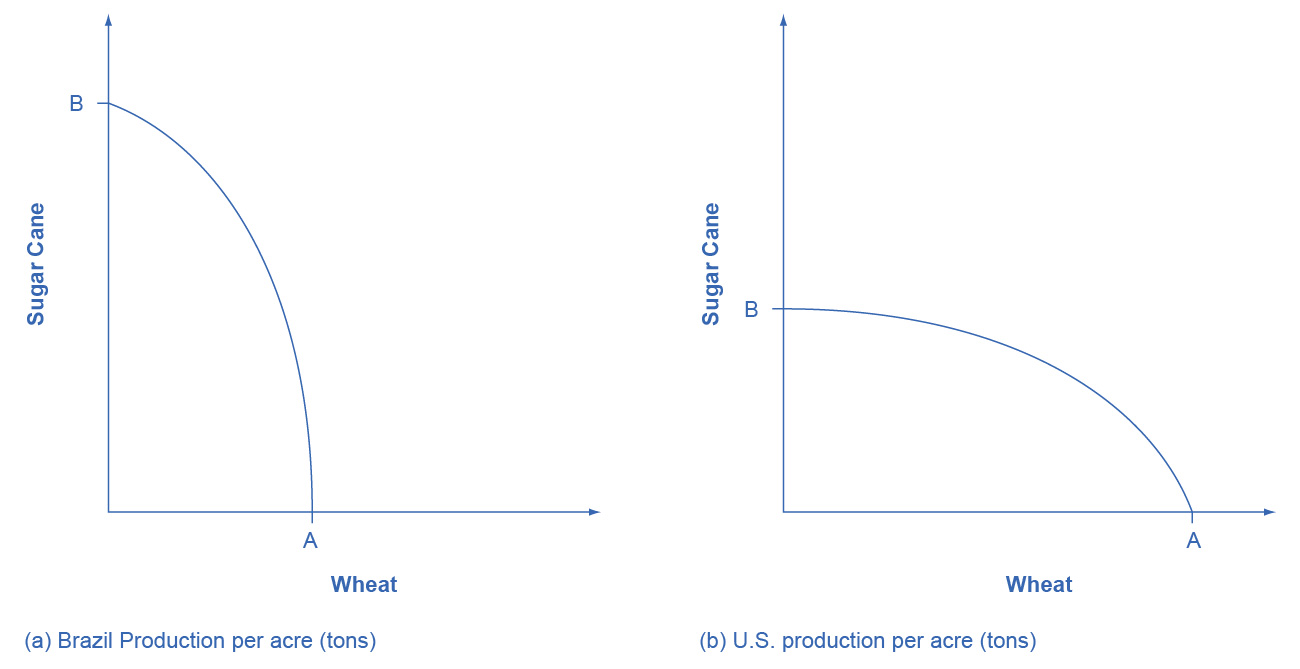

Figure 2.5図 2.5
The U.S. PPF is flatter than the Brazil PPF implying that the opportunity cost of wheat in terms of sugar cane is lower in the U.S. than in Brazil. Conversely, the opportunity cost of sugar cane is lower in Brazil. The U.S. has comparative advantage in wheat and Brazil has comparative advantage in sugar cane.
英語のヒント
米国のPPFはブラジルより平坦であり、サトウキビで測った小麦の機会費用が、ブラジルより米国で低いことを示す。逆に、サトウキビの機会費用はブラジルのほうが低い。米国は小麦に、ブラジルはサトウキビに比較優位を持つ。
When a country can produce a good at a lower opportunity cost than another country, we say that this country has a comparative advantage in that good. Comparative advantage is not the same as absolute advantage, which is when a country can produce more of a good. In our example, Brazil has an absolute advantage in sugar cane and the U.S. has an absolute advantage in wheat. One can easily see this with a simple observation of the extreme production points in the PPFs of the two countries. If Brazil devoted all of its resources to producing wheat, it would be producing at point A. If however it had devoted all of its resources to producing sugar cane instead, it would be producing a much larger amount than the U.S., at point B.
英語のヒント
ある国が別の国より低い機会費用で財を生産できるとき、その財に比較優位を持つという。比較優位は、より多くの財を生産できるという絶対優位とは違う。この例では、ブラジルはサトウキビに、米国は小麦に絶対優位を持つ。これは、両国のPPFの端の生産点を見るだけでわかる。ブラジルがすべての資源を小麦生産に充てるなら、点Aで生産する。しかし、すべての資源をサトウキビ生産に充てるなら、点Bで生産し、その量は米国よりはるかに多くなる。
The slope of the PPF gives the opportunity cost of producing an additional unit of wheat. While the slope is not constant throughout the PPFs, it is quite apparent that the PPF in Brazil is much steeper than in the U.S., and therefore the opportunity cost of wheat is generally higher in Brazil. In the chapter on International Trade you will learn that countries’ differences in comparative advantage determine which goods they will choose to produce and trade. When countries engage in trade, they specialize in the production of the goods in which they have comparative advantage, and trade part of that production for goods in which they do not have comparative advantage. With trade, manufacturers produce goods where the opportunity cost is lowest, so total production increases, benefiting both trading parties.
英語のヒント
PPFの傾きは、小麦をもう1単位生産する機会費用を表す。傾きはPPF全体で一定ではないが、ブラジルのPPFが米国よりはるかに急であり、小麦の機会費用が一般にブラジルで高いことは明らかである。「国際貿易」の章では、国ごとの比較優位の違いが、どの財を生産し、貿易するかを決めることを学ぶ。各国は貿易に参加すると、比較優位のある財の生産に特化し、その一部を比較優位のない財と交換する。貿易によって、生産者は機会費用が最も低い場所で財を生産するため、総生産量が増え、取引する双方に利益が生じる。
Key Concepts and Summary重要概念とまとめ
A production possibilities frontier defines the set of choices society faces for the combinations of goods and services it can produce given the resources and the technology that are available. The shape of the PPF is typically curved outward, rather than straight. Choices outside the PPF are unattainable and choices inside the PPF are wasteful. Over time, a growing economy will tend to shift the PPF outwards.
英語のヒント
生産可能性フロンティアは、利用できる資源と技術の下で社会が生産できる財・サービスの組み合わせについて、選択肢の集合を示す。PPFは通常、直線ではなく外側に膨らむ曲線である。PPFの外側の選択肢は実現できず、内側の選択肢には無駄がある。経済が成長すると、時間とともにPPFは外側へ移動する傾向がある。
The law of diminishing returns holds that as increments of additional resources are devoted to producing something, the marginal increase in output will become increasingly smaller. All choices along a production possibilities frontier display productive efficiency; that is, it is impossible to use society’s resources to produce more of one good without decreasing production of the other good. The specific choice along a production possibilities frontier that reflects the mix of goods society prefers is the choice with allocative efficiency. The curvature of the PPF is likely to differ by country, which results in different countries having comparative advantage in different goods. Total production can increase if countries specialize in the goods in which they have comparative advantage and trade some of their production for the remaining goods.
英語のヒント
収穫逓減の法則によれば、生産に資源を追加していくと、生産量の限界的な増加は次第に小さくなる。生産可能性フロンティア上のすべての選択肢は生産上効率的である。つまり、社会の資源を使って一方の財を増やすには、もう一方の生産を減らさなければならない。社会が好む財の組み合わせを反映する、フロンティア上の特定の選択肢が、配分上効率的な選択肢である。PPFの曲がり方は国によって異なるため、国ごとに比較優位を持つ財も異なる。それぞれの国が比較優位のある財に特化し、その生産物の一部をほかの財と交換すれば、総生産量を増やせる。