第2章希少性の世界での選択
Productive Efficiency and Allocative Efficiency生産の効率性と配分の効率性
The study of economics does not presume to tell a society what choice it should make along its production possibilities frontier. In a market-oriented economy with a democratic government, the choice will involve a mixture of decisions by individuals, firms, and government. However, economics can point out that some choices are unambiguously better than others. This observation is based on the concept of efficiency. In everyday usage, efficiency refers to lack of waste. An inefficient machine operates at high cost, while an efficient machine operates at lower cost, because it is not wasting energy or materials. An inefficient organization operates with long delays and high costs, while an efficient organization meets schedules, is focused, and performs within budget.
英語のヒント
経済学は、社会が生産可能性フロンティア上のどの選択肢を選ぶべきかを決めつけるものではない。民主的な政府を持つ市場志向の経済では、個人、企業、政府の意思決定が組み合わさって選択が行われる。しかし、ある選択肢が別の選択肢より明らかに優れていることは指摘できる。この見方の基礎になるのが効率性という概念である。日常語では、効率性は無駄がないことを意味する。非効率な機械は高い費用で動くが、効率のよい機械はエネルギーや材料を無駄にせず、低い費用で動く。非効率な組織は大幅な遅れと高い費用を生むが、効率のよい組織は日程を守り、仕事に集中し、予算内で成果を上げる。
The production possibilities frontier can illustrate two kinds of efficiency: productive efficiency and allocative efficiency. Figure 2.4 illustrates these ideas using a production possibilities frontier between healthcare and education.
英語のヒント
生産可能性フロンティアは、生産の効率性と配分の効率性という二種類の効率性を示せる。図2.4では、医療と教育の生産可能性フロンティアを使って、これらの考え方を示す。
Productive and Allocative Efficiency生産の効率性と配分の効率性
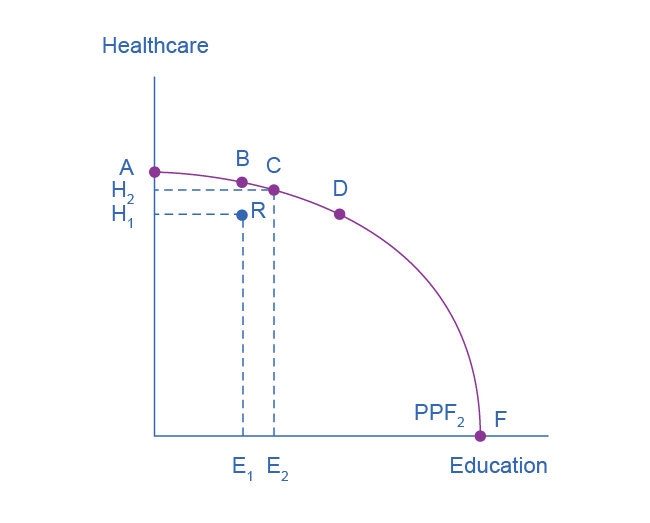

Figure 2.4図 2.4
Productive efficiency means it is impossible to produce more of one good without decreasing the quantity that is produced of another good. Thus, all choices along a given PPF like B, C, and D display productive efficiency, but R does not. Allocative efficiency means that the particular mix of goods being produced—that is, the specific choice along the production possibilities frontier—represents the allocation that society most desires.
英語のヒント
生産の効率性とは、一方の財の生産量を減らさずに、もう一方を増やすことができない状態をいう。したがって、B、C、Dのように、あるPPF上にあるすべての選択肢は生産上効率的だが、Rはそうではない。配分の効率性とは、生産する財の具体的な組み合わせ、すなわち生産可能性フロンティア上の特定の選択肢が、社会の最も望む配分を表すことである。
Productive efficiency means that, given the available inputs and technology, it is impossible to produce more of one good without decreasing the quantity that is produced of another good. All choices on the PPF in Figure 2.4, including A, B, C, D, and F, display productive efficiency. As a firm moves from any one of these choices to any other, either healthcare increases and education decreases or vice versa. However, any choice inside the production possibilities frontier is productively inefficient and wasteful because it is possible to produce more of one good, the other good, or some combination of both goods.
英語のヒント
生産の効率性とは、利用できる投入物と技術の下で、ある財の生産量を減らさずに別の財を増やすことが不可能な状態をいう。図2.4のPPF上にあるA、B、C、D、Fなどのすべての選択肢は、生産上効率的である。企業がこのうちのどの点からどの点へ移動しても、医療が増えて教育が減るか、その逆になる。一方、生産可能性フロンティアの内側は、どの選択肢も生産上非効率で無駄がある。一方の財、もう一方の財、あるいは両方の組み合わせを増やすことが可能だからである。
For example, point R is productively inefficient because it is possible at choice C to have more of both goods: education on the horizontal axis is higher at point C than point R (E2 is greater than E1), and healthcare on the vertical axis is also higher at point C than point R (H2 is great than H1).
英語のヒント
例えば、点Rは生産上非効率である。点Cを選べば、両方の財を増やせるからである。横軸の教育は点Rより点Cのほうが多く(E2はE1より大きい)、縦軸の医療も点Rより点Cのほうが多い(H2はH1より大きい)。
We can show the particular mix of goods and services produced—that is, the specific combination of selected healthcare and education along the production possibilities frontier—as a ray (line) from the origin to a specific point on the PPF. Output mixes that had more healthcare (and less education) would have a steeper ray, while those with more education (and less healthcare) would have a flatter ray.
英語のヒント
生産される財・サービスの具体的な組み合わせ、つまり生産可能性フロンティア上で選ぶ医療と教育の組み合わせは、原点からPPF上の特定の点へ伸びる半直線で示せる。医療が多く教育が少ない組み合わせでは半直線の傾きが急になり、教育が多く医療が少ない組み合わせでは平坦になる。
Allocative efficiency means that the particular combination of goods and services on the production possibility curve that a society produces represents the combination that society most desires. How to determine what a society desires can be a controversial question, and is usually a discussion in political science, sociology, and philosophy classes as well as in economics. At its most basic, allocative efficiency means producers supply the quantity of each product that consumers demand. Only one of the productively efficient choices will be the allocatively efficient choice for society as a whole.
英語のヒント
配分の効率性とは、社会が生産する、生産可能性曲線上の財・サービスの組み合わせが、その社会の最も望む組み合わせになっていることをいう。社会が何を望むかをどう決めるかは、議論の分かれる問題になりうる。経済学だけでなく、政治学、社会学、哲学の授業でもよく論じられる。最も基本的には、配分の効率性は、生産者が各製品について消費者の需要する量を供給することを意味する。生産上効率的な選択肢のうち、社会全体にとって配分上も効率的なのは一つだけである。
Why Society Must Choose社会はなぜ選ばなければならないのか
In Welcome to Economics! we learned that every society faces the problem of scarcity, where limited resources conflict with unlimited needs and wants. The production possibilities curve illustrates the choices involved in this dilemma.
英語のヒント
「経済学へようこそ」では、どの社会も、限られた資源と無限の必要・欲求がぶつかる希少性の問題に直面することを学んだ。生産可能性曲線は、このジレンマに伴う選択肢を示す。
Every economy faces two situations in which it may be able to expand consumption of all goods. In the first case, a society may discover that it has been using its resources inefficiently, in which case by improving efficiency and producing on the production possibilities frontier, it can have more of all goods (or at least more of some and less of none). In the second case, as resources grow over a period of years (e.g., more labor and more capital), the economy grows. As it does, the production possibilities frontier for a society will tend to shift outward and society will be able to afford more of all goods. In addition, over time, improvements in technology can increase the level of production with given resources, and hence push out the PPF.
英語のヒント
どの経済にも、すべての財の消費を増やせる可能性のある状況が二つある。第一に、資源を非効率に使っていたことが判明する場合である。この場合、効率を高め、生産可能性フロンティア上で生産すれば、すべての財を増やせる。少なくとも、一部の財を増やし、ほかを減らさずに済む。第二に、何年もかけて労働や資本などの資源が増え、経済が成長する場合である。その際、社会の生産可能性フロンティアは外側へ移動する傾向があり、すべての財をより多く手に入れられるようになる。また、時間とともに技術が進歩すると、同じ資源でも生産量が増え、PPFを外側へ押し広げられる。
However, improvements in productive efficiency take time to discover and implement, and economic growth happens only gradually. Thus, a society must choose between tradeoffs in the present. For government, this process often involves trying to identify where additional spending could do the most good and where reductions in spending would do the least harm. At the individual and firm level, the market economy coordinates a process in which firms seek to produce goods and services in the quantity, quality, and price that people want. However, for both the government and the market economy in the short term, increases in production of one good typically mean offsetting decreases somewhere else in the economy.
英語のヒント
しかし、生産効率を高める方法の発見と実行には時間がかかり、経済成長も徐々にしか進まない。そのため、社会は現在のトレードオフの下で選ばなければならない。政府の場合、追加支出が最も役立つ分野と、削減しても損害が最も小さい分野を見極めようとすることが多い。個人や企業の水準では、市場経済が調整を行い、企業は人々の望む数量、品質、価格で財・サービスを生産しようとする。しかし、政府でも市場経済でも、短期的には、ある財の生産を増やすと、通常は経済の別の場所で、それに対応する減少が起こる。