第2章希少性の世界での選択
Self-Check Questions理解度確認問題
Exercises 1練習問題 1
Exercise 1問題 1
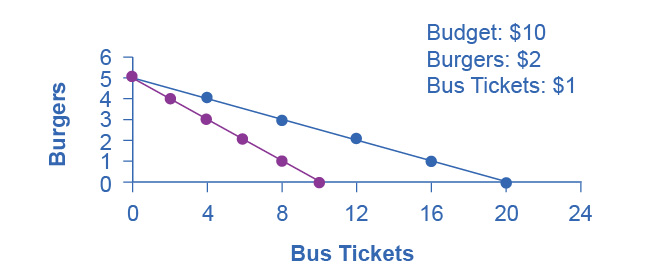
Suppose Alphonso’s town raised the price of bus tickets from $0.50 per trip to $1 per trip (while the price of burgers stayed at $2 and his budget remained $10 per week.) Draw Alphonso’s new budget constraint. What happens to the opportunity cost of bus tickets?
英語のヒント
アルフォンソの町で、バス乗車券の価格が1回0.50ドルから1ドルに上がったとする(ハンバーガーは2ドル、予算は週10ドルのままとする)。新しい予算制約を描け。バス乗車券の機会費用はどうなるか。
Solution解き方
The opportunity cost of bus tickets is the number of burgers that must be given up to obtain one more bus ticket. Originally, when the price of bus tickets was 50 cents per trip, this opportunity cost was 0.50/2 = .25 burgers. The reason for this is that at the original prices, one burger ($2) costs the same as four bus tickets ($0.50), so the opportunity cost of a burger is four bus tickets, and the opportunity cost of a bus ticket is .25 burgers (the inverse of the opportunity cost of a burger). With the new, higher price of bus tickets, the opportunity cost rises to $1/$2 or 0.50 burgers. You can see this graphically since the slope of the new budget constraint is steeper than the original one. If Alphonso spends all of his budget on burgers, the higher price of bus tickets has no impact so the vertical intercept of the budget constraint is the same. If he spends his entire budget on bus tickets, he can now afford only half as many, so the horizontal intercept is half as much. In short, the budget constraint rotates clockwise around the vertical intercept, steepening as it goes and the opportunity cost of bus tickets increases.
英語のヒント
バス乗車券の機会費用は、乗車券をもう1枚得るために諦めるハンバーガーの数である。もともと乗車券が1回50セントのとき、その機会費用は0.50÷2=0.25個だった。元の価格では、ハンバーガー1個(2ドル)とバス乗車券4枚(1枚0.50ドル)の費用が等しいためである。ハンバーガー1個の機会費用は乗車券4枚、乗車券1枚の機会費用はハンバーガー0.25個となる(ハンバーガーの機会費用の逆数である)。乗車券が値上がりすると、機会費用は1ドル÷2ドル、すなわちハンバーガー0.50個に上がる。グラフでは、新しい予算制約の傾きが元より急になることでわかる。予算をすべてハンバーガーに使う場合、乗車券の値上がりの影響はないので、縦軸の切片は変わらない。すべてを乗車券に使う場合、以前の半分の枚数しか買えないため、横軸の切片は半分になる。つまり、予算制約は縦軸の切片を中心に時計回りに回転して急になり、バス乗車券の機会費用は増加する。

Review Questions復習問題
Exercises 2–3練習問題 2–3
Exercise 2問題 2
Explain why scarcity leads to tradeoffs.
英語のヒント
希少性がトレードオフを生む理由を説明せよ。
Exercise 3問題 3
Explain why individuals make choices that are directly on the budget constraint, rather than inside the budget constraint or outside it.
英語のヒント
個人が予算制約の内側でも外側でもなく、ちょうど制約上の選択肢を選ぶ理由を説明せよ。
Critical Thinking Question考察問題
Exercises 4練習問題 4
Exercise 4問題 4
Suppose Alphonso’s town raises the price of bus tickets from $0.50 to $1 and the price of burgers rises from $2 to $4. Why is the opportunity cost of bus tickets unchanged? Suppose Alphonso’s weekly spending money increases from $10 to $20. How is his budget constraint affected from all three changes? Explain.
英語のヒント
アルフォンソの町でバス乗車券が0.50ドルから1ドルに、ハンバーガーが2ドルから4ドルに値上がりしたとする。バス乗車券の機会費用が変わらないのはなぜか。さらに、週に使えるお金が10ドルから20ドルに増えたとする。この三つの変化すべてによって予算制約はどう変わるか。説明せよ。
Problems問題
Exercises 5–8練習問題 5–8
Use this information to answer the following 4 questions: Jade has a weekly budget of $24, which she likes to spend on magazines and pies.
英語のヒント
次の情報を使って、以下の4問に答えよ。ジェイドの週の予算は24ドルで、雑誌とパイに使いたいと考えている。
Exercise 5問題 5
If the price of a magazine is $4 each, what is the maximum number of magazines she could buy in a week?
英語のヒント
雑誌が1冊4ドルなら、1週間に最大何冊買えるか。
Exercise 6問題 6
If the price of a pie is $12, what is the maximum number of pies she could buy in a week?
英語のヒント
パイが1個12ドルなら、1週間に最大何個買えるか。
Exercise 7問題 7
Draw Jade's budget constraint with pies on the horizontal axis and magazines on the vertical axis. What is the slope of the budget constraint?
英語のヒント
横軸にパイ、縦軸に雑誌を取り、ジェイドの予算制約を描け。その傾きはいくらか。
Exercise 8問題 8
What is Jade's opportunity cost of purchasing a pie?
英語のヒント
ジェイドがパイを1個買う機会費用はいくらか。
References参考文献
Bureau of Labor Statistics, U.S. Department of Labor. 2015. “Median Weekly Earnings by Educational Attainment in 2014.” Accessed March 27, 2015. http://www.bls.gov/opub/ted/2015/median-weekly-earnings-by-education-gender-race-and-ethnicity-in-2014.htm.
米国労働省労働統計局。2015年。「2014年の学歴別・週当たり所得の中央値」。2015年3月27日閲覧。http://www.bls.gov/opub/ted/2015/median-weekly-earnings-by-education-gender-race-and-ethnicity-in-2014.htm。
Robbins, Lionel. An Essay on the Nature and Significance of Economic Science. London: Macmillan. 1932.
ロビンズ、ライオネル。『経済学の本質と意義』。ロンドン:マクミラン。1932年。
United States Department of Transportation. “Total Passengers on U.S Airlines and Foreign Airlines U.S. Flights Increased 1.3% in 2012 from 2011.” Accessed October 2013. http://www.rita.dot.gov/bts/press_releases/bts016_13
米国運輸省。「米国航空会社と外国航空会社の米国発着便の総旅客数、2012年は2011年比1.3%増」。2013年10月閲覧。http://www.rita.dot.gov/bts/press_releases/bts016_13
budget constraint
予算制約
all possible consumption combinations of goods that someone can afford, given the prices of goods, when all income is spent; the boundary of the opportunity set
英語のヒント
財の価格が与えられ、所得をすべて使うときに購入できる、財の消費のすべての組み合わせ。機会集合の境界。
law of diminishing marginal utility
限界効用逓減の法則
as we consume more of a good or service, the utility we get from additional units of the good or service tends to become smaller than what we received from earlier units
英語のヒント
ある財やサービスの消費量が増えると、追加の単位から得る効用は、それより前の単位から得た効用より小さくなる傾向があること。
marginal analysis
限界分析
examination of decisions on the margin, meaning a little more or a little less from the status quo
英語のヒント
現状より少し多くするか、少し少なくするかという、限界での意思決定を検討すること。
opportunity cost
機会費用
measures cost by what we give up/forfeit in exchange; opportunity cost measures the value of the forgone alternative
英語のヒント
引き換えに断念・放棄するもので測った費用。諦める選択肢の価値を測る。
opportunity set
機会集合
all possible combinations of consumption that someone can afford given the prices of goods and the individual’s income
英語のヒント
財の価格と個人の所得が与えられたときに購入できる、消費のすべての組み合わせ。
sunk costs
埋没費用
costs that we make in the past that we cannot recover
英語のヒント
過去に支出し、回収できない費用。
utility
効用
satisfaction, usefulness, or value one obtains from consuming goods and services
英語のヒント
財やサービスを消費することで得る満足、有用性、価値。