第2章希少性の世界での選択
2.1 How Individuals Make Choices Based on Their Budget Constraint2.1 個人は予算制約に基づいてどのように選択するか
Learning Objectives学習目標
Learning Objectives学習目標
By the end of this section, you will be able to:
英語のヒント
この節を学ぶと、次のことができるようになる。
- Calculate and graph budget constraints
英語のヒント
予算制約を計算し、グラフに表す。 - Explain opportunity sets and opportunity costs
英語のヒント
機会集合と機会費用を説明する。 - Evaluate the law of diminishing marginal utility
英語のヒント
限界効用逓減の法則を検討する。 - Explain how marginal analysis and utility influence choices
英語のヒント
限界分析と効用が選択にどう影響するかを説明する。
Consider the typical consumer’s budget problem. Consumers have a limited amount of income to spend on the things they need and want. Suppose Alphonso has $10 in spending money each week that he can allocate between bus tickets for getting to work and the burgers that he eats for lunch. Burgers cost $2 each, and bus tickets are 50 cents each. We can see Alphonso's budget problem in Figure 2.2.
英語のヒント
典型的な消費者の予算の問題を考えよう。消費者が必要とし、欲しいと思うものに使える所得には限りがある。アルフォンソには、毎週使えるお金が10ドルあり、通勤のためのバス乗車券と、昼食に食べるハンバーガーに配分できるとする。ハンバーガーは1個2ドル、バス乗車券は1枚50セントである。アルフォンソの予算の問題を図2.2に示す。
The Budget Constraint: Alphonso’s Consumption Choice Opportunity Frontier予算制約――アルフォンソの消費選択の機会フロンティア
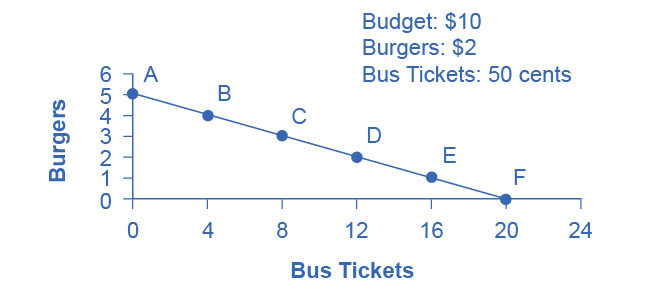

Figure 2.2図 2.2
Each point on the budget constraint represents a combination of burgers and bus tickets whose total cost adds up to Alphonso’s budget of $10. The relative price of burgers and bus tickets determines the slope of the budget constraint. All along the budget set, giving up one burger means gaining four bus tickets.
英語のヒント
予算制約上の各点は、ハンバーガーとバス乗車券の合計費用がアルフォンソの予算10ドルになる組み合わせを表す。ハンバーガーとバス乗車券の相対価格が、予算制約の傾きを決める。予算集合に沿って、ハンバーガーを1個諦めるとバス乗車券を4枚得られる。
The vertical axis in the figure shows burger purchases and the horizontal axis shows bus ticket purchases. If Alphonso spends all his money on burgers, he can afford five per week. ($10 per week/$2 per burger = 5 burgers per week.) However, if he does this, he will not be able to afford any bus tickets. Point A in the figure shows the choice (zero bus tickets and five burgers). Alternatively, if Alphonso spends all his money on bus tickets, he can afford 20 per week. ($10 per week/$0.50 per bus ticket = 20 bus tickets per week.) Then, however, he will not be able to afford any burgers. Point F shows this alternative choice (20 bus tickets and zero burgers).
英語のヒント
図の縦軸はハンバーガーの購入数、横軸はバス乗車券の購入数を表す。アルフォンソがお金をすべてハンバーガーに使うと、週に5個買える。(週10ドル÷1個2ドル=週5個。)しかし、その場合はバス乗車券を1枚も買えない。図の点Aが、この選択(バス乗車券0枚、ハンバーガー5個)を示している。逆に、お金をすべてバス乗車券に使うと、週に20枚買える。(週10ドル÷1枚0.50ドル=週20枚。)ただし、その場合はハンバーガーを1個も買えない。点Fが、このもう一つの選択(バス乗車券20枚、ハンバーガー0個)を示す。
If we connect all the points between A and F, we get Alphonso's budget constraint. This indicates all the combination of burgers and bus tickets Alphonso can afford, given the price of the two goods and his budget amount.
英語のヒント
AからFまでのすべての点を結ぶと、アルフォンソの予算制約が得られる。これは、二つの財の価格と予算額の下で、アルフォンソが買えるハンバーガーとバス乗車券のすべての組み合わせを示す。
If Alphonso is like most people, he will choose some combination that includes both bus tickets and burgers. That is, he will choose some combination on the budget constraint that is between points A and F. Every point on (or inside) the constraint shows a combination of burgers and bus tickets that Alphonso can afford. Any point outside the constraint is not affordable, because it would cost more money than Alphonso has in his budget.
英語のヒント
アルフォンソが大半の人と同じなら、バス乗車券とハンバーガーを両方含む組み合わせを選ぶだろう。つまり、予算制約上の点Aと点Fの間にある組み合わせを選ぶ。制約上、またはその内側のどの点も、アルフォンソが買える組み合わせを示す。制約の外側の点は、予算より多くのお金が必要になるため、購入できない。
The budget constraint clearly shows the tradeoff Alphonso faces in choosing between burgers and bus tickets. Suppose he is currently at point D, where he can afford 12 bus tickets and two burgers. What would it cost Alphonso for one more burger? It would be natural to answer $2, but that’s not the way economists think. Instead they ask, how many bus tickets would Alphonso have to give up to get one more burger, while staying within his budget? Since bus tickets cost 50 cents, Alphonso would have to give up four to afford one more burger. That is the true cost to Alphonso.
英語のヒント
予算制約は、ハンバーガーとバス乗車券のどちらを選ぶかについて、アルフォンソが直面するトレードオフを明確に示す。現在、バス乗車券を12枚、ハンバーガーを2個買える点Dにいるとしよう。ハンバーガーをもう1個得るための費用は何だろうか。2ドルと答えるのが自然かもしれないが、経済学者はそうは考えない。代わりに、予算内でハンバーガーをもう1個得るには、バス乗車券を何枚諦めなければならないかと問う。バス乗車券は50セントなので、ハンバーガーをもう1個買うには4枚諦める必要がある。これがアルフォンソにとっての本当の費用である。
The Concept of Opportunity Cost機会費用という概念
Economists use the term opportunity cost to indicate what people must give up to obtain what they desire. The idea behind opportunity cost is that the cost of one item is the lost opportunity to do or consume something else. In short, opportunity cost is the value of the next best alternative. For Alphonso, the opportunity cost of a burger is the four bus tickets he would have to give up. He would decide whether or not to choose the burger depending on whether the value of the burger exceeds the value of the forgone alternative—in this case, bus tickets. Since people must choose, they inevitably face tradeoffs in which they have to give up things they desire to obtain other things they desire more.
英語のヒント
経済学者は、望むものを手に入れるために諦めなければならないものを、機会費用と呼ぶ。この考え方では、あるものの費用とは、別のことをしたり、別のものを消費したりする機会を失うことである。簡単に言えば、機会費用は次善の選択肢の価値である。アルフォンソにとってハンバーガーの機会費用は、諦めなければならないバス乗車券4枚である。ハンバーガーの価値が、断念する選択肢、この場合はバス乗車券の価値を上回るかどうかによって、ハンバーガーを選ぶかを決める。人々は選ばなければならないので、より欲しいものを得るために、欲しい別のものを諦めるというトレードオフに必ず直面する。
Additional Resources追加教材
A fundamental principle of economics is that every choice has an opportunity cost. If you sleep through your economics class, the opportunity cost is the learning you miss from not attending class. If you spend your income on video games, you cannot spend it on movies. If you choose to marry one person, you give up the opportunity to marry anyone else. In short, opportunity cost is all around us and part of human existence.
英語のヒント
経済学の基本原理の一つは、どの選択にも機会費用があるということである。経済学の授業中に眠ってしまうなら、その機会費用は授業を受けずに失う学習である。所得をビデオゲームに使えば、その分を映画には使えない。ある人との結婚を選べば、ほかの人と結婚する機会を諦める。つまり、機会費用は身の回りのあらゆるところにあり、人間の生活の一部なのである。
The following Work It Out feature shows a step-by-step analysis of a budget constraint calculation. Read through it to understand another important concept—slope—that we further explain in the appendix The Use of Mathematics in Principles of Economics.
英語のヒント
次の「解いてみよう」では、予算制約の計算を段階を追って分析する。これを読み、もう一つの重要な概念である傾きを理解しよう。傾きは付録「経済学原理における数学の利用」でも詳しく説明する。