第4章労働市場と金融市場
4.2 Demand and Supply in Financial Markets4.2 金融市場の需要と供給
Learning Objectives学習目標
Learning Objectives学習目標
By the end of this section, you will be able to:
英語のヒント
この節を学ぶと、次のことができるようになる。
- Identify the demanders and suppliers in a financial market
英語のヒント
金融市場の需要者と供給者を特定する。 - Explain how interest rates can affect supply and demand
英語のヒント
利子率が需要と供給にどう影響するかを説明する。 - Analyze the economic effects of U.S. debt in terms of domestic financial markets
英語のヒント
米国の債務が経済に与える影響を、国内金融市場の観点から分析する。 - Explain the role of price ceilings and usury laws in the U.S.
英語のヒント
米国における価格上限と高利制限法の役割を説明する。
United States' households, institutions, and domestic businesses saved almost $1.3 trillion in 2015. Where did that savings go and how was it used? Some of the savings ended up in banks, which in turn loaned the money to individuals or businesses that wanted to borrow money. Some was invested in private companies or loaned to government agencies that wanted to borrow money to raise funds for purposes like building roads or mass transit. Some firms reinvested their savings in their own businesses.
英語のヒント
2015年、米国の家計、機関、国内企業は約1.3兆ドルを貯蓄した。その貯蓄はどこへ行き、何に使われたのだろうか。一部は銀行へ入り、銀行はそれを借りたい個人や企業に貸した。一部は民間企業に投資されたり、道路や公共交通機関の建設などのために資金を調達したい政府機関に貸されたりした。貯蓄を自社の事業に再投資した企業もある。
In this section, we will determine how the demand and supply model links those who wish to supply financial capital (i.e., savings) with those who demand financial capital (i.e., borrowing). Those who save money (or make financial investments, which is the same thing), whether individuals or businesses, are on the supply side of the financial market. Those who borrow money are on the demand side of the financial market. For a more detailed treatment of the different kinds of financial investments like bank accounts, stocks and bonds, see the Financial Markets chapter.
英語のヒント
この節では、金融資本を供給したい人々、つまり貯蓄したい人々と、それを需要する人々、つまり借りたい人々を、需要・供給モデルがどう結び付けるかを考える。貯蓄する人々、あるいは同じことだが金融投資をする人々は、個人でも企業でも金融市場の供給側にいる。お金を借りる人々は需要側だ。銀行口座、株式、債券など、さまざまな金融投資の詳しい説明は「金融市場」を参照しよう。
Who Demands and Who Supplies in Financial Markets?金融市場では誰が需要し、誰が供給するのか
In any market, the price is what suppliers receive and what demanders pay. In financial markets, those who supply financial capital through saving expect to receive a rate of return, while those who demand financial capital by receiving funds expect to pay a rate of return. This rate of return can come in a variety of forms, depending on the type of investment.
英語のヒント
どんな市場でも、価格は供給者が受け取り、需要者が支払うものである。金融市場では、貯蓄を通じて金融資本を供給する人々は収益率を得ることを期待し、資金を受け取ることで金融資本を需要する人々は収益率を支払うことを見込む。収益率の形は投資の種類によってさまざまだ。
The simplest example of a rate of return is the interest rate. For example, when you supply money into a savings account at a bank, you receive interest on your deposit. The interest the bank pays you as a percent of your deposits is the interest rate. Similarly, if you demand a loan to buy a car or a computer, you will need to pay interest on the money you borrow.
英語のヒント
収益率の最も単純な例は利子率である。例えば、銀行の貯蓄口座にお金を預けて資金を供給すると、預金に利子が付く。銀行が支払う利子を預金額に対する百分率で表したものが利子率だ。同様に、車やコンピューターを買うために融資を求めれば、借りたお金に利子を支払う必要がある。
Let’s consider the market for borrowing money with credit cards. In 2021, almost 200 million Americans were cardholders. Credit cards allow you to borrow money from the card's issuer, and pay back the borrowed amount plus interest, although most allow you a period of time in which you can repay the loan without paying interest. A typical credit card interest rate ranges from 12% to 18% per year. In May 2021, Americans had about $807 billion outstanding in credit card debts. As of 2021, just over 45% of American families carried some credit card debt. Let’s say that, on average, the annual interest rate for credit card borrowing is 15% per year. Thus, Americans pay tens of billions of dollars every year in interest on their credit cards—plus basic fees for the credit card or fees for late payments.
英語のヒント
クレジットカードでお金を借りる市場を考えよう。2021年には、米国人の約2億人がカードを持っていた。カードでは発行会社からお金を借り、借入額に利子を加えて返済する。ただし、多くのカードには、利子を支払わずに返済できる一定の期間がある。一般的なカードの利子率は年12〜18%だ。2021年5月、米国人のカード債務残高は約8,070億ドルだった。2021年時点では、米国の家族の45%強が何らかのカード債務を抱えていた。カード借り入れの平均年利を15%としよう。すると、米国人は毎年、カードの利子に数百億ドルを支払っていることになる。さらにカードの基本手数料や延滞手数料も加わる。
Figure 4.5 illustrates demand and supply in the financial market for credit cards. The horizontal axis of the financial market shows the quantity of money loaned or borrowed in this market. The vertical or price axis shows the rate of return, which in the case of credit card borrowing we can measure with an interest rate. Table 4.5 shows the quantity of financial capital that consumers demand at various interest rates and the quantity that credit card firms (often banks) are willing to supply.
英語のヒント
Demand and Supply for Borrowing Money with Credit Cardsクレジットカードによる借り入れの需要と供給
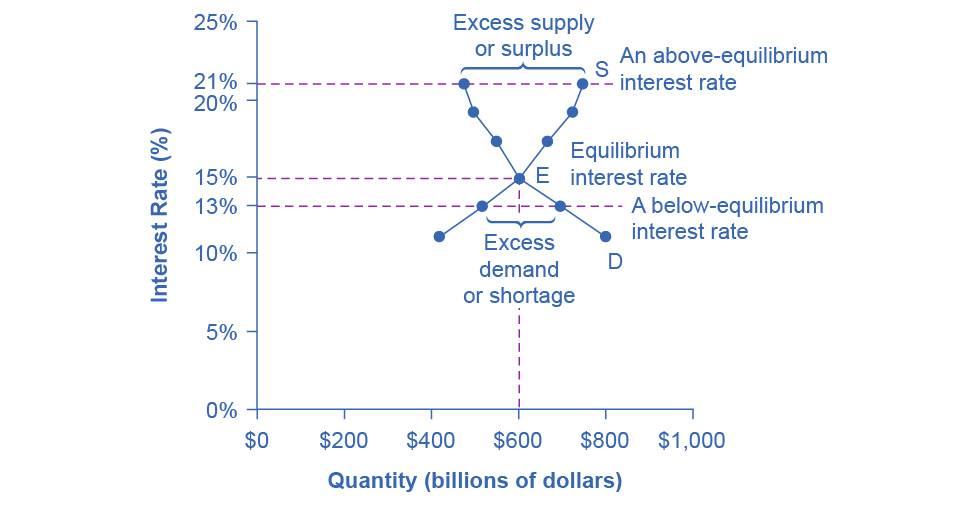

Figure 4.5図 4.5
In this market for credit card borrowing, the demand curve (D) for borrowing financial capital intersects the supply curve (S) for lending financial capital at equilibrium E. At the equilibrium, the interest rate (the “price” in this market) is 15% and the quantity of financial capital loaned and borrowed is $600 billion. The equilibrium price is where the quantity demanded and the quantity supplied are equal. At an above-equilibrium interest rate like 21%, the quantity of financial capital supplied would increase to $750 billion, but the quantity demanded would decrease to $480 billion. At a below-equilibrium interest rate like 13%, the quantity of financial capital demanded would increase to $700 billion, but the quantity of financial capital supplied would decrease to $510 billion.
英語のヒント
このクレジットカード借り入れ市場では、金融資本を借りる需要曲線Dと、金融資本を貸す供給曲線Sが、均衡Eで交わる。均衡では、利子率、つまりこの市場の「価格」は15%で、貸し借りされる金融資本量は6,000億ドルである。均衡価格では需要量と供給量が等しい。21%のように均衡より高い利子率では、金融資本の供給量は7,500億ドルに増えるが、需要量は4,800億ドルに減る。13%のように均衡より低い利子率では、需要量は7,000億ドルに増えるが、供給量は5,100億ドルに減る。
Interest Rate (%) 利子率(%) |
Quantity of Financial Capital Demanded (Borrowing) ($ billions) 金融資本の需要量(借り入れ)(10億ドル) |
Quantity of Financial Capital Supplied (Lending) ($ billions) 金融資本の供給量(貸し付け)(10億ドル) |
|---|---|---|
11 |
$800 |
$420 |
13 |
$700 |
$510 |
15 |
$600 |
$600 |
17 |
$550 |
$660 |
19 |
$500 |
$720 |
21 |
$480 |
$750 |
The laws of demand and supply continue to apply in the financial markets. According to the law of demand, a higher rate of return (that is, a higher price) will decrease the quantity demanded. As the interest rate rises, consumers will reduce the quantity that they borrow. According to the law of supply, a higher price increases the quantity supplied. Consequently, as the interest rate paid on credit card borrowing rises, more firms will be eager to issue credit cards and to encourage customers to use them. Conversely, if the interest rate on credit cards falls, the quantity of financial capital supplied in the credit card market will decrease and the quantity demanded will increase.
英語のヒント
需要と供給の法則は金融市場にも当てはまる。需要の法則によれば、収益率、つまり価格が高いほど需要量は減る。利子率が上がると、消費者は借入量を減らす。供給の法則によれば、価格が高いほど供給量は増える。そのため、カード借り入れの利子率が上がると、カードを発行し、顧客に利用を促そうとする企業が増える。逆に、カードの利子率が下がると、カード市場で供給される金融資本量は減り、需要量は増える。