第4章労働市場と金融市場
Price Floors in the Labor Market: Living Wages and Minimum Wages労働市場の価格下限――生活賃金と最低賃金
In contrast to goods and services markets, price ceilings are rare in labor markets, because rules that prevent people from earning income are not politically popular. There is one exception: boards of trustees or stockholders, as an example, propose limits on the high incomes of top business executives.
英語のヒント
財・サービスの市場と違って、労働市場では価格上限はまれである。人々の所得獲得を妨げる規則は、政治的な人気がないからだ。一つ例外がある。例えば、理事会や株主が、企業の経営幹部の高額所得に上限を設けることを提案する場合である。
The labor market, however, presents some prominent examples of price floors, which are an attempt to increase the wages of low-paid workers. The U.S. government sets a minimum wage, a price floor that makes it illegal for an employer to pay employees less than a certain hourly rate. In mid-2009, the U.S. minimum wage was raised to $7.25 per hour. Local political movements in a number of U.S. cities have pushed for a higher minimum wage, which they call a living wage. Promoters of living wage laws maintain that the minimum wage is too low to ensure a reasonable standard of living. They base this conclusion on the calculation that, if you work 40 hours a week at a minimum wage of $7.25 per hour for 50 weeks a year, your annual income is $14,500, which is less than the official U.S. government definition of what it means for a family to be in poverty. (A family with two adults earning minimum wage and two young children will find it more cost efficient for one parent to provide childcare while the other works for income. Thus the family income would be $14,500, which is significantly lower than the federal poverty line for a family of four, which was $26,500 in 2021.)
英語のヒント
しかし、労働市場には価格下限の代表例がある。低賃金労働者の賃金を引き上げる試みである。米国政府は最低賃金を定めている。これは、雇用主が従業員に一定の時給を下回る賃金を支払うことを違法とする価格下限だ。2009年半ば、米国の最低賃金は時給7.25ドルに引き上げられた。米国のいくつもの都市では、地域の政治運動が、生活賃金と呼ぶ、より高い最低賃金を求めてきた。生活賃金法の推進者は、最低賃金では適切な生活水準を確保できないと主張する。時給7.25ドルの最低賃金で週40時間、年間50週働くと、年収は14,500ドルになる。これは、米国政府が公式に定める家族の貧困基準を下回る。この計算が、その結論の根拠である。(最低賃金で働く大人2人と幼い子ども2人の家族では、片方の親が子どもの世話をし、もう片方が収入を得るほうが費用効率がよい。そのため、家族の所得は14,500ドルとなる。これは、2021年に26,500ドルだった4人家族の連邦貧困線を大幅に下回る。)
Supporters of the living wage argue that full-time workers should be assured a high enough wage so that they can afford the essentials of life: food, clothing, shelter, and healthcare. Since Baltimore passed the first living wage law in 1994, several dozen cities enacted similar laws in the late 1990s and the 2000s. The living wage ordinances do not apply to all employers, but they have specified that all employees of the city or employees of firms that the city hires be paid at least a certain wage that is usually a few dollars per hour above the U.S. minimum wage.
英語のヒント
生活賃金の支持者は、フルタイム労働者には、食料、衣服、住居、医療という生活必需品を賄えるだけの賃金を保障すべきだと主張する。ボルティモアが1994年に初の生活賃金法を可決して以来、1990年代後半から2000年代にかけて、数十の都市が同様の法律を制定した。生活賃金条例は、すべての雇用主に適用されるわけではない。しかし、市の全従業員と、市が契約する企業の従業員に、少なくとも一定額の賃金を支払うよう定めてきた。その額は通常、米国の最低賃金を時給で数ドル上回る。
Figure 4.4 illustrates the situation of a city considering a living wage law. For simplicity, we assume that there is no federal minimum wage. The wage appears on the vertical axis, because the wage is the price in the labor market. Before the passage of the living wage law, the equilibrium wage is $10 per hour and the city hires 1,200 workers at this wage. However, a group of concerned citizens persuades the city council to enact a living wage law requiring employers to pay no less than $12 per hour. In response to the higher wage, 1,600 workers look for jobs with the city. At this higher wage, the city, as an employer, is willing to hire only 700 workers. At the price floor, the quantity supplied exceeds the quantity demanded, and a surplus of labor exists in this market. For workers who continue to have a job at a higher salary, life has improved. For those who were willing to work at the old wage rate but lost their jobs with the wage increase, life has not improved. Table 4.4 shows the differences in supply and demand at different wages.
英語のヒント
図4.4は、生活賃金法を検討する都市の状況を示す。単純化のため、連邦最低賃金はないと仮定する。労働市場では賃金が価格なので、縦軸に賃金を取る。生活賃金法の成立前には、均衡賃金は時給10ドルで、市はこの賃金で1,200人を雇っている。しかし、問題を気にかける市民の集団が市議会を説得し、雇用主に時給12ドル以上の支払いを義務付ける生活賃金法を制定させる。賃金が上がったため、1,600人が市の仕事を求める。この高い賃金では、雇用主である市が雇おうとするのは700人だけだ。価格下限では供給量が需要量を上回り、この市場には労働の余剰が生じる。高い給与で仕事を続けられる労働者の生活は改善した。以前の賃金で働く意思があったのに、賃金上昇で失職した人々の生活は改善していない。表4.4は、賃金ごとの需要と供給の違いを示す。
A Living Wage: Example of a Price Floor生活賃金――価格下限の例
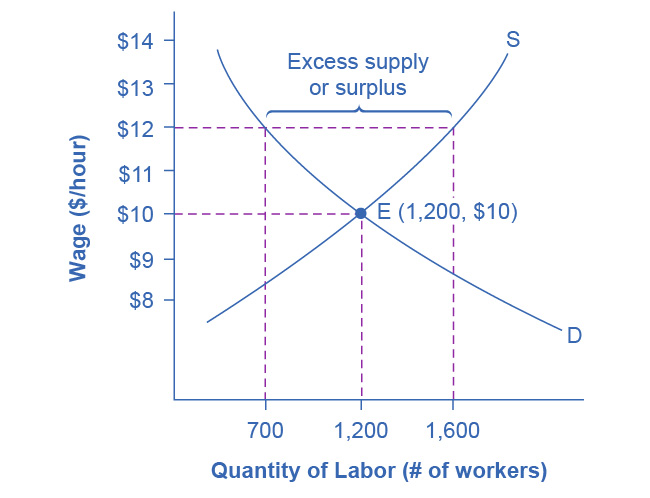

Figure 4.4図 4.4
The original equilibrium in this labor market is a wage of $10/hour and a quantity of 1,200 workers, shown at point E. Imposing a wage floor at $12/hour leads to an excess supply of labor. At that wage, the quantity of labor supplied is 1,600 and the quantity of labor demanded is only 700.
英語のヒント
この労働市場の元の均衡は、点Eに示す時給10ドル、労働者1,200人である。賃金の下限を時給12ドルにすると、労働の超過供給が生じる。この賃金では労働供給量は1,600人だが、労働需要量は700人しかない。
Wage 賃金 |
Quantity Labor Demanded 労働需要量 |
Quantity Labor Supplied 労働供給量 |
|---|---|---|
$8/hr 時給8ドル |
1,900 |
500 |
$9/hr 時給9ドル |
1,500 |
900 |
$10/hr 時給10ドル |
1,200 |
1,200 |
$11/hr 時給11ドル |
900 |
1,400 |
$12/hr 時給12ドル |
700 |
1,600 |
$13/hr 時給13ドル |
500 |
1,800 |
$14/hr 時給14ドル |
400 |
1,900 |