第4章労働市場と金融市場
Shifts in Labor Supply労働供給のシフト
The supply of labor is upward-sloping and adheres to the law of supply: The higher the price, the greater the quantity supplied and the lower the price, the less quantity supplied. The supply curve models the tradeoff between supplying labor into the market or using time in leisure activities at every given price level. The higher the wage, the more labor is willing to work and forego leisure activities. Table 4.3 lists some of the factors that will cause the supply to increase or decrease.
英語のヒント
労働の供給曲線は右上がりで、供給の法則に従う。価格が高いほど供給量は多く、低いほど少ない。供給曲線は、各価格水準で、市場に労働を提供するか、その時間を余暇に使うかというトレードオフを表す。賃金が高いほど、人々は余暇を諦めて働こうとする。表4.3は、供給を増減させる要因の一部を示す。
Factors 要因 |
Results 結果 |
|---|---|
Number of Workers 労働者数 |
An increased number of workers will cause the supply curve to shift to the right. An increased number of workers can be due to several factors, such as immigration, increasing population, an aging population, and changing demographics. Policies that encourage immigration will increase the supply of labor, and vice versa. Population grows when birth rates exceed death rates. This eventually increases supply of labor when the former reach working age. Another example of changing demographics is more women working outside of the home, which increases the supply of labor. 英語のヒント労働者が増えると、供給曲線は右へシフトする。移民、人口増加、高齢化、人口構成の変化など、いくつかの要因で人数は増えうる。移民を促す政策は労働供給を増やし、逆も成り立つ。出生率が死亡率を上回ると人口が増え、生まれた人々が働く年齢になったとき、労働供給が増える。人口構成の変化の別の例は、家庭の外で働く女性の増加であり、これも労働供給を増やす。 |
Required Education 必要な教育 |
The more required education, the lower the supply. There is a lower supply of PhD mathematicians than of high school mathematics teachers; there is a lower supply of cardiologists than of primary care physicians; and there is a lower supply of physicians than of nurses. 英語のヒント必要な教育が多いほど供給は少ない。博士号を持つ数学者の供給は高校の数学教員より少なく、循環器専門医の供給はプライマリケア医より少なく、医師の供給は看護師より少ない。 |
Government Policies 政府政策 |
Government policies can also affect the supply of labor for jobs. Alternatively, the government may support rules that set high qualifications for certain jobs: academic training, certificates or licenses, or experience. When these qualifications are made tougher, the number of qualified workers will decrease at any given wage. On the other hand, the government may also subsidize training or even reduce the required level of qualifications. For example, government might offer subsidies for nursing schools or nursing students. Such provisions would shift the supply curve of nurses to the right. In addition, government policies that change the relative desirability of working versus not working also affect the labor supply. These include unemployment benefits, maternity leave, child care benefits, and welfare policy. For example, child care benefits may increase the labor supply of working mothers. Long term unemployment benefits may discourage job searching for unemployed workers. All these policies must therefore be carefully designed to minimize any negative labor supply effects. 英語のヒント政府政策も、仕事に対する労働供給に影響する。政府は、特定の仕事について、学術的訓練、資格証明、免許、経験など、高い資格要件を設ける規則を支持することがある。要件が厳しくなると、どの賃金でも有資格者が減る。一方、政府は訓練に補助金を出したり、必要資格の水準を下げたりすることもある。例えば、看護学校や看護学生への補助金は、看護師の供給曲線を右へシフトさせる。さらに、働くことと働かないことの相対的な魅力を変える政策も、労働供給に影響する。失業給付、産休、育児給付、福祉政策などである。例えば、育児給付は働く母親の労働供給を増やすかもしれない。長期の失業給付は、失業者の求職活動を抑えるかもしれない。そのため、これらの政策はすべて、労働供給への負の効果を最小限にするよう、慎重に設計しなければならない。 |
A change in salary will lead to a movement along labor demand or labor supply curves, but it will not shift those curves. However, other events like those we have outlined here will cause either the demand or the supply of labor to shift, and thus will move the labor market to a new equilibrium salary and quantity.
英語のヒント
給与の変化は労働需要曲線や労働供給曲線に沿った移動を生むが、曲線自体はシフトさせない。しかし、ここで挙げたようなほかの出来事は需要や供給をシフトさせ、労働市場を新しい均衡給与・均衡数量へ移動させる。
Technology and Wage Inequality: The Four-Step Process技術と賃金格差――四つの手順
Economic events can change the equilibrium salary (or wage) and quantity of labor. Consider how the wave of new information technologies, like computer and telecommunications networks, has affected low-skill and high-skill workers in the U.S. economy. From the perspective of employers who demand labor, these new technologies are often a substitute for low-skill laborers like file clerks who used to keep file cabinets full of paper records of transactions. However, the same new technologies are a complement to high-skill workers like managers, who benefit from the technological advances by having the ability to monitor more information, communicate more easily, and juggle a wider array of responsibilities. How will the new technologies affect the wages of high-skill and low-skill workers? For this question, the four-step process of analyzing how shifts in supply or demand affect a market (introduced in Demand and Supply) works in this way:
英語のヒント
経済的な出来事は、労働の均衡給与・賃金と均衡数量を変える。コンピューターや電気通信ネットワークなど、新しい情報技術の波が、米国の低技能労働者と高技能労働者にどう影響したかを考えよう。労働を需要する雇用主から見ると、これらの技術は、紙の取引記録をキャビネットに保存していた文書係など、低技能労働の代わりになることが多い。しかし、同じ技術が、管理職のような高技能労働を補完することもある。技術進歩によって、より多くの情報を監視し、連絡を容易にし、幅広い責任を同時に処理できるからである。新技術は、両者の賃金にどう影響するだろうか。「需要と供給」で紹介した、需要や供給のシフトが市場に与える影響を分析する四つの手順を、次のように使う。
Step 1. What did the markets for low-skill labor and high-skill labor look like before the arrival of the new technologies? In Figure 4.3 (a) and Figure 4.3 (b), S0 is the original supply curve for labor and D0 is the original demand curve for labor in each market. In each graph, the original point of equilibrium, E0, occurs at the price W0 and the quantity Q0.
英語のヒント
Technology and Wages: Applying Demand and Supply技術と賃金――需要と供給の適用
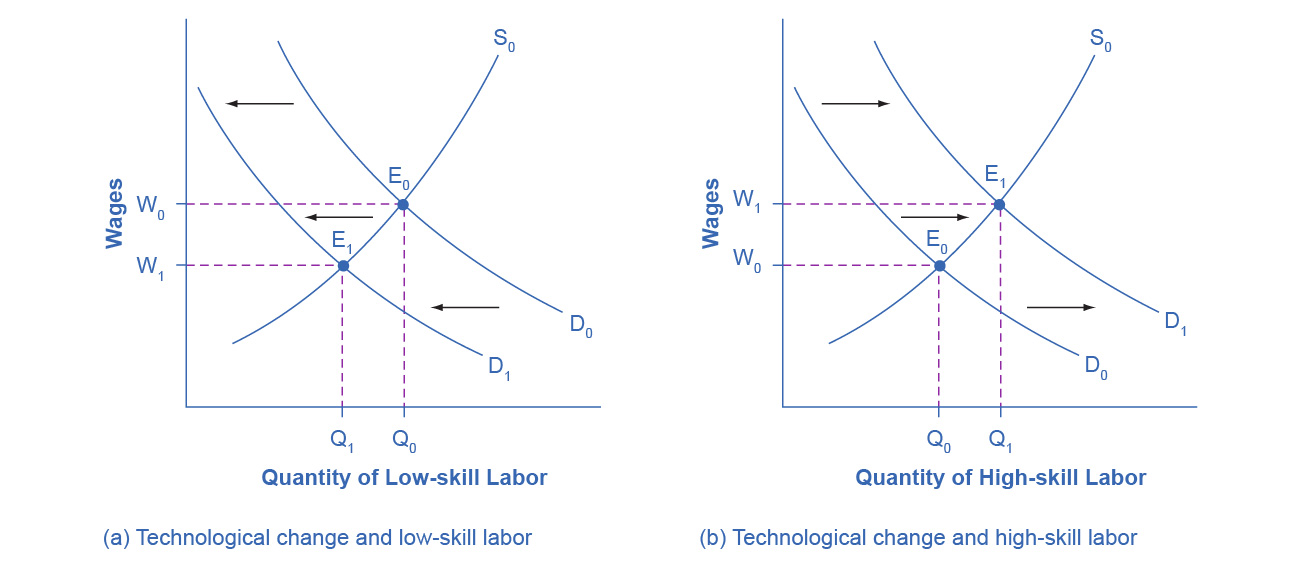

Figure 4.3図 4.3
(a) The demand for low-skill labor shifts to the left when technology can do the job previously done by these workers. (b) New technologies can also increase the demand for high-skill labor in fields such as information technology and network administration.
英語のヒント
(a)以前は労働者がしていた仕事を技術で行えるようになると、低技能労働の需要は左へシフトする。(b)新技術は、ITやネットワーク管理などの分野で、高技能労働への需要を増やすこともある。
Step 2. Does the new technology affect the supply of labor from households or the demand for labor from firms? The technology change described here affects demand for labor by firms that hire workers.
英語のヒント
手順2:新技術は、家計の労働供給と企業の労働需要のどちらに影響するか。ここで述べた技術変化は、労働者を雇う企業の需要に影響する。
Step 3. Will the new technology increase or decrease demand? Based on the description earlier, as the substitute for low-skill labor becomes available, demand for low-skill labor will shift to the left, from D0 to D1. As the technology complement for high-skill labor becomes cheaper, demand for high-skill labor will shift to the right, from D0 to D1.
英語のヒント
手順3:新技術は需要を増やすか、減らすか。先ほどの説明では、低技能労働の代わりになる技術が利用可能になると、その労働需要はD0からD1へ左にシフトする。高技能労働を補完する技術が安くなると、その労働需要はD0からD1へ右にシフトする。
Step 4. The new equilibrium for low-skill labor, shown as point E1 with price W1 and quantity Q1, has a lower wage and quantity hired than the original equilibrium, E0. The new equilibrium for high-skill labor, shown as point E1 with price W1 and quantity Q1, has a higher wage and quantity hired than the original equilibrium (E0).
英語のヒント
手順4:低技能労働の新しい均衡は点E1で、価格W1、数量Q1となり、元の均衡E0より賃金も雇用量も低い。高技能労働の新しい均衡は点E1で、価格W1、数量Q1となり、元の均衡E0より賃金も雇用量も高い。
Thus, the demand and supply model predicts that the new computer and communications technologies will raise the pay of high-skill workers but reduce the pay of low-skill workers. From the 1970s to the mid-2000s, the wage gap widened between high-skill and low-skill labor. According to the National Center for Education Statistics, in 1980, for example, a college graduate earned about 30% more than a high school graduate with comparable job experience, but by 2019, a college graduate earned about 59% more than an otherwise comparable high school graduate. Many economists believe that the trend toward greater wage inequality across the U.S. economy is due to improvements in technology.
英語のヒント
したがって、需要・供給モデルは、新しいコンピューター技術や通信技術が、高技能労働者の賃金を上げ、低技能労働者の賃金を下げると予測する。1970年代から2000年代半ばにかけて、両者の賃金格差は拡大した。全米教育統計センターによれば、例えば1980年には、大学卒業者の所得は同等の就業経験を持つ高校卒業者より約30%高かったが、2019年には約59%高かった。多くの経済学者は、米国全体で賃金格差が拡大する傾向は、技術進歩によるものと考える。