第4章労働市場と金融市場
The United States as a Global Borrower世界の借り手としての米国
In the global economy, trillions of dollars of financial investment cross national borders every year. In the early 2000s, financial investors from foreign countries were investing several hundred billion dollars per year more in the U.S. economy than U.S. financial investors were investing abroad. The following Work It Out deals with one of the macroeconomic concerns for the U.S. economy in recent years.
英語のヒント
世界経済では毎年、数兆ドルの金融投資が国境を越える。2000年代初め、外国の金融投資家による米国経済への年間投資は、米国の金融投資家による海外投資を数千億ドル上回っていた。次の「考えてみよう」では、近年の米国経済が抱えるマクロ経済上の懸念の一つを扱う。
The economy has experienced an enormous inflow of foreign capital. According to the U.S. Bureau of Economic Analysis, by the third quarter of 2021, U.S. investors had accumulated $34.45 trillion of foreign assets, but foreign investors owned a total of $50.53 trillion of U.S. assets. If foreign investors were to pull their money out of the U.S. economy and invest elsewhere in the world, the result could be a significantly lower quantity of financial investment in the United States, available only at a higher interest rate. This reduced inflow of foreign financial investment could impose hardship on U.S. consumers and firms interested in borrowing.
英語のヒント
米国経済には、巨額の外国資本が流入してきた。米国経済分析局によれば、2021年第3四半期までに、米国の投資家が蓄積した海外資産は34.45兆ドルだったが、外国の投資家が持つ米国資産は合計50.53兆ドルだった。外国投資家が米国経済から資金を引き揚げ、世界の別の場所に投資すれば、米国の金融投資量は大幅に減り、より高い利子率でしか調達できなくなるかもしれない。海外からの金融投資の流入が減ると、借り入れをしたい米国の消費者や企業は苦境に置かれうる。
In a modern, developed economy, financial capital often moves invisibly through electronic transfers between one bank account and another. Yet we can analyze these flows of funds with the same tools of demand and supply as markets for goods or labor.
英語のヒント
現代の先進経済では、金融資本は、銀行口座間の電子送金によって目に見えない形で動くことが多い。それでも、この資金の流れは、財市場や労働市場と同じ需要・供給の道具で分析できる。
Price Ceilings in Financial Markets: Usury Laws金融市場の価格上限――高利制限法
As we noted earlier, about 200 million Americans own credit cards, and their interest payments and fees total tens of billions of dollars each year. It is little wonder that political pressures sometimes arise for setting limits on the interest rates or fees that credit card companies charge. The firms that issue credit cards, including banks, oil companies, phone companies, and retail stores, respond that the higher interest rates are necessary to cover the losses created by those who borrow on their credit cards and who do not repay on time or at all. These companies also point out that cardholders can avoid paying interest if they pay their bills on time.
英語のヒント
前述のように、米国では約2億人がクレジットカードを持ち、年間の利子と手数料の支払いは数百億ドルに上る。カード会社の利子率や手数料に上限を設ける政治的圧力が、ときどき生じるのも不思議ではない。銀行、石油会社、電話会社、小売店などのカード発行企業は、高い利子率は、カードで借りたのに期限内に返さない人や、まったく返さない人による損失を埋めるために必要だと答える。期限内に請求額を支払えば、カード保有者は利子を払わずに済むとも指摘する。
Consider the credit card market as Figure 4.8 illustrates. In this financial market, the vertical axis shows the interest rate (which is the price in the financial market). Demanders in the credit card market are households and businesses. Suppliers are the companies that issue credit cards. This figure does not use specific numbers, which would be hypothetical in any case, but instead focuses on the underlying economic relationships. Imagine a law imposes a price ceiling that holds the interest rate charged on credit cards at the rate Rc, which lies below the interest rate R0 that would otherwise have prevailed in the market. The horizontal dashed line at interest rate Rc in Figure 4.8 shows the price ceiling. The demand and supply model predicts that at the lower price ceiling interest rate, the quantity demanded of credit card debt will increase from its original level of Q0 to Qd; however, the quantity supplied of credit card debt will decrease from the original Q0 to Qs. At the price ceiling (Rc), quantity demanded will exceed quantity supplied. Consequently, a number of people who want to have credit cards and are willing to pay the prevailing interest rate will find that companies are unwilling to issue cards to them. The result will be a credit shortage.
英語のヒント
図4.8のクレジットカード市場を考えよう。縦軸は利子率、つまり金融市場の価格である。需要者は家計と企業で、供給者はカード発行会社だ。どのみち仮定の値になるため、この図では具体的な数値を使わず、基礎にある経済的関係に注目する。法律が価格上限を設け、カードの利子率をRcに抑えるとしよう。これは、その法律がなければ市場で成立した利子率R0を下回る。図4.8の利子率Rcの位置にある横の破線が価格上限を示す。需要・供給モデルによれば、価格上限の低い利子率では、カード債務の需要量は元のQ0からQdへ増える。しかし、供給量は元のQ0からQsへ減る。価格上限Rcでは、需要量が供給量を上回る。そのため、カードを持ちたい、しかも現在の利子率を支払う意思もある多くの人々が、会社からカードを発行してもらえなくなる。結果は信用の不足である。
Credit Card Interest Rates: Another Price Ceiling Exampleクレジットカードの利子率――価格上限の別の例
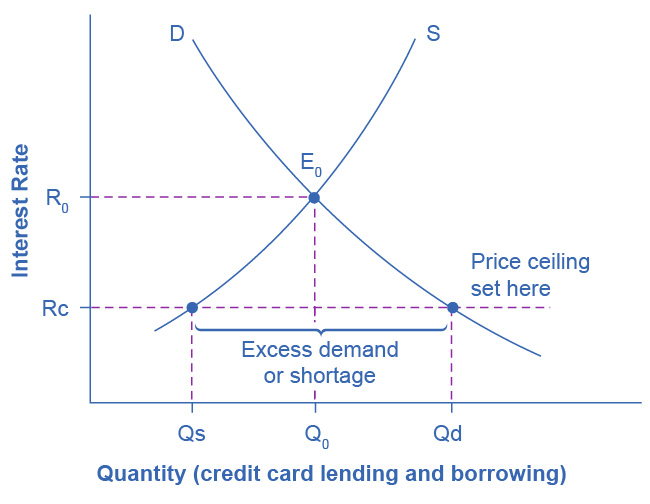

Figure 4.8図 4.8
The original intersection of demand D and supply S occurs at equilibrium E0. However, a price ceiling is set at the interest rate Rc, below the equilibrium interest rate R0, and so the interest rate cannot adjust upward to the equilibrium. At the price ceiling, the quantity demanded, Qd, exceeds the quantity supplied, Qs. There is excess demand, also called a shortage.
英語のヒント
需要Dと供給Sの元の交点は均衡E0にある。しかし、均衡利子率R0より低いRcに価格上限が設定され、利子率は均衡へ向かって上昇できない。価格上限では、需要量Qdが供給量Qsを上回る。超過需要、別名では不足が生じている。
Many states do have usury laws, which impose an upper limit on the interest rate that lenders can charge. However, in many cases these upper limits are well above the market interest rate. For example, if the interest rate is not allowed to rise above 30% per year, it can still fluctuate below that level according to market forces. A price ceiling that is set at a relatively high level is nonbinding, and it will have no practical effect unless the equilibrium price soars high enough to exceed the price ceiling.
英語のヒント
多くの州には、貸し手が請求できる利子率に上限を設ける高利制限法が実際にある。しかし、多くの場合、上限は市場利子率を大きく上回る。例えば、利子率が年30%を超えることは禁止されていても、その水準より下では市場の力に応じて変動できる。比較的高い水準に設定された価格上限は非拘束的であり、均衡価格が上限を超えるほど高騰しない限り、実際の効果を持たない。