第4章労働市場と金融市場
4.1 Demand and Supply at Work in Labor Markets4.1 労働市場で働く需要と供給
Learning Objectives学習目標
Learning Objectives学習目標
By the end of this section, you will be able to:
英語のヒント
この節を学ぶと、次のことができるようになる。
- Predict shifts in the demand and supply curves of the labor market
英語のヒント
労働市場の需要曲線と供給曲線のシフトを予測する。 - Explain the impact of new technology on the demand and supply curves of the labor market
英語のヒント
新技術が労働市場の需要曲線と供給曲線に与える影響を説明する。 - Explain price floors in the labor market such as minimum wage or a living wage
英語のヒント
最低賃金や生活賃金など、労働市場の価格下限を説明する。
Markets for labor have demand and supply curves, just like markets for goods. The law of demand applies in labor markets this way: A higher salary or wage—that is, a higher price in the labor market—leads to a decrease in the quantity of labor demanded by employers, while a lower salary or wage leads to an increase in the quantity of labor demanded. The law of supply functions in labor markets, too: A higher price for labor leads to a higher quantity of labor supplied; a lower price leads to a lower quantity supplied.
英語のヒント
労働市場にも、財市場と同じように需要曲線と供給曲線がある。需要の法則は、次のように働く。給与や賃金、つまり労働市場の価格が高いほど、雇用主が需要する労働の量は減り、低いほど増える。供給の法則も働く。労働の価格が高いほど供給量は増え、低いほど供給量は減る。
Equilibrium in the Labor Market労働市場の均衡
In 2020, nearly 41,000 registered nurses worked in the Minneapolis-St. Paul-Bloomington, Minnesota-Wisconsin metropolitan area, according to the BLS. They worked for a variety of employers: hospitals, doctors’ offices, schools, health clinics, and nursing homes. Figure 4.2 illustrates how demand and supply determine equilibrium in this labor market. The demand and supply schedules in Table 4.1 list the quantity supplied and quantity demanded of nurses at different salaries.
英語のヒント
Labor Market Example: Demand and Supply for Nurses in Minneapolis-St. Paul-Bloomington労働市場の例――ミネアポリス=セントポール=ブルーミントンの看護師の需要と供給
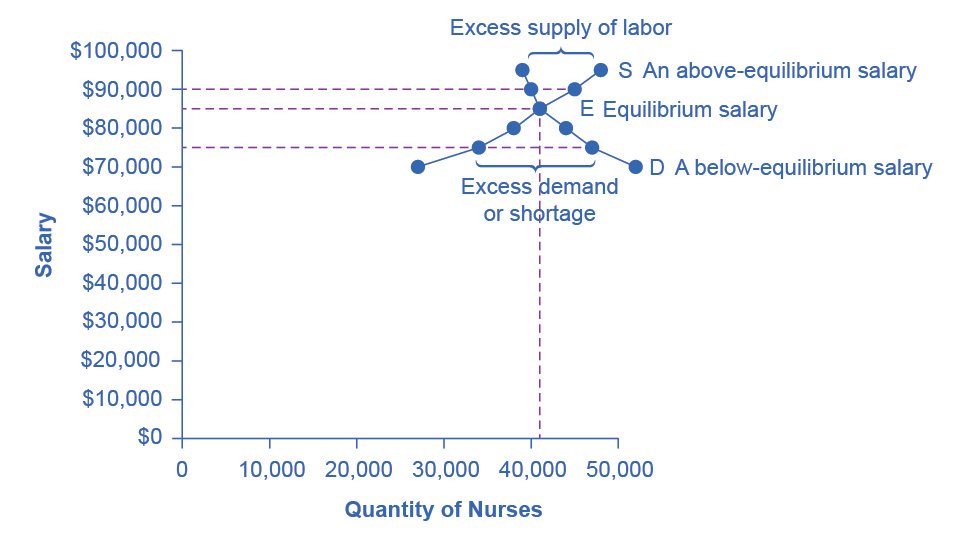

Figure 4.2図 4.2
The demand curve (D) of those employers who want to hire nurses intersects with the supply curve (S) of those who are qualified and willing to work as nurses at the equilibrium point (E). The equilibrium salary is $85,000 and the equilibrium quantity is 41,000 nurses. At an above-equilibrium salary of $90,000, quantity supplied increases to 45,000, but the quantity of nurses demanded at the higher pay declines to 40,000. At this above-equilibrium salary, an excess supply or surplus of nurses would exist. At a below-equilibrium salary of $75,000, quantity supplied declines to 34,000, while the quantity demanded at the lower wage increases to 47,000 nurses. At this below-equilibrium salary, excess demand or a shortage exists.
英語のヒント
看護師を雇いたい雇用主の需要曲線Dと、資格を持ち看護師として働く意思のある人々の供給曲線Sが、均衡点Eで交わる。均衡給与は85,000ドル、均衡数量は41,000人である。均衡を上回る給与90,000ドルでは、供給量は45,000人へ増えるが、需要量は40,000人へ減り、超過供給、すなわち余剰が生じる。均衡を下回る給与75,000ドルでは、供給量は34,000人へ減る一方、需要量は47,000人へ増え、超過需要、すなわち不足が生じる。
Annual Salary 年間給与 |
Quantity Demanded 需要量 |
Quantity Supplied 供給量 |
|---|---|---|
$70,000 |
52,000 |
27,000 |
$75,000 |
47,000 |
34,000 |
$80,000 |
44,000 |
38,000 |
$85,000 |
41,000 |
41,000 |
$90,000 |
40,000 |
45,000 |
$95,000 |
39,000 |
48,000 |
The horizontal axis shows the quantity of nurses hired. In this example we measure labor by number of workers, but another common way to measure the quantity of labor is by the number of hours worked. The vertical axis shows the price for nurses’ labor—that is, how much they are paid. In the real world, this “price” would be total labor compensation: salary plus benefits. It is not obvious, but benefits are a significant part (as high as 30 percent) of labor compensation. In this example we measure the price of labor by salary on an annual basis, although in other cases we could measure the price of labor by monthly or weekly pay, or even the wage paid per hour. As the salary for nurses rises, the quantity demanded will fall. Some hospitals and nursing homes may reduce the number of nurses they hire, or they may lay off some of their existing nurses, rather than pay them higher salaries. Employers who face higher nurses’ salaries may also try to replace some nursing functions by investing in physical equipment, like computer monitoring and diagnostic systems to monitor patients, or by using lower-paid health care aides to reduce the number of nurses they need.
英語のヒント
横軸は雇用される看護師の人数を示す。この例では人数で労働量を測るが、労働時間で測るのも一般的である。縦軸は看護師の労働の価格、つまり報酬額を示す。現実には、この「価格」は給与に福利厚生を加えた労働報酬全体である。目立ちにくいが、福利厚生は報酬の重要な部分で、30%に達することもある。この例では年間給与で価格を測るが、ほかの場合には月給、週給、時給を使うこともできる。看護師の給与が上がると、需要量は減る。病院や介護施設の一部は、高い給与を払う代わりに、採用を減らしたり、在籍する看護師の一部を解雇したりするかもしれない。また、患者を監視するコンピューターや診断システムなどの設備に投資したり、給与の低い医療補助員を使ったりして、看護師の仕事の一部を置き換え、必要人数を減らそうとする雇用主もいるだろう。
As the salary for nurses rises, the quantity supplied will rise. If nurses’ salaries in Minneapolis-St. Paul-Bloomington are higher than in other cities, more nurses will move to Minneapolis-St. Paul-Bloomington to find jobs, more people will be willing to train as nurses, and those currently trained as nurses will be more likely to pursue nursing as a full-time job. In other words, there will be more nurses looking for jobs in the area.
英語のヒント
看護師の給与が上がると、供給量は増える。ミネアポリス=セントポール=ブルーミントンの給与がほかの都市より高ければ、仕事を求めて移住する看護師が増え、看護師の訓練を受けようとする人も増える。すでに訓練を受けた人も、看護をフルタイムの仕事にする可能性が高まる。つまり、この地域で仕事を探す看護師が増える。
At equilibrium, the quantity supplied and the quantity demanded are equal. Thus, every employer who wants to hire a nurse at this equilibrium wage can find a willing worker, and every nurse who wants to work at this equilibrium salary can find a job. In Figure 4.2, the supply curve (S) and demand curve (D) intersect at the equilibrium point (E). The equilibrium quantity of nurses in the Minneapolis-St. Paul-Bloomington area is 41,000, and the equilibrium salary is $85,000 per year. This example simplifies the nursing market by focusing on the “average” nurse. In reality, of course, the market for nurses actually comprises many smaller markets, like markets for nurses with varying degrees of experience and credentials. Many markets contain closely related products that differ in quality. For instance, even a simple product like gasoline comes in regular, premium, and super-premium, each with a different price. Even in such cases, discussing the average price of gasoline, like the average salary for nurses, can still be useful because it reflects what is happening in most of the submarkets.
英語のヒント
均衡では供給量と需要量が等しい。そのため、均衡賃金で看護師を雇いたい雇用主は、働く意思のある人を見つけられ、均衡給与で働きたい看護師は仕事を見つけられる。図4.2では、供給曲線Sと需要曲線Dが均衡点Eで交わる。この都市圏の均衡数量は41,000人、均衡給与は年85,000ドルである。この例は「平均的な」看護師に焦点を当て、市場を単純化している。現実には、経験や資格の異なる看護師の市場など、多くの小さな市場から成る。多くの市場には、品質の異なる、互いに近い製品が含まれる。例えばガソリンのような単純な製品にも、レギュラー、プレミアム、スーパープレミアムがあり、それぞれ価格が違う。それでも、看護師の平均給与と同じく、ガソリンの平均価格を論じることは有用である。大半の下位市場で起きていることを反映するからである。
When the price of labor is not at the equilibrium, economic incentives tend to move salaries toward the equilibrium. For example, if salaries for nurses in Minneapolis-St. Paul-Bloomington were above the equilibrium at $90,000 per year, then 45,000 people want to work as nurses, but employers want to hire only 40,000 nurses. At that above-equilibrium salary, excess supply or a surplus results. In a situation of excess supply in the labor market, with many applicants for every job opening, employers will have an incentive to offer lower wages than they otherwise would have. Nurses’ salary will move down toward equilibrium.
英語のヒント
労働の価格が均衡していないと、経済的な誘因が給与を均衡へ向かわせる。例えば、この都市圏の看護師の給与が均衡を上回る年90,000ドルなら、45,000人が働きたいと考えるが、雇用主が雇いたいのは40,000人だけである。この給与では超過供給、すなわち余剰が生じる。求人一つに多くの応募者がいる超過供給の状況では、雇用主には、そうでない場合より低い賃金を提示する誘因がある。看護師の給与は均衡へ向けて下がる。
In contrast, if the salary is below the equilibrium at, say, $70,000 per year, then a situation of excess demand or a shortage arises. In this case, employers encouraged by the relatively lower wage want to hire 52,000 nurses, but only 27,000 individuals want to work as nurses at that salary in Minneapolis-St. Paul-Bloomington. In response to the shortage, some employers will offer higher pay to attract the nurses. Other employers will have to match the higher pay to keep their own employees. The higher salaries will encourage more nurses to train or work in Minneapolis-St. Paul-Bloomington. Again, price and quantity in the labor market will move toward equilibrium.
英語のヒント
逆に、給与が均衡を下回り、例えば年70,000ドルなら、超過需要、すなわち不足が生じる。比較的低い賃金に促され、雇用主は52,000人を雇いたいと考えるが、その給与でこの都市圏で働きたい人は27,000人しかいない。不足に対応して、一部の雇用主は高い給与を提示し、看護師を引き付けようとする。ほかの雇用主も、自分の従業員をつなぎ留めるため、給与を合わせなければならない。給与の上昇は、この地域で訓練を受けたり働いたりする人を増やす。こうして、労働市場の価格と数量は再び均衡へ向かう。