第29章ビッグバンThe Big Bang
29.6 The Inflationary Universe29.6 インフレーション宇宙
Learning Objectives学習の目標
By the end of this section, you will be able to:
この節を終えると、次のことができるようになる。
Describe two important properties of the universe that the simple Big Bang model cannot explain
単純なビッグバンモデルでは説明できない、宇宙の重要な二つの性質を述べる。
Explain why these two characteristics of the universe can be accounted for if there was a period of rapid expansion (inflation) of the universe just after the Big Bang
ビッグバン直後に急膨張、すなわちインフレーションの時期があれば、その二つの性質を説明できる理由を述べる。
Name the four forces that control all physical processes in the universe
宇宙のすべての物理過程を支配する四つの力を挙げる。
The hot Big Bang model that we have been describing is remarkably successful. It accounts for the expansion of the universe, explains the observations of the CMB, and correctly predicts the abundances of the light elements. Primordial nucleosynthesis constrains the relativistic particles present in the early universe. These constraints are consistent with three light active neutrino species, whose number was also measured through Z-boson decays at high-energy accelerators. We can’t relax just yet, however. This standard model of the universe doesn’t explain all the observations we have made about the universe as a whole.
英語のヒント
ここまで説明してきた高温ビッグバンモデルは、目覚ましい成功を収めている。宇宙の膨張、CMBの観測を説明し、軽い元素の存在量を正しく予測する。初期の元素合成は、初期宇宙にあった相対論的な粒子を制約する。この制約は、軽い活動的ニュートリノが3種類あることと整合する。その種類数は、高エネルギー加速器でのZ粒子の崩壊からも測られた。しかし、まだ安心はできない。この宇宙の標準モデルは、宇宙全体について行ったすべての観測を説明しているわけではない。
Problems with the Standard Big Bang Model標準的なビッグバンモデルの問題点
There are a number of characteristics of the universe that can only be explained by considering further what might have happened before the emission of the CMB. One problem with the standard Big Bang model is that it does not explain why the density of the universe is equal to the critical density. The mass density could have been, after all, so low and the effects of dark energy so high that the expansion would have been too rapid to form any galaxies at all. Alternatively, there could have been so much matter that the universe would have already begun to contract long before now. Why is the universe balanced so precisely on the knife edge of the critical density?
英語のヒント
宇宙の性質の中には、CMBが放たれるより前に何があったか、さらに踏み込まなければ説明できないものがある。標準的なビッグバンモデルの問題の一つは、宇宙の密度がなぜ臨界密度に等しいかを説明しないことである。質量密度が極めて低く、暗黒エネルギーの効果が極めて大きければ、膨張が速すぎて銀河は一つも形成できなかったかもしれない。逆に、物質が多すぎれば、宇宙は今よりはるか以前に収縮へ転じていたかもしれない。なぜ宇宙は、臨界密度という刃先のような境目で、これほど精密に釣り合っているのだろうか。
Another puzzle is the remarkable uniformity of the universe. The temperature of the CMB is the same to about 1 part in 100,000 everywhere we look. This sameness might be expected if all the parts of the visible universe were in contact at some point in time and had the time to come to the same temperature. In the same way, if we put some ice into a glass of lukewarm water and wait a while, the ice will melt and the water will cool down until they are the same temperature.
英語のヒント
もう一つの謎は、宇宙の驚くほどの一様さである。CMBの温度は、どこを見ても約10万分の1の精度で同じだ。見える宇宙のすべての部分が、かつて互いに接触し、同じ温度になるだけの時間があったなら、この一様さは予想できる。ぬるい水の入ったコップに氷を入れてしばらく待つと、氷が融け、水が冷え、全体が同じ温度になるのと同じである。
However, if we accept the standard Big Bang model, all parts of the visible universe were not in contact at any time. The fastest that information can go from one point to another is the speed of light. There is a maximum distance that light can have traveled from any point since the time the universe began—that’s the distance light could have covered since then. This distance is called that point’s horizon distance because anything farther away is “below its horizon”—unable to make contact with it. One region of space separated by more than the horizon distance from another has been completely isolated from it through the entire history of the universe.
英語のヒント
しかし、標準的なビッグバンモデルを受け入れるなら、見える宇宙のすべての部分が、互いに接触できた時期はない。情報が一地点から別の地点へ伝わる最高速度は光速である。宇宙が始まってから、ある地点の光が進めた距離には上限がある。それ以来、光が進めた距離が、その上限だ。この距離を、その地点の地平線距離と呼ぶ。そこより遠くは「地平線の下」にあり、接触できないからである。ある領域から地平線距離を超えて離れた別の領域は、宇宙の全歴史を通じて、完全に隔絶されてきた。
If we measure the CMB in two opposite directions in the sky, we are observing regions that were significantly beyond each other’s horizon distance at the time the CMB was emitted. We can see both regions, but they can never have seen each other. Why, then, are their temperatures so precisely the same? According to the standard Big Bang model, they have never been able to exchange information, and there is no reason they should have identical temperatures. (It’s a little like seeing the clothes that all the students wear at two schools in different parts of the world become identical, without the students ever having been in contact.) The only explanation we could suggest was simply that the universe somehow started out being absolutely uniform (which is like saying all students were born liking the same clothes). Scientists are always uncomfortable when they must appeal to a special set of initial conditions to account for what they see.
英語のヒント
空の正反対の二方向のCMBを測ると、CMBが放たれた時点では、互いの地平線を大きく超えていた領域を見ていることになる。私たちには両方が見えるが、その二つは互いを見る機会がなかった。では、なぜ温度がこれほど正確に同じなのだろうか。標準的なビッグバンモデルによれば、情報を交換できたことがなく、同じ温度である理由はない。世界の離れた場所にある二つの学校で、生徒たちが一度も接触していないのに、全員同じ服装になるようなものだ。提案できた説明は、宇宙が何らかの理由で完全に一様な状態から始まった、というものだけだった。これは、生徒は全員、生まれつき同じ服が好きだったと言うのに似ている。見えるものを説明するために、特別な初期条件に頼らなければならないとき、科学者はいつも居心地の悪さを覚える。
The Inflationary Hypothesisインフレーション仮説
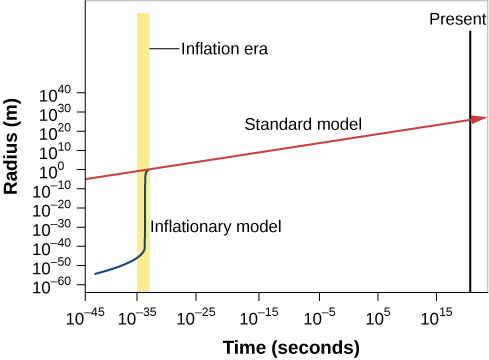
Some physicists suggested that these fundamental characteristics of the cosmos—its flatness and uniformity—can be explained if shortly after the Big Bang (and before the emission of the CMB), the universe experienced a sudden increase in size. A model universe in which this rapid, early expansion occurs is called an inflationary universe. The inflationary universe is identical to the Big Bang universe for all time after the first 10–30 second. Prior to that, the model suggests that there was a brief period of extraordinarily rapid expansion or inflation, during which the scale of the universe increased by a factor of about 1030 times more than predicted by standard Big Bang models (Figure 29.25).
英語のヒント
宇宙の平坦さと一様さという基本的な性質は、ビッグバン直後、CMBが放たれるより前に、宇宙の大きさが突然増大したなら説明できる、と提案した物理学者たちがいた。初期にこのような急膨張が起こる宇宙モデルを、インフレーション宇宙と呼ぶ。最初の10–30秒より後は、インフレーション宇宙とビッグバン宇宙は同じである。それより前に、極めて急速な膨張、すなわちインフレーションが短時間起こり、宇宙の尺度が標準的なビッグバンモデルの予測より約1030倍も大きくなったと、このモデルは考える(図29.25)。
Expansion of the Universe.宇宙の膨張。
OpenStax / Rice University · CC BY 4.0
Figure 29.25 This graph shows how the scale factor of the observable universe changes with time for the standard Big Bang model (red line) and for the inflationary model (blue line). (Note that the time scale at the bottom is extremely compressed.) During inflation, regions that were very small and in contact with each other are suddenly blown up to be much larger and outside each other’s horizon distance. The two models are the same for all times after 10–30 second.
英語のヒント
図29.25 標準的なビッグバンモデル(赤線)とインフレーションモデル(青線)で、観測可能な宇宙の尺度因子が時間とともにどう変わるかを示す。下の時間目盛りは、極度に圧縮されている。インフレーションの間に、非常に小さく互いに接触できた領域が突然膨れ上がり、はるかに大きく、互いの地平線距離の外へ出る。10–30秒より後は、二つのモデルは同じである。
Prior to (and during) inflation, all the parts of the universe that we can now see were so small and close to each other that they could exchange information, that is, the horizon distance included all of the universe that we can now observe. Before (and during) inflation, there was adequate time for the observable universe to homogenize itself and come to the same temperature. Then, inflation expanded those regions tremendously, so that many parts of the universe are now beyond each other’s horizon.
英語のヒント
インフレーション以前と、その最中には、現在見える宇宙のすべての部分は、ごく小さく近接していて、情報を交換できた。つまり、地平線距離の中に、今観測できる宇宙全体が収まっていた。観測可能な宇宙が一様になり、同じ温度になるだけの時間があったのである。その後、インフレーションがそれらの領域を大きく広げ、多くの部分が今では互いの地平線の外にある。
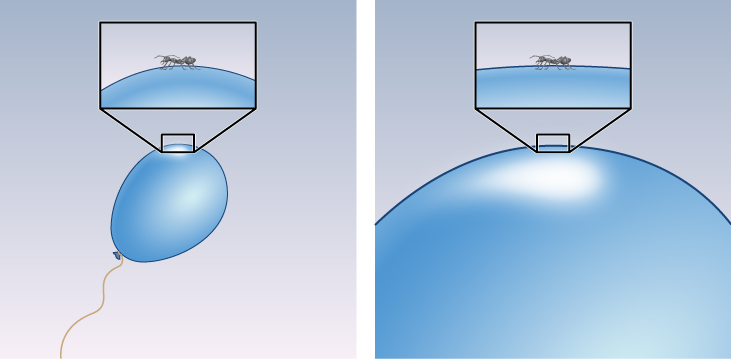
Another appeal of the inflationary model is its prediction that the density of the universe should be exactly equal to the critical density. To see why this is so, remember that curvature of spacetime is intimately linked to the density of matter. If the universe began with some curvature of its spacetime, one analogy for it might be the skin of a balloon. The period of inflation was equivalent to blowing up the balloon to a tremendous size. The universe became so big that from our vantage point, no curvature should be visible (Figure 29.26). In the same way, Earth’s surface is so big that it looks flat to us no matter where we are. Calculations show that a universe with no curvature is one that is at critical density. Universes with densities either higher or lower than the critical density would show marked curvature. But we saw that the observations of the CMB in Figure 29.18, which show that the universe has critical density, rule out the possibility that space is significantly curved.
英語のヒント
インフレーションモデルのもう一つの魅力は、宇宙の密度が臨界密度と正確に等しくなるはずだと予測することである。理由を考えるため、時空の曲がりが物質の密度と深く結び付くことを思い出そう。もし初めの時空に曲がりがあったなら、風船の表面にたとえられる。インフレーション期は、その風船をとてつもなく大きく膨らませることに当たる。宇宙は大きくなりすぎて、私たちの視点からは曲がりが見えなくなるはずだ(図29.26)。地球の表面が大きいため、どこにいても平らに見えるのと同じである。計算によれば、曲がりのない宇宙は臨界密度にある。密度が臨界値より高くても低くても、目立つ曲がりが現れる。しかし、図29.18のCMB観測が宇宙の臨界密度を示したことから、空間が大きく曲がっている可能性は排除される。
Analogy for Inflation.インフレーションのたとえ。
OpenStax / Rice University · CC BY 4.0
Figure 29.26 During a period of rapid inflation, a curved balloon grows so large that to any local observer it looks flat. The inset shows the geometry from the ant’s point of view.
英語のヒント
図29.26 急激なインフレーションの間に、曲がった風船はあまりに大きく成長し、局所的な観測者には平らに見える。挿入図は、アリの視点での形を示す。