第6章天文学の観測装置Astronomical Instruments
Thinking Aheadまず考えてみよう
James Webb Space Telescope (JWST).ジェイムズ・ウェッブ宇宙望遠鏡(JWST)。
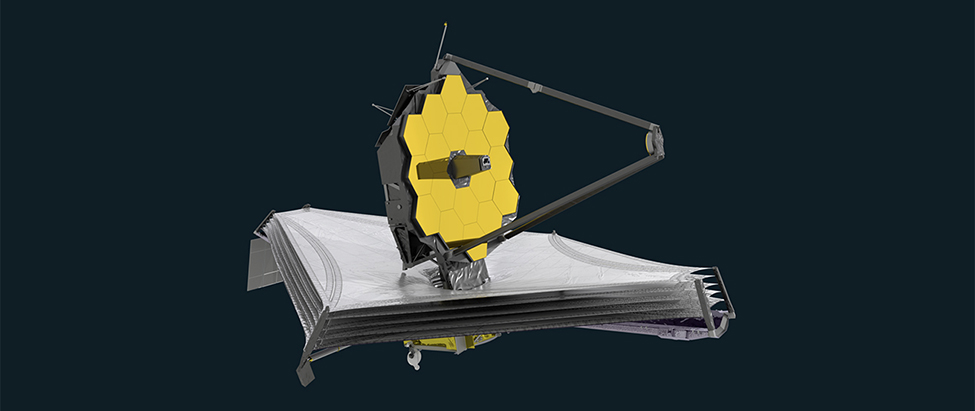
credit: modification of work “Artist’s Impression of the NASA/ESA/CSA James Webb Space Telescope” by ESA/ATG medialab · CC BY 4.0
Figure 6.1 The James Webb Space Telescope, launched December 25, 2021, is the largest space telescope humanity has deployed so far. Its 18 gold-coated beryllium segments make up a mirror for reflecting infrared light that is 6.5 meters in diameter. Below it on our illustration you see the tennis-court-sized sunscreen that protects it from the heat of our star. The first Webb science images were released in July 2022. (credit: modification of work “Artist’s Impression of the NASA/ESA/CSA James Webb Space Telescope” by ESA/ATG medialab)
図6.1 2021年12月25日に打ち上げられたジェイムズ・ウェッブ宇宙望遠鏡は、人類がこれまでに配備した最大の宇宙望遠鏡である。金でコーティングした18枚のベリリウム製分割鏡が、赤外線を反射する直径6.5メートルの鏡を構成する。図でその下に見えるのは、私たちの恒星である太陽の熱から望遠鏡を守る、テニスコートほどの大きさの日よけである。ウェッブによる最初の科学観測画像は2022年7月に公開された。(クレジット:ESA/ATG medialabによる「Artist’s Impression of the NASA/ESA/CSA James Webb Space Telescope」を改変)
If you look at the sky when you are far away from city lights, there seem to be an overwhelming number of stars up there. In reality, only about 9000 stars are visible to the unaided eye (from both hemispheres of our planet). The light from most stars is so weak that by the time it reaches Earth, it cannot be detected by the human eye. How can we learn about the vast majority of objects in the universe that our unaided eyes simply cannot see?
英語のヒント
街明かりから遠く離れた場所で空を見上げると、頭上には圧倒されるほど多くの星があるように思える。実際には、肉眼で見える星は、地球の南北両半球を合わせても約9000個にすぎない。ほとんどの星の光はとても弱く、地球に届くころには人間の目では捉えられない。宇宙の天体の大多数は、肉眼だけではどうしても見ることができない。そのような天体について、どうすれば知ることができるだろうか。
In this chapter, we describe the tools astronomers use to extend their vision into space. We have learned almost everything we know about the universe from studying electromagnetic radiation, as discussed in the chapter on Radiation and Spectra. In the twentieth century, our exploration of space made it possible to detect electromagnetic radiation at all wavelengths, from gamma rays to radio waves. The different wavelengths carry different kinds of information, and the appearance of any given object often depends on the wavelength at which the observations are made.
英語のヒント
この章では、天文学者が宇宙へと視野を広げるために使う道具を説明する。「放射とスペクトル」の章で述べたように、私たちが宇宙について知っていることのほとんどすべては、電磁放射の研究から得られた。20世紀には宇宙探査が進み、ガンマ線から電波まで、あらゆる波長の電磁放射を検出できるようになった。波長が異なれば、運ばれる情報の種類も異なる。同じ天体でも、どの波長で観測するかによって、その見え方が変わることが多い。