第6章天文学の観測装置Astronomical Instruments
Spectroscopy分光法
Spectroscopy is one of the astronomer’s most powerful tools, providing information about the composition, temperature, motion, and other characteristics of celestial objects. More than half of the time spent on most large telescopes is used for spectroscopy.
英語のヒント
分光法は天文学者の最も強力な道具の一つで、天体の組成、温度、運動など、さまざまな性質について情報を与える。多くの大型望遠鏡では、使用時間の半分以上が分光観測に使われている。
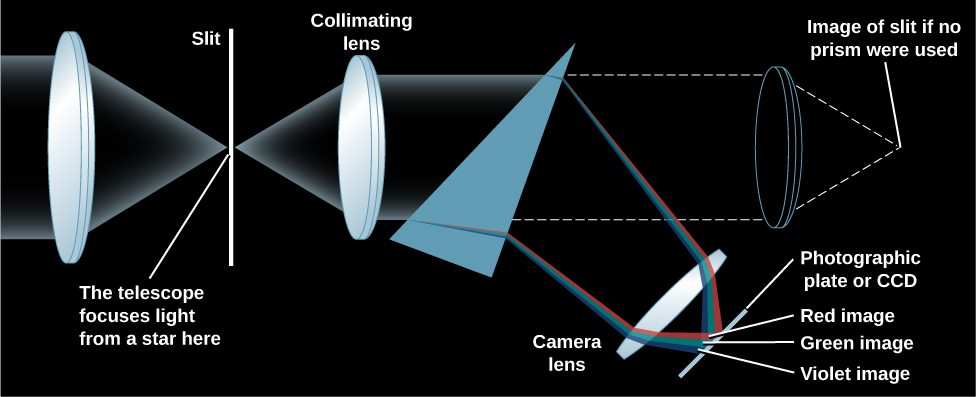
The many different wavelengths present in light can be separated by passing them through a spectrometer to form a spectrum. The design of a simple spectrometer is illustrated in Figure 6.16. Light from the source (actually, the image of a source produced by the telescope) enters the instrument through a small hole or narrow slit, and is collimated (made into a beam of parallel rays) by a lens. The light then passes through a prism, producing a spectrum: different wavelengths leave the prism in different directions because each wavelength is bent by a different amount when it enters and leaves the prism. A second lens placed behind the prism focuses the many different images of the slit or entrance hole onto a CCD or other detecting device. This collection of images (spread out by color) is the spectrum that astronomers can then analyze at a later point. As spectroscopy spreads the light out into more and more collecting bins, fewer photons go into each bin, so either a larger telescope is needed or the integration time must be greatly increased—usually both.
英語のヒント
光に含まれるさまざまな波長は、分光器を通すことで分けられ、スペクトルを作る。単純な分光器の設計を図6.16に示す。光源からの光、正確には望遠鏡が作る光源の像は、小さな穴や細いスリットを通って装置に入り、レンズで平行な光線の束へ整えられる。これをコリメートするという。次に光はプリズムを通り、スペクトルを作る。プリズムに入るときと出るときに、波長ごとに曲がる量が違うため、異なる波長は異なる方向へ出ていく。プリズムの後ろに置いた2枚目のレンズが、波長ごとにできるスリットや入射穴のさまざまな像を、CCDなどの検出器上へ結ぶ。色ごとに広がったこの像の集まりがスペクトルであり、天文学者は後でそれを解析できる。分光では、光をより多くの受け取り区画へ分けるほど、一つの区画に入る光子が少なくなる。そのため、大きな望遠鏡を使うか、積分時間を大幅に長くする必要がある。通常は、その両方が必要になる。
Prism Spectrometer.プリズム分光器。
OpenStax / Rice University · CC BY 4.0
Figure 6.16 The light from the telescope is focused on a slit. A prism (or grating) disperses the light into a spectrum, which is then photographed or recorded electronically.
図6.16 望遠鏡からの光をスリット上に集める。プリズム、あるいは回折格子が光を分散してスペクトルを作り、それを写真や電子的な方法で記録する。
In practice, astronomers today are more likely to use a different device, called a grating, to disperse the spectrum. A grating is a piece of material with thousands of grooves on its surface. While it functions completely differently, a grating, like a prism, also spreads light out into a spectrum.
英語のヒント
実際には、今日の天文学者は、スペクトルを分散させるために、回折格子という別の装置を使うことのほうが多い。回折格子は、表面に何千本もの溝を刻んだものである。働く仕組みはまったく異なるが、プリズムと同じように、光を広げてスペクトルを作る。
Visible-light detectors include the human eye, photographic film, and charge-coupled devices (CCDs). Detectors that are sensitive to infrared radiation must be cooled to very low temperatures since everything in and near the telescope gives off infrared waves. A spectrometer disperses the light into a spectrum to be recorded for detailed analysis.
可視光の検出器には、人間の目、写真フィルム、電荷結合素子(CCD)などがある。赤外線を感知する検出器は、非常に低い温度に冷やさなければならない。望遠鏡の中や周囲のあらゆるものが赤外線を放つからである。分光器は光を分散してスペクトルを作り、詳しい解析のために記録できるようにする。
charge-coupled device (CCD)
電荷結合素子(CCD)
array of high-sensitivity electronic detectors of electromagnetic radiation, used at the focus of a telescope (or camera lens) to record an image or spectrum
電磁放射に対する高感度の電子検出器を並べたもの。望遠鏡やカメラレンズの焦点で、像やスペクトルを記録するために用いる。