第6章天文学の観測装置Astronomical Instruments
6.5 Observations outside Earth’s Atmosphere6.5 地球大気の外からの観測
Learning Objectives学習の目標
By the end of this section, you will be able to:
この節を学び終えると、次のことができるようになる。
List the advantages of making astronomical observations from space
宇宙から天体観測を行う利点を挙げる。
Explain the importance of the James Webb and Hubble Space Telescopes
ジェイムズ・ウェッブ宇宙望遠鏡とハッブル宇宙望遠鏡の重要性を説明する。
Describe some of the major space-based observatories astronomers use
天文学者が使う主な宇宙観測施設の一部を説明する。
Earth’s atmosphere blocks most radiation at wavelengths shorter than visible light, so we can only make direct ultraviolet, X-ray, and gamma ray observations from space (though indirect gamma ray observations can be made from Earth). Getting above the distorting effects of the atmosphere is also an advantage at visible and infrared wavelengths. The stars don’t “twinkle” in space, so the amount of detail you can observe is limited only by the size of your instrument. On the other hand, it is expensive to place telescopes into space, and repairs can present a major challenge. This is why astronomers continue to build telescopes for use on the ground as well as for launching into space.
英語のヒント
地球大気は、可視光より短い波長の放射のほとんどを遮る。そのため、紫外線、X線、ガンマ線を直接観測できるのは宇宙からだけである。ただし、ガンマ線の間接的な観測は地上からでもできる。可視光や赤外線でも、像をゆがめる大気の外へ出る利点がある。宇宙では星が「またたかない」ので、どこまで細かく見えるかを制限するのは装置の大きさだけになる。他方、望遠鏡を宇宙へ運ぶには費用がかかり、修理も大きな難題になりうる。だからこそ天文学者は、宇宙へ打ち上げる望遠鏡とともに、地上で使う望遠鏡も造り続けている。
Airborne and Space Infrared Telescopes航空機搭載型と宇宙の赤外線望遠鏡
Water vapor, the main source of atmospheric interference for making infrared observations, is concentrated in the lower part of Earth’s atmosphere. For this reason, a gain of even a few hundred meters in elevation can make an important difference in the quality of an infrared observatory site. Given the limitations of high mountains, most of which attract clouds and violent storms, and the fact that the ability of humans to perform complex tasks degrades at high altitudes, it was natural for astronomers to investigate the possibility of observing infrared waves from airplanes and ultimately from space.
英語のヒント
赤外線観測を妨げる大気中の主な原因である水蒸気は、地球大気の下層に集中している。そのため、高度がわずか数百メートル上がるだけでも、赤外線天文台の立地条件に大きな違いが生じる。高山には限界がある。多くの山には雲がかかり、激しい嵐が起こるうえ、高地では人間が複雑な作業を行う能力も低下する。こうした事情を考えれば、天文学者が航空機から、さらに最終的には宇宙から赤外線を観測する可能性を探ったのは自然なことだった。
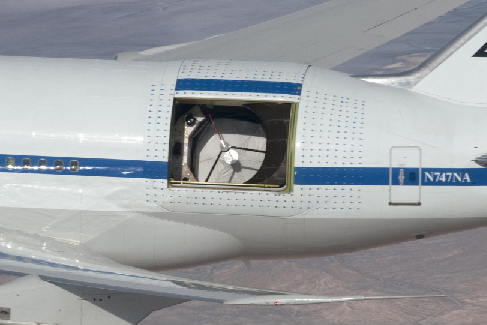
Infrared observations from airplanes have been made since the 1960s, starting with a 15-centimeter telescope on board a Learjet. From 1974 through 1995, NASA operated a 0.9-meter airborne telescope flying regularly out of the Ames Research Center south of San Francisco. Observing from an altitude of 12 kilometers, the telescope was above 99% of the atmospheric water vapor. Between 2010 and 2022, NASA (in partnership with the German Aerospace Center) used a much larger 2.5-meter telescope, called the Stratospheric Observatory for Infrared Astronomy (SOFIA), which flew in a modified Boeing 747SP (Figure 6.23).
英語のヒント
航空機からの赤外線観測は1960年代に始まった。最初はリアジェットに搭載した15センチメートル望遠鏡だった。1974〜1995年には、NASAが口径0.9メートルの航空機搭載望遠鏡を運用し、サンフランシスコの南にあるエイムズ研究センターから定期的に飛ばした。高度12キロメートルから観測するこの望遠鏡は、大気中の水蒸気の99%より上に位置していた。2010〜2022年には、NASAはドイツ航空宇宙センターと協力し、さらに大きな2.5メートル望遠鏡を使った。成層圏赤外線天文台SOFIAと呼ばれ、改造したボーイング747SPに載せて飛行した(図6.23)。
Stratospheric Observatory for Infrared Astronomy (SOFIA).成層圏赤外線天文台(SOFIA)。
credit: NASA · NASA media use guidelines
Figure 6.23 SOFIA allowed observations to be made above most of Earth’s atmospheric water vapor. (credit: NASA)
図6.23 SOFIAは、地球大気の水蒸気の大部分より上での観測を可能にした。(クレジット:NASA)
Getting even higher and making observations from space itself have important advantages for infrared astronomy. First is the elimination of all interference from the atmosphere. Equally important is the opportunity to cool the entire optical system of the instrument in order to nearly eliminate infrared radiation from the telescope itself. If we tried to cool a telescope within the atmosphere, it would quickly become coated with condensing water vapor and other gases, making it useless. Only in the vacuum of space can optical elements be cooled to hundreds of degrees below freezing and still remain operational.
英語のヒント
さらに高く上がり、宇宙空間そのものから観測することには、赤外線天文学にとって重要な利点がある。第一は、大気の妨害をすべて取り除けることだ。同じくらい重要なのは、装置の光学系全体を冷やし、望遠鏡自体から出る赤外線をほぼなくせることである。大気の中で望遠鏡を冷やそうとすれば、すぐに凝結した水蒸気やほかの気体で覆われ、使い物にならなくなってしまう。光学素子を水の凍る温度より数百度低く冷やし、それでも動作させられるのは、宇宙の真空の中だけである。
The first orbiting infrared observatory, launched in 1983, was the Infrared Astronomical Satellite (IRAS), built as a joint project by the United States, the Netherlands, and Britain. IRAS was equipped with a 0.6-meter telescope cooled to a temperature of less than 10 K. For the first time, the infrared sky could be seen as if it were night, rather than through a bright foreground of atmospheric and telescope emissions. IRAS carried out a rapid but comprehensive survey of the entire infrared sky over a 10-month period, cataloging about 350,000 sources of infrared radiation. Since then, several other infrared telescopes have operated in space with much better sensitivity and resolution due to improvements in infrared detectors. The most powerful of these early infrared telescopes was the 0.85-meter Spitzer Space Telescope, which launched in 2003 and ended operations in 2020. But, as we shall see later in this chapter, a much larger infrared telescope (the James Webb Space Telescope) has now taken its place. We continue to build larger and more sensitive infrared telescopes in space because they can help us detect the cooler parts of cosmic objects, such as the dust clouds around nurseries of infant stars and the remnants of dying stars, that visible-light images cannot reveal.
英語のヒント
最初の軌道上の赤外線天文台は、1983年に打ち上げられた赤外線天文衛星IRASで、米国、オランダ、英国の共同事業として造られた。IRASは、10 K未満に冷却された0.6メートル望遠鏡を備えていた。大気や望遠鏡の放射による明るい前景越しではなく、あたかも夜であるかのように赤外線の空を見ることが、初めて可能になった。IRASは10か月間で赤外線の全天を素早く、しかもくまなく調査し、約35万の赤外線源をカタログに収めた。その後、赤外線検出器の改良により、はるかに高い感度と分解能を持つ赤外線望遠鏡が、さらにいくつも宇宙で稼働した。こうした初期の赤外線望遠鏡の中で最も強力だったのは、口径0.85メートルのスピッツァー宇宙望遠鏡である。2003年に打ち上げられ、2020年に運用を終えた。しかし、この章の後で見るように、現在でははるかに大きな赤外線望遠鏡、ジェイムズ・ウェッブ宇宙望遠鏡がその役割を引き継いでいる。より大型で高感度の赤外線望遠鏡を宇宙へ送り続けるのは、可視光画像では見えない、宇宙の天体の冷たい部分を検出する助けになるからだ。たとえば、生まれたばかりの星の育つ場所を取り巻く塵の雲や、死にゆく星の残骸などである。
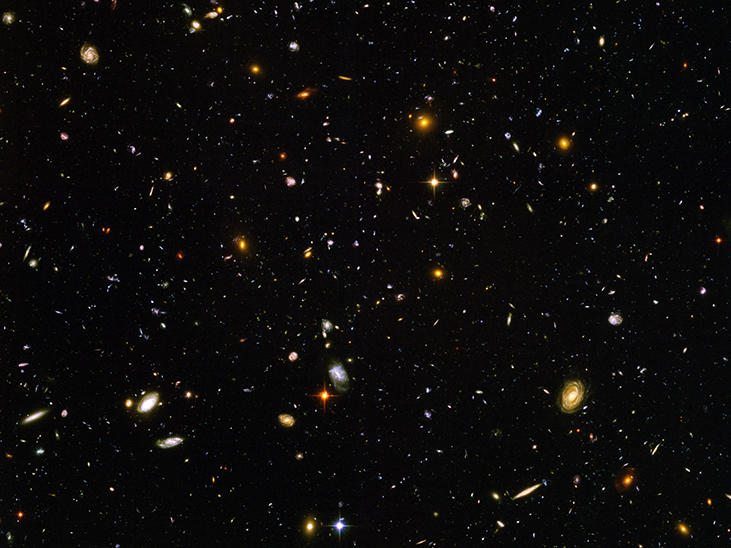
Hubble Ultra-Deep Field (HUDF).ハッブル・ウルトラ・ディープ・フィールド(HUDF)。
credit: modification of work by NASA · NASA media use guidelines
Figure 6.24 The Hubble Space Telescope has provided an image of a specific region of space built from data collected between September 24, 2003, and January 16, 2004. These data allow us to search for galaxies that existed approximately 13 billion years ago. (credit: modification of work by NASA)
図6.24 ハッブル宇宙望遠鏡は、2003年9月24日から2004年1月16日までに集めたデータから、宇宙の特定の領域の画像を作り出した。このデータによって、約130億年前に存在した銀河を探すことができる。(クレジット:NASAの作品を改変)
Hubble Space Telescopeハッブル宇宙望遠鏡
In April 1990, a great leap forward in astronomy was made with the launch of the Hubble Space Telescope (HST). It has a mirror 2.4 meters in diameter and has earned a reputation as one of the most important telescopes in the history of astronomy. (Its aperture was limited by the size of the payload bay in the Space Shuttle that served as its launch vehicle.) It was named for Edwin Hubble, the astronomer who discovered the expansion of the universe in the 1920s (whose work we will discuss in the chapters on Galaxies).
英語のヒント
1990年4月、ハッブル宇宙望遠鏡HSTの打ち上げによって、天文学は大きく前進した。直径2.4メートルの鏡を持ち、天文学史で最も重要な望遠鏡の一つと評価されている。口径は、打ち上げに使われたスペースシャトルの貨物室の大きさによって制限された。名称は、1920年代に宇宙の膨張を発見した天文学者、エドウィン・ハッブルに由来する。彼の仕事は「銀河」の章で取り上げる。
HST is operated jointly by NASA’s Goddard Space Flight Center and the Space Telescope Science Institute in Baltimore. It was the first orbiting observatory designed to be serviced by Shuttle astronauts and, over the years since it was launched, they made several visits to improve or replace its initial instruments and to repair some of the systems that operate the spacecraft—though this repair program has now been discontinued, and no more visits or improvements will be made.
英語のヒント
HSTは、NASAゴダード宇宙飛行センターと、ボルティモアの宇宙望遠鏡科学研究所が共同で運用している。シャトルの宇宙飛行士が保守作業を行うように設計された、最初の軌道上の天文台だった。打ち上げ後の長年にわたり、宇宙飛行士は何度か訪問して、初期の観測装置を改良・交換し、宇宙機を動かすシステムの一部を修理した。ただし、この修理計画はすでに終了しており、これ以上の訪問や改良は行われない。
With the Hubble, astronomers have obtained some of the most detailed images of astronomical objects from the solar system outward to the most distant galaxies. Among its many great achievements is the Hubble Ultra-Deep Field, an image of a small region of the sky observed for almost 100 hours. It contains views of about 10,000 galaxies, some of which formed when the universe was just a few percent of its current age (Figure 6.24).
英語のヒント
天文学者はハッブルを使い、太陽系から最遠方の銀河に至るまで、天体の最も詳細な画像の数々を得てきた。多くの大きな成果の一つが、空の小さな領域を100時間近く観測した画像、ハッブル・ウルトラ・ディープ・フィールドである。そこには約1万個の銀河が写っている。その一部は、宇宙の年齢が現在のわずか数%だったころに形成された(図6.24)。
The HST’s mirror was ground and polished to a remarkable degree of accuracy. If we were to scale up its 2.4-meter mirror to the size of the entire continental United States, there would be no hill or valley larger than about 6 centimeters in its smooth surface. Unfortunately, after it was launched, scientists discovered that the primary mirror had a slight error in its shape, equal to roughly 1/50 the width of a human hair. Small as that sounds, it was enough to ensure that much of the light entering the telescope did not come to a clear focus and that all the images were blurry. (In a misplaced effort to save money, a complete test of the optical system had not been carried out before launch, so the error was not discovered until HST was in orbit.)
英語のヒント
HSTの鏡は、驚くほど高い精度で研削・研磨された。直径2.4メートルの鏡を米国本土全体の大きさにまで拡大したとしても、その滑らかな表面には約6センチメートルを超える山や谷がないことになる。残念ながら、打ち上げ後、主鏡の形には髪の毛の幅のおよそ50分の1に相当する、わずかな誤差があるとわかった。小さく聞こえるかもしれないが、それだけで入ってくる光の多くが一点にきれいに集まらず、画像がすべてぼやけるほどだった。経費を節約しようとした判断が裏目に出て、打ち上げ前に光学系全体の試験をしていなかった。そのため、HSTが軌道に乗るまで、この誤差は発見されなかった。
The solution was to do something very similar to what we do for astronomy students with blurry vision: put corrective optics in front of their eyes. In December 1993, in one of the most exciting and difficult space missions ever flown, astronauts captured the orbiting telescope and brought it back into the shuttle payload bay. There they installed a package containing compensating optics as well as a new, improved camera before releasing HST back into orbit. The telescope now works as it was intended to, and further missions to it were able to install even more advanced instruments to take advantage of its capabilities.
英語のヒント
解決策は、視力がぼやけた天文学の学生にすることと、よく似たものだった。目の前に視力を補正する光学系を置くのである。1993年12月、それまでで特に胸を躍らせる一方で難しい宇宙飛行の一つで、宇宙飛行士たちは軌道上の望遠鏡を捕まえ、シャトルの貨物室へ運び込んだ。そこで、補正用の光学系を含む装置と、新しく改良したカメラを取り付け、その後HSTを再び軌道へ放した。望遠鏡は今では設計どおりに働き、その後の整備ミッションでも、能力を生かすさらに高度な装置を取り付けることができた。