第20章星と星の間――宇宙のガスと塵Between the Stars: Gas and Dust in Space
Thinking Aheadこれから考えること
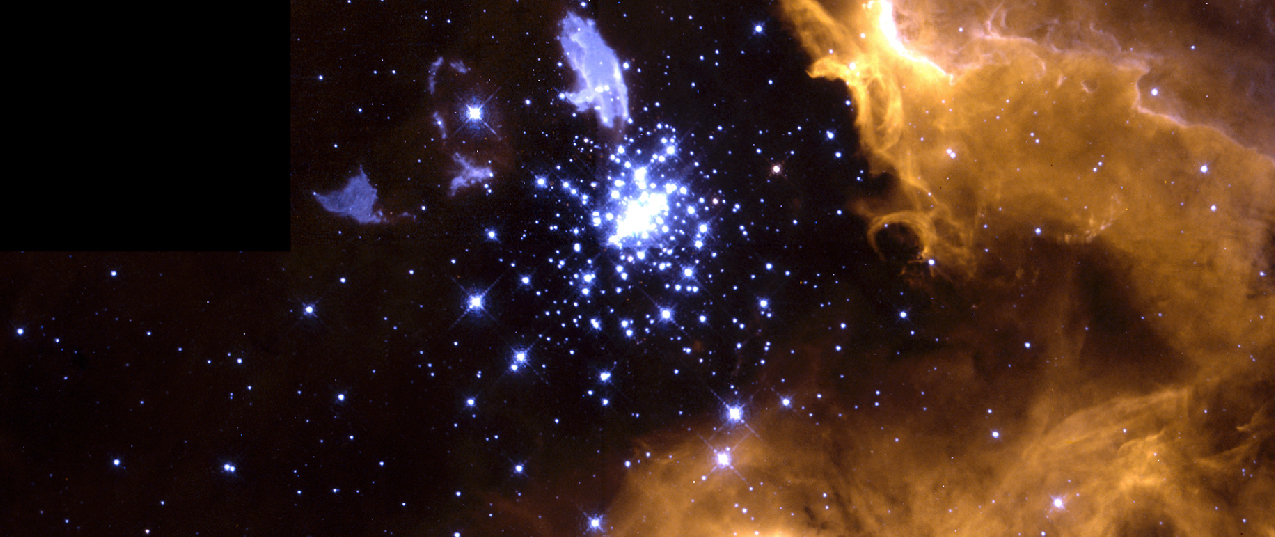
NGC 3603 and Its Parent Cloud.NGC 3603と、その母体となった雲
credit: modification of work by NASA, Wolfgang Brandner (JPL/IPAC), Eva K. Grebel (University of Washington), You-Hua Chu (University of Illinois Urbana-Champaign) · JPL image use policy
Figure 20.1 This image, taken by the Hubble Space Telescope, shows the young star cluster NGC 3603 interacting with the cloud of gas from which it recently formed. The bright blue stars of the cluster have blown a bubble in the gas cloud. The remains of this cloud can be seen in the lower right part of the frame, glowing in response to the starlight illuminating it. In its darker parts, shielded from the harsh light of NGC 3603, new stars continue to form. Although the stars of NGC 3603 formed only recently, the most massive of them are already dying and ejecting their mass, producing the blue ring and streak features visible in the upper left part of the image. Thus, this image shows the full life cycle of stars, from formation out of interstellar gas, through life on the main sequence, to death and the return of stellar matter to interstellar space. (credit: modification of work by NASA, Wolfgang Brandner (JPL/IPAC), Eva K. Grebel (University of Washington), You-Hua Chu (University of Illinois Urbana-Champaign))
英語のヒント
図20.1 ハッブル宇宙望遠鏡が撮影したこの画像は、若い星団NGC 3603と、それが最近生まれたガス雲との相互作用を示す。星団の明るい青い星々は、ガス雲に泡状の空洞を吹き開けている。雲の残りは右下に見え、照らす星の光を受けて輝いている。NGC 3603の強烈な光から守られた暗い部分では、新しい星が生まれ続ける。NGC 3603の星々は生まれたばかりだが、最も大質量の星はすでに死に始め、物質を放出している。それが、左上に見える青いリングや筋状の構造を作っている。こうしてこの画像は、星間ガスからの形成、主系列星としての一生、そして死と星の物質の星間空間への返還まで、星の一生の循環全体を示している。(クレジット:NASA、Wolfgang Brandner〔JPL/IPAC〕、Eva K. Grebel〔ワシントン大学〕、You-Hua Chu〔イリノイ大学アーバナ・シャンペーン校〕の作品を改変)
Where do stars come from? We already know from earlier chapters that stars must die because ultimately they exhaust their nuclear fuel. We might hypothesize that new stars come into existence to replace the ones that die. In order to form new stars, however, we need the raw material to make them. It also turns out that stars eject mass throughout their lives (a kind of wind blows from their surface layers) and that material must go somewhere. What does this “raw material” of stars look like? How would you detect it, especially if it is not yet in the form of stars and cannot generate its own energy?
英語のヒント
星はどこから生まれるのだろうか。前の章から、星はいずれ核燃料を使い果たすため、死ななければならないことは分かっている。死んでいく星に代わって、新しい星が生まれるのではないかと考えられる。しかし、新しい星を作るには、その材料が要る。また、星は一生を通じて質量を放出していることも分かっている。表層から一種の風が吹き出し、その物質はどこかへ行くはずだ。星のこの「原材料」は、どのような姿をしているのだろうか。特に、まだ星の形ではなく、自分ではエネルギーを生み出せないのなら、どのように検出すればよいだろうか。
One of the most exciting discoveries of twentieth-century astronomy was that our Galaxy contains vast quantities of this “raw material”—atoms or molecules of gas and tiny solid dust particles found between the stars. Studying this diffuse matter between the stars helps us understand how new stars form and gives us important clues about our own origins billions of years ago.
英語のヒント
20世紀の天文学で最も胸の躍る発見の一つは、天の川銀河には、この「原材料」が膨大にあるというものだった。星と星の間にある、ガスの原子や分子、そして小さな固体の塵の粒である。星々の間にまばらに広がるこの物質を調べると、新しい星がどう生まれるかを理解でき、数十億年前の私たち自身の起源についても、重要な手がかりが得られる。