第28章銀河の進化と分布The Evolution and Distribution of Galaxies
Thinking Aheadまず考えてみよう
Colliding Galaxies.衝突する銀河
credit left: modification of work by Bob and Bill Twardy/Adam Block/NOAO/AURA/NSF; credit right: modification of work by NASA, ESA, and the Hubble Heritage Team (STScI/AURA)-ESA/Hubble Collaboration · CC BY 4.0
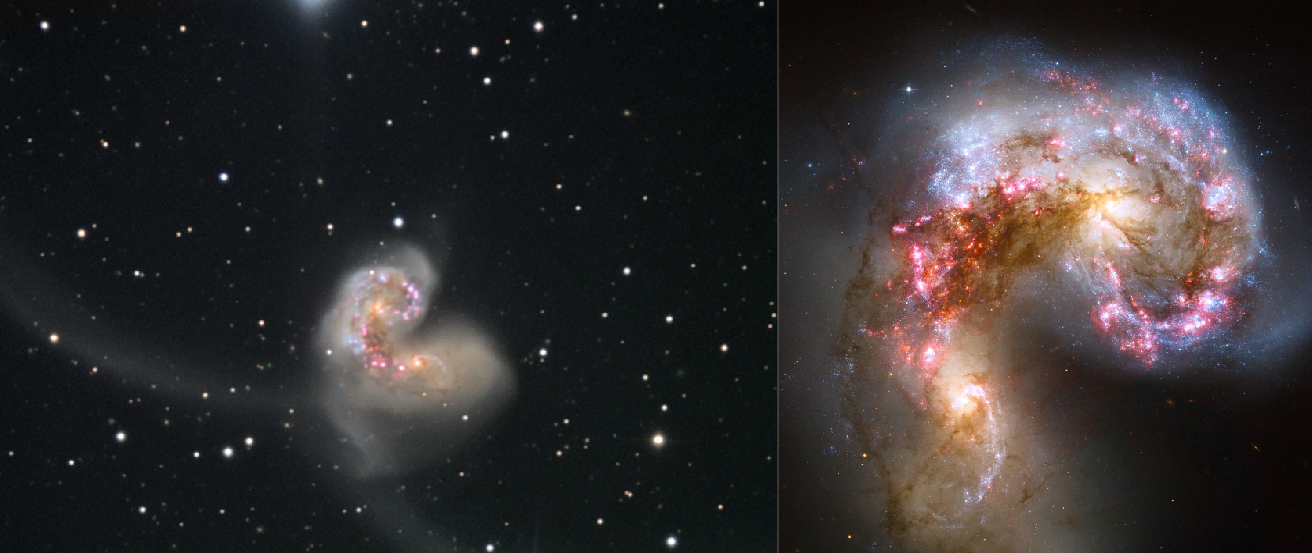
Figure 28.1 Collisions and mergers of galaxies strongly influence their evolution. On the left is a ground-based image of two colliding galaxies (NGC 4038 and 4039), sometimes nicknamed the Antennae galaxies. The long, luminous tails are material torn out of the galaxies by tidal forces during the collision. The right image shows the inner regions of these two galaxies, as taken by the Hubble Space Telescope. The cores of the twin galaxies are the orange blobs to the lower left and upper right of the center of the image. Note the dark lanes of dust crossing in front of the bright regions. The bright pink and blue star clusters are the result of a burst of star formation stimulated by the collision. (credit left: modification of work by Bob and Bill Twardy/Adam Block/NOAO/AURA/NSF; credit right: modification of work by NASA, ESA, and the Hubble Heritage Team (STScI/AURA)-ESA/Hubble Collaboration)
図28.1 銀河の衝突と合体は、その進化に大きな影響を及ぼす。左は、触角銀河とも呼ばれる二つの衝突中の銀河、NGC 4038と4039を地上から撮影した画像である。長く輝く尾は、衝突の際に潮汐力によって銀河から引きちぎられた物質である。右は、ハッブル宇宙望遠鏡が撮影した、この二つの銀河の内部である。画像の中心から見て左下と右上にあるオレンジ色の塊が、それぞれの銀河の中心核に当たる。明るい領域の手前を横切る、暗い塵の筋に注目しよう。明るいピンク色や青色の星団は、衝突に刺激されて星形成が一気に起きた結果である。(左のクレジット:Bob and Bill Twardy/Adam Block/NOAO/AURA/NSFによる作品を改変。右のクレジット:NASA, ESA, and the Hubble Heritage Team (STScI/AURA)-ESA/Hubble Collaborationによる作品を改変)
How and when did galaxies like our Milky Way form? Which formed first: stars or galaxies? Can we see direct evidence of the changes galaxies undergo over their lifetimes? If so, what determines whether a galaxy will “grow up” to be spiral or elliptical? And what is the role of “nature versus nurture”? That is to say, how much of a galaxy’s development is determined by what it looks like when it is born and how much is influenced by its environment?
英語のヒント
天の川銀河のような銀河は、いつ、どのように形成されたのだろうか。先にできたのは恒星か、それとも銀河か。銀河が一生の間に変化する直接の証拠を、観測できるだろうか。できるとしたら、銀河が渦巻銀河に「育つ」か、楕円銀河に育つかを決めるものは何か。また、「生まれつきと育ち」は、それぞれどのように関係するのだろうか。つまり、銀河の発達は、誕生時の姿によってどれほど決まり、周囲の環境からどれほど影響を受けるのだろうか。
Astronomers today have the tools needed to explore the universe almost back to the time it began. The huge new telescopes and sensitive detectors built in the last decades make it possible to obtain both images and spectra of galaxies so distant that their light has traveled to reach us for more than 13 billion years—more than 90% of the way back to the Big Bang: we can use the finite speed of light and the vast size of the universe as a cosmic time machine to peer back and observe how galaxies formed and evolved over time. Studying galaxies so far away in any detail is always a major challenge, largely because their distance makes them appear very faint. However, today’s large telescopes on the ground and in space are finally making such a task possible.
英語のヒント
現在の天文学者は、宇宙が始まったころまで、ほとんどさかのぼって調べられる観測手段を持っている。ここ数十年に造られた新しい巨大望遠鏡と高感度の検出器によって、光が届くのに130億年以上かかった遠方の銀河についても、画像とスペクトルの両方を得られるようになった。これは、ビッグバンまでの時間の90%以上をさかのぼることになる。光速が有限であり、宇宙が途方もなく広いことを、宇宙のタイムマシンとして利用できるのである。過去をのぞき、銀河がどのように形成され、時間とともに進化したかを観測できる。それほど遠い銀河を詳しく調べるのは、今なお大きな難題である。主な理由は、遠いため非常に暗く見えることだ。しかし、地上と宇宙の大型望遠鏡が、ついにそれを可能にしつつある。