第28章銀河の進化と分布The Evolution and Distribution of Galaxies
A Changing Universe of Galaxies変わりゆく銀河の宇宙
Back in the middle decades of the twentieth century, the observation that all galaxies contain some old stars led astronomers to the hypothesis that galaxies were born fully formed near the time when the universe began its expansion. This hypothesis was similar to suggesting that human beings were born as adults and did not have to pass through the various stages of development from infancy through the teens. If this hypothesis were correct, the most distant galaxies should have shapes and sizes very much like the galaxies we see nearby. According to this old view, galaxies, after they formed, should then change only slowly, as successive generations of stars within them formed, evolved, and died. As the interstellar matter was slowly used up and fewer new stars formed, the galaxies would gradually become dominated by fainter, older stars and look dimmer and dimmer.
英語のヒント
20世紀半ばには、どの銀河にも古い星があるという観測から、天文学者は、銀河は宇宙の膨張が始まったころ、完成した姿で誕生したという仮説を立てた。これは、人間が乳児期から10代までの発達段階を通らず、大人の姿で生まれると言うようなものである。この仮説が正しければ、最も遠い銀河も、近くに見える銀河とよく似た形や大きさを持つはずだった。この古い見方では、銀河は形成された後、内部の恒星が世代を重ねて誕生し、進化し、死ぬにつれて、ゆっくりとしか変化しないはずである。星間物質が少しずつ使い尽くされ、新しくできる星が減ると、銀河では、より暗く古い星が優勢になり、次第に暗く見えるようになると考えられた。
Thanks to the new generation of large ground- and space-based telescopes, we now know that this picture of galaxies evolving peacefully and in isolation from one another is completely wrong. As we will see later in this chapter, galaxies in the distant universe do not look like the Milky Way and nearby galaxies such as Andromeda, and the story of their development is more complex and involves far more interaction with their neighbors.
英語のヒント
新世代の地上・宇宙の大型望遠鏡のおかげで、銀河が互いに孤立して穏やかに進化する、というこの描像は、完全に誤りだったとわかった。この章の後半で見るように、遠方の宇宙の銀河は、天の川銀河や、アンドロメダ銀河のような近くの銀河とは似ていない。成長の歴史はもっと複雑で、近隣の銀河との相互作用が、はるかに多く関わっている。
Why were astronomers so wrong? Up until the early 1990s, the most distant normal galaxy that had been observed emitted its light 8 billion years ago. During the last 8 billion years, many galaxies—and particularly the giant ellipticals, which are the most luminous and therefore the easiest to see at large distances—did evolve peacefully and slowly. But the Hubble, Spitzer, Herschel, Keck, and now JWST, all of which have come on line since the 1990s, make it possible to pierce the 8-billion-light-year barrier. We now have detailed views of many thousands of galaxies that emitted their light much earlier (some more than 13 billion years ago—see Figure 28.3).
英語のヒント
天文学者は、なぜそれほど見誤ったのだろうか。1990年代初めまでに観測されていた最も遠い通常の銀河は、80億年前に光を放出したものだった。過去80億年には、多くの銀河、とりわけ大きな楕円銀河は、実際に穏やかに、ゆっくりと進化していた。巨大楕円銀河は最も光度が高く、遠方でも特に見つけやすい銀河でもある。しかし、1990年代以降に稼働し始めたハッブル、スピッツァー、ハーシェル、ケック、そして現在のジェイムズ・ウェッブ宇宙望遠鏡は、80億光年の壁を越えることを可能にした。今では、それよりずっと昔に光を放出した何千もの銀河を、詳しく見ることができる。中には130億年以上前のものもある(図28.3)。
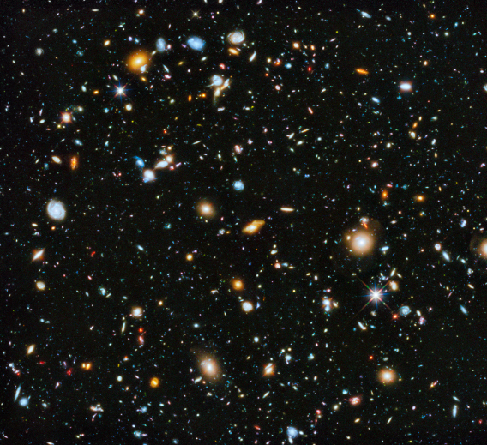
Much of the recent work on the evolution of galaxies has progressed by studying a few specific small regions of the sky where the Hubble, Spitzer, JWST, and ground-based telescopes have taken extremely long exposure images. This allowed astronomers to detect very faint, very distant, and therefore very young galaxies (Figure 28.4). Our deep space telescope images show some galaxies that are 100 times fainter than the faintest objects that can be observed spectroscopically with today’s giant ground-based telescopes. This turns out to mean that we can obtain the spectra needed to determine redshifts for only the very brightest five percent of the galaxies in these images.
英語のヒント
近年の銀河進化の研究の多くは、空の特定の小さな領域をいくつか、ハッブル、スピッツァー、ジェイムズ・ウェッブ、そして地上の望遠鏡で、非常に長い時間をかけて撮影することで進んできた。これにより、非常に暗く、非常に遠い、したがって非常に若い銀河を検出できるようになった(図28.4)。宇宙望遠鏡で深く撮影した画像には、現在の地上の巨大望遠鏡で分光観測できる最も暗い天体よりも、さらに100倍暗い銀河が写る。つまり、こうした画像の銀河のうち、赤方偏移を決めるために必要なスペクトルを得られるのは、最も明るい上位5%だけだということになる。
Hubble Ultra-Deep Field.ハッブル・ウルトラ・ディープ・フィールド
credit: modification of work by NASA, ESA, H. Teplitz and M. Rafelski (IPAC/Caltech), A. Koekemoer (STScI), R. Windhorst (Arizona State University), and Z. Levay (STScI) · CC BY 4.0
Figure 28.4 This image is the result of an 11-day-long observation with the Hubble Space Telescope of a tiny region of sky, located toward the constellation Fornax near the south celestial pole. This is an area that has only a handful of Milky Way stars. (Since the Hubble orbits Earth every 96 minutes, the telescope returned to view the same tiny piece of sky over and over again until enough light was collected and added together to make this very long exposure.) There are about 10,000 objects in this single image, nearly all of them galaxies, each with tens or hundreds of billions of stars. We can see some pinwheel-shaped spiral galaxies, which are like the Milky Way. But we also find a large variety of peculiar-shaped galaxies that are in collision with companion galaxies. Elliptical galaxies, which contain mostly old stars, appear as reddish blobs. (credit: modification of work by NASA, ESA, H. Teplitz and M. Rafelski (IPAC/Caltech), A. Koekemoer (STScI), R. Windhorst (Arizona State University), and Z. Levay (STScI))
図28.4 ハッブル宇宙望遠鏡が、南天の天の南極に近い、ろ座の方向の小さな領域を、11日間かけて観測した画像である。この領域には、天の川銀河の恒星がごくわずかしかない。ハッブルは96分ごとに地球を一周するため、同じ小さな空の領域へ何度も戻って観測し、十分な光を集めて足し合わせることで、この非常に長い露光を実現した。一枚の画像におよそ1万個の天体があり、そのほとんどが銀河である。それぞれに数百億から数千億の恒星が含まれる。天の川銀河のような、風車の形をした渦巻銀河もいくつか見える。しかし、伴銀河と衝突している、さまざまな奇妙な形の銀河も多い。主に古い恒星を含む楕円銀河は、赤みがかった塊として見える。(クレジット:NASA, ESA, H. Teplitz and M. Rafelski〔IPAC/Caltech〕、A. Koekemoer〔STScI〕、R. Windhorst〔Arizona State University〕、Z. Levay〔STScI〕による作品を改変)
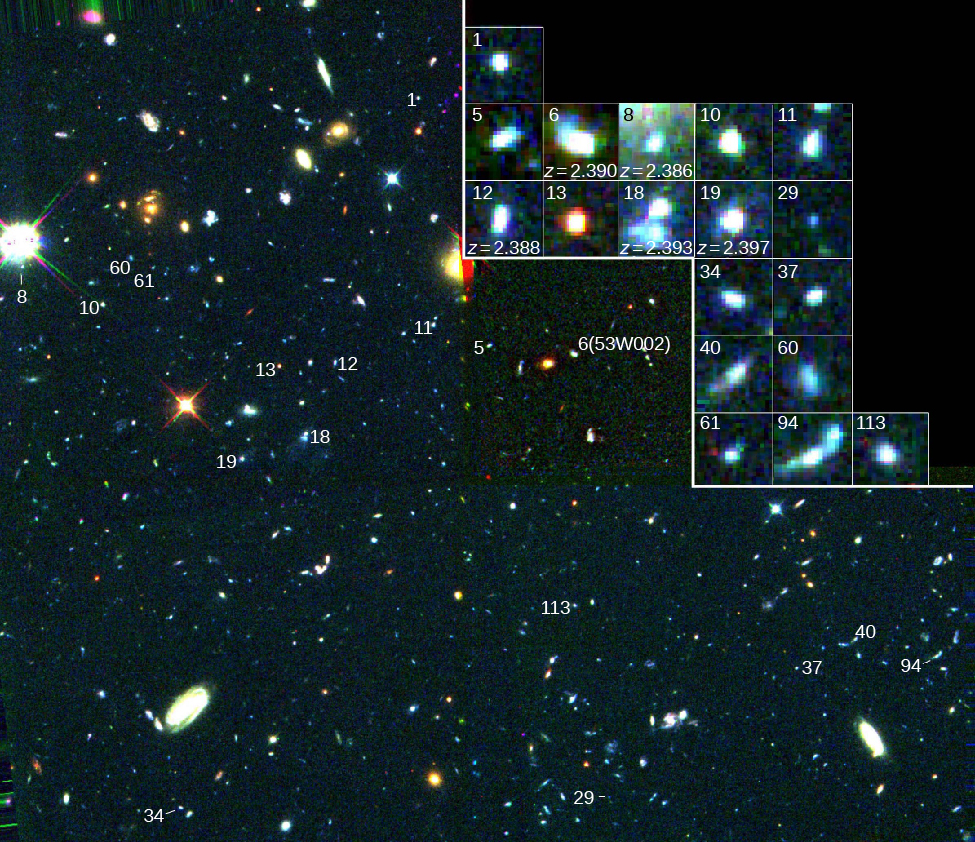
Although we do not have spectra for most of the faint galaxies, the Hubble Space Telescope has been used to study the shapes of a large number of very distant galaxies. It can do this because the images taken in space are not blurred by the Earth's atmosphere. To the surprise of astronomers, the distant galaxies did not fit Hubble’s classification scheme at all. Remember that Hubble found that nearly all nearby galaxies could be classified into a few categories, depending on whether they were ellipticals or spirals. The distant galaxies observed by the Hubble Space Telescope look very different from present-day galaxies, without identifiable spiral arms, disks, and bulges (Figure 28.5). They also tend to be much clumpier than most galaxies today. In other words, it’s becoming clear that the shapes of galaxies have changed significantly over time. In fact, we now know that the Hubble scheme works well for only the last half of the age of the universe. Before then, galaxies were much more chaotic.
英語のヒント
暗い銀河の大半についてはスペクトルを得られないが、ハッブル宇宙望遠鏡では、多数の非常に遠い銀河の形を調べてきた。宇宙で撮影した画像は地球の大気でぼやけないため、それができる。天文学者が驚いたことに、遠い銀河はハッブルの分類体系にまったく当てはまらなかった。ハッブルは、近くのほぼすべての銀河を、楕円銀河か渦巻銀河かなどに応じて、いくつかの種類に分けられると見いだしたことを思い出そう。しかし、ハッブル宇宙望遠鏡で観測した遠方の銀河は、現在の銀河とは大きく異なる。はっきり識別できる渦状腕、円盤、バルジがないのである(図28.5)。また、現在の大半の銀河より、ずっと塊だらけの姿をしていることが多い。言い換えれば、銀河の形は、時間とともに大きく変わったことが明らかになりつつある。実際、ハッブルの分類体系がよく働くのは、宇宙の歴史の後半だけだと、今ではわかっている。それ以前の銀河は、はるかに混沌としていた。
Early Galaxies.初期の銀河
credit: modification of work by Rogier Windhorst (Arizona State University) and NASA · NASA media use guidelines
Figure 28.5 This Hubble Space Telescope image shows what are probably “galaxies under construction” in the early universe. The boxes in this color image show enlargements of 18 groups of stars smaller than galaxies as we know them. All these objects emitted their light about 11 billion years ago. They are typically only about 2,000 light-years across, which is much smaller than the Milky Way, with its diameter of 100,000 light-years. These 18 objects are found in a region only 2 million light-years across and are close enough together that they will probably collide and merge to build one or more normal galaxies. (credit: modification of work by Rogier Windhorst (Arizona State University) and NASA)
図28.5 ハッブル宇宙望遠鏡の画像に写るのは、おそらく初期宇宙の「建設中の銀河」である。カラー画像の枠内は、現在よく知る銀河より小さい、18個の恒星集団の拡大像を示す。いずれも約110億年前に光を放出した。典型的な幅はわずか約2000光年で、直径10万光年の天の川銀河よりはるかに小さい。この18個の天体は、幅がわずか200万光年の領域にあり、互いに十分近い。そのため、おそらく衝突・合体し、一つ、あるいはいくつかの通常の銀河を作るだろう。(クレジット:Rogier Windhorst〔Arizona State University〕とNASAによる作品を改変)
It’s not just the shapes that are different. Nearly all the galaxies with red-shifts that correspond to 11 billion light-years or more—that is, galaxies that we are seeing when they were less than 3 billion years old—are extremely blue, indicating that they contain a lot of young stars and that star formation in them is occurring at a higher rate than in nearby galaxies. Observations also show that very distant galaxies are systematically smaller on average than nearby galaxies. Relatively few galaxies present before the universe was about 8 billion years old have masses greater than 1011 MSun. That’s 1/20 the mass of the Milky Way if we include its dark matter halo. Eleven billion years ago, there were only a few galaxies with masses greater than 1010 MSun. What we see instead seem to be small pieces or fragments of galactic material (Figure 28.6). When we look at galaxies that emitted their light 11 to 12 billion years ago, we now believe we are seeing the seeds of elliptical galaxies and of the central bulges of spirals. Over time, these smaller galaxies collided and merged to build up today’s large galaxies.
英語のヒント
違うのは形だけではない。110億光年以上に対応する赤方偏移を持つ銀河、つまり、30億歳に満たなかったころの姿を見ている銀河のほとんどは、極めて青い。これは、若い恒星を多く含み、近くの銀河よりも速いペースで星形成が起きていることを示す。観測によれば、非常に遠い銀河は、平均すると、近くの銀河より系統的に小さい。宇宙が約80億歳になる前に存在した銀河のうち、質量が1011 MSunを超えるものは比較的少ない。ダークマター・ハローまで含めた天の川銀河の質量の、20分の1である。110億年前には、1010 MSunを超える銀河は、ごく少数しかなかった。代わりに見えるのは、銀河を作る物質の小さな塊や断片のようである(図28.6)。現在では、110億〜120億年前に光を放出した銀河を観測するとき、私たちは楕円銀河や渦巻銀河の中心バルジの種を見ていると考えている。時間がたつにつれて、こうした小さい銀河が衝突し、合体して、現在の大きな銀河を作り上げたのである。
Bear in mind that stars that formed more than 11 billion years ago will be very old stars today. Indeed when we look nearby (at galaxies we see closer to our time), we find mostly old stars in the nuclear bulges of nearby spirals and in elliptical galaxies.
英語のヒント
110億年以上前に形成された星は、現在では非常に古い星になっていることを覚えておこう。実際、近くの銀河、つまり私たちの時代に近い姿が見える銀河を調べると、近くの渦巻銀河の中心バルジや楕円銀河には、主に古い恒星が見つかる。
Some of the Farthest, Faintest, and Smallest Galaxies Ever Seen.これまでに見つかった、最も遠く、暗く、小さい銀河の例
credit: modification of work by NASA, ESA, CSA, and STScI, M. Zamani (ESA/Webb), L. Hustak (STScI). Science: B. Robertson (UCSC), S. Tacchella (Cambridge), E. Curtis-Lake (Hertfordshire), S. Carniani (Scuola Normale Superiore), and the JADES Collaboration · CC BY 4.0
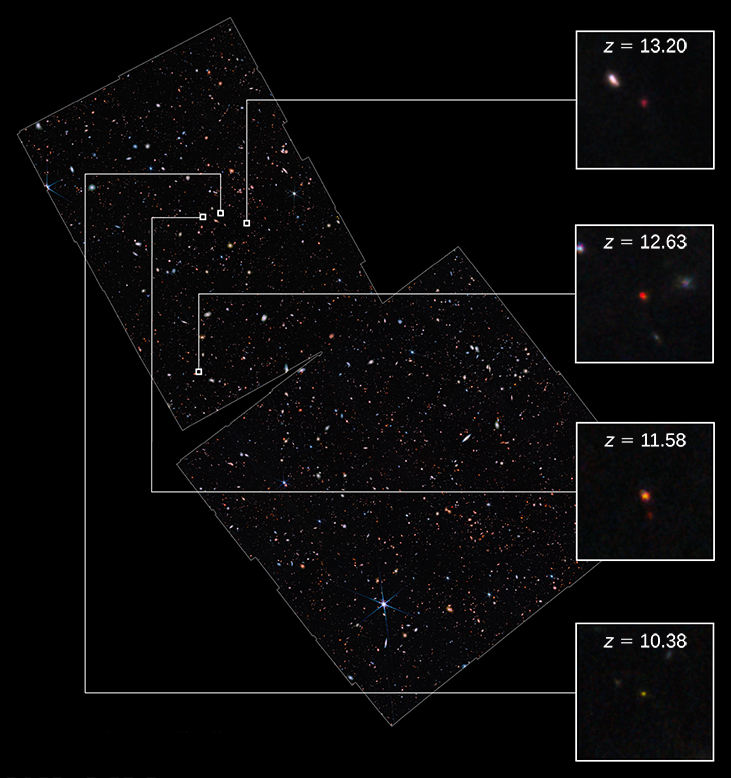
Figure 28.6 JWST has obtained spectra and measured redshifts showing that these four galaxies were formed at an unprecedentedly early epoch. All four were formed when the universe was no more than about 400 million years old. The most distant of these galaxies is the one shown at the top of the image, and it dates back to about 330 million years after the Big Bang, a time when the universe was only about 2 percent of its current age. The size of each galaxy’s redshift is denoted with the letter z in the diagram. These observations focused on the area in and around the Hubble Space Telescope’s Ultra Deep Field. For over 20 years, this small patch of sky has been the target of nearly all large telescopes, building an exceptionally sensitive data set spanning the full electromagnetic spectrum. Now Webb is adding its unique view, providing the faintest and sharpest images yet obtained. (credit: modification of work by NASA, ESA, CSA, and STScI, M. Zamani (ESA/Webb), L. Hustak (STScI). Science: B. Robertson (UCSC), S. Tacchella (Cambridge), E. Curtis-Lake (Hertfordshire), S. Carniani (Scuola Normale Superiore), and the JADES Collaboration)
図28.6 ジェイムズ・ウェッブ宇宙望遠鏡は、これら四つの銀河のスペクトルと赤方偏移を測定し、かつてないほど早い時代に形成されていたことを示した。どれも、宇宙が約4億歳を超えないころに形成されている。画像の一番上に示す最も遠い銀河は、ビッグバンから約3億3000万年後にさかのぼる。当時の宇宙の年齢は、現在のわずか約2%だった。図では、各銀河の赤方偏移の大きさをzという文字で示す。観測は、ハッブル宇宙望遠鏡のウルトラ・ディープ・フィールドと、その周辺に集中して行われた。この小さな空の領域は、20年以上にわたり、ほぼすべての大型望遠鏡の観測対象となり、電磁スペクトル全域にまたがる、非常に感度の高いデータが蓄積されている。今、ウェッブは独自の視点を加え、これまでで最も暗いものまで捉えた、最も鮮明な画像を提供している。(クレジット:NASA, ESA, CSA, STScI, M. Zamani〔ESA/Webb〕、L. Hustak〔STScI〕による作品を改変。科学研究:B. Robertson〔UCSC〕、S. Tacchella〔Cambridge〕、E. Curtis-Lake〔Hertfordshire〕、S. Carniani〔Scuola Normale Superiore〕、JADES Collaboration)
What such observations are showing us is that galaxies have grown in size as the universe has aged. Not only were galaxies smaller several billion years ago, but there were more of them; gas-rich galaxies, particularly the less luminous ones, were much more numerous then than they are today.
英語のヒント
こうした観測が示しているのは、宇宙が年を重ねるにつれて、銀河も大きくなってきたということである。数十億年前の銀河は、単に小さかっただけでなく、数も多かった。ガスに富む銀河、特に光度の低いものは、当時、現在よりはるかに多数あった。
Those are some of the basic observations we can make of individual galaxies (and their evolution) looking back in cosmic time. Now we want to turn to the larger context. If stars are grouped into galaxies, are the galaxies also grouped in some way? In the third section of this chapter, we’ll explore the largest structures known in the universe.
英語のヒント
ここまでが、宇宙の過去をさかのぼって、個々の銀河とその進化について行える基本的な観測の一部である。次は、もっと大きな背景へ目を向けよう。恒星が集まって銀河を作るなら、銀河も何らかの形で集まっているのだろうか。この章の第3節では、宇宙で知られている最大の構造を調べる。