第28章銀河の進化と分布The Evolution and Distribution of Galaxies
28.5 The Formation and Evolution of Galaxies and Structure in the Universe28.5 宇宙の銀河と構造の形成・進化
Learning Objectives学習の目標
By the end of this section, you will be able to:
この節を学ぶと、次のことができるようになる。
Summarize the main theories attempting to explain how individual galaxies formed
個々の銀河がどう形成されたかを説明しようとする、主な理論をまとめる。
Explain how tiny “seeds” of dark matter in the early universe grew by gravitational attraction over billions of years into the largest structures observed in the universe: galaxy clusters and superclusters, filaments, and voids
初期宇宙のダークマターの小さな「種」が、重力によって数十億年かけて成長し、銀河団、超銀河団、フィラメント、ボイドという、宇宙で観測される最大の構造になった過程を説明する。
As with most branches of natural science, astronomers and cosmologists always want to know the answer to the question, “How did it get that way?” What made galaxies and galaxy clusters, superclusters, voids, and filaments look the way they do? The existence of such large filaments of galaxies and voids is an interesting puzzle because we have evidence (to be discussed in The Big Bang) that the universe was extremely smooth even a few hundred thousand years after forming. The challenge for theoreticians is to understand how a nearly featureless universe changed into the complex and lumpy one that we see today. Armed with our observations and current understanding of galaxy evolution over cosmic time, dark matter, and large-scale structure, we are now prepared to try to answer that question on some of the largest possible scales in the universe. As we will see, the short answer to how the universe got this way is “dark matter + gravity + time.”
英語のヒント
自然科学の多くの分野と同じく、天文学者や宇宙論研究者は、いつも「どうしてそうなったのか」と問う。銀河、銀河団、超銀河団、ボイド、フィラメントを、今の姿にしたのは何だろうか。巨大な銀河フィラメントやボイドの存在は、興味深い謎である。なぜなら、宇宙は誕生から数十万年たっても極めて滑らかだったという証拠があるからだ。この証拠は「ビッグバン」で説明する。理論家の課題は、ほとんど特徴のない宇宙が、どうして現在の複雑で塊だらけの宇宙になったかを理解することである。銀河進化、ダークマター、大規模構造の観測と現在の理解を備えた今、宇宙の中でも最大級のスケールについて、この問いに答えようとする準備ができた。これから見るように、短い答えは「ダークマター+重力+時間」である。
How Galaxies Form and Grow銀河はどのように形成され、成長するか
We’ve already seen that galaxies were more numerous, but smaller, bluer, and clumpier, in the distant past than they are today, and that galaxy mergers play a significant role in their evolution. At the same time, we have observed quasars and galaxies that emitted their light when the universe was less than a billion years old—so we know that large condensations of matter had begun to form at least that early. We also saw in Active Galaxies, Quasars, and Supermassive Black Holes that many quasars are found in the centers of elliptical galaxies. This means that some of the first large concentrations of matter must have evolved into the elliptical galaxies that we see in today’s universe. It seems likely that the supermassive black holes in the centers of galaxies and the spherical distribution of ordinary matter around them formed at the same time and through related physical processes.
英語のヒント
すでに、遠い過去の銀河は現在より数が多いが、小さく、青く、塊が多かったことと、合体が銀河進化に重要な役割を果たすことを見てきた。同時に、宇宙が10億歳に達する前に光を放出したクエーサーや銀河も観測されている。したがって、少なくとも、それほど早い時期には、物質の大きな凝集が始まっていたとわかる。また、「活動銀河・クエーサー・超大質量ブラックホール」では、多くのクエーサーが楕円銀河の中心に見つかることを学んだ。これは、最初の大きな物質の集まりの一部が、現在の楕円銀河へ進化したはずだと示している。銀河中心の超大質量ブラックホールと、それを囲む球状分布の普通の物質は、同じ時期に、互いに関係する物理過程を通じて形成された可能性が高い。
Dramatic confirmation of that picture arrived only in the last two decades, when astronomers discovered a curious empirical relationship: as we saw in Active Galaxies, Quasars, and Supermassive Black Holes, the more massive a galaxy is, the more massive its central black hole is. Somehow, the black hole and the galaxy “know” enough about each other to match their growth rates.
英語のヒント
この見方を強く裏付ける発見が出たのは、ここ20年ほどのことである。天文学者は、奇妙な経験的関係を発見した。「活動銀河・クエーサー・超大質量ブラックホール」で見たように、銀河の質量が大きいほど、中心のブラックホールも重いのである。何らかの方法で、ブラックホールと銀河は互いのことを「知り」、成長率を合わせているように見える。
There have been two main types of galaxy formation models to explain all those observations. The first asserts that massive elliptical galaxies formed in a single, rapid collapse of gas and dark matter, during which virtually all the gas was turned quickly into stars. Afterward the galaxies changed only slowly as the stars evolved. This is what astronomers call a “top-down” scenario.
英語のヒント
これらの観測を説明する銀河形成モデルには、大きく二つの種類がある。第一のモデルでは、大質量の楕円銀河は、ガスとダークマターが一度に急速に崩壊して形成され、その間にガスのほぼすべてが、すばやく恒星へ変わったとする。その後、銀河は内部の恒星の進化とともに、ゆっくりとしか変わらなかった。天文学者は、これを「トップダウン」の筋書きと呼ぶ。
The second model suggests that today’s giant ellipticals were formed mostly through mergers of smaller galaxies that had already converted at least some of their gas into stars—a “bottom-up” scenario. In other words, astronomers have debated whether giant ellipticals formed most of their stars in the large galaxy that we see today or in separate small galaxies that subsequently merged.
英語のヒント
第二のモデルでは、現在の巨大楕円銀河は、すでにガスの少なくとも一部を恒星へ変えていた、小さな銀河の合体によって、主に形成されたとする。「ボトムアップ」の筋書きである。言い換えれば、巨大楕円銀河の星の大半は、現在見える大きな銀河の中でできたのか、それとも、後に合体する、別々の小さな銀河の中でできたのか。その点を天文学者は議論してきた。
Since we see some luminous quasars from when the universe was less than a billion years old, it is likely that at least some giant ellipticals began their evolution very early through the collapse of a single cloud. However, the best evidence also seems to show that mature giant elliptical galaxies like the ones we see nearby were rare before the universe was about 6 billion years old and that they are much more common today than they were when the universe was young. Observations also indicate that most of the gas in elliptical galaxies was converted to stars by the time the universe was about 3 billion years old, so it appears that elliptical galaxies have not formed many new stars since then. They are often said to be “red and dead”—that is, they mostly contain old, cool, red stars, and there is little or no new star formation going on.
英語のヒント
宇宙が10億歳未満のころの明るいクエーサーが見えるので、少なくとも一部の巨大楕円銀河は、非常に早くに、一つの雲の崩壊によって進化を始めた可能性が高い。しかし、最良の証拠は、近くに見えるような成熟した巨大楕円銀河は、宇宙が約60億歳になるまでは少なく、若い宇宙より現在のほうが、はるかに多いことも示すようである。また、観測によれば、楕円銀河のガスの大半は、宇宙が約30億歳になるまでに恒星へ変わった。そのため、それ以来、多数の新しい星は作られていないらしい。楕円銀河がしばしば「赤く、死んでいる」と言われるのは、このためである。つまり、主に古く低温の赤い星を含み、新たな星形成がほとんど、あるいはまったくないということだ。
These observations (when considered together) suggest that the giant elliptical galaxies that we see nearby formed from a combination of both top-down and bottom-up mechanisms, with the most massive galaxies forming in the densest clusters where both processes happened very early and quickly in the history of the universe.
英語のヒント
これらの観測を合わせて考えると、近くに見える巨大楕円銀河は、トップダウンとボトムアップを組み合わせて形成されたと考えられる。最も大質量の銀河は、最も密な銀河団で形成され、そこでは二つの過程が、宇宙の歴史の非常に早い時期に、すばやく進んだのである。
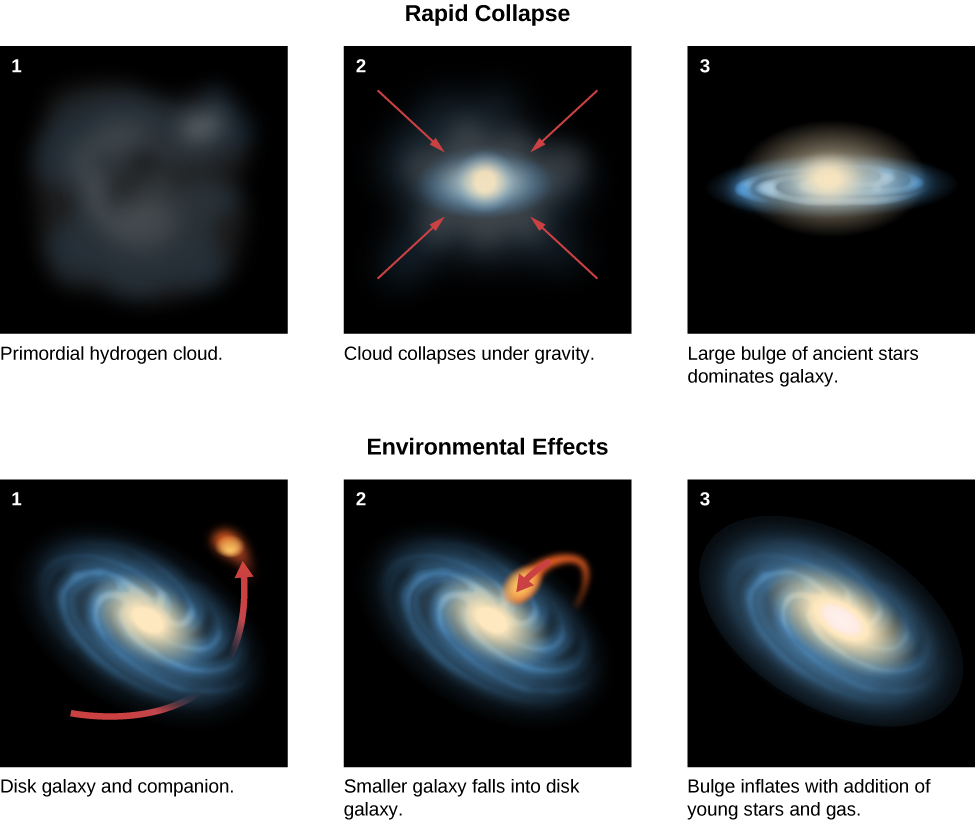
The situation with spiral galaxies is apparently very different. The bulges of these galaxies formed early, like the elliptical galaxies (Figure 28.27). However, the disks formed later (remember that the stars in the disk of the Milky Way are younger than the stars in the bulge and the halo) and still contain gas and dust. However, the rate of star formation in spirals today is about ten times lower than it was 8 billion years ago. The number of stars being formed drops as the gas is used up. So spirals seem to form mostly “bottom up” but over a longer time than ellipticals and in a more complex way, with at least two distinct phases.
英語のヒント
渦巻銀河では、どうやら事情が大きく異なる。バルジは、楕円銀河のように早い時期に形成された(図28.27)。しかし、円盤は後に形成され、現在もガスと塵を含む。天の川銀河の円盤の星は、バルジやハローの星より若いことを思い出そう。それでも、現在の渦巻銀河の星形成率は、80億年前の約10分の1である。ガスを使うにつれて、生まれる星の数は減る。したがって、渦巻銀河も主にボトムアップで作られるらしいが、楕円銀河より長い時間をかけ、少なくとも二つの異なる段階を持つ、より複雑な過程を経る。
Growth of Spiral Bulges.渦巻銀河のバルジの成長
OpenStax / Rice University · CC BY 4.0
Figure 28.27 The nuclear bulges of some spiral galaxies formed through the collapse of a single protogalactic cloud (top row). Others grew over time through mergers with other smaller galaxies (bottom row).
図28.27 一部の渦巻銀河の中心バルジは、一つの原始銀河雲が崩壊して形成された(上段)。ほかのものは、より小さな銀河との合体を重ね、時間とともに成長した(下段)。
Hubble’s classification sequence does not mean that elliptical galaxies are young and will eventually turn into spirals. In fact, as we saw above, it’s more likely the other way around: two spirals that crash together under their mutual gravity can turn into an elliptical.
英語のヒント
ハッブルの分類の並びは、楕円銀河が若く、やがて渦巻銀河になることを意味しない。実際には、前に見たように、逆のほうが起こりやすい。互いの重力によって衝突した二つの渦巻銀河が、楕円銀河になるのである。
Despite these advances in our understanding of how galaxies form and evolve, many questions remain. For example, it’s even possible, given current evidence, that spiral galaxies could lose their spiral arms and disks in a merger event, making them look more like an elliptical or irregular galaxy, and then regain the disk and arms again later if enough gas remains available. The story of how galaxies assume their final shapes is still being written as we learn more about galaxies and their environment.
英語のヒント
銀河の形成・進化の理解は進んだが、なお多くの問いが残る。例えば、現在の証拠からすれば、渦巻銀河が合体で渦状腕と円盤を失い、楕円銀河や不規則銀河に似た姿になった後、十分なガスさえ残っていれば、後になって円盤と腕を取り戻すことさえありうる。銀河が最終的な姿を得るまでの物語は、銀河とその環境について知識が増えるにつれ、今も書き進められている。