第28章銀河の進化と分布The Evolution and Distribution of Galaxies
The Local Group局所銀河群
The region of the universe for which we have the most detailed information is, as you would expect, our own local neighborhood. It turns out that the Milky Way Galaxy is a member of a small group of galaxies called, not too imaginatively, the Local Group. It is spread over about 3 million light-years and contains 60 or so members. There are three large spiral galaxies (our own, the Andromeda galaxy, and M33), two intermediate ellipticals, and many dwarf ellipticals and irregular galaxies.
英語のヒント
宇宙の中で最も詳しい情報があるのは、予想どおり、私たちの近所である。天の川銀河は、あまりひねりのない名前だが、「局所銀河群」と呼ばれる小さな銀河の集団の一員だとわかった。約300万光年に広がり、約60の銀河を含む。大きな渦巻銀河が三つ、すなわち天の川銀河、アンドロメダ銀河、M33があり、中くらいの楕円銀河が二つ、そして多数の矮小楕円銀河と不規則銀河がある。
New members of the Local Group are still being discovered. We mentioned in The Milky Way Galaxy a dwarf galaxy only about 80,000 light-years from Earth and about 50,000 light-years from the center of the galaxy that was discovered in 1994 in the constellation of Sagittarius. (This dwarf is actually venturing too close to the much larger Milky Way and will eventually be consumed by it.)
英語のヒント
局所銀河群の新しい仲間は、今も発見されている。「天の川銀河」では、1994年にいて座で発見された矮小銀河を紹介した。地球からわずか約8万光年、銀河中心から約5万光年しか離れていない。この矮小銀河は実際、はるかに大きい天の川銀河に近づきすぎており、最終的には食べられてしまうだろう。
Many of the recent discoveries have been made possible by the new generation of automated, sensitive, wide-field surveys, such as the Sloan Digital Sky Survey, that map the positions of millions of stars across most of the visible sky. By digging into the data with sophisticated computer programs, astronomers have turned up numerous tiny, faint dwarf galaxies that are all but invisible to the eye even in those deep telescopic images. These new findings may help solve a long-standing problem: the prevailing theories of how galaxies form predicted that there should be more dwarf galaxies around big galaxies like the Milky Way than had been observed—and only now do we have the tools to find these faint and tiny galaxies and begin to compare the numbers of them with theoretical predictions.
英語のヒント
近年の発見の多くを可能にしたのは、スローン・デジタル・スカイ・サーベイのような、新世代の自動化された、高感度で広視野の調査である。これらは、見える空の大半にわたり、何百万もの星の位置を地図にする。天文学者は、高度なコンピュータープログラムでデータを掘り下げ、非常に小さく暗い矮小銀河を多数見つけてきた。暗いものまで捉えた望遠鏡画像の中でさえ、目で見ただけでは、ほとんど識別できない銀河である。こうした発見は、長年の問題の解決に役立つかもしれない。銀河形成の有力な理論では、天の川銀河のような大きな銀河の周囲には、観測されていたより多くの矮小銀河があると予測されていた。ようやく今になって、この暗く小さい銀河を見つける手段がそろい、その数を理論予測と比べ始められるようになったのである。
Several new dwarf galaxies have also been found near the Andromeda galaxy. Such dwarf galaxies are difficult to find because they typically contain relatively few stars, and it is hard to distinguish them from the foreground stars in our own Milky Way.
英語のヒント
アンドロメダ銀河の近くでも、新しい矮小銀河がいくつか見つかっている。こうした銀河は、含まれる恒星が比較的少ないことが多く、手前にある天の川銀河の恒星と区別しにくいため、発見が難しい。
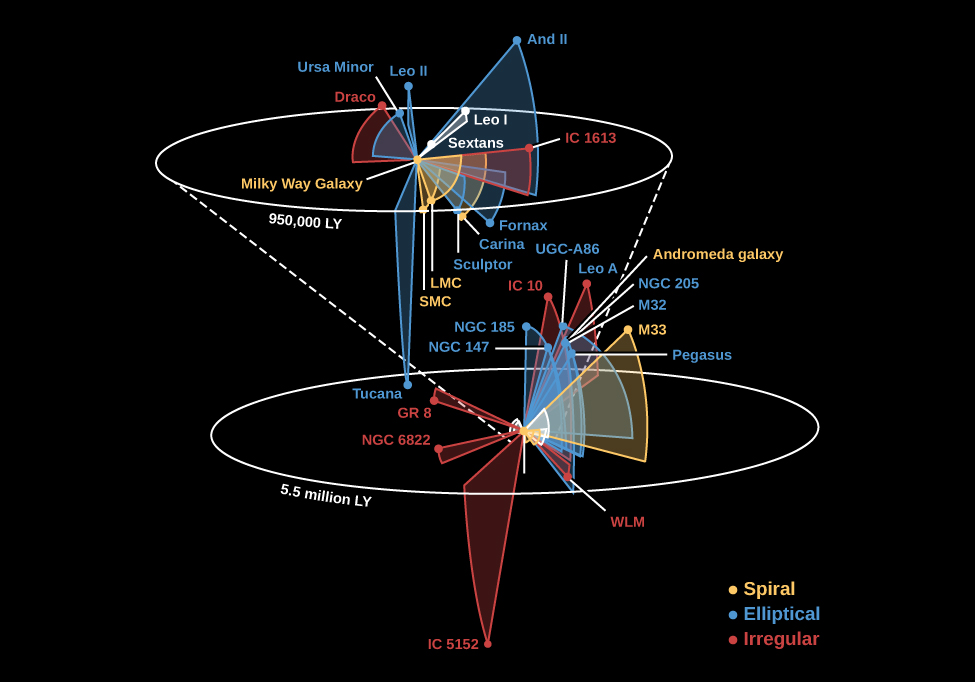
Figure 28.14 is a rough sketch showing where the brighter members of the Local Group are located. The average of the motions of all the galaxies in the Local Group indicates that its total mass is about 4 × 10¹² MSun, and at least half of this mass is contained in the two giant spirals—the Andromeda galaxy and the Milky Way Galaxy. And bear in mind that a substantial amount of the mass in the Local Group is in the form of dark matter.
英語のヒント
図28.14は、局所銀河群の明るい仲間がどこにあるかを示す概略図である。群のすべての銀河の運動を平均すると、全質量は約4 × 10¹² MSunと推定される。その少なくとも半分は、二つの巨大渦巻銀河、アンドロメダ銀河と天の川銀河に含まれる。局所銀河群の質量のかなりの部分が、ダークマターの形を取っていることも忘れないようにしよう。
Local Group.局所銀河群
OpenStax / Rice University · CC BY 4.0
Figure 28.14 This illustration shows some members of the Local Group of galaxies, with our Milky Way at the center. The exploded view at the top shows the region closest to the Milky Way and fits into the bigger view at the bottom as shown by the dashed lines. The three largest galaxies among the three dozen or so members of the Local Group are all spirals; the others are small irregular galaxies and dwarf ellipticals. A number of new members of the group have been found since this map was made.
図28.14 天の川銀河を中心に、局所銀河群の仲間の一部を示した図。上の拡大図は、天の川銀河に最も近い領域を示し、破線で示すように、下の広い範囲の図に収まる。約36の仲間のうち、最も大きな三つはいずれも渦巻銀河であり、ほかは小さな不規則銀河や矮小楕円銀河である。この地図が作られた後にも、新しい仲間が多数見つかっている。
Neighboring Groups and Clusters近隣の銀河群と銀河団
Small galaxy groups like ours are hard to notice at larger distances. However, there are much more substantial groups called galaxy clusters that are easier to spot even many millions of light-years away. Such clusters are described as poor or rich depending on how many galaxies they contain. Rich clusters have thousands or even tens of thousands of galaxies, although many of the galaxies are quite faint and hard to detect.
英語のヒント
局所銀河群のような小さな集団は、遠くでは見つけにくい。しかし、何百万光年も離れていても見つけやすい、ずっと大きな集団があり、銀河団と呼ばれる。含まれる銀河の数に応じて、銀河団は貧弱、または豊かと表現される。豊かな銀河団には、何千、時には何万もの銀河がある。ただし、その多くは非常に暗く、検出が難しい。
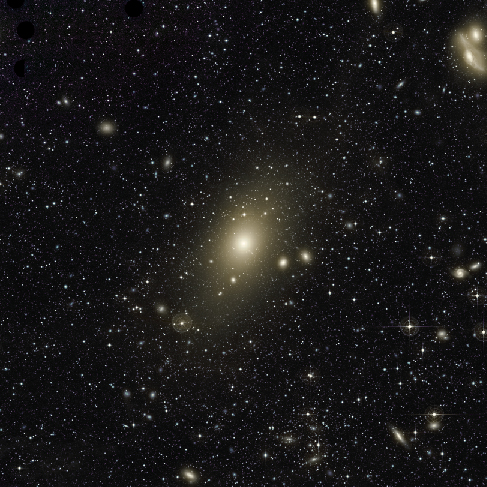
The nearest moderately rich galaxy cluster is called the Virgo Cluster, after the constellation in which it is seen. It is about 50 million light-years away and contains thousands of members, of which a few are shown in Figure 28.15. The giant elliptical (and very active) galaxy M87, which you came to know and love in the chapter on Active Galaxies, Quasars, and Supermassive Black Holes, belongs to the Virgo Cluster.
英語のヒント
適度に豊かな銀河団の中で最も近いものは、それが見える星座にちなんで、おとめ座銀河団と呼ばれる。約5000万光年先にあり、何千もの銀河を含む。その一部を図28.15に示す。「活動銀河・クエーサー・超大質量ブラックホール」の章で親しんだ巨大楕円銀河M87も、おとめ座銀河団の一員である。M87は非常に活動的な銀河でもある。
Central Region of the Virgo Cluster.おとめ座銀河団の中心部
credit: modification of work by Chris Mihos (Case Western Reserve University)/ESO · CC BY 4.0
Figure 28.15 Virgo is the nearest rich cluster and is at a distance of about 50 million light-years. It contains hundreds of bright galaxies. In this picture you can see only the central part of the cluster, including the giant elliptical galaxy M87, just below center. Other spirals and ellipticals are visible; the two galaxies to the top right are known as “The Eyes.” (credit: modification of work by Chris Mihos (Case Western Reserve University)/ESO)
図28.15 おとめ座銀河団は最も近い豊かな銀河団で、距離は約5000万光年である。明るい銀河を数百個含む。この写真に見えるのは中心部だけで、中央のやや下に巨大楕円銀河M87がある。他の渦巻銀河や楕円銀河も見え、右上の二つは「目」と呼ばれる。(クレジット:Chris Mihos〔Case Western Reserve University〕/ESOによる作品を改変)
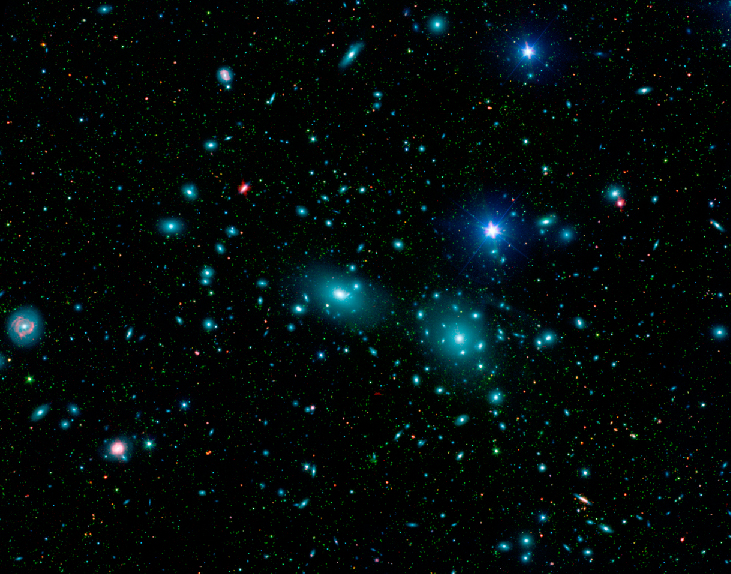
A good example of a cluster that is much larger than the Virgo complex is the Coma cluster, with a diameter of at least 10 million light-years (Figure 28.16). A little over 300 million light-years distant, this cluster is centered on two giant ellipticals whose luminosities equal about 400 billion Suns each. Thousands of galaxies have been observed in Coma, but the galaxies we see are almost certainly only part of what is really there. Dwarf galaxies are too faint to be seen at the distance of Coma, but we expect they are part of this cluster just as they are part of nearer ones. If so, then Coma likely contains tens of thousands of galaxies. The total mass of this cluster is about MSun (enough mass to make 4 million billion stars like the Sun).
英語のヒント
おとめ座銀河団の集まりより、ずっと大きい銀河団の例が、かみのけ座銀河団である。直径は少なくとも1000万光年ある(図28.16)。距離は3億光年あまりで、中心には、それぞれ太陽の約4000億倍の光度を持つ、二つの巨大楕円銀河がある。かみのけ座銀河団では、何千もの銀河が観測されている。しかし、見えているのは、実際にある銀河の一部にすぎないことが、ほぼ確実である。矮小銀河は、その距離では暗すぎて見えないが、近くの銀河団と同じように含まれると予想される。それが正しければ、かみのけ座銀河団には何万もの銀河があるのだろう。全質量は約 MSunであり、太陽のような星を400万×10億個作れるだけの質量に当たる。
Let’s pause here for a moment of perspective. We are now discussing numbers by which even astronomers sometimes feel overwhelmed. The Coma cluster may have 10, 20, or 30 thousand galaxies, and each galaxy has billions and billions of stars. If you were traveling at the speed of light, it would still take you more than 10 million years (longer than the history of the human species) to cross this giant swarm of galaxies. And if you lived on a planet on the outskirts of one of these galaxies, many other members of the cluster would be close enough to be noteworthy sights in your nighttime sky.
英語のヒント
少し立ち止まり、この規模を考えてみよう。ここで扱っている数は、天文学者でさえ、ときに圧倒されるほど大きい。かみのけ座銀河団には、1万、2万、あるいは3万もの銀河があるかもしれない。そして、一つ一つの銀河に、何十億、何百億もの恒星がある。光速で旅をしても、この巨大な銀河の群れを横切るのに、1000万年以上かかる。人類という種の歴史よりも長い。そして、その中のある銀河の外縁にある惑星に住んでいたなら、同じ銀河団の他の多くの銀河が、夜空で目を引く眺めになるほど近くに見えるだろう。
Central Region of the Coma Cluster.かみのけ座銀河団の中心部
credit: modification of work by NASA/JPL-Caltech/L. Jenkins (GSFC) · JPL image use policy
Figure 28.16 This combined visible-light (from the Sloan Digital Sky Survey) and infrared (from the Spitzer Space Telescope) image has been color coded so that faint dwarf galaxies are seen as green. Note the number of little green smudges on the image. The cluster is roughly 320 million light-years away from us. (credit: modification of work by NASA/JPL-Caltech/L. Jenkins (GSFC))
図28.16 スローン・デジタル・スカイ・サーベイの可視光画像と、スピッツァー宇宙望遠鏡の赤外線画像を合成し、暗い矮小銀河が緑色になるよう着色している。画像中の小さな緑のにじみが、いくつもあることに注目しよう。この銀河団までの距離は、約3億2000万光年である。(クレジット:NASA/JPL-Caltech/L. Jenkins〔GSFC〕による作品を改変)
Really rich clusters such as Coma usually have a high concentration of galaxies near the center. We can see giant elliptical galaxies in these central regions but few, if any, spiral galaxies. The spirals that do exist generally occur on the outskirts of clusters.
英語のヒント
かみのけ座銀河団のように非常に豊かな銀河団では、普通、中心近くに銀河が密集している。中心部には巨大楕円銀河が見えるが、渦巻銀河は、あったとしてもごくわずかである。存在する渦巻銀河は、一般に銀河団の外縁にある。
We might say that ellipticals are highly “social”: they are often found in groups and very much enjoy “hanging out” with other ellipticals in crowded situations. It is precisely in such crowds that collisions are most likely and, as we discussed earlier, we think that most large ellipticals are built through mergers of smaller galaxies.
英語のヒント
楕円銀河は、とても「社交的」だと言えるかもしれない。集団の中に見つかることが多く、混み合った場所で、他の楕円銀河と「つるむ」のを大いに楽しんでいるようである。まさに、こうした混雑した場所でこそ、衝突は起こりやすい。すでに述べたように、大きな楕円銀河の大半は、小さな銀河の合体で作られると考えられている。
Spirals, on the other hand, are more “shy”: they are more likely to be found in poor clusters or on the edges of rich clusters where collisions are less likely to disrupt the spiral arms or strip out the gas needed for continued star formation.
英語のヒント
その反対に、渦巻銀河は、もっと「内気」である。貧弱な銀河団や、豊かな銀河団の端のほうで見つかりやすい。そうした場所では、衝突が渦状腕を乱したり、星形成を続けるために必要なガスをはぎ取ったりする可能性が低いからである。