第28章銀河の進化と分布The Evolution and Distribution of Galaxies
28.2 Galaxy Mergers and Active Galactic Nuclei28.2 銀河の合体と活動銀河核
Learning Objectives学習の目標
By the end of this section, you will be able to:
この節を学ぶと、次のことができるようになる。
Explain how galaxies grow by merging with other galaxies and by consuming smaller galaxies (for lunch)
他の銀河との合体や、小さな銀河を「昼食にする」ことによって、銀河がどう成長するかを説明する。
Describe the effects that supermassive black holes in the centers of most galaxies have on the fate of their host galaxies
大半の銀河の中心にある超大質量ブラックホールが、母銀河の運命に及ぼす影響を説明する。
One of the conclusions astronomers have reached from studying distant galaxies is that collisions and mergers of whole galaxies play a crucial role in determining how galaxies acquired the shapes and sizes we see today. Only a few of the nearby galaxies are currently involved in collisions, but detailed studies of those tell us what to look for when we seek evidence of mergers in very distant and very faint galaxies. These in turn give us important clues about the different evolutionary paths galaxies have taken over cosmic time. Let’s examine in more detail what happens when two galaxies collide.
英語のヒント
遠方の銀河を調べた天文学者が得た結論の一つは、銀河全体の衝突と合体が、現在見られる形や大きさを得る過程で、決定的な役割を果たしたということである。近くの銀河で、現在衝突中のものは少ない。しかし、それらを詳しく調べれば、非常に遠く暗い銀河で合体の証拠を探すとき、何に注目すべきかがわかる。そして、それが、宇宙の歴史を通じて銀河がたどった、さまざまな進化の道筋を知る重要な手がかりとなる。二つの銀河が衝突すると何が起きるか、さらに詳しく見てみよう。
Mergers and Cannibalism合体と共食い
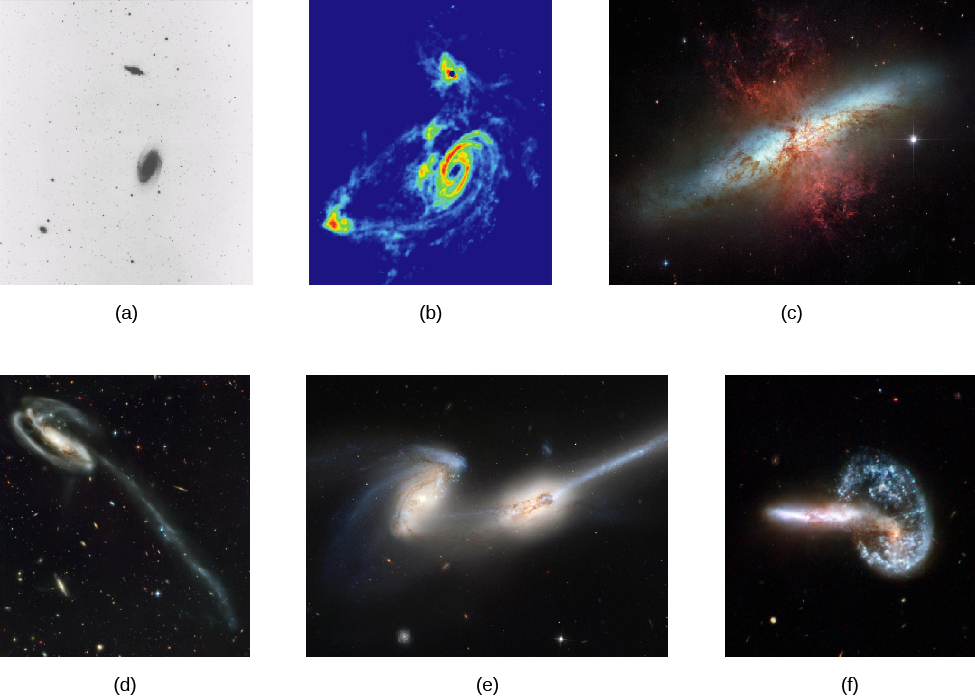
Figure 28.1 shows a dynamic view of two galaxies that are colliding. The stars themselves in this pair of galaxies will not be affected much by this cataclysmic event. (See the Astronomy Basics feature box Why Galaxies Collide but Stars Rarely Do.) Since there is a lot of space between the stars, a direct collision between two stars is very unlikely. However, the orbits of many of the stars will be changed as the two galaxies move through each other, and the change in orbits can totally alter the appearance of the interacting galaxies. A gallery of interesting colliding galaxies is shown in Figure 28.7. Great rings, huge tendrils of stars and gas, and other complex structures can form in such cosmic collisions. Indeed, these strange shapes are the signposts that astronomers use to identify colliding galaxies.
英語のヒント
図28.1は、二つの銀河の衝突を、迫力ある姿で示している。この激しい出来事でも、二つの銀河の恒星そのものは、あまり影響を受けない。「天文学の基礎:銀河は衝突するのに、恒星はめったに衝突しない理由」を参照しよう。恒星の間には大きな空間があるため、二つの星が直接衝突する可能性は非常に低い。しかし、二つの銀河が互いの中を通り抜けると、多数の恒星の軌道が変わる。その変化は、相互作用する銀河の外見を、すっかり変えてしまうことがある。図28.7には、興味深い衝突銀河の姿を集めてある。巨大な環、星やガスが長く伸びた巨大なつる状構造など、複雑な形が宇宙の衝突で作られる。実際、天文学者は、このような奇妙な形を、衝突銀河を見分ける目印として使う。
Gallery of Interacting Galaxies.相互作用する銀河のさまざまな姿
credit a, b: modification of work by NRAO/AUI; credit c: modification of work by NASA, ESA, and The Hubble Heritage Team (STScI/AURA); credit d, e: modification of work by NASA, H. Ford (JHU), G. Illingworth (UCSC/LO), M.Clampin (STScI), G. Hartig (STScI), the ACS Science Team, and ESA; credit f: modification of work by NASA, ESA, the Hubble Heritage (STScI/AURA)-ESA/Hubble Collaboration, and A. Evans (University of Virginia, Charlottesville/NRAO/Stony Brook University) · CC BY 4.0
Figure 28.7 (a and b) M82 (smaller galaxy at top) and M81 (spiral) are seen (a) in a black-and-white visible light image and (b) in radio waves given off by cold hydrogen gas. The hydrogen image shows that the two galaxies are wrapped in a common shroud of gas that is being tugged and stretched by the gravity of the two galaxies. (c) This close-up view by the Hubble Space Telescope shows some of the effects of this interaction on galaxy M82, including gas streaming outward (red tendrils) powered by supernovae explosions of massive stars formed in the burst of star formation that was a result of the collision. (d) Galaxy UGC 10214 (“The Tadpole”) is a barred spiral galaxy 420 million light-years from the Milky Way that has been disrupted by the passage of a smaller galaxy. The interloper’s gravity pulled out the long tidal tail, which is about 280,000 light-years long, and triggered bursts of star formation seen as blue clumps along the tail. (e) Galaxies NGC 4676 A and B are nicknamed “The Mice.” In this Hubble Space Telescope image, you can see the long, narrow tails of stars pulled away from the galaxies by the interactions of the two spirals. (f) Arp 148 is a pair of galaxies that are caught in the act of merging to become one new galaxy. The two appear to have already passed through each other once, causing a shockwave that reformed one into a bright blue ring of star formation, like the ripples from a stone tossed into a pond. (credit a, b: modification of work by NRAO/AUI; credit c: modification of work by NASA, ESA, and The Hubble Heritage Team (STScI/AURA); credit d, e: modification of work by NASA, H. Ford (JHU), G. Illingworth (UCSC/LO), M.Clampin (STScI), G. Hartig (STScI), the ACS Science Team, and ESA; credit f: modification of work by NASA, ESA, the Hubble Heritage (STScI/AURA)-ESA/Hubble Collaboration, and A. Evans (University of Virginia, Charlottesville/NRAO/Stony Brook University))
図28.7 (a・b)M82(上の小さい銀河)とM81(渦巻銀河)を、白黒の可視光画像(a)と、低温の水素ガスが放出する電波(b)で示す。水素の画像では、両銀河が共通のガスの覆いに包まれ、そのガスが二つの銀河の重力で引かれ、引き伸ばされている。(c)ハッブル宇宙望遠鏡による拡大像は、M82に及ぼされた相互作用の影響を示す。外へ流れ出す赤いつる状のガスも、その一つである。その動力源は、衝突による活発な星形成で誕生した大質量星の、超新星爆発である。(d)UGC 10214、通称「おたまじゃくし銀河」は、天の川銀河から4億2000万光年先にある棒渦巻銀河で、小さな銀河の通過によって乱された。侵入者の重力が、約28万光年もの長い潮汐尾を引き出し、活発な星形成を誘発した。その様子は、尾に沿う青い塊として見える。(e)NGC 4676 AとBは「ねずみ銀河」と呼ばれる。このハッブル画像では、二つの渦巻銀河の相互作用によって、銀河から引き出された恒星の細長い尾が見える。(f)Arp 148は、一つの新しい銀河へ合体している最中の二つの銀河である。すでに一度互いを通り抜けたようで、その衝撃波が片方を、星形成の起きる明るい青い環へ変えた。池へ石を投げ込んだ時の波紋に似ている。(a・bのクレジット:NRAO/AUIによる作品を改変。c:NASA, ESA, The Hubble Heritage Team〔STScI/AURA〕による作品を改変。d・e:NASA, H. Ford〔JHU〕、G. Illingworth〔UCSC/LO〕、M. Clampin〔STScI〕、G. Hartig〔STScI〕、ACS Science Team、ESAによる作品を改変。f:NASA, ESA, Hubble Heritage〔STScI/AURA〕-ESA/Hubble Collaboration、A. Evans〔University of Virginia, Charlottesville/NRAO/Stony Brook University〕による作品を改変)
The details of galaxy collisions are complex, and the process can take hundreds of millions of years. Thus, collisions are best simulated on a computer (Figure 28.8), where astronomers can calculate the slow interactions of stars, and clouds of gas and dust, via gravity. These calculations show that if the collision is slow, the colliding galaxies may coalesce to form a single galaxy.
英語のヒント
銀河衝突の詳しい過程は複雑で、数億年かかることもある。そのため、コンピューターによるシミュレーションが適している(図28.8)。これなら、恒星や、ガスと塵の雲が、重力を通じてゆっくり相互作用する様子を計算できる。計算によると、衝突がゆっくりなら、二つの銀河は一体化し、一つの銀河になる可能性がある。
Computer Simulation of a Galaxy Collision.銀河衝突のコンピューターシミュレーション
Figure 28.8 This computer simulation starts with two spiral galaxies merging and ends with a single elliptical galaxy. The colors show the colors of stars in the system; note the bursts of blue color as copious star formation gets triggered by the interaction. The timescale from start to finish in this sequence is about a billion years. (credit: modification of work by P. Jonsson (Harvard-Smithsonian Center for Astrophysics), G. Novak (Princeton University), and T. J. Cox (Carnegie Observatories))
図28.8 このコンピューターシミュレーションは、二つの渦巻銀河の合体から始まり、一つの楕円銀河で終わる。色は、系内の恒星の色を示す。相互作用で大量の星形成が誘発されると、青い色が一気に広がることに注目しよう。この一連の始まりから終わりまでの時間は、約10億年である。(クレジット:P. Jonsson〔Harvard-Smithsonian Center for Astrophysics〕、G. Novak〔Princeton University〕、T. J. Cox〔Carnegie Observatories〕による作品を改変)
When two galaxies of equal size are involved in a collision, we call such an interaction a merger (the term applied in the business world to two equal companies that join forces). But small galaxies can also be swallowed by larger ones—a process astronomers have called, with some relish, galactic cannibalism (Figure 28.9).
英語のヒント
同じ大きさの二つの銀河が衝突する場合、この相互作用を「合体」と呼ぶ。英語のmergerは、同じ規模の二つの企業が力を合わせる、ビジネス上の合併にも使われる言葉である。しかし、小さな銀河が大きな銀河にのみ込まれることもある。天文学者は、この過程を少し面白がって、「銀河の共食い」と呼んでいる(図28.9)。
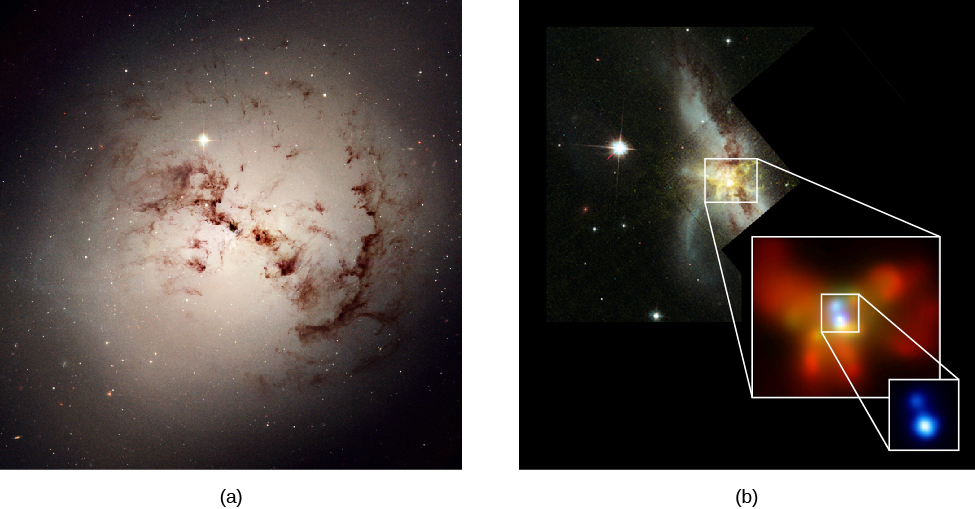
Galactic Cannibalism.銀河の共食い
credit a: modification of work by NASA, ESA, and The Hubble Heritage Team (STScI/AURA); credit b: X-ray: NASA/CXC/MPE/S.Komossa et al.; Optical: NASA/STScI/R.P.van der Marel & J.Gerssen · CC BY 4.0
Figure 28.9 (a) This Hubble image shows the eerie silhouette of dark dust clouds against the glowing nucleus of the elliptical galaxy NGC 1316. Elliptical galaxies normally contain very little dust. These clouds are probably the remnant of a small companion galaxy that was cannibalized (eaten) by NGC 1316 about 100 million years ago. (b) The highly disturbed galaxy NGC 6240, imaged by Hubble Space Telescope (background image) and Chandra X-ray Telescope (both insets) is apparently the product of a merger between two gas-rich spiral galaxies. The X-ray images show that there is not one but two nuclei, both glowing brightly in X-rays and separated by only 4000 light-years. These are likely the locations of two supermassive black holes that inhabited the cores of the two galaxies pre-merger; here they are participating in a kind of “death spiral,” in which the two black holes themselves will merge to become one. (credit a: modification of work by NASA, ESA, and The Hubble Heritage Team (STScI/AURA); credit b: X-ray: NASA/CXC/MPE/S.Komossa et al.; Optical: NASA/STScI/R.P.van der Marel & J.Gerssen)
図28.9 (a)ハッブルの画像では、楕円銀河NGC 1316の輝く中心核を背景に、暗い塵の雲が不気味な輪郭を浮かべる。通常、楕円銀河には塵がほとんどない。この雲は、おそらく約1億年前にNGC 1316に食べられた、小さな伴銀河の残骸である。(b)激しく乱されたNGC 6240を、ハッブル宇宙望遠鏡(背景)とチャンドラX線望遠鏡(二つの挿入図)で示す。この銀河は、ガスに富む二つの渦巻銀河が合体した結果らしい。X線画像には、一つではなく二つの核があり、ともにX線で明るく輝き、わずか4000光年しか離れていない。これらはおそらく、合体前の両銀河の中心核にあった、二つの超大質量ブラックホールの位置である。今や二つは、一種の「死のらせん」に入っており、ブラックホール自体も合体して一つになるだろう。(aのクレジット:NASA, ESA, The Hubble Heritage Team〔STScI/AURA〕による作品を改変。bのX線:NASA/CXC/MPE/S. Komossaほか。可視光:NASA/STScI/R. P. van der Marel, J. Gerssen)
The very large elliptical galaxies we discussed in Galaxies probably form by cannibalizing a variety of smaller galaxies in their clusters. These “monster” galaxies frequently possess more than one nucleus and have probably acquired their unusually high luminosities by swallowing nearby galaxies. The multiple nuclei are the remnants of their victims (Figure 28.9). Many of the large, peculiar galaxies that we observe also owe their chaotic shapes to past interactions. Slow collisions and mergers can even transform two or more spiral galaxies into a single elliptical galaxy.
英語のヒント
「銀河」で扱った非常に大きな楕円銀河は、おそらく、同じ銀河団のさまざまな小さい銀河を食べて形成される。こうした「怪物」銀河は、しばしば複数の核を持つ。近くの銀河をのみ込むことで、並外れて高い光度を得たのだろう。複数の核は、犠牲になった銀河の残骸である(図28.9)。観測される大きく特異な銀河の多くも、過去の相互作用によって、混沌とした形になった。ゆっくりした衝突と合体は、二つ以上の渦巻銀河を、一つの楕円銀河に変えてしまうことさえある。
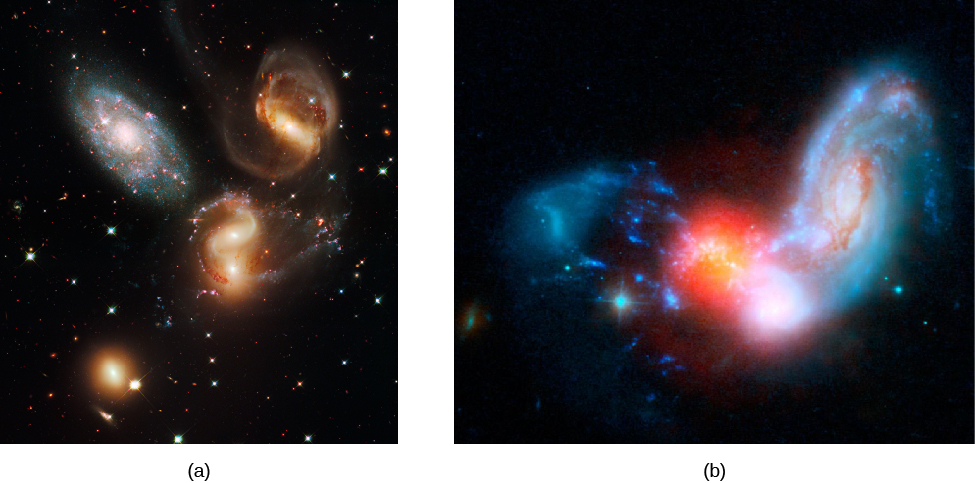
A change in shape is not all that happens when galaxies collide. If either galaxy contains interstellar matter, the collision can compress the gas and trigger an increase in the rate at which stars are being formed—by as much as a factor of 100. Astronomers call this abrupt increase in the number of stars being formed a starburst, and the galaxies in which the increase occurs are termed starburst galaxies (Figure 28.10). In some interacting galaxies, star formation is so intense that all the available gas is exhausted in only a few million years; the burst of star formation is clearly only a temporary phenomenon. While a starburst is going on, however, the galaxy where it is taking place becomes much brighter and much easier to detect at large distances.
英語のヒント
銀河衝突で起きるのは、形の変化だけではない。どちらかの銀河が星間物質を含むなら、衝突がガスを圧縮し、星形成率を最大で100倍にも高めることがある。天文学者は、新しく作られる星の数の急増を「スターバースト」と呼び、それが起きる銀河をスターバースト銀河と呼ぶ(図28.10)。相互作用する銀河の中には、あまりに激しく星を作るため、使えるガスをわずか数百万年で使い果たすものもある。したがって、この爆発的な星形成は、明らかに一時的な現象である。それでも、スターバーストが続く間、その銀河ははるかに明るくなり、遠くからでもずっと検出しやすくなる。
Starburst Associated with Colliding Galaxies.銀河衝突に伴うスターバースト
credit a: modification of work by NASA, ESA, and the Hubble SM4 ERO Team; credit b: modification of work by NASA/JPL-Caltech/STScI · JPL image use policy
Figure 28.10 (a) Three of the galaxies in the small group known as Stephan’s Quintet are interacting gravitationally with each other (the galaxy at upper left is actually much closer than the other three and is not part of this interaction), resulting in the distorted shapes seen here. Long strings of young, massive blue stars and hundreds of star formation regions glowing in the pink light of excited hydrogen gas are also results of the interaction. The ages of the star clusters range from 2 million to 1 billion years old, suggesting that there have been several different collisions within this group of galaxies, each leading to bursts of star formation. The three interacting members of Stephan’s Quintet are located at a distance of 270 million light-years. (b) Most galaxies form new stars at a fairly slow rate, but members of a rare class known as starburst galaxies blaze with extremely active star formation. The galaxy II Zw 096 is one such starburst galaxy, and this combined image using both Hubble and Spitzer Space Telescope data shows that it is forming bright clusters of new stars at a prodigious rate. The blue colors show the merging galaxies in visible light, while the red colors show infrared radiation from the dusty region where star formation is happening. This galaxy is at a distance of 500 million light-years and has a diameter of about 50,000 light-years, about half the size of the Milky Way. (credit a: modification of work by NASA, ESA, and the Hubble SM4 ERO Team; credit b: modification of work by NASA/JPL-Caltech/STScI)
図28.10 (a)ステファンの五つ子という小銀河群のうち、三つの銀河が重力的に相互作用し、ここに見られるゆがんだ形になっている。左上の銀河は、実際には他の三つよりずっと近く、この相互作用には加わっていない。若く大質量の青い星が長く連なっていることや、励起された水素ガスのピンク色の光で輝く数百の星形成領域も、相互作用の結果である。星団の年齢は200万歳から10億歳まで幅があり、この銀河群では、異なる衝突が何度も起き、そのたびに星形成が一気に進んだことを示唆する。相互作用している三つの銀河までの距離は、2億7000万光年である。(b)大半の銀河は比較的ゆっくりと新しい星を作るが、まれなスターバースト銀河の仲間は、極めて活発な星形成でまばゆく輝く。II Zw 096もその一つである。ハッブルとスピッツァーのデータを組み合わせた画像は、この銀河が驚異的な速さで、明るい新しい星団を作っていることを示す。青は合体する銀河の可視光、赤は星形成が起きる塵の多い領域からの赤外放射である。この銀河は5億光年先にあり、直径は約5万光年、天の川銀河の約半分である。(aのクレジット:NASA, ESA, Hubble SM4 ERO Teamによる作品を改変。b:NASA/JPL-Caltech/STScIによる作品を改変)
When astronomers finally had the tools to examine a significant number of galaxies that emitted their light 11 to 12 billion years ago, they found that these very young galaxies often resemble nearby starburst galaxies that are involved in mergers: they also have multiple nuclei and peculiar shapes, they are usually clumpier than normal galaxies today, with multiple intense knots and lumps of bright starlight, and they have higher rates of star formation than isolated galaxies. They also contain lots of blue, young, type O and B stars, as do nearby merging galaxies.
英語のヒント
110億〜120億年前に光を放出した銀河を、相当な数まで調べられるようになると、天文学者は、これらの非常に若い銀河が、合体中の近くのスターバースト銀河によく似ていると気付いた。遠い銀河も、複数の核や特異な形を持ち、現在の普通の銀河より、塊が多い傾向にある。強い星の光の結び目や塊がいくつもあり、孤立した銀河よりも星形成率が高い。また、近くの合体銀河と同じように、青く若いO型星やB型星を多数含んでいる。
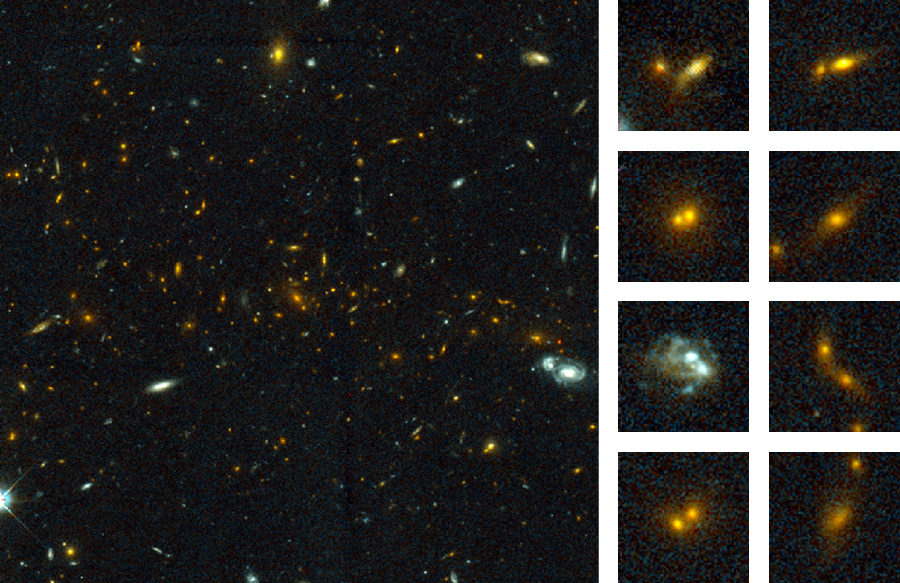
Galaxy mergers in today’s universe are rare. Only about five percent of nearby galaxies are currently involved in interactions. Interactions were much more common billions of years ago (Figure 28.11) and helped build up the “more mature” galaxies we see in our time. Clearly, interactions of galaxies have played a crucial role in their evolution.
英語のヒント
現在の宇宙では、銀河の合体はまれである。近くの銀河のうち、今、相互作用に関わっているのは約5%にすぎない。数十億年前には、相互作用はもっと頻繁に起こり(図28.11)、現在見られる「より成熟した」銀河を作り上げる助けとなった。銀河同士の相互作用が、その進化に決定的な役割を果たしてきたことは明らかである。
Collisions of Galaxies in a Distant Cluster.遠方の銀河団での銀河衝突
credit: modification of work by Pieter van Dokkum, Marijn Franx (University of Groningen/Leiden), ESA and NASA · NASA media use guidelines
Figure 28.11 The large picture on the left shows the Hubble Space Telescope image of a cluster of galaxies at a distance of about 8 billion light-years. Among the 81 galaxies in the cluster that have been examined in some detail, 13 are the result of recent collisions of pairs of galaxies. The eight smaller images on the right are close-ups of some of the colliding galaxies. The merger process typically takes a billion years or so. (credit: modification of work by Pieter van Dokkum, Marijn Franx (University of Groningen/Leiden), ESA and NASA)
図28.11 左の大きな画像は、約80億光年先の銀河団を、ハッブル宇宙望遠鏡が撮影したものである。ある程度詳しく調べた81個の銀河のうち、13個は最近の銀河同士の衝突の結果である。右の八つの小さい画像は、衝突中の銀河の一部の拡大像を示す。合体には、典型的に約10億年かかる。(クレジット:Pieter van Dokkum, Marijn Franx〔University of Groningen/Leiden〕、ESA、NASAによる作品を改変)