第28章銀河の進化と分布The Evolution and Distribution of Galaxies
Forming Galaxy Clusters, Superclusters, Voids, and Filaments銀河団、超銀河団、ボイド、フィラメントの形成
If individual galaxies seem to grow mostly by assembling smaller pieces together gravitationally over cosmic time, what about the clusters of galaxies and larger structures such as those seen in Figure 28.21? How do we explain the large-scale maps that show galaxies distributed on the walls of huge sponge- or bubble-like structures spanning hundreds of millions of light-years?
英語のヒント
個々の銀河が、主に小さい断片を重力で集め、宇宙の歴史を通じて成長するのだとすれば、図28.21のような銀河団や、もっと大きい構造はどうだろうか。何億光年にも広がる巨大なスポンジ状、あるいは泡状の構造の壁に銀河が分布する大規模な地図を、どう説明すればよいのだろうか。
As we saw, observations have found increasing evidence for concentrations, filaments, clusters, and superclusters of galaxies when the universe was less than 3 billion years old (Figure 28.28). This means that large concentrations of galaxies had already come together when the universe was less than a quarter as old as it is now.
すでに見たように、宇宙が30億歳に満たなかったころから、銀河の密集、フィラメント、銀河団、超銀河団があったという観測の証拠は増えている(図28.28)。つまり、宇宙の年齢が現在の4分の1に届く前には、銀河の大きな集まりが、すでにできていたことになる。
Merging Galaxies in a Distant Cluster.遠方の銀河団で合体する銀河
credit: modification of work by NASA/STScI/ESA/JPL-Caltech/McGill · JPL image use policy
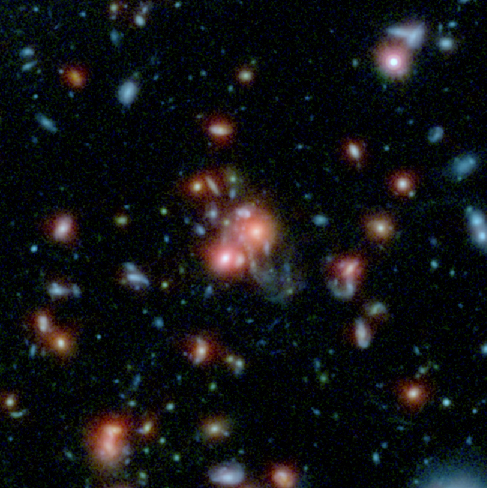
Figure 28.28 This Hubble image shows the core of one of the most distant galaxy clusters yet discovered, SpARCS 1049+56; we are seeing it as it was nearly 10 billion years ago. The surprise delivered by the image was the “train wreck” of chaotic galaxy shapes and blue tidal tails: apparently there are several galaxies right in the core that are merging together, the probable cause of a massive burst of star formation and bright infrared emission from the cluster. (credit: modification of work by NASA/STScI/ESA/JPL-Caltech/McGill)
図28.28 ハッブル画像は、発見された中でも特に遠い銀河団の一つ、SpARCS 1049+56の中心部を示す。私たちが見ているのは、約100億年前の姿である。画像がもたらした驚きは、銀河の混沌とした形と青い潮汐尾が作る、「列車事故」のような有様だった。中心部では、どうやら複数の銀河が合体しつつある。それが、大規模な星形成と、銀河団からの明るい赤外放射の原因なのだろう。(クレジット:NASA/STScI/ESA/JPL-Caltech/McGillによる作品を改変)
Almost all the currently favored models of how large-scale structure formed in the universe tell a story similar to that for individual galaxies: tiny dark matter “seeds” in the hot cosmic soup after the Big Bang grew by gravity into larger and larger structures as cosmic time ticked on (Figure 28.29). The final models we construct will need to be able to explain the size, shape, age, number, and spatial distribution of galaxies, clusters, and filaments—not only today, but also far back in time. Therefore, astronomers are working hard to measure and then to model those features of large-scale structure as accurately as possible. So far, a mixture of 5% normal atoms, 27% cold dark matter, and 68% dark energy seems to be the best way to explain all the evidence currently available (see The Big Bang).
英語のヒント
現在支持される宇宙の大規模構造形成モデルのほぼすべては、個々の銀河と似た歴史を描く。ビッグバン後の熱い宇宙のスープにあった、ダークマターの小さな「種」が、宇宙の時間の経過とともに、重力で次々と大きい構造へ育ったのである(図28.29)。最終的なモデルは、銀河、銀河団、フィラメントの大きさ、形、年齢、数、空間分布を説明できなければならない。現在の姿だけでなく、遠い過去についても説明する必要がある。そのため天文学者は、大規模構造のこうした特徴を、できる限り正確に測定し、モデル化しようとしている。今のところ、通常の原子5%、コールドダークマター27%、ダークエネルギー68%という組み合わせが、得られている証拠をすべて説明する最良の方法のようである。「ビッグバン」を参照しよう。
Growth of Large-Scale Structure as Calculated by Supercomputers.スーパーコンピューターで計算した大規模構造の成長
Figure 28.29 The boxes show how filaments and superclusters of galaxies grow over time, from a relatively smooth distribution of dark matter and gas, with few galaxies formed in the first 2 billion years after the Big Bang, to the very clumpy strings of galaxies with large voids today. Compare the last image in this sequence with the actual distribution of nearby galaxies shown in Figure 28.21. (credit: modification of work by CXC/MPE/V.Springel)
図28.29 箱は、銀河のフィラメントや超銀河団が時間とともに成長する様子を示す。ビッグバン後の最初の20億年には、少数の銀河が形成される中で、ダークマターとガスは比較的滑らかに分布していた。それが現在では、大きなボイドを隔てて、塊の多い銀河の連なりになっている。最後の画像を、図28.21の、実際の近くの銀河の分布と比べてみよう。(クレジット:CXC/MPE/V. Springelによる作品を改変)
The box at left is labeled “Big Bang,” the box at center is unlabeled and the box at right is labeled “Present”. A white arrow points from left to right representing the direction of time.
左の箱には「ビッグバン」、右の箱には「現在」と書かれ、中央の箱にはラベルがない。左から右を指す白い矢印が、時間の進む方向を示す。
Scientists even have a model to explain how a nearly uniform, hot “soup” of particles and energy at the beginning of time acquired the Swiss-cheese-like structure that we now see on the largest scales. As we will see in The Big Bang, when the universe was only a few hundred thousand years old, everything was at a temperature of a few thousand degrees. Theorists suggest that at that early time, all the hot gas was vibrating, much as sound waves vibrate the air of a nightclub with an especially loud band. This vibrating could have concentrated matter into high-density peaks and created emptier spaces between them. When the universe cooled, the concentrations of matter were “frozen in,” and galaxies ultimately formed from the matter in these high-density regions.
英語のヒント
研究者は、宇宙の始まりにあった、粒子とエネルギーのほぼ一様で熱い「スープ」が、最大のスケールで現在見られる、スイスチーズのような構造をどう得たかについても、モデルを持っている。「ビッグバン」で見るように、宇宙がまだ数十万歳のころ、すべては数千度の温度にあった。理論家は、その初期には、熱いガス全体が振動していたと考える。大音量のバンドが演奏するナイトクラブで、音波が空気を振動させるのに似ている。この振動が、物質を高密度の山へ集め、その間に、より空いた空間を作った可能性がある。宇宙が冷えると、物質の集中は「凍結」され、最終的には、その高密度領域の物質から銀河が形成された。
The Big Picture全体像
To finish this chapter, let’s put all these ideas together to tell a coherent story of how the universe came to look the way it does. Initially, as we said, the distribution of matter (both luminous and dark) was nearly, but not quite exactly, smooth and uniform. That “not quite” is the key to everything. Here and there were lumps where the density of matter (both luminous and dark) was ever so slightly higher than average.
英語のヒント
この章の締めくくりに、ここまでの考えを組み合わせ、宇宙がどう現在の姿になったかを、一貫した物語としてたどろう。初め、物質の分布は、光るものもダークマターも、ほぼ滑らかで一様だった。しかし、完全にそうだったわけではない。この「完全ではない」ことが、すべての鍵である。所々に、光る物質もダークマターも、密度が平均よりほんのわずかに高い塊があった。
Initially, each individual lump expanded because the whole universe was expanding. However, as the universe continued to expand, the regions of higher density acquired still more mass because they exerted a slightly larger than average gravitational force on surrounding material. If the inward pull of gravity was high enough, the denser individual regions ultimately stopped expanding. They then began to collapse into irregularly shaped blobs (that’s the technical term astronomers use!). In many regions the collapse was more rapid in one direction, so the concentrations of matter were not spherical but came to resemble giant clumps, pancakes, and rope-like filaments—each much larger than individual galaxies.
英語のヒント
初め、それぞれの塊は、宇宙全体の膨張とともに広がった。しかし、宇宙が膨張し続ける中、高密度の領域は、周囲の物質へ平均より少し強い重力を及ぼし、さらに質量を集めた。内向きの重力が十分に強ければ、高密度の領域は、やがて膨張を止めた。その後、それらは不規則な塊へと崩壊し始めた。英語のblob、つまり「塊」は、天文学者が使う専門用語でもある。多くの領域では、一つの方向へ速く崩壊したため、物質は球形にはならず、巨大な塊、パンケーキ、ロープ状のフィラメントに似た形になった。どれも個々の銀河より、はるかに大きい。
These elongated clumps existed throughout the early universe, oriented in different directions and collapsing at different rates. The clumps provided the framework for the large-scale filamentary and bubble-like structures that we see preserved in the universe today.
英語のヒント
これらの細長い塊は、初期宇宙の至るところにあり、異なる方向を向き、異なる速さで崩壊していた。それが、現在の宇宙に残る、大規模な糸状・泡状構造の骨組みを与えたのである。
The universe then proceeded to “build itself” from the bottom up. Within the clumps, smaller structures formed first, then merged to build larger ones, like Lego pieces being put together one by one to create a giant Lego metropolis. The first dense concentrations of matter that collapsed were the size of small dwarf galaxies or globular clusters—which helps explain why globular clusters are the oldest things in the Milky Way and most other galaxies. These fragments then gradually assembled to build galaxies, galaxy clusters, and, ultimately, superclusters of galaxies.
英語のヒント
その後、宇宙はボトムアップで「自分を組み立てて」いった。塊の中で、まず小さな構造ができ、それらが合体して大きな構造を作った。レゴの部品を一つずつ組み合わせ、巨大なレゴ都市を作るようなものである。最初に崩壊した密な物質の集まりは、小さい矮小銀河や球状星団ほどの大きさだった。これは、球状星団が天の川銀河や大半の銀河で、最も古いものになっている理由の説明に役立つ。その後、これらの断片が徐々に集まり、銀河、銀河団、そして最終的には超銀河団を作った。
According to this picture, small galaxies and large star clusters first formed in the highest density regions of all—the filaments and nodes where the pancakes intersect—when the universe was about two percent of its current age. Some stars may have formed even before the first star clusters and galaxies came into existence. Some galaxy-galaxy collisions triggered massive bursts of star formation, and some of these led to the formation of black holes. In that rich, crowded environment, black holes found constant food and grew in mass. The development of massive black holes then triggered quasars and other active galactic nuclei whose powerful outflows of energy and matter shut off the star formation in their host galaxies. The early universe must have been an exciting place!
英語のヒント
この描像によれば、小さい銀河と大きな星団は、宇宙が現在の年齢の約2%だったころ、最も密度の高い領域で初めて形成された。パンケーキ状構造が交わる、フィラメントと結節点である。最初の星団や銀河が存在する前にも、いくつかの恒星は形成されていたかもしれない。銀河同士の衝突の一部は、大規模な星形成を誘発し、その中にはブラックホールの形成につながるものもあった。物質が豊富で混み合う環境で、ブラックホールは絶えず餌を得て重くなった。その大質量ブラックホールの成長が、クエーサーやその他の活動銀河核を生み出した。そこからの強いエネルギーと物質の流出が、母銀河の星形成を止めたのである。初期宇宙は、さぞ刺激的な場所だったに違いない。
Clusters of galaxies then formed as individual galaxies congregated, drawn together by their mutual gravitational attraction (Figure 28.30). First, a few galaxies came together to form groups, much like our own Local Group. Then the groups began combining to form clusters and, eventually, superclusters. This model predicts that clusters and superclusters should still be in the process of gathering together, and observations do in fact suggest that clusters are still gathering up their flocks of galaxies and collecting more gas as it flows in along filaments. In some instances we even see entire clusters of galaxies merging together.
英語のヒント
次に、個々の銀河が互いの重力で引き合って集まり、銀河団が形成された(図28.30)。初めは少数の銀河が集まって、局所銀河群のような銀河群を作った。その後、銀河群が結び付き、銀河団、そして超銀河団になった。このモデルは、銀河団や超銀河団が現在も集まる途中にあるはずだと予測する。実際、観測は、銀河団が今も銀河の群れを集め、フィラメントに沿って流れ込むガスを取り込んでいることを示唆する。銀河団全体が、別の銀河団と合体する例さえ見られる。
Formation of Cluster of Galaxies.銀河団の形成
OpenStax / Rice University · CC BY 4.0
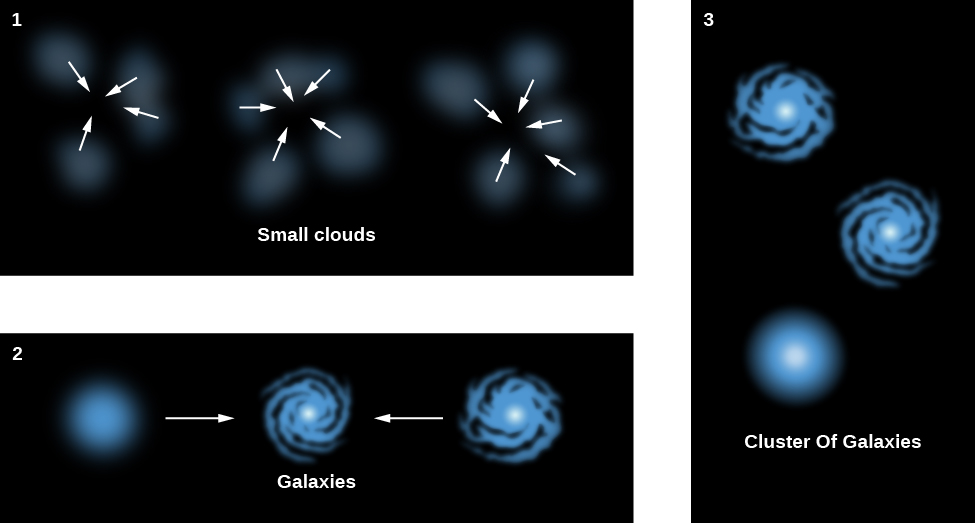
Figure 28.30 This schematic diagram shows how galaxies might have formed if small clouds formed first and then congregated to form galaxies and then clusters of galaxies.
図28.30 この模式図は、まず小さい雲が形成され、それらが集まって銀河となり、さらに銀河団となった場合に、どのように形成が進みうるかを示す。
Most giant elliptical galaxies formed through the collision and merger of many smaller fragments. Some spiral galaxies may have formed in relatively isolated regions from a single cloud of gas that collapsed to make a flattened disk, but others acquired additional stars, gas, and dark matter through collisions, and the stars acquired through these collisions now populate their halos and bulges. As we have seen, our Milky Way is still capturing small galaxies and adding them to its halo, and probably also pulling fresh gas from these galaxies into its disk.
英語のヒント
巨大楕円銀河の大半は、多数の小さい断片の衝突・合体によって形成された。一部の渦巻銀河は、比較的孤立した領域で、一つのガス雲が崩壊して平たい円盤を作り、形成されたのかもしれない。ほかの渦巻銀河は、衝突を通じて星、ガス、ダークマターを追加で得た。そうして取り込んだ星が、現在のハローやバルジを満たしている。すでに見たように、天の川銀河も今なお小さい銀河を捕らえ、ハローへ加えている。おそらく、それらの銀河から新しいガスを円盤へ引き込んでもいる。