第26章銀河Galaxies
Thinking Aheadまず考えてみよう
Spiral Galaxy.渦巻銀河
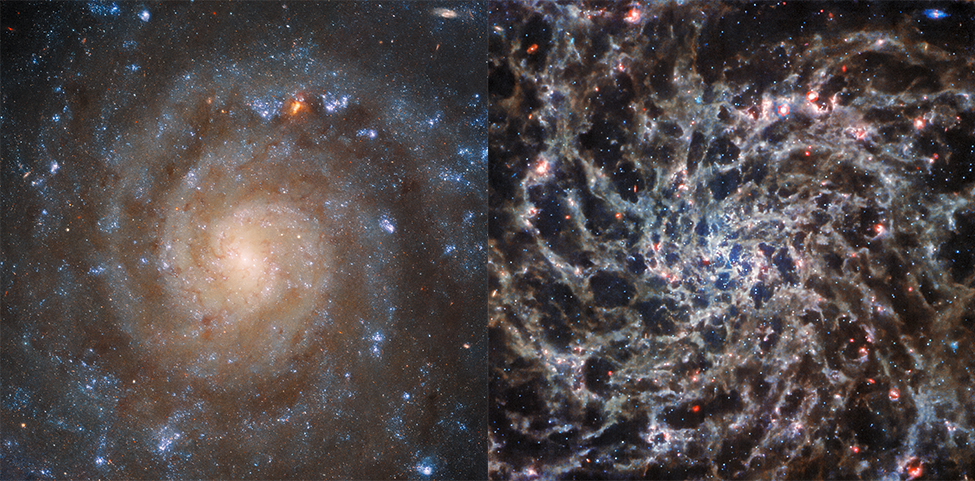
credit: modification of work by ESA/Webb, NASA & CSA, J. Lee and the PHANGS-JWST and PHANGS-HST Teams · CC BY 4.0
Figure 26.1 Known by its catalog number IC5332, this spiral galaxy, seen nearly face on, is about 30 million light-years away in the constellation of Sculptor. On the left, we see a visible light and ultraviolet image taken with the Hubble Space Telescope. The glow comes mainly from bright stars, organized into a grand spiral shape, with lanes of dust showing as dark regions among the shining stars. On the right, the same galaxy is seen with the James Webb Space Telescope’s Mid-Infrared Instrument, which operates at a temperature of only 7 degrees above absolute zero. In this wavelength range, the dust is transparent, and we see mainly tangles of stars that are cooler, older, and dimmer than our Sun. Note the far greater complexity in the galaxy’s spiral structure in this image. (credit: modification of work by ESA/Webb, NASA & CSA, J. Lee and the PHANGS-JWST and PHANGS-HST Teams)
英語のヒント
図26.1 カタログ番号IC5332で知られるこの渦巻銀河は、ほぼ正面から見えており、ちょうこくしつ座の方向、約3000万光年の距離にある。左はハッブル宇宙望遠鏡で撮影した可視光・紫外線画像である。主に明るい星々が壮大な渦巻模様に並んで輝き、輝く星々の間では塵の帯が暗い領域として見えている。右は、ジェイムズ・ウェッブ宇宙望遠鏡の中間赤外線観測装置で見た同じ銀河である。この装置は絶対零度よりわずか7度高い温度で動作する。この波長域では塵を透かして見ることができ、主に太陽より低温で古く、暗い星々が複雑に絡み合った姿が見える。この画像で銀河の渦巻構造がどれほど複雑になっているか、注目してほしい。(クレジット:ESA/Webb、NASA & CSA、J. Lee、PHANGS-JWSTおよびPHANGS-HST Teamsの作品を改変)
In the last chapter, we explored our own Galaxy. But is it the only one? If there are others, are they like the Milky Way? How far away are they? Can we see them? As we shall learn, some galaxies turn out to be so far away that it has taken billions of years for their light to reach us. These remote galaxies can tell us what the universe was like when it was young.
英語のヒント
前章では、私たちの天の川銀河を探った。しかし、銀河はこれ一つだけなのだろうか。ほかにもあるなら、天の川銀河に似ているのだろうか。どれほど遠くにあり、私たちにも見ることができるのだろうか。これから学ぶように、銀河の中にはあまりに遠いため、その光が私たちに届くまで何十億年もかかるものがある。こうした遠方の銀河は、若かったころの宇宙がどのような姿だったかを教えてくれる。
In this chapter, we start our exploration of the vast realm of galaxies. Like tourists from a small town making their first visit to the great cities of the world, we will be awed by the beauty and variety of the galaxies. And yet, we will recognize that much of what we see is not so different from our experiences at home, and we will be impressed by how much we can learn by looking at structures built long ago.
英語のヒント
この章では、広大な銀河の世界の探検を始める。小さな町から初めて世界の大都市へ出かけた旅行者のように、私たちは銀河の美しさと多様さに圧倒されるだろう。それでも、目にするものの多くが、故郷での経験とそれほど違わないことにも気づくはずだ。そして、遠い昔にできた構造を調べることで、どれほど多くを学べるのかに感銘を受けるだろう。
We begin our voyage with a guide to the properties of galaxies, much as a tourist begins with a guidebook to the main features of the cities on the itinerary. In later chapters, we will look more carefully at the past history of galaxies, how they have changed over time, and how they acquired their many different forms. First, we’ll begin our voyage through the galaxies with the question: is our Galaxy the only one?
英語のヒント
旅人が行程に入っている都市の見どころをガイドブックで調べるように、私たちも銀河の性質の案内から旅を始めよう。後の章では、銀河の過去の歴史を、時間とともにどう変わってきたか、そして多種多様な形をどのように得たかという点まで、さらに詳しく見ていく。まずは「私たちの天の川銀河が唯一の銀河なのか」という問いから、銀河をめぐる旅に出発しよう。