第26章銀河Galaxies
Elliptical Galaxies楕円銀河
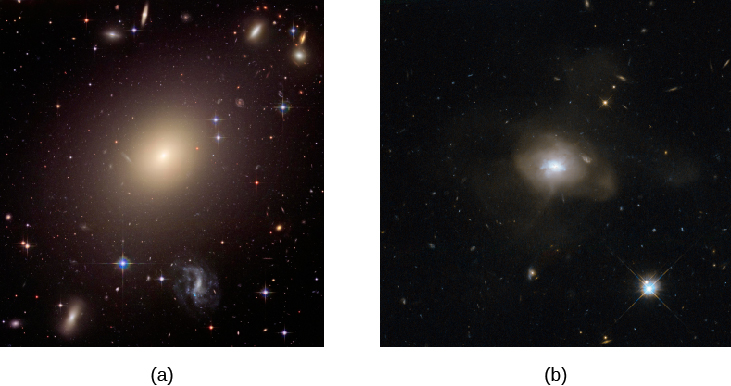
Elliptical galaxies consist almost entirely of old stars and have shapes that are spheres or ellipsoids (somewhat squashed spheres) (Figure 26.7). They contain no trace of spiral arms. Their light is dominated by older reddish stars (the population II stars discussed in The Milky Way Galaxy). In the larger nearby ellipticals, many globular clusters can be identified. Dust and emission nebulae are not conspicuous in elliptical galaxies, but many do contain a small amount of interstellar matter.
英語のヒント
楕円銀河はほとんどすべて古い星からなり、球や楕円体、つまり少し押しつぶした球の形をしている(図26.7)。渦状腕の痕跡はない。光の大部分を担うのは、古い赤みを帯びた星である。「天の川銀河」の章で扱った種族IIの星に当たる。近くにある比較的大きな楕円銀河では、多数の球状星団を見分けられる。塵や輝線星雲は目立たないが、少量の星間物質を含む楕円銀河は多い。
Elliptical Galaxies.楕円銀河
credit a: modification of work by NASA, ESA, and The Hubble Heritage Team (STScI/AURA); credit b: modification of work by ESA/Hubble, NASA · CC BY 4.0
Figure 26.7 (a) ESO 325-G004 is a giant elliptical galaxy. Other elliptical galaxies can be seen around the edges of this image. (b) This elliptical galaxy probably originated from the collision of two spiral galaxies. (credit a: modification of work by NASA, ESA, and The Hubble Heritage Team (STScI/AURA); credit b: modification of work by ESA/Hubble, NASA)
図26.7 (a)ESO 325-G004は巨大楕円銀河である。画像の端の付近にも、ほかの楕円銀河が見えている。(b)この楕円銀河は、おそらく二つの渦巻銀河の衝突から生じた。(クレジットa:NASA、ESA、Hubble Heritage Team(STScI/AURA)の作品を改変。b:ESA/Hubble、NASAの作品を改変)
Elliptical galaxies show various degrees of flattening, ranging from systems that are approximately spherical to those that approach the flatness of spirals. The rare giant ellipticals (for example, ESO 325-G004 in Figure 26.7) reach luminosities of 1011 LSun. The mass in a giant elliptical can be as large as 1013 MSun. The diameters of these large galaxies extend over several hundred thousand light-years and are considerably larger than the largest spirals. Although individual stars orbit the center of an elliptical galaxy, the orbits are not all in the same direction, as occurs in spirals. Therefore, ellipticals don’t appear to rotate in a systematic way, making it difficult to estimate how much dark matter they contain.
英語のヒント
楕円銀河の平たさにはさまざまな程度があり、ほぼ球形のものから、渦巻銀河の平たさに近づくものまである。数は少ないが、巨大楕円銀河――たとえば図26.7のESO 325-G004――の光度は1011 LSunに達する。質量は1013 MSunにもなり得る。こうした大型銀河の直径は数十万光年に及び、最大の渦巻銀河よりもかなり大きい。個々の星は楕円銀河の中心を回っているが、渦巻銀河の場合のように軌道の向きがそろってはいない。そのため、楕円銀河は全体として整然と回転しているようには見えず、含まれる暗黒物質の量を推定しにくい。
We find that elliptical galaxies range all the way from the giants, just described, to dwarfs, which may be the most common kind of galaxy. Dwarf ellipticals (sometimes called dwarf spheroidals) escaped our notice for a long time because they are very faint and difficult to see. The luminosity of this typical dwarf is about equal to that of the brightest globular clusters.
英語のヒント
楕円銀河には、今述べた巨大なものから、銀河の中で最も数が多い種類かもしれない矮小なものまで、幅広い大きさがある。矮小楕円銀河は、矮小楕円体銀河とも呼ばれることがある。非常に暗く見つけにくいため、長い間見過ごされていた。典型的な矮小銀河の光度は、最も明るい球状星団とほぼ同じである。
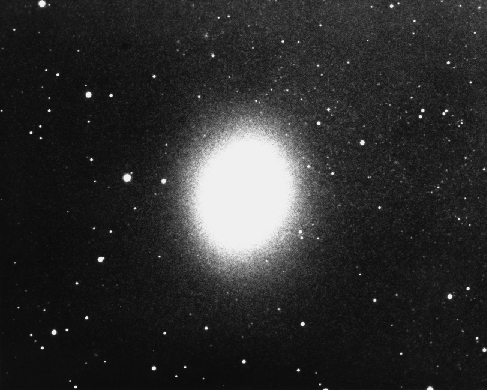
Intermediate between the giant and dwarf elliptical galaxies are systems such as M32 (see Figure 26.8) and M110, the two companions of the Andromeda galaxy. While they are often referred to as dwarf ellipticals, these galaxies can be significantly larger than the typical dwarf galaxies.
英語のヒント
巨大楕円銀河と矮小楕円銀河の中間に位置するのが、アンドロメダ銀河に伴う二つの銀河M32(図26.8)とM110のような天体である。これらも矮小楕円銀河と呼ばれることが多いが、典型的な矮小銀河よりもかなり大きい場合がある。
Dwarf Elliptical Galaxy.矮小楕円銀河
credit: NOAO/AURA/NSF · CC BY 4.0
Figure 26.8 M32, a dwarf elliptical galaxy and one of the companions to the giant Andromeda galaxy M31. M32 is a dwarf by galactic standards, as it is only 2400 light-years across. (credit: NOAO/AURA/NSF)
図26.8 矮小楕円銀河M32。巨大なアンドロメダ銀河M31に伴う銀河の一つである。直径はわずか2400光年なので、銀河の尺度では矮小といえる。(クレジット:NOAO/AURA/NSF)
Irregular Galaxies不規則銀河
Hubble classified galaxies that do not have the regular shapes associated with the categories we just described into the catchall bin of an irregular galaxy, and we continue to use his term. Typically, irregular galaxies have lower masses and luminosities than spiral galaxies. Irregular galaxies often appear disorganized, and many are undergoing relatively intense star formation activity. They contain both young population I stars and old population II stars.
英語のヒント
ハッブルは、ここまで説明した種類の整った形を持たない銀河を、ひとまとめに「不規則銀河」という分類に入れた。現在もこの呼び名が使われている。通常、不規則銀河の質量と光度は渦巻銀河より小さい。不規則銀河はまとまりのない姿に見えることが多く、その多くで比較的激しい星形成活動が起きている。若い種族Iの星と、古い種族IIの星の両方を含んでいる。
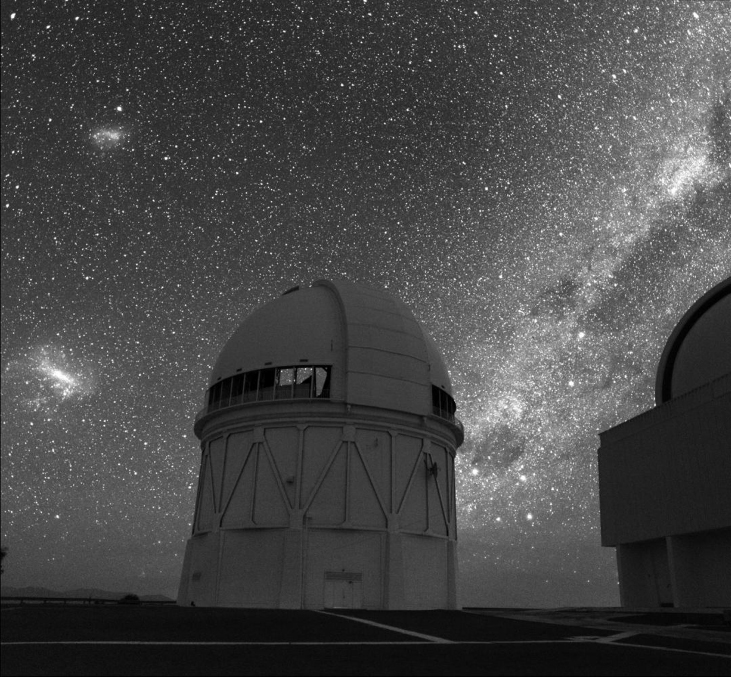
The two best-known irregular galaxies are the Large Magellanic Cloud and Small Magellanic Cloud (Figure 26.9), which are at a distance of a little more than 160,000 light-years away and are among our nearest extragalactic neighbors. Their names reflect the fact that Ferdinand Magellan and his crew, making their round-the-world journey, were the first European travelers to notice them. Although not visible from the United States and Europe, these two systems are prominent from the Southern Hemisphere, where they look like wispy clouds in the night sky. Since they are only about one-tenth as distant as the Andromeda galaxy, they present an excellent opportunity for astronomers to study nebulae, star clusters, variable stars, and other key objects in the setting of another galaxy. For example, the Large Magellanic Cloud contains the 30 Doradus complex (also known as the Tarantula Nebula), one of the largest and most luminous groups of supergiant stars known in any galaxy.
英語のヒント
最もよく知られた二つの不規則銀河は、大マゼラン雲と小マゼラン雲である(図26.9)。16万光年を少し超える距離にあり、銀河系外の天体としては最も近い隣人の仲間に入る。名称は、世界一周の航海をしていたフェルディナンド・マゼランと船員たちが、ヨーロッパの旅行者として初めてその存在に気づいたことに由来する。アメリカやヨーロッパからは見えないが、南半球では夜空の薄い雲のように、よく目立つ。アンドロメダ銀河の約10分の1という近さなので、別の銀河という環境の中で、星雲・星団・変光星などの重要な天体を調べる絶好の機会を天文学者に与えてくれる。たとえば大マゼラン雲には、かじき座30複合領域、別名タランチュラ星雲がある。どの銀河にあるものと比べても、知られている中で特に大きく光度の高い超巨星の集まりの一つである。
4-Meter Telescope at Cerro Tololo Inter-American Observatory Silhouetted against the Southern Sky.南の星空を背景にシルエットを見せる、セロ・トロロ汎米天文台の4メートル望遠鏡
credit: Roger Smith/NOAO/AURA/NSF · CC BY 4.0
Figure 26.9 The Milky Way is seen to the right of the dome, and the Large and Small Magellanic Clouds are seen to the left. (credit: Roger Smith/NOAO/AURA/NSF)
図26.9 ドームの右側に天の川、左側に大マゼラン雲と小マゼラン雲が見えている。(クレジット:Roger Smith/NOAO/AURA/NSF)
The Small Magellanic Cloud is considerably less massive than the Large Magellanic Cloud, and it is six times longer than it is wide. This narrow wisp of material points directly toward our Galaxy like an arrow. The Small Magellanic Cloud was most likely contorted into its current shape through gravitational interactions with the Milky Way. A large trail of debris from this interaction between the Milky Way and the Small Magellanic Cloud has been strewn across the sky and is seen as a series of gas clouds moving at abnormally high velocity, known as the Magellanic Stream. We will see that this kind of interaction between galaxies will help explain the irregular shapes of this whole category of small galaxies,
英語のヒント
小マゼラン雲の質量は大マゼラン雲よりかなり小さく、長さは幅の6倍ある。この細長い物質のかけらは、矢のように天の川銀河の方向をまっすぐ指している。現在の形にゆがめられたのは、おそらく天の川銀河との重力的な相互作用による。天の川銀河と小マゼラン雲の相互作用で生じた大量の残骸は、長い尾となって空に散らばっている。それは異常に高速で動く一連のガス雲として観測され、マゼラニック・ストリームと呼ばれる。この種の銀河同士の相互作用が、不規則銀河という小さな銀河の仲間全体の形を説明する手がかりになることを、後で見ていく。
Galaxy Evolution銀河の進化
Encouraged by the success of the H-R diagram for stars (see Analyzing Starlight), astronomers studying galaxies hoped to find some sort of comparable scheme, where differences in appearance could be tied to different evolutionary stages in the life of galaxies. Wouldn’t it be nice if every elliptical galaxy evolved into a spiral, for example, just as every main-sequence star evolves into a red giant? Several simple ideas of this kind were tried, some by Hubble himself, but none stood the test of time (and observation).
英語のヒント
恒星のH–R図が成功を収めたことに励まされ(「星の光を分析する」を参照)、銀河を研究する天文学者も、似たような分類の枠組みを見つけたいと考えた。見た目の違いを、銀河の一生の異なる進化段階に結び付けられるような枠組みである。たとえば、主系列星が赤色巨星に進化するように、どの楕円銀河も渦巻銀河へ進化するのだとしたら、分かりやすいだろう。この種の単純な考えがいくつか試され、中にはハッブル自身が提案したものもあった。しかし、時間と観測による検証に耐えたものは、一つもなかった。
Because no simple scheme for evolving one type of galaxy into another could be found, astronomers then tended to the opposite point of view. For a while, most astronomers thought that all galaxies formed very early in the history of the universe and that the differences between them had to do with the rate of star formation. Ellipticals were those galaxies in which all the interstellar matter was converted rapidly into stars. Spirals were galaxies in which star formation occurred slowly over the entire lifetime of the galaxy. This idea turned out to be too simple as well.
英語のヒント
ある型の銀河が別の型へ変わる単純な仕組みが見つからなかったため、天文学者は反対の見方に傾いていった。しばらくの間、大部分の天文学者は、すべての銀河が宇宙の歴史のごく初期に形成され、その違いは星形成の速さに関わると考えた。楕円銀河では、星間物質がすべて急速に星へ変わった。渦巻銀河では、銀河の一生を通じて、星の形成がゆっくり進んだというのである。この考えもまた、単純すぎることが分かった。
Today, we understand that at least some galaxies have changed types over the billions of years since the universe began. As we shall see in later chapters, collisions and mergers between galaxies may dramatically change spiral galaxies into elliptical galaxies. Even isolated spirals (with no neighbor galaxies in sight) can change their appearance over time. As they consume their gas, the rate of star formation will slow down, and the spiral arms will gradually become less conspicuous. Over long periods, spirals therefore begin to look more like the galaxies at the middle of Figure 26.6 (which astronomers refer to as S0 types).
英語のヒント
現在では、少なくとも一部の銀河は、宇宙が始まってからの何十億年もの間に種類を変えてきたと分かっている。後の章で見るように、銀河どうしの衝突や合体は、渦巻銀河を楕円銀河へと大きく変えることがある。近隣に別の銀河が見当たらない孤立した渦巻銀河でも、時とともに姿を変えうる。ガスを使い尽くしていくにつれ、星形成の速度は低下し、渦状腕も徐々に目立たなくなる。そのため、長い時間がたつと、渦巻銀河は図26.6の中央にある銀河に似た姿になっていく。天文学者はこれらをS0型と呼ぶ。
Over the past several decades, the study of how galaxies evolve over the lifetime of the universe has become one of the most active fields of astronomical research. We will discuss the evolution of galaxies in more detail in The Evolution and Distribution of Galaxies, but let’s first see in a little more detail just what different galaxies are like.
英語のヒント
この数十年で、宇宙の歴史を通して銀河がどのように進化するかという研究は、天文学で最も活発な分野の一つになった。銀河の進化は「銀河の進化と分布」で詳しく扱うが、まずは種類の違う銀河がどのようなものなのか、もう少し詳しく見ていこう。