第26章銀河Galaxies
26.2 Types of Galaxies26.2 銀河の種類
Learning Objectives学習の目標
By the end of this section, you will be able to:
この節を読み終えると、次のことができるようになる。
Describe the properties and features of elliptical, spiral, and irregular galaxies
楕円銀河・渦巻銀河・不規則銀河の性質と特徴を説明する。
Explain what may cause a galaxy’s appearance to change over time
時間とともに銀河の見た目が変わる原因として、何が考えられるか説明する。
Having established the existence of other galaxies, Hubble and others began to observe them more closely—noting their shapes, their contents, and as many other properties as they could measure. This was a daunting task in the 1920s when obtaining a single photograph or spectrum of a galaxy could take a full night of tireless observing. Today, larger telescopes and electronic detectors have made this task less difficult, although observing the most distant galaxies (those that show us the universe in its earliest phases) still requires enormous effort.
英語のヒント
ほかの銀河が存在することを確立したハッブルらは、その銀河をさらに詳しく観測し始めた。形や構成内容に加え、測定できる性質をできるだけ多く記録したのである。1920年代には、これは気の遠くなるような仕事だった。銀河の写真やスペクトルを一つ得るだけでも、一晩中、休みなく観測しなければならないことがあった。現在では、大型望遠鏡と電子検出器のおかげで、この仕事は以前ほど難しくない。それでも、最も遠い銀河――宇宙のごく初期の姿を見せてくれる銀河――の観測には、今なお途方もない努力が必要である。
The first step in trying to understand a new type of object is often simply to describe it. Remember, the first step in understanding stellar spectra was simply to sort them according to appearance (see Analyzing Starlight). As it turns out, the biggest and most luminous galaxies come in one of two basic shapes: either they are flatter and have spiral arms, like our own Galaxy, or they appear to be elliptical (blimp- or cigar-shaped). Many smaller galaxies, in contrast, have an irregular shape.
英語のヒント
新しい種類の天体を理解しようとするとき、最初の一歩は、まずその姿を記述することという場合が多い。恒星のスペクトルを理解する際も、最初の一歩は見た目に従って分類することだったのを思い出してほしい(「星の光を分析する」を参照)。調べてみると、特に大きく光度の高い銀河の基本的な形は二つに分かれた。私たちの銀河のように平たく、渦状腕を持つものと、楕円形、つまり飛行船や葉巻のような形に見えるものである。それに対して、小さい銀河の多くは不規則な形をしている。
Spiral Galaxies渦巻銀河
Our own Galaxy and the Andromeda galaxy are typical, large spiral galaxies (see Figure 26.2). They consist of a central bulge, a halo, a disk, and spiral arms. Interstellar material is usually spread throughout the disks of spiral galaxies. Bright emission nebulae and hot, young stars are present, especially in the spiral arms, showing that new star formation is still occurring. The disks are often dusty, which is especially noticeable in those systems that we view almost edge on (Figure 26.4).
英語のヒント
天の川銀河とアンドロメダ銀河は、典型的な大型の渦巻銀河である(図26.2)。中心のバルジ、ハロー、円盤、渦状腕から構成される。渦巻銀河では通常、星間物質が円盤全体に広がっている。特に渦状腕には、明るい輝線星雲と高温で若い星があり、星の形成が今も起こっていることを示す。円盤は塵を多く含むことが多く、ほぼ真横から見る銀河では、とりわけそれが目立つ(図26.4)。
Spiral Galaxies.渦巻銀河
Figure 26.4 (a) The spiral arms of M100, shown here, are bluer than the rest of the galaxy, indicating young, high-mass stars and star-forming regions. (b) We view this spiral galaxy, NGC 4565, almost exactly edge on, and from this angle, we can see the dust in the plane of the galaxy; it appears dark because it absorbs the light from the stars in the galaxy. (credit a: modification of work by Hubble Legacy Archive, NASA, ESA, and Judy Schmidt; credit b: modification of work by “Jschulman555”/ Wikimedia)
英語のヒント
図26.4 (a)ここに示したM100の渦状腕は、銀河のほかの部分より青い。若い大質量星と星形成領域があることを示している。(b)この渦巻銀河NGC 4565は、ほぼ完全に真横から見えている。この角度では、銀河の円盤面にある塵が見える。塵が銀河内の星の光を吸収するため、暗く見えるのである。(クレジットa:Hubble Legacy Archive、NASA、ESA、Judy Schmidtの作品を改変。b:「Jschulman555」/ Wikimediaの作品を改変)
In galaxies that we see face on, the bright stars and emission nebulae make the arms of spirals stand out like those of a pinwheel on the fourth of July. Open star clusters can be seen in the arms of nearer spirals, and globular clusters are often visible in their halos. Spiral galaxies contain a mixture of young and old stars, just as the Milky Way does. All spirals rotate, and the direction of their spin is such that the arms appear to trail much like the wake of a boat.
英語のヒント
正面から見える渦巻銀河では、明るい星と輝線星雲によって渦状腕が際立つ。アメリカの7月4日の祝祭に見られる風車花火のような姿である。近い渦巻銀河の腕には散開星団が見え、ハローには球状星団が見えることも多い。渦巻銀河には、天の川銀河と同じように若い星と古い星が混在している。どの渦巻銀河も回転しており、その回転方向に対して、腕は船の航跡のように後ろへたなびいて見える。
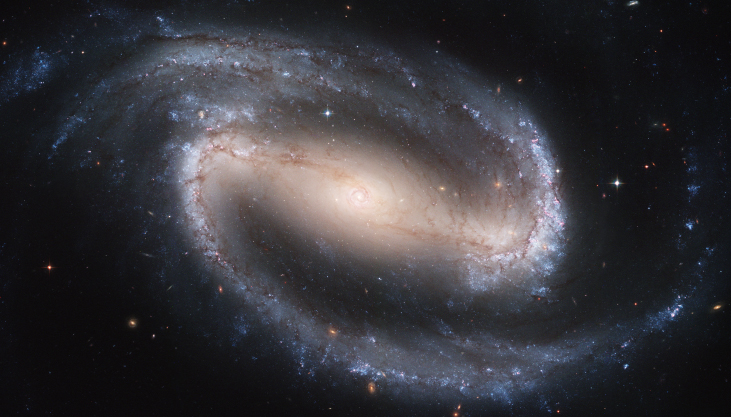
About two-thirds of the nearby spiral galaxies have boxy or peanut-shaped bars of stars running through their centers (Figure 26.5). Showing great originality, astronomers call these galaxies barred spirals.
英語のヒント
近くにある渦巻銀河のおよそ3分の2には、中心を貫く、箱形やピーナツ形の星の棒状構造がある(図26.5)。天文学者は、実に独創性を発揮して、こうした銀河を「棒渦巻銀河」と呼んでいる。
Barred Spiral Galaxy.棒渦巻銀河
credit: NASA, ESA, and the Hubble Heritage Team(STScI/AURA) · CC BY 4.0
Figure 26.5 NGC 1300, shown here, is a barred spiral galaxy. Note that the spiral arms begin at the ends of the bar. (credit: NASA, ESA, and the Hubble Heritage Team(STScI/AURA))
図26.5 ここに示すNGC 1300は棒渦巻銀河である。渦状腕が棒の両端から始まっていることに注目してほしい。(クレジット:NASA、ESA、Hubble Heritage Team(STScI/AURA))
As we noted in The Milky Way Galaxy chapter, our Galaxy has a modest bar too (see Figure 25.10). The spiral arms usually begin from the ends of the bar. The fact that bars are so common suggests that they are long lived; it may be that most spiral galaxies form a bar at some point during their evolution.
英語のヒント
「天の川銀河」の章で述べたように、私たちの銀河にも控えめな棒状構造がある(図25.10)。渦状腕は通常、棒の両端から始まる。棒状構造がこれほどありふれているという事実は、それが長く存続することを示唆する。大部分の渦巻銀河が、その進化のどこかの段階で棒状構造を作るのかもしれない。
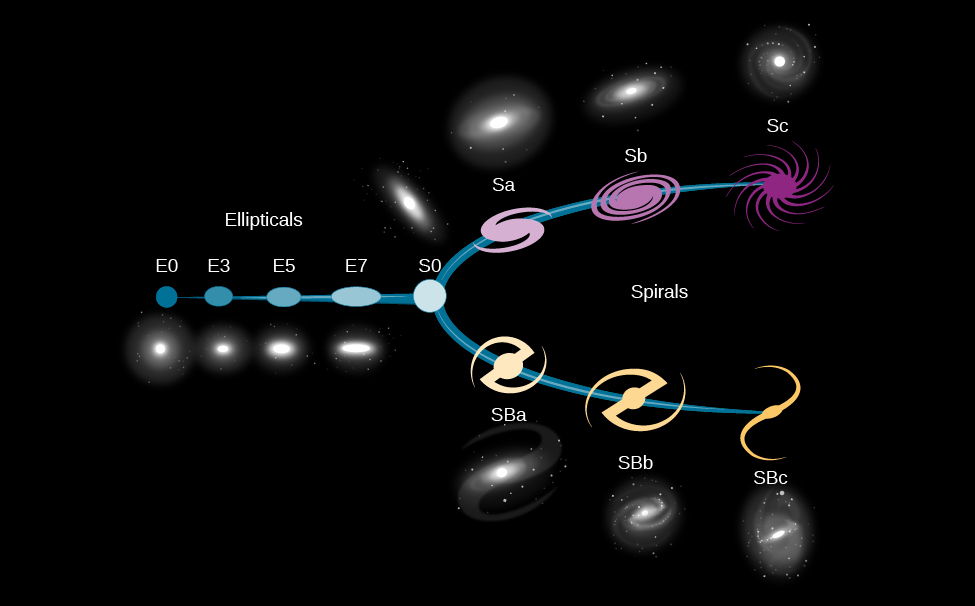
In both barred and unbarred spiral galaxies, we observe a range of different shapes. At one extreme, the central bulge is large and luminous, the arms are faint and tightly coiled, and bright emission nebulae and supergiant stars are inconspicuous. Hubble, who developed a system of classifying galaxies by shape, gave these galaxies the designation Sa. Galaxies at this extreme may have no clear spiral arm structure, resulting in a lens-like appearance (they are sometimes referred to as lenticular galaxies). These galaxies seem to share as many properties with elliptical galaxies as they do with spiral galaxies
英語のヒント
棒のある渦巻銀河にも、棒のない渦巻銀河にも、さまざまな形が見られる。その一方の極端では、中心のバルジが大きく明るく、腕は淡くきつく巻き付いている。明るい輝線星雲や超巨星は目立たない。形による銀河の分類法を作ったハッブルは、このような銀河をSaと名付けた。こちらの極端に近い銀河では、明瞭な渦状腕の構造がなく、レンズのように見えることもある。そのため、レンズ状銀河と呼ばれる場合もある。こうした銀河は、渦巻銀河と同じくらい多くの性質を、楕円銀河とも共有しているように見える。
At the other extreme, the central bulge is small and the arms are loosely wound. In these Sc galaxies, luminous stars and emission nebulae are very prominent. Our Galaxy and the Andromeda galaxy are both intermediate between the two extremes. Photographs of spiral galaxies, illustrating the different types, are shown in Figure 26.6, along with elliptical galaxies for comparison.
英語のヒント
反対の極端では、中心のバルジが小さく、腕は緩やかに巻いている。このSc型の銀河では、高光度の星と輝線星雲が非常によく目立つ。天の川銀河とアンドロメダ銀河は、どちらも両極端の中間に当たる。異なる型の渦巻銀河の写真を図26.6に示す。比較のため、楕円銀河も一緒に載せてある。
Hubble Classification of Galaxies.ハッブルによる銀河の分類
credit: modification of work by NASA, ESA · NASA media use guidelines
Figure 26.6 This figure shows Edwin Hubble’s original classification of galaxies. Elliptical galaxies are on the left. On the right, you can see the basic spiral shapes illustrated, alongside images of actual barred and unbarred spirals. (credit: modification of work by NASA, ESA)
図26.6 エドウィン・ハッブルが最初に提案した銀河の分類を示す。左側が楕円銀河である。右側には基本的な渦巻形の模式図があり、そのそばに、棒のある渦巻銀河と棒のない渦巻銀河の実際の画像を並べてある。(クレジット:NASA、ESAの作品を改変)
The luminous parts of spiral galaxies appear to range in diameter from about 20,000 to more than 100,000 light-years. Recent studies have found that there is probably a large amount of galactic material that extends well beyond the apparent edge of galaxies. This material appears to be thin, cold gas that is difficult to detect in most observations.
英語のヒント
渦巻銀河の光って見える部分の直径は、約2万光年から10万光年以上まであると考えられる。近年の研究では、銀河の見かけの縁をはるかに越えて広がる物質が、おそらく大量に存在することが分かった。この物質は希薄で冷たいガスとみられ、大部分の観測方法では検出が難しい。
From the observational data available, the masses of the visible portions of spiral galaxies are estimated to range from 1 billion to 1 trillion Suns (109 to 1012 MSun). The total luminosities of most spirals fall in the range of 100 million to 100 billion times the luminosity of our Sun (108 to 1011 LSun). Our Galaxy and M31 are relatively large and massive, as spirals go. There is also considerable dark matter in and around the galaxies, just as there is in the Milky Way; we deduce its presence from how fast stars in the outer parts of the Galaxy are moving in their orbits.
英語のヒント
得られている観測データから、渦巻銀河の可視部分の質量は、太陽の10億倍から1兆倍(109〜1012 MSun)と推定される。大部分の渦巻銀河の全光度は、太陽光度の1億倍から1000億倍(108〜1011 LSun)の範囲にある。天の川銀河とM31は、渦巻銀河の中では比較的大きく、質量も大きい。天の川銀河と同様に、ほかの銀河の内部や周囲にも暗黒物質が相当量存在する。その存在は、銀河の外側にある星々が、軌道上をどれほど速く動いているかから推定できる。