第26章銀河Galaxies
Hubble’s Law and Distancesハッブルの法則と距離
The regularity expressed in Hubble’s law has a built-in bonus: it gives us a new way to determine the distances to remote galaxies. First, we must reliably establish Hubble’s constant by measuring both the distance and the velocity of many galaxies in many directions to be sure Hubble’s law is truly a universal property of galaxies. But once we have calculated the value of this constant and are satisfied that it applies everywhere, much more of the universe opens up for distance determination. Basically, if we can obtain a spectrum of a galaxy, we can immediately tell how far away it is.
英語のヒント
ハッブルの法則が表す規則性には、おまけがついてくる。遠方の銀河までの距離を求める、新しい方法が得られるのだ。まず、さまざまな方向の多数の銀河について距離と速度を測り、ハッブル定数を確実に定めなければならない。ハッブルの法則が、銀河に本当に普遍的な性質であると確かめるためである。しかし、いったん定数の値を計算し、どこでも適用できると確信できれば、距離を求められる宇宙の範囲は大きく広がる。基本的には、銀河のスペクトルさえ得られれば、その銀河がどれだけ遠いかを直ちに知ることができる。
The procedure works like this. We use the spectrum to measure the speed with which the galaxy is moving away from us. If we then put this speed and the Hubble constant into Hubble’s law equation, we can solve for the distance.
英語のヒント
手順は次のとおりだ。スペクトルを使って、銀河が私たちから遠ざかる速さを測定する。その速さとハッブル定数をハッブルの法則の式に代入し、距離について解く。
Hubble’s Lawハッブルの法則
Hubble’s law (v = H × d) allows us to calculate the distance to any galaxy. Here is how we use it in practice.
ハッブルの法則(v = H × d)を使えば、銀河までの距離を計算できる。実際の使い方を見てみよう。
We have measured Hubble’s constant to be 22 km/s per million light-years. This means that if a galaxy is 1 million light-years farther away, it will move away 22 km/s faster. So, if we find a galaxy that is moving away at 18,000 km/s, what does Hubble’s law tells us about the distance to the galaxy?
ハッブル定数は22 km/s/百万光年と測定されている。これは、距離が百万光年大きい銀河では、後退速度が22 km/s大きくなるという意味である。では、18,000 km/sで遠ざかる銀河を見つけたとき、ハッブルの法則から、その銀河までの距離について何が分かるだろうか。
Solution解き方
Note how we handled the units here: the km/s in the numerator and denominator cancel, and the factor of million light-years in the denominator of the constant must be divided correctly before we get our distance of 818 million light-years.
英語のヒント
単位の扱いに注意しよう。分子と分母のkm/sは約分される。また、定数の分母にある「百万光年」という単位を正しく処理すると、距離は8億1800万光年と得られる。
Check Your Learning理解を確かめよう
Using 22 km/s/million light-years for Hubble’s constant, what recessional velocity do we expect to find if we observe a galaxy at 500 million light-years?
英語のヒント
ハッブル定数を22 km/s/百万光年として、5億光年先の銀河を観測すると、どれくらいの後退速度が予想されるだろうか。
Variation of Hubble’s Constantハッブル定数の変化
The use of redshift is potentially a very important technique for determining distances because as we have seen, most of our methods for determining galaxy distances are limited to approximately the nearest few hundred million light-years (and they have large uncertainties at these distances). The use of Hubble’s law as a distance indicator requires only a spectrum of a galaxy and a measurement of the Doppler shift, and with large telescopes and modern spectrographs, spectra can be taken of extremely faint galaxies.
英語のヒント
すでに見たように、銀河までの距離を求める方法のほとんどは、およそ数億光年以内に限られ、その距離では不確かさも大きい。そのため、赤方偏移を利用する方法は、距離測定で非常に重要になる可能性がある。ハッブルの法則を距離の指標として使うために必要なのは、銀河のスペクトルとドップラー偏移の測定だけだ。大型望遠鏡と現代の分光器があれば、極めて暗い銀河のスペクトルも取得できる。
But, as is often the case in science, things are not so simple. This technique works if, and only if, the Hubble constant has been truly constant throughout the entire life of the universe. When we observe galaxies billions of light-years away, we are seeing them as they were billions of years ago. What if the Hubble “constant” was different billions of years ago? Before 1998, astronomers thought that, although the universe is expanding, the expansion should be slowing down, or decelerating, because the overall gravitational pull of all matter in the universe would have a dominant, measureable effect. If the expansion is decelerating, then the Hubble constant should be decreasing over time.
英語のヒント
しかし、科学ではよくあることだが、話はそう単純ではない。この方法がそのまま成り立つのは、ハッブル定数が宇宙の全歴史を通じて本当に一定だった場合に限られる。何十億光年も先の銀河を観測するとき、私たちが見ているのは何十億年も前の姿だ。もしハッブル「定数」が、何十億年も前には違っていたらどうだろう。1998年より前、天文学者は、宇宙は膨張しているものの、その膨張は遅くなっている、つまり減速しているはずだと考えていた。宇宙の全物質による重力の引き合いが、支配的で測定可能な影響を及ぼすはずだからだ。膨張が減速しているなら、ハッブル定数は時間とともに小さくなるはずである。
The discovery that type Ia supernovae are standard bulbs gave astronomers the tool they needed to observe extremely distant galaxies and measure the rate of expansion billions of years ago. The results were completely unexpected. It turns out that the expansion of the universe is accelerating over time! What makes this result so astounding is that there is no way that existing physical theories can account for this observation. While a decelerating universe could easily be explained by gravity, there was no force or property in the universe known to astronomers that could account for the acceleration. In The Big Bang chapter, we will look in more detail at the observations that led to this totally unexpected result and explore its implications for the ultimate fate of the universe.
英語のヒント
Ia型超新星が標準光源になるという発見によって、天文学者は極めて遠い銀河を観測し、何十億年も前の膨張率を測定する手段を得た。その結果は、まったく予想外だった。宇宙の膨張は、時間とともに加速していると分かったのである。この結果が驚異的なのは、既存の物理理論では、この観測を説明できなかったことだ。減速する宇宙なら重力で容易に説明できたが、加速を説明できる宇宙の力や性質は、当時の天文学者には知られていなかった。「ビッグバン」の章では、このまったく予想外の結果を導いた観測を詳しく見て、それが宇宙の最終的な運命に何を意味するかを探る。
In any case, if the Hubble constant is not really a constant when we look over large spans of space and time, then the calculation of galaxy distances using the Hubble constant won’t be accurate. As we shall see in the chapter on The Big Bang, the accurate calculation of distances requires a model for how the Hubble constant has changed over time. The farther away a galaxy is (and the longer ago we are seeing it), the more important it is to include the effects of the change in the Hubble constant. For galaxies within a few billion light-years, however, the assumption that the Hubble constant is indeed constant gives good estimates of distance.
英語のヒント
いずれにせよ、広大な空間と長い時間にわたって見るとハッブル定数が実際には一定でないなら、一定値を使った銀河の距離の計算は正確にならない。「ビッグバン」の章で見るように、距離を正確に計算するには、ハッブル定数が時間とともにどう変わったかを表すモデルが必要である。銀河が遠いほど、つまり遠い過去の姿を見ているほど、その変化の影響を含めることが重要になる。しかし数十億光年以内の銀河なら、ハッブル定数が実際に一定だと仮定しても、距離のよい推定値が得られる。
Models for an Expanding Universe膨張する宇宙の模型
At first, thinking about Hubble’s law and being a fan of the work of Copernicus and Harlow Shapley, you might be shocked. Are all the galaxies really moving away from us? Is there, after all, something special about our position in the universe? Worry not; the fact that galaxies are receding from us and that more distant galaxies are moving away more rapidly than nearby ones shows only that the universe is expanding uniformly.
英語のヒント
コペルニクスやハーロー・シャプレーの研究を支持する人は、ハッブルの法則を初めて考えたとき、驚くかもしれない。本当にすべての銀河が私たちから遠ざかっているのだろうか。結局のところ、宇宙の中で私たちの位置には特別なところがあるのだろうか。心配はいらない。銀河が私たちから遠ざかり、遠い銀河ほど近い銀河より速く遠ざかるという事実は、宇宙が一様に膨張していることを示すだけである。
A uniformly expanding universe is one that is expanding at the same rate everywhere. In such a universe, we and all other observers, no matter where they are located, must observe a proportionality between the velocities and distances of equivalently remote galaxies. (Here, we are ignoring the fact that the Hubble constant is not constant over all time, but if at any given time in the evolution of the universe the Hubble constant has the same value everywhere, this argument still works.)
英語のヒント
一様に膨張する宇宙とは、どこでも同じ割合で膨張している宇宙だ。そのような宇宙では、私たちも、ほかのすべての観測者も、どこにいようと、同じように遠い銀河について速度と距離の比例関係を観測するはずである。ここでは、ハッブル定数が全時代を通じて一定ではないという事実をひとまず無視している。しかし、宇宙の進化のある任意の時点で、ハッブル定数がどこでも同じ値なら、この議論はやはり成り立つ。
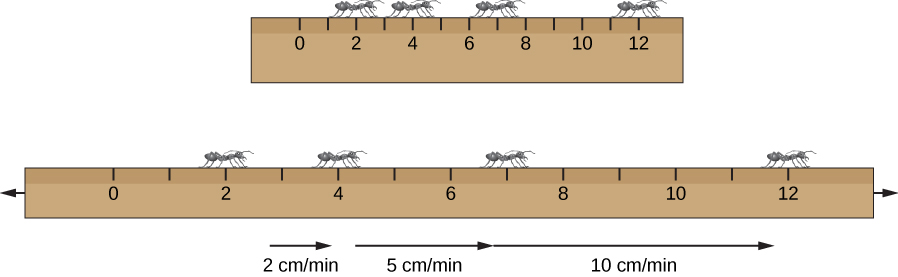
To see why, first imagine a ruler made of stretchable rubber, with the usual lines marked off at each centimeter. Now suppose someone with strong arms grabs each end of the ruler and slowly stretches it so that, say, it doubles in length in 1 minute (Figure 26.16). Consider an intelligent ant sitting on the mark at 2 centimeters—a point that is not at either end nor in the middle of the ruler. He measures how fast other ants, sitting at the 4-, 7-, and 12-centimeter marks, move away from him as the ruler stretches.
英語のヒント
なぜそうなるかを見るため、まず伸縮するゴム製の定規を想像してほしい。普通の定規のように1センチメートルごとに目盛りがついている。腕力のある人が両端をつかみ、例えば1分間で長さが2倍になるように、ゆっくり引き伸ばすとしよう(図26.16)。2センチメートルの目盛りに、賢いアリが座っているとする。そこは定規の端でも中央でもない。このアリは、定規が伸びるにつれて、4、7、12センチメートルの目盛りに座るほかのアリが、自分からどれくらいの速さで遠ざかるかを測る。
Stretching a Ruler.定規を引き伸ばす
OpenStax / Rice University · CC BY 4.0
Figure 26.16 Ants on a stretching ruler see other ants move away from them. The speed with which another ant moves away is proportional to its distance.
図26.16 伸びる定規の上にいるアリには、ほかのアリが自分から遠ざかるように見える。ほかのアリが遠ざかる速さは、そのアリまでの距離に比例する。
The ant at 4 centimeters, originally 2 centimeters away from our ant, has doubled its distance in 1 minute; it therefore moved away at a speed of 2 centimeters per minute. The ant at the 7-centimeters mark, which was originally 5 centimeters away from our ant, is now 10 centimeters away; it thus had to move at 5 centimeters per minute. The one that started at the 12-centimeters mark, which was 10 centimeters away from the ant doing the counting, is now 20 centimeters away, meaning it must have raced away at a speed of 10 centimeters per minute. Ants at different distances move away at different speeds, and their speeds are proportional to their distances (just as Hubble’s law indicates for galaxies). Yet, notice in our example that all the ruler was doing was stretching uniformly. Also, notice that none of the ants were actually moving of their own accord, it was the stretching of the ruler that moved them apart.
英語のヒント
4センチメートルの目盛りのアリは、観測するアリから最初は2センチメートル離れていたが、1分間で距離が2倍になった。したがって、毎分2センチメートルで遠ざかった。7センチメートルの目盛りのアリは、最初は5センチメートル先だったが、今は10センチメートル先にいる。つまり、毎分5センチメートルで動いたことになる。12センチメートルの目盛りから出発したアリは、測定するアリから最初は10センチメートル先にいたが、今は20センチメートル先にいる。毎分10センチメートルで遠ざかったはずだ。異なる距離にいるアリは異なる速さで遠ざかり、その速さは距離に比例する。銀河についてハッブルの法則が示すのと同じである。それでも、この例で定規がしていたことは、一様に伸びることだけだった点に注意しよう。また、どのアリも自分から動いてはいない。アリどうしを遠ざけたのは、定規が伸びたことだった。
Now let’s repeat the analysis, but put the intelligent ant on some other mark—say, on 7 or 12 centimeters. We discover that, as long as the ruler stretches uniformly, this ant also finds every other ant moving away at a speed proportional to its distance. In other words, the kind of relationship expressed by Hubble’s law can be explained by a uniform stretching of the “world” of the ants. And all the ants in our simple diagram will see the other ants moving away from them as the ruler stretches.
英語のヒント
次に、賢いアリを別の目盛り、例えば7センチメートルや12センチメートルの位置へ移して、同じ分析を繰り返そう。定規が一様に伸びる限り、そのアリも、ほかのすべてのアリが距離に比例した速さで遠ざかると分かる。言い換えれば、ハッブルの法則が表す関係は、アリの「世界」が一様に伸びることで説明できる。この単純な図のすべてのアリは、定規が伸びると、ほかのアリが自分から遠ざかるのを見ることになる。
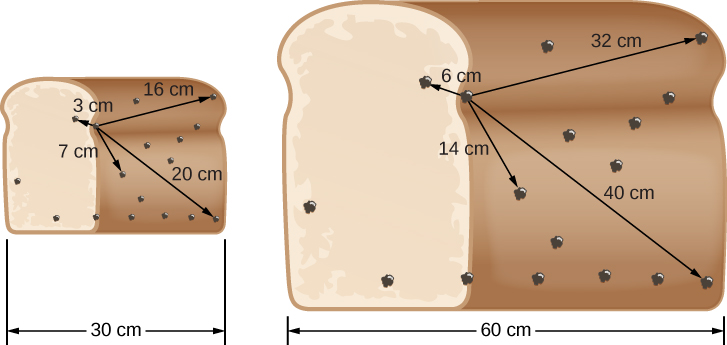
For a three-dimensional analogy, let’s look at the loaf of raisin bread in Figure 26.17. The chef has accidentally put too much yeast in the dough, and when she sets the bread out to rise, it doubles in size during the next hour, causing all the raisins to move farther apart. On the figure, we again pick a representative raisin (that is not at the edge or the center of the loaf) and show the distances from it to several others in the figure (before and after the loaf expands).
英語のヒント
三次元のたとえとして、図26.17のレーズンパンを見よう。パン職人がうっかり生地にイーストを入れすぎたため、発酵させようと置いておくと、次の1時間でパンの大きさが2倍になり、すべてのレーズンが互いに遠ざかる。図では、パンの端でも中央でもない一つのレーズンを、再び代表として選んでいる。そしてパンが膨らむ前と後について、そのレーズンからいくつかのほかのレーズンまでの距離を示している。
Expanding Raisin Bread.膨らむレーズンパン
OpenStax / Rice University · CC BY 4.0
Figure 26.17 As the raisin bread rises, the raisins “see” other raisins moving away. More distant raisins move away faster in a uniformly expanding bread.
図26.17 レーズンパンが膨らむと、それぞれのレーズンには、ほかのレーズンが遠ざかるように「見える」。一様に膨らむパンでは、遠いレーズンほど速く遠ざかる。
Measure the increases in distance and calculate the speeds for yourself on the raisin bread, just like we did for the ruler. You will see that, since each distance doubles during the hour, each raisin moves away from our selected raisin at a speed proportional to its distance. The same is true no matter which raisin you start with.
定規のときと同じように、レーズンパンでも距離の増加を測り、自分で速さを計算してみよう。1時間でどの距離も2倍になるため、それぞれのレーズンは、選んだレーズンから、その距離に比例する速さで遠ざかることが分かる。どのレーズンを出発点にしても同じである。
Our two analogies are useful for clarifying our thinking, but you must not take them literally. On both the ruler and the raisin bread, there are points that are at the end or edge. You can use these to pinpoint the middle of the ruler and the loaf. While our models of the universe have some resemblance to the properties of the ruler and the loaf, the universe has no boundaries, no edges, and no center (all mind-boggling ideas that we will discuss in a later chapter).
英語のヒント
この二つのたとえは考えを整理するのに役立つが、そのまま文字どおりに受け取ってはいけない。定規にもレーズンパンにも端があり、そこから中央の位置を特定できる。宇宙の模型には定規やパンの性質と似たところがあるが、宇宙には境界も縁も中心もない。いずれも頭がくらくらするような考えで、後の章で取り上げる。
What is useful to notice about both the ants and the raisins is that they themselves did not “cause” their motion. It isn’t as if the raisins decided to take a trip away from each other and then hopped on a hoverboard to get away. No, in both our analogies, it was the stretching of the medium (the ruler or the bread) that moved the ants or the raisins farther apart. In the same way, we will see in The Big Bang chapter that the galaxies don’t have rocket motors propelling them away from each other. Instead, they are passive participants in the expansion of space. As space stretches, the galaxies are carried farther and farther apart much as the ants and the raisins were. (If this notion of the “stretching” of space surprises or bothers you, now would be a good time to review the information about spacetime in Black Holes and Curved Spacetime. We will discuss these ideas further as our discussion broadens from galaxies to the whole universe.)
英語のヒント
アリとレーズンの両方で注目すべきなのは、それら自身が運動を「引き起こした」のではないという点だ。レーズンが互いから離れる旅に出ようと決め、ホバーボードに飛び乗ったわけではない。どちらのたとえでも、アリやレーズンを遠ざけたのは、それらを載せるもの——定規やパン——が伸びたことだった。同じように、「ビッグバン」の章で見るとおり、銀河にも、互いから遠ざかるために推進するロケットエンジンがついているわけではない。銀河は空間の膨張に、受け身で加わっている。空間が伸びるにつれて、アリやレーズンと同じように、銀河も次第に遠くへ運ばれていく。空間が「伸びる」という考えに驚いたり戸惑ったりしたなら、今は「ブラックホールと曲がった時空」の時空についての説明を復習するよい機会だ。銀河から宇宙全体へ議論を広げる中で、これらの考えをさらに検討していく。
The expansion of the universe, by the way, does not imply that the individual galaxies and clusters of galaxies themselves are expanding. Neither raisins nor the ants in our analogy grow in size as the loaf expands. Similarly, gravity holds galaxies and clusters of galaxies together, and they get farther away from each other—without themselves changing in size—as the universe expands.
英語のヒント
ちなみに、宇宙が膨張するからといって、一つ一つの銀河や銀河団そのものが膨張しているわけではない。このたとえでも、パンが膨らむにつれてレーズンやアリ自体が大きくなるわけではなかった。同様に、銀河や銀河団は重力によってまとまりを保っている。宇宙が膨張するとき、それら自身の大きさは変わらず、互いの間隔が広がっていく。