第26章銀河Galaxies
26.3 Properties of Galaxies26.3 銀河の性質
Learning Objectives学習の目標
By the end of this section, you will be able to:
この節を読み終えると、次のことができるようになる。
Describe the methods through which astronomers can estimate the mass of a galaxy
銀河の質量を推定する方法を説明する。
Characterize each type of galaxy by its mass-to-light ratio
各種の銀河の特徴を、質量光度比を用いて述べる。
The technique for deriving the masses of galaxies is basically the same as that used to estimate the mass of the Sun, the stars, and our own Galaxy. We measure how fast objects in the outer regions of the galaxy are orbiting the center, and then we use this information along with Kepler’s third law to calculate how much mass is inside that orbit.
英語のヒント
銀河の質量を求める方法は、基本的には太陽や恒星、私たちの銀河系の質量を推定する方法と同じである。銀河の外側にある天体が、中心の周りをどれくらいの速さで公転しているかを測定する。次に、その情報とケプラーの第3法則を使って、その軌道の内側にどれだけの質量があるかを計算する。
Masses of Galaxies銀河の質量
Astronomers can measure the rotation speed in spiral galaxies by obtaining spectra of either stars or gas, and looking for wavelength shifts produced by the Doppler effect. Remember that the faster something is moving toward or away from us, the greater the shift of the lines in its spectrum. Kepler’s law, together with such observations of the part of the Andromeda galaxy that is bright in visible light, for example, show it to have a galactic mass of about MSun (enough material to make 400 billion stars like the Sun).
英語のヒント
天文学者は、星またはガスのスペクトルを取得し、ドップラー効果によって生じた波長のずれを調べることで、渦巻銀河の回転速度を測定できる。天体が私たちに近づく、あるいは遠ざかる速度が大きいほど、スペクトル線のずれも大きくなることを思い出そう。例えば、アンドロメダ銀河の可視光で明るく見える部分について、このような観測結果とケプラーの法則を組み合わせると、銀河の質量は約 MSunと分かる。太陽のような星を4000億個作れるだけの物質に相当する。
The total mass of the Andromeda galaxy is greater than this, however, because we have not included the mass of the material that lies beyond its visible edge. Fortunately, there is a handful of objects—such as isolated stars, star clusters, and satellite galaxies—beyond the visible edge that allows astronomers to estimate how much additional matter is hidden out there. Recent studies show that the amount of dark matter beyond the visible edge of Andromeda may be as large as the mass of the bright portion of the galaxy. Indeed, using Kepler’s third law and the velocities of its satellite galaxies, the Andromeda galaxy is estimated to have a mass closer to MSun. The mass of the Milky Way Galaxy is estimated to be MSun, and so our Milky Way is turning out to be somewhat smaller than Andromeda.
英語のヒント
しかし、アンドロメダ銀河の総質量はこれより大きい。見えている縁の外側にある物質の質量を、まだ含めていないからだ。幸い、その縁の外側にも、孤立した星、星団、伴銀河などの天体がいくらか存在する。これらを使えば、見えないところにどれだけの物質がさらに隠れているかを推定できる。近年の研究によると、アンドロメダ銀河の見えている縁より外側にある暗黒物質の量は、明るい部分の質量に匹敵する可能性がある。実際、ケプラーの第3法則と伴銀河の速度を用いると、アンドロメダ銀河の質量は MSunに近いと推定される。天の川銀河の質量は MSunと推定されており、私たちの銀河系はアンドロメダ銀河よりいくらか小さいことが分かってきた。
Elliptical galaxies do not rotate in a systematic way, so we cannot determine a rotational velocity; therefore, we must use a slightly different technique to measure their mass. Their stars are still orbiting the galactic center, but not in the organized way that characterizes spirals. Since elliptical galaxies contain stars that are billions of years old, we can assume that the galaxies themselves are not flying apart. Therefore, if we can measure the various speeds with which the stars are moving in their orbits around the center of the galaxy, we can calculate how much mass the galaxy must contain in order to hold the stars within it.
英語のヒント
楕円銀河は全体としてそろった向きに回転していないため、一つの回転速度を決めることができない。その質量を測るには、少し違う方法が必要になる。星はやはり銀河の中心の周りを公転しているが、渦巻銀河のように整然とした運動はしていない。楕円銀河には数十億歳の星が含まれているので、銀河そのものがばらばらに飛び散っているわけではないと考えられる。そこで、星々が銀河の中心の周りの軌道を動くさまざまな速さを測定できれば、それらの星を銀河の中につなぎ留めるために、銀河がどれだけの質量をもつ必要があるかを計算できる。
In practice, the spectrum of a galaxy is a composite of the spectra of its many stars, whose different motions produce different Doppler shifts (some red, some blue). The result is that the lines we observe from the entire galaxy contain the combination of many Doppler shifts. When some stars provide blueshifts and others provide redshifts, they create a wider or broader absorption or emission feature than would the same lines in a hypothetical galaxy in which the stars had no orbital motion. Astronomers call this phenomenon line broadening. The amount by which each line broadens indicates the range of speeds at which the stars are moving with respect to the center of the galaxy. The range of speeds depends, in turn, on the force of gravity that holds the stars within the galaxies. With information about the speeds, it is possible to calculate the mass of an elliptical galaxy.
英語のヒント
実際に得られる銀河のスペクトルは、多数の星のスペクトルが重なったものだ。それぞれの星の動きが違うため、ドップラー偏移も異なり、赤方偏移するものも青方偏移するものもある。したがって、銀河全体から観測するスペクトル線には、多数のドップラー偏移が重ね合わされている。一部の星が青方偏移を、ほかの星が赤方偏移を生じさせると、吸収線や輝線の幅は、星が公転していない仮想的な銀河で同じ線を見た場合よりも広くなる。天文学者はこの現象を「線幅の広がり」と呼ぶ。各スペクトル線がどれだけ広がるかは、星が銀河の中心に対してどの範囲の速さで動いているかを示す。その速さの範囲は、今度は星を銀河内につなぎ留める重力の強さによって決まる。こうして速さの情報が得られれば、楕円銀河の質量を計算できる。
Table 26.1 summarizes the range of masses (and other properties) of the various types of galaxies. Interestingly enough, the most and least massive galaxies are ellipticals. On average, irregular galaxies have less mass than spirals.
英語のヒント
表26.1に、さまざまな種類の銀河について、質量の範囲とその他の性質をまとめた。興味深いことに、最も重い銀河も最も軽い銀河も楕円銀河である。平均すると、不規則銀河は渦巻銀河より質量が小さい。
Characteristics of the Different Types of Galaxies 種類による銀河の特徴の違い |
|||
|---|---|---|---|
Characteristic 特徴 |
Spirals 渦巻銀河 |
Ellipticals 楕円銀河 |
Irregulars 不規則銀河 |
Mass (MSun) 質量(MSun) |
109 to 1012 109〜1012 |
105 to 1013 105〜1013 |
108 to 1011 108〜1011 |
Diameter (thousands of light-years) 直径(千光年) |
15 to 150 15〜150 |
3 to >700 3〜700超 |
3 to 30 3〜30 |
Luminosity (LSun) 光度(LSun) |
108 to 1011 108〜1011 |
106 to 1011 106〜1011 |
107 to 2 × 10⁹ 107〜2 × 10⁹ |
Populations of stars 星の世代 |
Old and young 古い星と若い星 |
Old 古い星 |
Old and young 古い星と若い星 |
Interstellar matter 星間物質 |
Gas and dust ガスと塵 |
Almost no dust; little gas 塵はほぼなく、ガスも少ない |
Much gas; some have little dust, some much dust ガスが多い。塵が少ないものも多いものもある |
Mass-to-light ratio in the visible part 可視部分の質量光度比 |
2 to 10 2〜10 |
10 to 20 10〜20 |
1 to 10 1〜10 |
Mass-to-light ratio for total galaxy 銀河全体の質量光度比 |
100 | 100 | ? |
Mass-to-Light Ratio質量光度比
A useful way of characterizing a galaxy is by noting the ratio of its mass (in units of the Sun’s mass) to its light output (in units of the Sun’s luminosity). This single number tells us roughly what kind of stars make up most of the luminous population of the galaxy, and it also tells us whether a lot of dark matter is present. For stars like the Sun, the mass-to-light ratio is 1 by our definition.
英語のヒント
銀河の特徴を表すのに便利なのが、その質量と放射する光の明るさの比である。質量は太陽質量を単位に、明るさは太陽光度を単位にして比を取る。この一つの数値から、銀河の光を放つ星々の大部分がどのような種類なのか、おおよその見当がつく。また、大量の暗黒物質が存在するかどうかも分かる。この定義では、太陽と同じような星の質量光度比は1になる。
Galaxies are not, of course, composed entirely of stars that are identical to the Sun. The overwhelming majority of stars are less massive and less luminous than the Sun, and usually these stars contribute most of the mass of a system without accounting for very much light. The mass-to-light ratio for low-mass stars is greater than 1 (you can verify this using the data in Table 18.3). Therefore, a galaxy’s mass-to-light ratio is also generally greater than 1, with the exact value depending on the ratio of high-mass stars to low-mass stars.
英語のヒント
もちろん、銀河が太陽とまったく同じ星だけでできているわけではない。星の圧倒的多数は太陽より軽く暗い。通常、こうした星が天体の集団の質量の大部分を占める一方で、光にはそれほど寄与しない。低質量星の質量光度比は1より大きい。表18.3のデータで確かめられる。したがって、銀河の質量光度比も一般に1より大きく、正確な値は大質量星と低質量星の割合によって決まる。
Galaxies in which star formation is still occurring have many massive stars, and their mass-to-light ratios are usually in the range of 1 to 10. Galaxies consisting mostly of an older stellar population, such as ellipticals, in which the massive stars have already completed their evolution and have ceased to shine, have mass-to-light ratios of 10 to 20.
英語のヒント
星形成が現在も続く銀河には大質量星が多く、質量光度比は通常1〜10の範囲にある。楕円銀河のように、主に古い星の集団からなる銀河では、大質量星はすでに進化を終えて輝かなくなっている。そのような銀河の質量光度比は10〜20である。
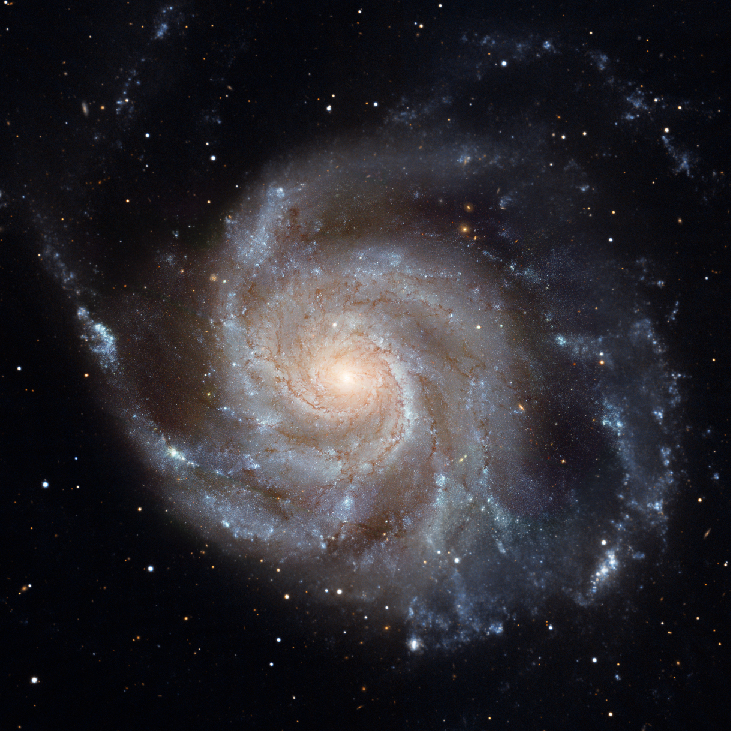
But these figures refer only to the inner, conspicuous parts of galaxies (Figure 26.10). In The Milky Way Galaxy and above, we discussed the evidence for dark matter in the outer regions of our own Galaxy, extending much farther from the galactic center than do the bright stars and gas. Recent measurements of the rotation speeds of the outer parts of nearby galaxies, such as the Andromeda galaxy we discussed earlier, suggest that they too have extended distributions of dark matter around the visible disk of stars and dust. This largely invisible matter adds to the mass of the galaxy while contributing nothing to its luminosity, thus increasing the mass-to-light ratio. If dark invisible matter is present in a galaxy, its mass-to-light ratio can be as high as 100. The two different mass-to-light ratios measured for various types of galaxies are given in Table 26.1.
英語のヒント
ただし、これらの値は、銀河の内側のよく見える部分だけについてのものだ(図26.10)。「天の川銀河」とこの節の前半では、私たちの銀河系の外側に暗黒物質がある証拠を検討した。暗黒物質は、明るい星やガスよりもはるかに遠くまで、銀河の中心から広がっている。先に取り上げたアンドロメダ銀河など、近隣の銀河の外側の回転速度を最近測定した結果、それらにも星と塵の見える円盤を取り囲む広大な暗黒物質の分布があると示唆されている。大部分が見えないこの物質は、銀河の光度にはまったく寄与せず、質量だけを増やす。その結果、質量光度比は大きくなる。光らず見えない物質が存在すれば、銀河の質量光度比は100に達することもある。各種の銀河について測定された、この二通りの質量光度比を表26.1に示す。
M101, the Pinwheel Galaxy.M101、回転花火銀河
credit: NASA, ESA, K. Kuntz (Johns Hopkins University), F. Bresolin (University of Hawaii), J. Trauger (Jet Propulsion Lab), J. Mould (NOAO), Y.-H. Chu (University of Illinois, Urbana), and STScI · CC BY 4.0
Figure 26.10 This galaxy is a face-on spiral at a distance of 21 million light-years. M101 is almost twice the diameter of the Milky Way, and it contains at least 1 trillion stars. (credit: NASA, ESA, K. Kuntz (Johns Hopkins University), F. Bresolin (University of Hawaii), J. Trauger (Jet Propulsion Lab), J. Mould (NOAO), Y.-H. Chu (University of Illinois, Urbana), and STScI)
図26.10 2100万光年先にある渦巻銀河を正面から見ている。M101の直径は天の川銀河のほぼ2倍で、少なくとも1兆個の星を含む。(クレジット:NASA、ESA、K. Kuntz〔ジョンズ・ホプキンズ大学〕、F. Bresolin〔ハワイ大学〕、J. Trauger〔ジェット推進研究所〕、J. Mould〔NOAO〕、Y.-H. Chu〔イリノイ大学アーバナ校〕、STScI)
These measurements of other galaxies support the conclusion already reached from studies of the rotation of our own Galaxy—namely, that most of the material in the universe cannot at present be observed directly in any part of the electromagnetic spectrum. An understanding of the properties and distribution of this invisible matter is crucial to our understanding of galaxies. It’s becoming clearer and clearer that, through the gravitational force it exerts, dark matter plays a dominant role in galaxy formation and early evolution. There is an interesting parallel here between our time and the time during which Edwin Hubble was receiving his training in astronomy. By 1920, many scientists were aware that astronomy stood on the brink of important breakthroughs—if only the nature and behavior of the nebulae could be settled with better observations. In the same way, many astronomers today feel we may be closing in on a far more sophisticated understanding of the large-scale structure of the universe—if only we can learn more about the nature and properties of dark matter. If you follow astronomy articles in the news (as we hope you will), you should be hearing more about dark matter in the years to come.
英語のヒント
ほかの銀河についてのこうした測定は、銀河系の回転の研究からすでに得られていた結論を裏づける。すなわち、宇宙の物質の大部分は、現在のところ電磁スペクトルのどの領域でも直接観測できないという結論だ。この見えない物質の性質と分布を理解することは、銀河の理解に欠かせない。暗黒物質が及ぼす重力が、銀河の形成と初期の進化で主要な役割を担うことが、次第にはっきりしてきている。ここには、現在と、エドウィン・ハッブルが天文学の訓練を受けていた時代との興味深い共通点がある。1920年までに、多くの科学者が、天文学はいくつもの重要な飛躍の目前にあると気づいていた。よりよい観測によって、星雲の正体と振る舞いさえ解明できれば、という状況だった。同じように今日の多くの天文学者も、宇宙の大規模構造について、はるかに精密な理解に近づいているのかもしれないと感じている。暗黒物質の正体と性質が、もっと分かりさえすればよいのだ。ニュースで天文学の記事を追っていけば——ぜひそうしてほしい——これからの年月で、暗黒物質の話をさらに耳にするはずである。