第17章星の光を分析するAnalyzing Starlight
Thinking Aheadまず考えてみよう
Star Colors.恒星の色。
credit: modification of work by ESO/A.Santerne · CC BY 4.0
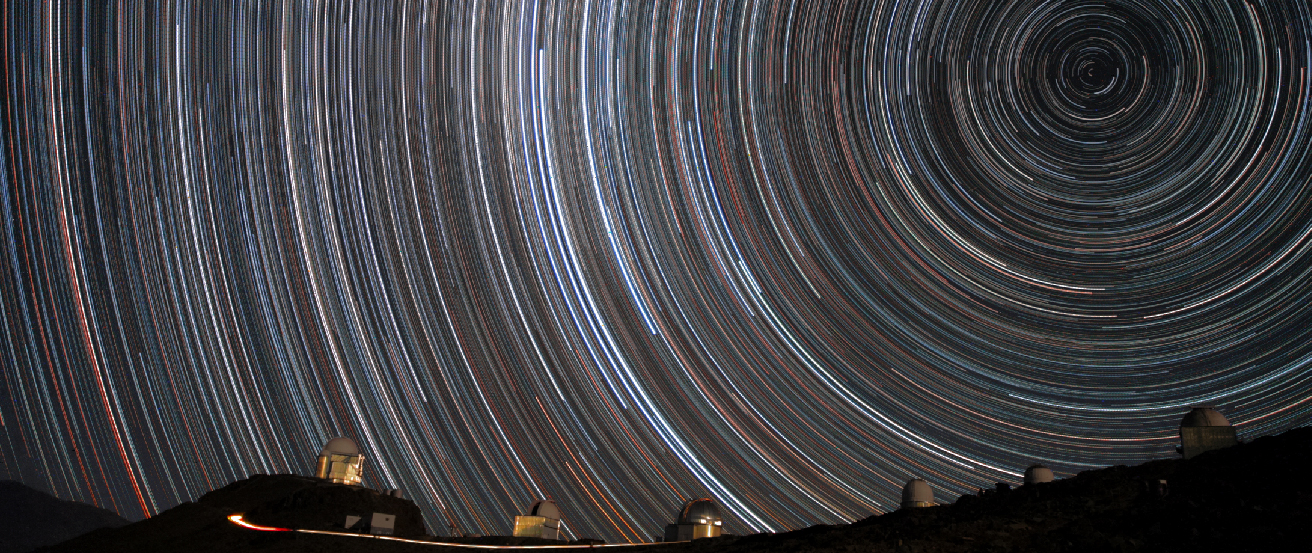
Figure 17.1 This long time exposure shows the colors of the stars. The circular motion of the stars across the image is provided by Earth’s rotation. The various colors of the stars are caused by their different temperatures. (credit: modification of work by ESO/A.Santerne)
図17.1 長時間露光によって、恒星の色がわかる。画像を横切る星の円運動は、地球の自転によるものだ。恒星のさまざまな色は、温度の違いによって生じる。(クレジット:ESO/A. Santerneの作品を改変)
Everything we know about stars—how they are born, what they are made of, how far away they are, how long they live, and how they will die—we learn by decoding the messages contained in the light and radiation that reaches Earth. What questions should we ask, and how do we find the answers?
英語のヒント
恒星はどのように生まれ、何でできているのか。どれくらい遠くにあり、どれほど長く生き、どう死んでいくのか。私たちが恒星について知っているすべては、地球に届く光や放射に含まれるメッセージを読み解くことで学んだものである。どのような問いを立て、その答えをどう見つければよいのだろうか。
We can begin our voyage to the stars by looking at the night sky. It is obvious that stars do not all appear equally bright, nor are they all the same color. To understand the stars, we must first determine their basic properties, such as what their temperatures are, how much material they contain (their masses), and how much energy they produce. Since our Sun is a star, of course the same techniques, including spectroscopy, used to study the Sun can be used to find out what stars are like. As we learn more about the stars, we will use these characteristics to begin assembling clues to the main problems we are interested in solving: How do stars form? How long do they survive? What is their ultimate fate?
英語のヒント
星への旅は、夜空を眺めることから始められる。星はすべて同じ明るさに見えるわけではなく、色も同じでないことは明らかだ。恒星を理解するには、まず、温度はどれくらいか、どれだけの物質を含むか、つまり質量はいくらか、どれほどのエネルギーを生むか、といった基本的な性質を調べなければならない。太陽も恒星なので、もちろん、分光法を含め、太陽の研究に使ったのと同じ方法で、ほかの恒星の様子を調べられる。恒星について知ることが増えたら、こうした性質を使い、解きたい大きな問題の手掛かりを集めていく。恒星はどう形成されるのか。どれほど長く存続するのか。そして最終的にどのような運命をたどるのか。