第17章星の光を分析するAnalyzing Starlight
Radial Velocity視線速度
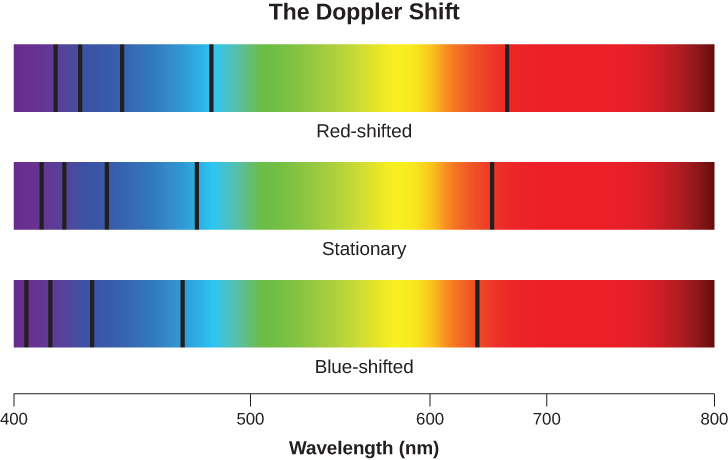
When we measure the spectrum of a star, we determine the wavelength of each of its lines. If the star is not moving with respect to the Sun, then the wavelength corresponding to each element will be the same as those we measure in a laboratory here on Earth. But if stars are moving toward or away from us, we must consider the Doppler effect (see The Doppler Effect section). We should see all the spectral lines of moving stars shifted toward the red end of the spectrum if the star is moving away from us, or toward the blue (violet) end if it is moving toward us (Figure 17.10). The greater the shift, the faster the star is moving. Such motion, along the line of sight between the star and the observer, is called radial velocity and is usually measured in kilometers per second.
英語のヒント
恒星のスペクトルを測るとき、私たちは各線の波長を決める。恒星が太陽に対して動いていなければ、各元素に対応する波長は、地球の実験室で測ったものと同じになる。しかし、恒星が私たちに近づいたり遠ざかったりしているなら、ドップラー効果を考慮しなければならない。「ドップラー効果」の節を参照してほしい。恒星が遠ざかっているなら、そのすべてのスペクトル線はスペクトルの赤い側にずれて見え、近づいているなら青い側、すなわち紫の側にずれて見えるはずである(図17.10)。ずれが大きいほど、恒星は速く動いている。恒星と観測者を結ぶ視線に沿ったこのような運動を視線速度と呼び、通常はキロメートル毎秒で測る。
Doppler-Shifted Stars.ドップラー効果で線がずれる恒星
OpenStax / Rice University · CC BY 4.0
Figure 17.10 When the spectral lines of a moving star shift toward the red end of the spectrum, we know that the star is moving away from us. If they shift toward the blue end, the star is moving toward us.
図17.10 動いている恒星のスペクトル線が赤い側へずれれば、その恒星が私たちから遠ざかっているとわかる。青い側へずれれば、私たちに近づいている。
William Huggins, pioneering yet again, in 1868 made the first radial velocity determination of a star. He observed the Doppler shift in one of the hydrogen lines in the spectrum of Sirius and found that this star is moving away from the solar system. (Better measurements now indicate that Sirius is actually moving toward us, but Huggins is still celebrated as a pioneer in making such measurements.) Today, radial velocity can be measured for any star bright enough for its spectrum to be observed. As we will see in The Stars: A Celestial Census, radial velocity measurements of double stars are crucial in deriving stellar masses.
英語のヒント
ウィリアム・ハギンズは、1868年に再び先駆的な仕事をし、恒星の視線速度を初めて測定した。シリウスのスペクトルにある水素の線の一つのドップラーシフトを観測し、この星は太陽系から遠ざかっていると判断した。現在の、より精密な測定によれば、シリウスは実際には私たちへ近づいている。それでも、こうした測定を切り開いた先駆者としてハギンズはたたえられている。今日では、スペクトルを観測できるほど明るい恒星なら、どれでも視線速度を測れる。「恒星――星の世界の実態を調べる」で見るように、連星の視線速度の測定は、恒星の質量を求めるうえで極めて重要である。
Proper Motion固有運動
There is another type of motion stars can have that cannot be detected with stellar spectra. Unlike radial motion, which is along our line of sight (i.e., toward or away from Earth), this motion, called proper motion, is transverse: that is, across our line of sight. We see it as a change in the relative positions of the stars on the celestial sphere (Figure 17.11). These changes are very slow. Even the star with the largest proper motion takes 200 years to change its position in the sky by an amount equal to the width of the full Moon, and the motions of other stars are smaller yet.
英語のヒント
恒星には、スペクトルでは検出できない別の種類の運動もある。視線に沿う運動、つまり地球へ近づいたり遠ざかったりする運動と違い、固有運動と呼ばれるこの運動は、視線を横切る方向の運動である。私たちには、天球上での星どうしの相対的な位置の変化として見える(図17.11)。こうした変化は非常にゆっくりしている。固有運動が最も大きい恒星でさえ、空での位置を満月の幅だけ変えるのに200年かかり、ほかの恒星の動きはさらに小さい。
Large Proper Motion.大きな固有運動
Figure 17.11 Three photographs of Barnard’s star, the star with the largest known proper motion, show how this faint star has moved over a period of 20 years. (modification of work by Steve Quirk)
図17.11 知られている中で最大の固有運動をもつバーナード星の3枚の写真。この暗い星が20年間でどう移動したかを示す。(Steve Quirkの画像を改変)
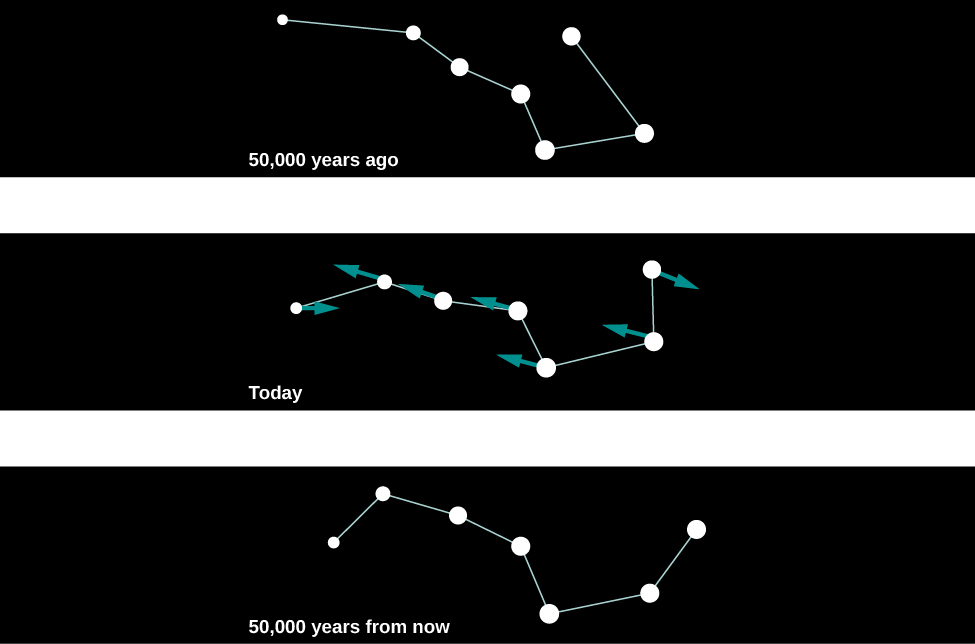
For this reason, with our naked eyes, we do not notice any change in the positions of the bright stars during the course of a human lifetime. If we could live long enough, however, the changes would become obvious. For example, some 50,000 years from now, terrestrial observers will find the handle of the Big Dipper unmistakably more bent than it is now (Figure 17.12).
英語のヒント
このため、人間の一生ほどの期間では、明るい恒星の位置が変わることに肉眼では気づかない。しかし十分に長く生きられれば、その変化は明らかになるだろう。たとえば今から約5万年後、地球の観測者には、北斗七星のひしゃくの柄が、今より明らかに大きく曲がって見えるはずである(図17.12)。
Changes in the Big Dipper.北斗七星の変化
OpenStax / Rice University · CC BY 4.0
Figure 17.12 This figure shows changes in the appearance of the Big Dipper due to proper motion of the stars over 100,000 years.
図17.12 恒星の固有運動により、10万年間で北斗七星の見かけがどう変わるかを示す図。
We measure the proper motion of a star in arcseconds (1/3600 of a degree) per year. That is, the measurement of proper motion tells us only by how much of an angle a star has changed its position on the celestial sphere. If two stars at different distances are moving at the same velocity perpendicular to our line of sight, the closer one will show a larger shift in its position on the celestial sphere in a year’s time. As an analogy, imagine you are standing at the side of a freeway. Cars will appear to whiz past you. If you then watch the traffic from a vantage point half a mile away, the cars will move much more slowly across your field of vision. In order to convert this angular motion to a velocity, we need to know how far away the star is.
英語のヒント
恒星の固有運動は、1年あたりの角秒、すなわち1度の3600分の1を単位として測る。つまり固有運動を測ってわかるのは、天球上の位置がどれだけの角度変わったかだけである。距離が異なる2個の恒星が、視線と垂直な方向へ同じ速度で動くなら、近い星のほうが、1年間の天球上での位置のずれは大きくなる。たとえとして、高速道路の脇に立っていると想像しよう。車は目の前をさっと走り抜けるように見える。そこから半マイル離れた見晴らしのよい地点から交通を眺めれば、車は視野の中をずっとゆっくり動いて見える。この角度で表した運動を速度へ変換するには、恒星がどれほど遠くにあるかを知る必要がある。
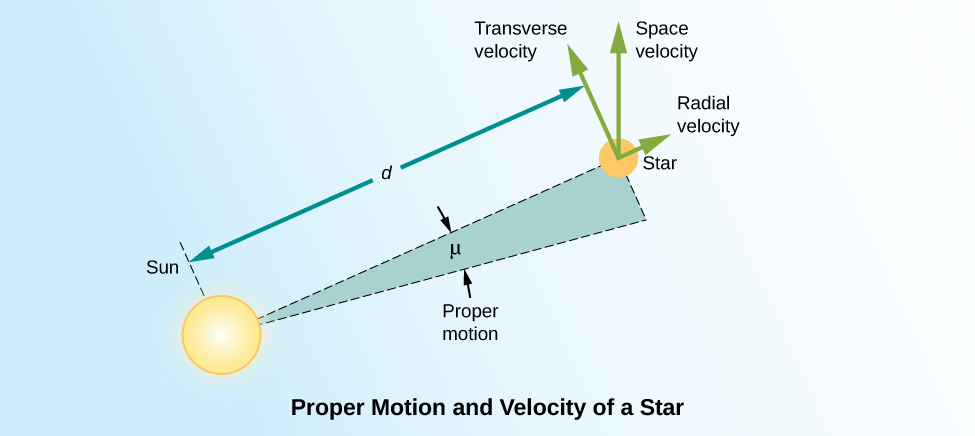
To know the true space velocity of a star—that is, its total speed and the direction in which it is moving through space relative to the Sun—we must know its radial velocity, proper motion, and distance (Figure 17.13). A star’s space velocity can also, over time, cause its distance from the Sun to change significantly. Over several hundred thousand years, these changes can be large enough to affect the apparent brightnesses of nearby stars. Today, Sirius, in the constellation Canis Major (the Big Dog) is the brightest star in the sky, but 100,000 years ago, the star Canopus in the constellation Carina (the Keel) was the brightest one. A little over 200,000 years from now, Sirius will have moved away and faded somewhat, and Vega, the bright blue star in Lyra, will take over its place of honor as the brightest star in Earth’s skies.
英語のヒント
恒星の本当の空間速度、すなわち太陽を基準に宇宙空間を動く全体としての速さと方向を知るには、その視線速度、固有運動、距離を知らなければならない(図17.13)。恒星の空間速度によって、時間がたつと太陽からの距離も大きく変わりうる。数十万年では、その変化は近くの恒星の見かけの明るさに影響するほど大きくなることがある。現在、空で最も明るい恒星は、おおいぬ座のシリウスである。しかし10万年前には、りゅうこつ座のカノープスが最も明るかった。今から20万年余りたつと、シリウスは遠ざかっていくらか暗くなり、こと座の明るい青い星ベガが、地球の空で最も明るい恒星という栄誉ある地位を引き継ぐ。
Space Velocity and Proper Motion.空間速度と固有運動
OpenStax / Rice University · CC BY 4.0
Figure 17.13 This figure shows the true space velocity of a star. The radial velocity is the component of the space velocity projected along the line of sight from the Sun to a star. The transverse velocity is a component of the space velocity projected on the sky. What astronomers measure is proper motion (μ), which is the change in the apparent direction on the sky measured in fractions of a degree. To convert this change in direction to a speed in, say, kilometers per second, it is necessary to also know the distance (d) from the Sun to the star.
図17.13 恒星の本当の空間速度を示す図。視線速度は、太陽から恒星へ向かう視線方向に投影した空間速度の成分である。接線速度は、空に投影した成分である。天文学者が測るのは固有運動μであり、空での見かけの方向の変化を、1度より小さい角度の単位で測ったものだ。この方向の変化を、たとえばキロメートル毎秒という速さに変換するには、太陽から恒星までの距離dも知る必要がある。