第5章放射とスペクトルRadiation and Spectra
5.6 The Doppler Effect5.6 ドップラー効果
Learning Objectives学習の目標
By the end of this section, you will be able to:
この節を終えると、次のことができるようになる。
Explain why the spectral lines of photons we observe from an object will change as a result of the object’s motion toward or away from us
天体がこちらに近づいたり遠ざかったりすると、観測する光子のスペクトル線がなぜ変化するかを説明する
Describe how we can use the Doppler effect to deduce how fast astronomical objects are moving through space
ドップラー効果から、天体が宇宙空間を動く速さをどう推定するかを説明する
The last two sections introduced you to many new concepts, and we hope that through those, you have seen one major idea emerge. Astronomers can learn about the elements in stars and galaxies by decoding the information in their spectral lines. There is a complicating factor in learning how to decode the message of starlight, however. If a star is moving toward or away from us, its lines will be in a slightly different place in the spectrum from where they would be in a star at rest. And most objects in the universe do have some motion relative to the Sun.
英語のヒント
前の2つの節では、多くの新しい概念を紹介した。それらを通じて、一つの大きな考えが見えてきたことと思う。天文学者は、スペクトル線にある情報を読み解くことで、恒星や銀河の中の元素を知ることができるのである。しかし、星の光のメッセージを解読するには、一つ複雑にする要因がある。恒星がこちらへ近づいたり遠ざかったりしていると、その線は、静止した恒星の場合とは、スペクトルの中でわずかに違う位置に現れる。そして宇宙のほとんどの天体は、実際に太陽に対する何らかの運動を持つ。
Motion Affects Waves運動は波に影響する
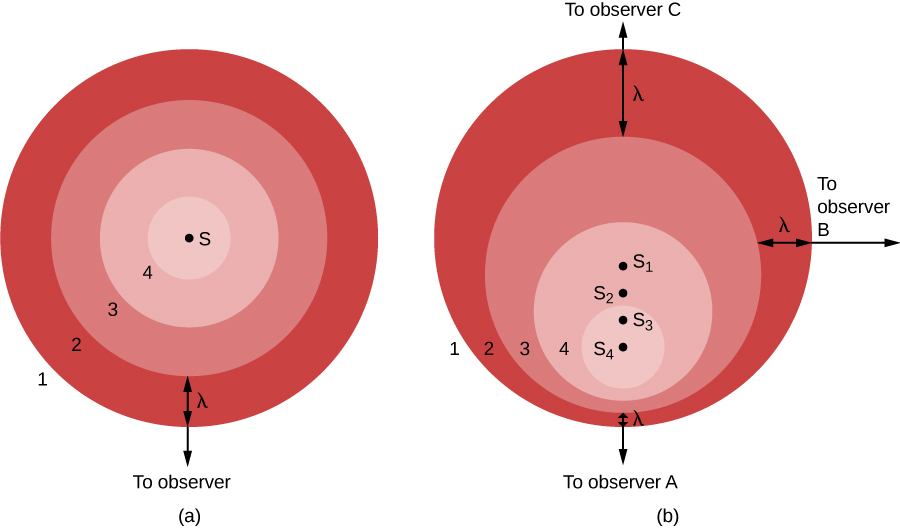
In 1842, Christian Doppler first measured the effect of motion on waves by hiring a group of musicians to play on an open railroad car as it was moving along the track. He then applied what he learned to all waves, including light, and pointed out that if a light source is approaching or receding from the observer, the light waves will be, respectively, crowded more closely together or spread out. The general principle, now known as the Doppler effect, is illustrated in Figure 5.22.
英語のヒント
1842年、クリスティアン・ドップラーは、音楽家の一団を雇い、走る屋根のない鉄道車両の上で演奏してもらうことで、運動が波に与える効果を初めて測定した。その後、学んだことを、光を含むすべての波に当てはめた。そして、光源が観測者に近づく場合は光の波の間隔が詰まり、遠ざかる場合は広がると指摘した。現在「ドップラー効果」として知られるこの一般原理を、図5.22に示す。
Doppler Effect.ドップラー効果。
OpenStax / Rice University · CC BY 4.0
Figure 5.22 (a) A source, S, makes waves whose numbered crests (1, 2, 3, and 4) wash over a stationary observer. (b) The source S now moves toward observer A and away from observer C. Wave crest 1 was emitted when the source was at position S1, crest 2 at position S2, and so forth. Observer A sees waves compressed by this motion and sees a blueshift (if the waves are light). Observer C sees the waves stretched out by the motion and sees a redshift. Observer B, whose line of sight is perpendicular to the source’s motion, sees no change in the waves (and feels left out).
図5.22 (a)波源Sが作る波の、番号1、2、3、4の山が、静止した観測者を通り過ぎる。(b)今度は波源Sが、観測者Aに近づき、観測者Cから遠ざかっている。波の山1は波源がS₁にあったとき、山2はS₂にあったときに放出され、以下も同様である。観測者Aには、この運動によって波が圧縮されて見え、光の波であれば青方偏移が見える。観測者Cには波が引き伸ばされて見え、赤方偏移が見える。視線が波源の運動と直角になっている観測者Bには、波の変化が見えず、仲間外れになった気がする。
In part (a) of the figure, the light source (S) is at rest with respect to the observer. The source gives off a series of waves, whose crests we have labeled 1, 2, 3, and 4. The light waves spread out evenly in all directions, like the ripples from a splash in a pond. The crests are separated by a distance, λ, where λ is the wavelength. The observer, who happens to be located in the direction of the bottom of the image, sees the light waves coming nice and evenly, one wavelength apart. Observers located anywhere else would see the same thing.
英語のヒント
図(a)では、光源Sは観測者に対して静止している。光源が出す一連の波の山に、1、2、3、4と番号を付けてある。光の波は、池で水が跳ねたあとの波紋のように、あらゆる方向へ均等に広がる。山どうしは、波長λだけ離れている。たまたま図の下側の方向にいる観測者には、光の波が一波長ずつ離れ、きれいに均等に届く。他のどこにいる観測者にも、同じものが見えるだろう。
On the other hand, if the source of light is moving with respect to the observer, as seen in part (b), the situation is more complicated. Between the time one crest is emitted and the next one is ready to come out, the source has moved a bit, toward the bottom of the page. From the point of view of observer A, this motion of the source has decreased the distance between crests—it’s squeezing the crests together, this observer might say.
英語のヒント
それに対し、図(b)のように光源が観測者に対して動くと、状況は複雑になる。一つの山が出てから、次の山が出るまでの間に、光源は紙面の下のほうへ少し移動している。観測者Aから見ると、この光源の移動によって山と山の距離が縮まっている。山どうしが押し縮められている、と、この観測者は言うかもしれない。
In part (b), we show the situation from the perspective of three observers. The source is seen in four positions, S1, S2, S3, and S4, each corresponding to the emission of one wave crest. To observer A, the waves seem to follow one another more closely, at a decreased wavelength and thus increased frequency. (Remember, all light waves travel at the speed of light through empty space, no matter what. This means that motion cannot affect the speed, but only the wavelength and the frequency. As the wavelength decreases, the frequency must increase. If the waves are shorter, more will be able to move by during each second.)
英語のヒント
図(b)では、3人の観測者の立場から状況を示している。光源はS₁、S₂、S₃、S₄という4つの位置に描かれ、それぞれが一つの波の山を放出したときに対応する。観測者Aには、波がより詰まって次々に届くように見え、波長は短く、振動数は高くなる。空っぽの空間では、どんな場合も光の波はすべて光速で進むことを思い出そう。そのため、運動で変わるのは速さではなく、波長と振動数だけである。波長が短くなると、振動数は増えなければならない。波が短ければ、毎秒より多くの波が通過できるからである。
The situation is not the same for other observers. Let’s look at the situation from the point of view of observer C, located opposite observer A in the figure. For her, the source is moving away from her location. As a result, the waves are not squeezed together but instead are spread out by the motion of the source. The crests arrive with an increased wavelength and decreased frequency. To observer B, in a direction at right angles to the motion of the source, no effect is observed. The wavelength and frequency remain the same as they were in part (a) of the figure.
英語のヒント
ほかの観測者には同じようには見えない。図で観測者Aの反対側にいる、観測者Cの立場から見てみよう。Cにとっては、光源はこちらから遠ざかっている。そのため波は押し詰められず、光源の運動によって、逆に引き離される。波の山は、波長が長く、振動数が低くなって届く。光源の運動と直角の方向にいる観測者Bには、効果は観測されない。波長も振動数も、図(a)のときと同じままである。
We can see from this illustration that the Doppler effect is produced only by a motion toward or away from the observer, a motion called radial velocity. Sideways motion does not produce such an effect. Observers between A and B would observe some shortening of the light waves for that part of the motion of the source that is along their line of sight. Observers between B and C would observe lengthening of the light waves that are along their line of sight.
英語のヒント
この図から、ドップラー効果が生じるのは、観測者に近づくか遠ざかる運動だけであることがわかる。この方向の速度を「視線速度」という。横向きの運動は、このような効果を生まない。AとBの間にいる観測者は、光源の運動のうち、自分の視線に沿う成分について、光の波の短縮を観測する。BとCの間にいる観測者は、自分の視線に沿う光の波が長くなるのを観測する。
You may have heard the Doppler effect with sound waves. When a train whistle or police siren approaches you and then moves away, you will notice a decrease in the pitch (which is how human senses interpret sound wave frequency) of the sound waves. Compared to the waves at rest, they have changed from slightly more frequent when coming toward you, to slightly less frequent when moving away from you.
英語のヒント
音の波によるドップラー効果を、耳で聞いたことがあるかもしれない。列車の汽笛やパトカーのサイレンが近づき、その後遠ざかると、音の高さが下がるのに気づくだろう。音の高さとは、音波の振動数を人の感覚がどう受け取るかである。波源が静止している場合と比べ、近づくときは少し高かった振動数が、遠ざかるときには少し低くなる。