第5章放射とスペクトルRadiation and Spectra
5.4 The Structure of the Atom5.4 原子の構造
Learning Objectives学習の目標
By the end of this section, you will be able to:
この節を終えると、次のことができるようになる。
Describe the structure of atoms and the components of nuclei
原子の構造と、原子核の構成要素を説明する
Explain the behavior of electrons within atoms and how electrons interact with light to move among energy levels
原子の中の電子の振る舞いと、光との相互作用によって電子がエネルギー準位の間をどう移るかを説明する
The idea that matter is composed of tiny particles called atoms is at least 25 centuries old. It took until the twentieth century, however, for scientists to invent instruments that permitted them to probe inside an atom and find that it is not, as had been thought, hard and indivisible. Instead, the atom is a complex structure composed of still smaller particles.
英語のヒント
物質は、原子と呼ばれる小さな粒子からできているという考えは、少なくとも25世紀前にさかのぼる。しかし、科学者が原子の内部を探る装置を発明し、それまで考えられていたような、硬くて分割できないものではないと確かめられたのは、20世紀になってからだった。それどころか原子は、さらに小さな粒子からできた、複雑な構造だったのである。
Probing the Atom原子の内部を探る
The first of these smaller particles was discovered by British physicist James (J. J.) Thomson in 1897. Named the electron, this particle is negatively charged. (It is the flow of these particles that produces currents of electricity, whether in lightning bolts or in the wires leading to your lamp.) Because an atom in its normal state is electrically neutral, each electron in an atom must be balanced by the same amount of positive charge.
英語のヒント
この、さらに小さな粒子の最初のものは、1897年にイギリスの物理学者ジェームズ(J・J)・トムソンによって発見された。電子と名づけられたこの粒子は、負の電荷を帯びている。雷の稲妻でも、電灯へつながる導線でも、電流を生み出すのは、この粒子の流れである。通常の状態の原子は電気的に中性なので、原子の中のそれぞれの電子に対して、同じ量の正の電荷がつり合っていなければならない。
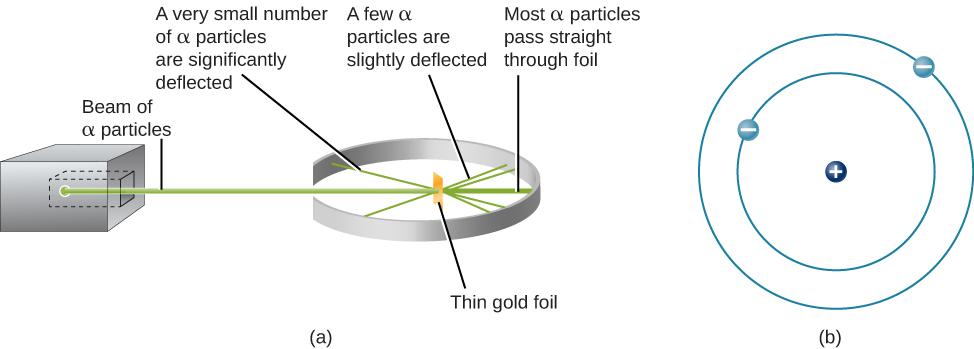
The next step was to determine where in the atom the positive and negative charges are located. In 1911, British physicist Ernest Rutherford devised an experiment that provided part of the answer to this question. He bombarded an extremely thin piece of gold foil, only about 400 atoms thick, with a beam of alpha particles (Figure 5.14). Alpha particles (α particles) are helium atoms that have lost their electrons and thus are positively charged. Most of these particles passed though the gold foil just as if it and the atoms in it were nearly empty space. About 1 in 8000 of the alpha particles, however, completely reversed direction and bounced backward from the foil. Rutherford wrote, [Quotation omitted for rights reasons.]
英語のヒント
次の課題は、原子のなかで正電荷と負電荷がどこにあるのかを明らかにすることだった。1911年、イギリスの物理学者アーネスト・ラザフォードは、この疑問への答えの一部を与える実験を考案した。厚さが原子約400個分しかない極薄の金箔に、アルファ粒子のビームを当てたのである(図5.14)。アルファ粒子(α粒子)は、電子を失ったヘリウム原子であり、正の電荷を持っている。粒子の大半は、金箔もその内部の原子もほぼ空っぽであるかのように、通り抜けた。しかし約8,000個に1個のアルファ粒子は、進行方向を完全に反転させ、金箔から後ろへ跳ね返った。ラザフォードはこう書いている。〔権利の関係で割愛〕
Rutherford’s Experiment.ラザフォードの実験。
OpenStax / Rice University · CC BY 4.0
Figure 5.14 (a) When Rutherford allowed α particles from a radioactive source to strike a target of gold foil, he found that, although most of them went straight through, some rebounded back in the direction from which they came. (b) From this experiment, he concluded that the atom must be constructed like a miniature solar system, with the positive charge concentrated in the nucleus and the negative charge orbiting in the large volume around the nucleus. Note that this drawing is not to scale; the electron orbits are much larger relative to the size of the nucleus.
図5.14 (a)ラザフォードは、放射性の線源から出たα粒子を、標的である金箔に当てた。大部分はまっすぐ通り抜けたが、一部は来た方向へ跳ね返ることがわかった。(b)この実験から、原子は小さな太陽系のようにできているはずだと結論した。正の電荷は原子核に集中し、負の電荷はその周りの広い体積の中を回る。この図は実際の縮尺ではないことに注意しよう。原子核の大きさに比べて、電子の軌道ははるかに大きい。
The only way to account for the particles that reversed direction when they hit the gold foil was to assume that nearly all of the mass, as well as all of the positive charge in each individual gold atom, is concentrated in a tiny center or nucleus. When a positively charged alpha particle strikes a nucleus, it reverses direction, much as a cue ball reverses direction when it strikes another billiard ball. Rutherford’s model placed the other type of charge—the negative electrons—in orbit around this nucleus.
英語のヒント
金箔に当たると向きを反転させる粒子を説明する唯一の方法は、一つ一つの金原子のほぼ全質量と、正の電荷のすべてが、中心のごく小さな部分、すなわち原子核に集中していると仮定することだった。正に帯電したアルファ粒子が原子核にぶつかると、ビリヤードの手球が別の球にぶつかって戻るのとよく似た形で、向きを反転させる。ラザフォードのモデルは、もう一方の種類の電荷、つまり負の電子を、この原子核の周りの軌道に置いた。
Rutherford’s model required that the electrons be in motion. Positive and negative charges attract each other, so stationary electrons would fall into the positive nucleus. Also, because both the electrons and the nucleus are extremely small, most of the atom is empty, which is why nearly all of Rutherford’s particles were able to pass right through the gold foil without colliding with anything. Rutherford’s model was a very successful explanation of the experiments he conducted, although eventually scientists would discover that even the nucleus itself has structure.
英語のヒント
ラザフォードのモデルでは、電子が動いている必要があった。正と負の電荷は引き合うため、静止した電子は正の原子核へ落ち込んでしまうだろう。また電子と原子核はどちらも非常に小さいので、原子の大部分は空っぽである。そのため、ラザフォードが使った粒子のほとんどは、何にも衝突せずに金箔をまっすぐ通り抜けることができた。ラザフォードのモデルは、彼が行った実験を非常にうまく説明した。ただし科学者たちは、やがて、原子核そのものにも構造があることを発見することになる。
The Atomic Nucleus原子核
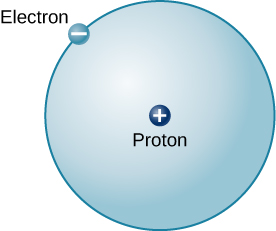
The simplest possible atom (and the most common one in the Sun and stars) is hydrogen. The nucleus of ordinary hydrogen contains a single proton. Moving around this proton is a single electron. The mass of an electron is nearly 2000 times smaller than the mass of a proton; the electron carries an amount of charge exactly equal to that of the proton but opposite in sign (Figure 5.15). Opposite charges attract each other, so it is an electromagnetic force that holds the proton and electron together, just as gravity is the force that keeps planets in orbit around the Sun.
英語のヒント
最も単純な原子で、太陽や恒星の中で最も多い原子が、水素である。通常の水素の原子核には、陽子が1個だけある。その周りを、1個の電子が動いている。電子の質量は、陽子のほぼ2,000分の1である。電子が運ぶ電荷は、陽子と大きさがまったく同じで、符号が反対である(図5.15)。異符号の電荷どうしは引き合うので、陽子と電子を結びつけているのは電磁気力である。これは、太陽の周りの軌道に惑星を保っている力が重力であるのと、よく似ている。
Hydrogen Atom.水素原子。
OpenStax / Rice University · CC BY 4.0
Figure 5.15 This is a schematic diagram of a hydrogen atom in its lowest energy state, also called the ground state. The proton and electron have equal but opposite charges, which exert an electromagnetic force that binds the hydrogen atom together. In the illustration, the size of the particles is exaggerated so that you can see them; they are not to scale. They are also shown much closer than they would actually be as it would take more than an entire page to show their actual distance to scale.
図5.15 基底状態とも呼ばれる、最もエネルギーの低い状態の水素原子を示した模式図。陽子と電子は大きさが等しく、符号が反対の電荷を持ち、それらが及ぼす電磁気力によって水素原子が結びついている。図では粒子が見えるように、大きさを誇張しており、実際の縮尺にはなっていない。また、実際の距離を縮尺どおりに描くと、1ページいっぱいでも足りなくなるため、両者は本来よりずっと近くに示している。
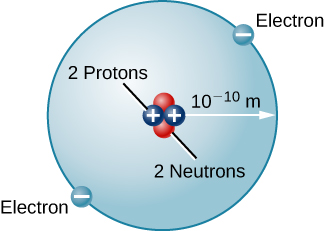
There are many other types of atoms in nature. Helium, for example, is the second-most abundant element in the Sun. Helium has two protons in its nucleus instead of the single proton that characterizes hydrogen. In addition, the helium nucleus contains two neutrons, particles with a mass comparable to that of the proton but with no electric charge. Moving around this nucleus are two electrons, so the total net charge of the helium atom is also zero (Figure 5.16).
英語のヒント
自然界には、ほかにも多くの種類の原子がある。たとえばヘリウムは、太陽の中で2番目に多い元素である。水素の特徴となる1個の陽子の代わりに、ヘリウムは原子核に2個の陽子を持つ。さらにヘリウム原子核には、陽子と同程度の質量を持つが、電荷を持たない粒子である中性子が2個含まれる。この原子核の周りには2個の電子が動いているので、ヘリウム原子全体の正味の電荷もゼロである(図5.16)。
Helium Atom.ヘリウム原子。
OpenStax / Rice University · CC BY 4.0
Figure 5.16 Here we see a schematic diagram of a helium atom in its lowest energy state. Two protons are present in the nucleus of all helium atoms. In the most common variety of helium, the nucleus also contains two neutrons, which have nearly the same mass as the proton but carry no charge. Two electrons orbit the nucleus.
図5.16 最もエネルギーの低い状態のヘリウム原子を示した模式図。どのヘリウム原子の原子核にも陽子が2個ある。最も一般的な種類のヘリウムでは、原子核には中性子も2個含まれる。中性子は陽子とほぼ同じ質量を持つが、電荷は持たない。2個の電子が原子核を回る。
From this description of hydrogen and helium, perhaps you have guessed the pattern for building up all the elements (different types of atoms) that we find in the universe. The type of element is determined by the number of protons in the nucleus of the atom. For example, any atom with six protons is the element carbon, with eight protons is oxygen, with 26 is iron, and with 92 is uranium. On Earth, a typical atom has the same number of electrons as protons, and these electrons follow complex orbital patterns around the nucleus. Deep inside stars, however, it is so hot that the electrons get loose from the nucleus and (as we shall see) lead separate yet productive lives.
英語のヒント
水素とヘリウムのこの説明から、宇宙にあるすべての元素、つまりさまざまな種類の原子を組み立てる規則を、もう推測できたかもしれない。元素の種類は、原子核内の陽子の数によって決まる。たとえば陽子が6個の原子は炭素、8個なら酸素、26個なら鉄、92個ならウランという元素である。地上の典型的な原子は、陽子と同じ数の電子を持ち、電子は原子核の周りを複雑な軌道の模様に従って動く。しかし恒星の内部深くでは、あまりに高温なので、電子が原子核から自由になり、これから見るように、別々に、それでも重要な働きをしながら過ごしている。
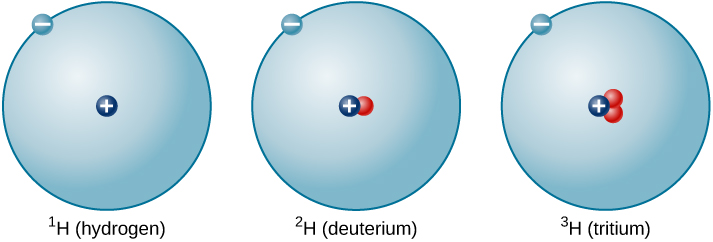
The ratio of neutrons to protons increases as the number of protons increases, but each element is unique. The number of neutrons is not necessarily the same for all atoms of a given element. For example, most hydrogen atoms contain no neutrons at all. There are, however, hydrogen atoms that contain one proton and one neutron, and others that contain one proton and two neutrons. The various types of hydrogen nuclei with different numbers of neutrons are called isotopes of hydrogen (Figure 5.17), and all other elements have isotopes as well. You can think of isotopes as siblings in the same element “family”—closely related but with different characteristics and behaviors.
英語のヒント
陽子の数が増えると、陽子に対する中性子の比も増えるが、元素はそれぞれ固有のものである。また、ある元素の原子すべてで、中性子の数が必ず同じとは限らない。たとえば水素原子の大部分には、中性子がまったくない。しかし、陽子1個と中性子1個を持つ水素原子や、陽子1個と中性子2個を持つ水素原子もある。このように中性子の数が異なる、さまざまな種類の水素原子核を、水素の「同位体」と呼ぶ(図5.17)。ほかのすべての元素にも、同位体がある。同位体は、同じ元素の「家族」の中のきょうだいと考えられる。近い関係にあるが、性質や振る舞いが異なるのである。
Isotopes of Hydrogen.水素の同位体。
OpenStax / Rice University · CC BY 4.0
Figure 5.17 A single proton in the nucleus defines the atom to be hydrogen, but there may be zero, one, or two neutrons. The most common isotope of hydrogen is the one with only a single proton and no neutrons.
図5.17 原子核に陽子が1個あることで、その原子は水素と定まるが、中性子の数は0個、1個、2個の場合がある。最もよくある水素の同位体は、陽子1個だけを持ち、中性子を持たないものである。