第5章放射とスペクトルRadiation and Spectra
The Wave-Like Characteristics of Light光の波としての性質
The changing electric and magnetic fields in light are similar to the waves that can be set up in a quiet pool of water. In both cases, the disturbance travels rapidly outward from the point of origin and can use its energy to disturb other things farther away. (For example, in water, the expanding ripples moving away from our frog could disturb the peace of a dragonfly resting on a leaf in the same pool.) In the case of electromagnetic waves, the radiation generated by a transmitting antenna full of charged particles and moving electrons at your local radio station can, sometime later, disturb a group of electrons in your car radio antenna and bring you the news and weather while you are driving to class or work in the morning.
英語のヒント
光の中の変化する電場と磁場は、静かな水たまりに作ることのできる波によく似ている。どちらの場合も、乱れは発生点から外へすばやく伝わり、そのエネルギーを使って、さらに遠い別のものを揺らすことができる。たとえば水の場合、先ほどのカエルから離れて広がる波紋は、同じ水たまりの葉の上で休んでいるトンボの静けさを乱すかもしれない。電磁波の場合には、地元のラジオ局の送信アンテナで作られる放射を考えられる。アンテナには電荷を帯びた粒子や動く電子がたくさんあり、そこからの放射が、少し後に、車のラジオのアンテナ内の電子の集まりを動かす。こうして、朝、授業や仕事へ車で向かっている私たちに、ニュースや天気予報を届けてくれる。
The waves generated by charged particles differ from water waves in some profound ways, however. Water waves require water to travel in. The sound waves we hear, to give another example, are pressure disturbances that require air to travel though. But electromagnetic waves do not require water or air: the fields generate each other and so can move through a vacuum (such as outer space). This was such a disturbing idea to nineteenth-century scientists that they actually made up a substance to fill all of space—one for which there was not a single shred of evidence—just so light waves could have something to travel through: they called it the aether. Today, we know that there is no aether and that electromagnetic waves have no trouble at all moving through empty space (as all the starlight visible on a clear night must surely be doing).
英語のヒント
しかし、電荷を帯びた粒子が作る波は、水の波とはいくつかの本質的な点で異なる。水の波が伝わるには、水が必要である。別の例として、私たちに聞こえる音の波は、伝わるために空気を必要とする圧力の乱れである。ところが、電磁波には水も空気も必要ない。電場と磁場が互いを生み出すため、宇宙空間のような真空の中も進める。19世紀の科学者たちにとって、これは非常に受け入れにくい考え方だった。そのため彼らは、光の波が伝わるための何かを持てるようにするためだけに、空間全体を満たす物質を本当に考え出した。その物質の存在を示す証拠は、ひとかけらもなかった。彼らはそれをエーテルと呼んだ。現在では、エーテルは存在せず、電磁波は空っぽの空間を何の支障もなく進めるとわかっている。晴れた夜に見える星の光は、確かにすべて、そのようにして進んできたはずである。
The other difference is that all electromagnetic waves move at the same speed in empty space (the speed of light—approximately 300,000 kilometers per second, or 300,000,000 meters per second, which can also be written as ), which turns out to be the fastest possible speed in the universe. No matter where electromagnetic waves are generated from and no matter what other properties they have, when they are moving (and not interacting with matter), they move at the speed of light. Yet you know from everyday experience that there are different kinds of light. For example, we perceive that light waves differ from one another in a property we call color. Let’s see how we can denote the differences among the whole broad family of electromagnetic waves.
英語のヒント
もう一つの違いは、すべての電磁波が、空っぽの空間では同じ速さで動くことである。この光速は、毎秒約30万キロメートル、つまり毎秒3億メートルであり、とも書ける。そして、これが宇宙で可能な最も速い速さだとわかっている。電磁波がどこで発生したものであっても、ほかにどのような性質を持っていても、物質と相互作用せずに進んでいるときには、光速で進む。しかし日常の経験から、光にはさまざまな種類があることを、私たちは知っている。たとえば、光の波が「色」と呼ぶ性質の違いを持つことを感じ取れる。電磁波という広い仲間全体の中で、その違いをどう表せるかを見ていこう。
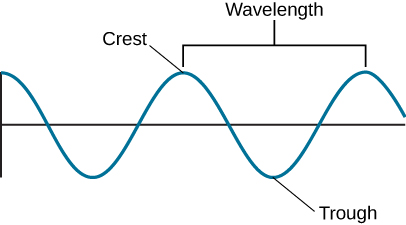
The nice thing about a wave is that it is a repeating phenomenon. Whether it is the up-and-down motion of a water wave or the changing electric and magnetic fields in a wave of light, the pattern of disturbance repeats in a cyclical way. Thus, any wave motion can be characterized by a series of crests and troughs (Figure 5.4). Moving from one crest through a trough to the next crest completes one cycle. The horizontal length covered by one cycle is called the wavelength. Ocean waves provide an analogy: the wavelength is the distance that separates successive wave crests.
英語のヒント
波のありがたい特徴は、繰り返す現象だということである。水の波の上下運動でも、光の波の変化する電場と磁場でも、乱れの模様は周期的に繰り返される。したがって、どのような波動も、山と谷の連なりによって特徴づけられる(図5.4)。ある山から谷を通り、次の山へ至ると、1周期分の繰り返しが完了する。1周期分が占める水平方向の長さを「波長」という。海の波をたとえにすると、波長は、隣り合う波の山を隔てる距離である。
Characterizing Waves.波の特徴を表す。
OpenStax / Rice University · CC BY 4.0
Figure 5.4 Electromagnetic radiation has wave-like characteristics. The wavelength (λ) is the distance between crests, the frequency (f) is the number of cycles per second, and the speed (c) is the distance the wave covers during a specified period of time (e.g., kilometers per second).
図5.4 電磁放射には、波としての性質がある。波長λは山どうしの間の距離であり、振動数fは1秒当たりの周期の数である。速さcは、決められた時間に波が進む距離を表す。たとえば、毎秒何キロメートルという量である。
For visible light, our eyes perceive different wavelengths as different colors: red, for example, is the longest visible wavelength, and violet is the shortest. The main colors of visible light from longest to shortest wavelength can be remembered using the mnemonic ROY G BIV—for Red, Orange, Yellow, Green, Blue, Indigo, and Violet. Other invisible forms of electromagnetic radiation have different wavelengths, as we will see in the next section.
英語のヒント
可視光では、私たちの目は波長の違いを色の違いとして感じ取る。たとえば、赤は目に見える中で最も波長が長く、紫は最も短い。可視光の主な色を波長の長い順に覚えるには、ROY G BIVという語呂合わせが使える。Red(赤)、Orange(橙)、Yellow(黄)、Green(緑)、Blue(青)、Indigo(藍)、Violet(紫)の頭文字である。目に見えないほかの種類の電磁放射は、次の節で見るように、さらに異なる波長を持っている。
We can also characterize different waves by their frequency, the number of wave cycles that pass by per second. If you count 10 crests moving by each second, for example, then the frequency is 10 cycles per second (cps). In honor of Heinrich Hertz, the physicist who—inspired by Maxwell’s work—discovered radio waves, a cps is also called a hertz (Hz). Take a look at your radio, for example, and you will see the channel assigned to each radio station is characterized by its frequency, usually in units of kHz (kilohertz, or thousands of hertz) or MHz (megahertz, or millions of hertz).
英語のヒント
波は、1秒間に通過する周期の数である「振動数」によっても区別できる。たとえば、毎秒10個の山が通り過ぎれば、振動数は毎秒10周期、10 cpsである。マクスウェルの研究に触発されて電波を発見した物理学者ハインリヒ・ヘルツに敬意を表し、1 cpsは1ヘルツ(Hz)とも呼ばれる。たとえばラジオを見てみよう。各放送局に割り当てられたチャンネルが、その周波数で表されているのがわかる。単位は通常、1,000 Hzを表すkHz(キロヘルツ)や、100万Hzを表すMHz(メガヘルツ)である。
Wavelength (λ) and frequency (f) are related because all electromagnetic waves travel at the same speed. To see how this works, imagine a parade in which everyone is forced by prevailing traffic conditions to move at exactly the same speed. You stand on a corner and watch the waves of marchers come by. First you see row after row of miniature ponies. Because they are not very large and, therefore, have a shorter wavelength, a good number of the ponies can move past you each minute; we can say they have a high frequency. Next, however, come several rows of circus elephants. The elephants are large and marching at the same speed as the ponies, so far fewer of them can march past you per minute: Because they have a wider spacing (longer wavelength), they represent a lower frequency.
英語のヒント
波長λと振動数fは、すべての電磁波が同じ速さで進むため、互いに関係している。その仕組みを見るため、周囲の交通状況によって、全員がまったく同じ速さで進まなければならないパレードを想像しよう。皆さんは街角に立って、次々に通り過ぎる行進の列を見ている。最初に見えるのは、何列にも続く小型のポニーである。あまり大きくなく、そのため波長が短いので、毎分かなり多くのポニーが皆さんの前を通り過ぎる。これらは振動数が高いと言える。ところが次に、サーカスのゾウの列がいくつもやってくる。ゾウは大きく、しかもポニーと同じ速さで歩いているため、1分間に通り過ぎられる頭数はずっと少ない。間隔が広い、つまり波長が長いので、振動数が低い場合に対応している。
The formula for this relationship can be expressed as follows: for any wave motion, the speed at which a wave moves equals the frequency times the wavelength. Waves with longer wavelengths have lower frequencies. Mathematically, we can express this as
英語のヒント
この関係を式で表すと、次のようになる。どのような波動でも、波が進む速さは、振動数と波長の積に等しい。波長が長い波ほど、振動数は低い。数学的には、こう書ける。
where the Greek letter for “l”—lambda, λ—is used to denote wavelength and c is the scientific symbol for the speed of light. Solving for the wavelength, this is expressed as:
英語のヒント
ここで、波長を表すために、英字のlに対応するギリシャ文字のラムダλを使っており、cは科学で光速を表す記号である。この式を波長について解くと、次のようになる。
Deriving and Using the Wave Equation波の関係式を導き、使う
The equation for the relationship between the speed and other characteristics of a wave can be derived from our basic understanding of motion. The average speed of anything that is moving is:
英語のヒント
波の速さと、ほかの特徴との関係を表す式は、運動についての基本的な理解から導ける。動いているものの平均の速さは、次のように表される。
(So, for example, a car on the highway traveling at a speed of 100 km/h covers 100 km during the time of 1 h.) For an electromagnetic wave to travel the distance of one of its wavelengths, λ, at the speed of light, c, we have . The frequency of a wave is the number of cycles per second. If a wave has a frequency of a million cycles per second, then the time for each cycle to go by is a millionth of a second. So, in general, . Substituting into our wave equation, we get . Now let’s use this to calculate an example. What is the wavelength of visible light that has a frequency of ?
英語のヒント
たとえば、高速道路を100 km/hで走る自動車は、1時間で100 km進む。電磁波が光速cで、波長λの1個分の距離を進む場合には、となる。波の振動数は、1秒当たりの周期の数である。振動数が毎秒100万周期なら、1周期分が通過する時間は100万分の1秒である。したがって一般に、となる。これを波の関係式に代入すると、が得られる。では、この式を使って例を計算しよう。振動数がである可視光の波長は、いくらだろうか。
Solution解き方
Solving the wave equation for wavelength, we find:
波の関係式を波長について解くと、次のようになる。
Substituting our values gives:
数値を代入すると、次の結果が得られる。
This answer can also be written as 530 nm, which is in the yellow-green part of the visible spectrum (nm stands for nanometers, where the term “nano” means “billionths”).
英語のヒント
この答えは530 nmとも書け、可視スペクトルの黄緑色の領域に当たる。nmはナノメートルを表し、「ナノ」は10億分の1を意味する。
Check Your Learning理解を確かめよう
“Tidal waves,” or tsunamis, are waves caused by earthquakes that travel rapidly through the ocean. If a tsunami travels at the speed of 600 km/h and approaches a shore at a rate of one wave crest every 15 min (4 waves/h), what would be the distance between those wave crests at sea?
英語のヒント
「潮汐波」とも呼ばれる津波は、地震によって生じ、海を速く伝わる波である。津波が600 km/hで進み、15分ごとに一つの波の山が、すなわち1時間に4個の山が岸へ近づいてくるとすると、海上での山どうしの距離はいくらになるだろうか。