第5章放射とスペクトルRadiation and Spectra
Light as a Photon光子としての光
The electromagnetic wave model of light (as formulated by Maxwell) was one of the great triumphs of nineteenth-century science. In 1887, when Heinrich Hertz actually made invisible electromagnetic waves (what today are called radio waves) on one side of a room and detected them on the other side, it ushered in a new era that led to the modern age of telecommunications. His experiment ultimately led to the technologies of television, cell phones, and today’s wireless networks around the globe.
英語のヒント
マクスウェルが定式化した、光を電磁波とするモデルは、19世紀の科学における大きな成功の一つだった。1887年、ハインリヒ・ヘルツは、目に見えない電磁波、今日でいう電波を、部屋の一方の側で実際に発生させ、反対側で検出した。この出来事は、新しい時代の幕を開け、現代の電気通信の時代へとつながった。ヘルツの実験は、最終的にはテレビや携帯電話、そして現在、世界中を覆う無線ネットワークの技術へつながったのである。
However, by the beginning of the twentieth century, more sophisticated experiments had revealed that light behaves in certain ways that cannot be explained by the wave model. Reluctantly, physicists had to accept that sometimes light behaves more like a “particle”—or at least a self-contained packet of energy—than a wave. We call such a packet of electromagnetic energy a photon.
英語のヒント
しかし20世紀の初めまでに、さらに高度な実験から、光には波のモデルで説明できない振る舞いもあると明らかになっていた。物理学者たちは、気が進まないながらも、光はときに、波よりも「粒子」、あるいは少なくとも、それ自体でまとまったエネルギーのひとかたまりのように振る舞うことを認めなければならなかった。このような電磁エネルギーのひとかたまりを、「光子」と呼ぶ。
The fact that light behaves like a wave in certain experiments and like a particle in others was a very surprising and unlikely idea. After all, our common sense says that waves and particles are opposite concepts. On one hand, a wave is a repeating disturbance that, by its very nature, is not in only one place, but spreads out. A particle, on the other hand, is something that can be in only one place at any given time. Strange as it sounds, though, countless experiments now confirm that electromagnetic radiation can sometimes behave like a wave and at other times like a particle.
英語のヒント
光が、ある実験では波のように、別の実験では粒子のように振る舞うということは、とても意外で、ありそうにもない考え方だった。何といっても私たちの常識では、波と粒子は反対の概念だからである。一方では、波は繰り返す乱れであり、その本性からして、一か所だけにあるのではなく広がっている。他方、粒子は、ある瞬間には一か所だけに存在できるものである。奇妙に聞こえるかもしれないが、今では無数の実験によって、電磁放射が、あるときは波のように、別のときは粒子のように振る舞えることが確かめられている。
Then, again, perhaps we shouldn’t be surprised that something that always travels at the “speed limit” of the universe and doesn’t need a medium to travel through might not obey our everyday common sense ideas. The confusion that this wave-particle duality of light caused in physics was eventually resolved by the introduction of a more complicated theory of waves and particles, now called quantum mechanics. (This is one of the most interesting fields of modern science, but it is mostly beyond the scope of our book. If you are interested in it, see some of the suggested resources at the end of this chapter.)
英語のヒント
もっとも、宇宙の「制限速度」でいつも進み、伝わるための媒質も必要としないものが、私たちの日常的な常識に従わないかもしれないということに、驚くべきではないのかもしれない。光のこの波動と粒子の二重性が物理学にもたらした混乱は、現在「量子力学」と呼ばれる、波と粒子についてのより複雑な理論の導入によって、最終的に解決された。これは現代科学の最も興味深い分野の一つだが、大部分は本書の範囲を超えている。興味があれば、この章の最後に挙げた参考資料をいくつか見てほしい。
In any case, you should now be prepared when scientists (or the authors of this book) sometimes discuss electromagnetic radiation as if it consisted of waves and at other times refer to it as a stream of photons. A photon (being a packet of energy) carries a specific amount of energy. We can use the idea of energy to connect the photon and wave models. How much energy a photon has depends on its frequency when you think about it as a wave. A low-energy radio wave has a low frequency as a wave, while a high-energy X-ray at your dentist’s office is a high-frequency wave. Among the colors of visible light, violet-light photons have the highest energy and red-light photons have the lowest.
英語のヒント
いずれにせよ、科学者や本書の著者が、あるときには電磁放射を波からできているかのように論じ、別のときには光子の流れとして述べても、これでもう戸惑わずにすむだろう。光子は、エネルギーのひとかたまりなので、一定の量のエネルギーを運ぶ。このエネルギーという考え方を使って、光子モデルと波のモデルを結びつけられる。光子が持つエネルギーの量は、それを波として考えたときの振動数に依存する。エネルギーの低い電波は、波としては振動数が低い。それに対し、歯科医院で使われるエネルギーの高いX線は、振動数の高い波である。可視光の色の中では、紫の光子のエネルギーが最も高く、赤の光子のエネルギーが最も低い。
Test whether the connection between photons and waves is clear to you. In the above example, which photon would have the longer wavelength as a wave: the radio wave or the X-ray? If you answered the radio wave, you are correct. Radio waves have a lower frequency, so the wave cycles are longer (they are elephants, not miniature ponies).
英語のヒント
光子と波の結びつきを理解できたか、確かめてみよう。前の例では、電波とX線のどちらの光子が、波として考えたときに長い波長を持つだろうか。電波と答えたなら、正解である。電波は振動数が低いため、波の1周期分の長さは長い。先ほどのたとえなら、小型のポニーではなく、ゾウに当たる。
Propagation of Light光の伝播
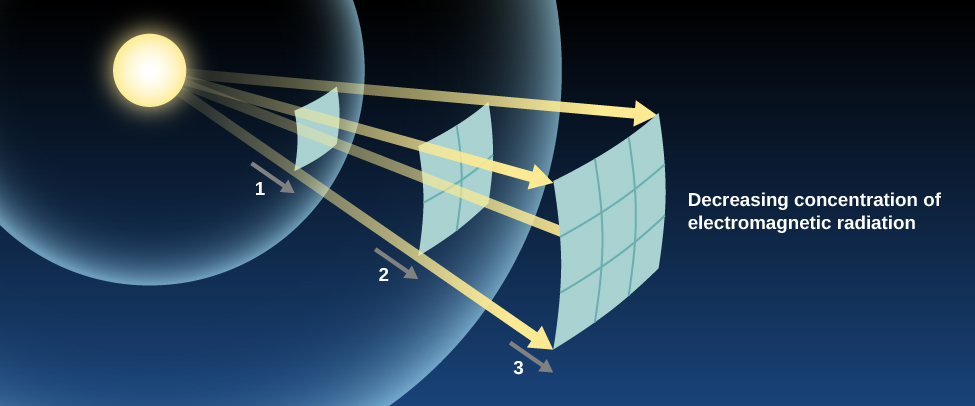
Let’s think for a moment about how light from a lightbulb moves through space. As waves expand, they travel away from the bulb, not just toward your eyes but in all directions. They must therefore cover an ever-widening space. Yet the total amount of light available can’t change once the light has left the bulb. This means that, as the same expanding shell of light covers a larger and larger area, there must be less and less of it in any given place. Light (and all other electromagnetic radiation) gets weaker and weaker as it gets farther from its source.
英語のヒント
電球からの光が、空間をどのように進むかを少し考えてみよう。波は広がりながら電球を離れ、皆さんの目の方向だけでなく、あらゆる方向へ進む。したがって、ますます広い空間を覆わなければならない。しかし、いったん電球を離れたあとでは、光の総量は変わることができない。これは、同じ光が殻のように広がり、覆う面積がますます大きくなると、ある一つの場所にある光の量は、ますます少なくならなければならないことを意味する。光も、それ以外のすべての電磁放射も、発生源から遠ざかるにつれて弱くなる。
The increase in the area that the light must cover is proportional to the square of the distance that the light has traveled (Figure 5.5). If we stand twice as far from the source, our eyes will intercept two-squared (2 × 2), or four times less light. If we stand 10 times farther from the source, we get 10-squared, or 100 times less light. You can see how this weakening means trouble for sources of light at astronomical distances. One of the nearest stars, Alpha Centauri A, emits about the same total energy as the Sun. But it is about 270,000 times farther away, and so it appears about 73 billion times fainter. No wonder the stars, which close-up would look more or less like the Sun, look like faint pinpoints of light from far away.
英語のヒント
光が覆わなければならない面積の増加は、光が進んだ距離の2乗に比例する(図5.5)。光源から2倍の距離に立てば、目が受け取る光は、2の2乗、つまり2×2で4分の1になる。10倍の距離に立てば、10の2乗、つまり100分の1の光を受け取る。この弱まり方が、天文学的な距離にある光源にとって問題になることがわかるだろう。最も近い恒星の一つ、ケンタウルス座α星Aは、太陽とほぼ同じ総エネルギーを放出している。しかし、約27万倍遠くにあるため、見かけの明るさは約730億分の1になる。近くで見ればおおむね太陽のように見える恒星が、遠くからはかすかな光の点に見えるのも、不思議ではない。
Inverse Square Law for Light.光の逆2乗の法則。
OpenStax / Rice University · CC BY 4.0
Figure 5.5 As light radiates away from its source, it spreads out in such a way that the energy per unit area (the amount of energy passing through one of the small squares) decreases as the square of the distance from its source.
図5.5 光が光源から離れて放射状に広がると、単位面積当たりのエネルギー、すなわち小さな正方形一つを通過するエネルギーの量は、光源からの距離の2乗に反比例して減少する。
This idea—that the apparent brightness of a source (how bright it looks to us) gets weaker with distance in the way we have described—is known as the inverse square law for light propagation. In this respect, the propagation of light is similar to the effects of gravity. Remember that the force of gravity between two attracting masses is also inversely proportional to the square of their separation.
英語のヒント
光源の見かけの明るさ、つまり私たちにどれくらい明るく見えるかが、ここで説明した仕方で距離とともに弱くなるという考え方を、光の伝播に関する「逆2乗の法則」という。この点で、光の伝播は重力の作用に似ている。引き合う二つの質量の間の重力も、それらの距離の2乗に反比例することを思い出そう。
The Inverse Square Law for Light光の逆2乗の法則
The intensity of a 120-W lightbulb observed from a distance 2 m away is 2.4 W/m2. What would be the intensity if this distance was doubled?
英語のヒント
120 Wの電球を2 m離れた場所から観測すると、光の強度は2.4 W/m²である。この距離を2倍にすると、強度はいくらになるだろうか。
Solution解き方
If we move twice as far away, then the answer will change according to the inverse square of the distance, so the new intensity will be of the original intensity, or 0.6 W/m2.
2倍遠くへ移動すると、値は距離の2乗の逆数に従って変化する。そのため、新しい強度は元の強度の、つまり0.6 W/m²になる。
Check Your Learning理解を確かめよう
How many times brighter or fainter would a star appear if it were moved to:
ある恒星を次の距離へ移したとすると、見かけの明るさは元の何倍、または何分の1になるか。
twice its present distance?
現在の2倍の距離
ten times its present distance?
現在の10倍の距離
half its present distance?
現在の半分の距離