第21章星の誕生と太陽系外惑星の発見The Birth of Stars and the Discovery of Planets outside the Solar System
Thinking Aheadまず考えてみよう
Where Stars Are Born.星が生まれる場所。
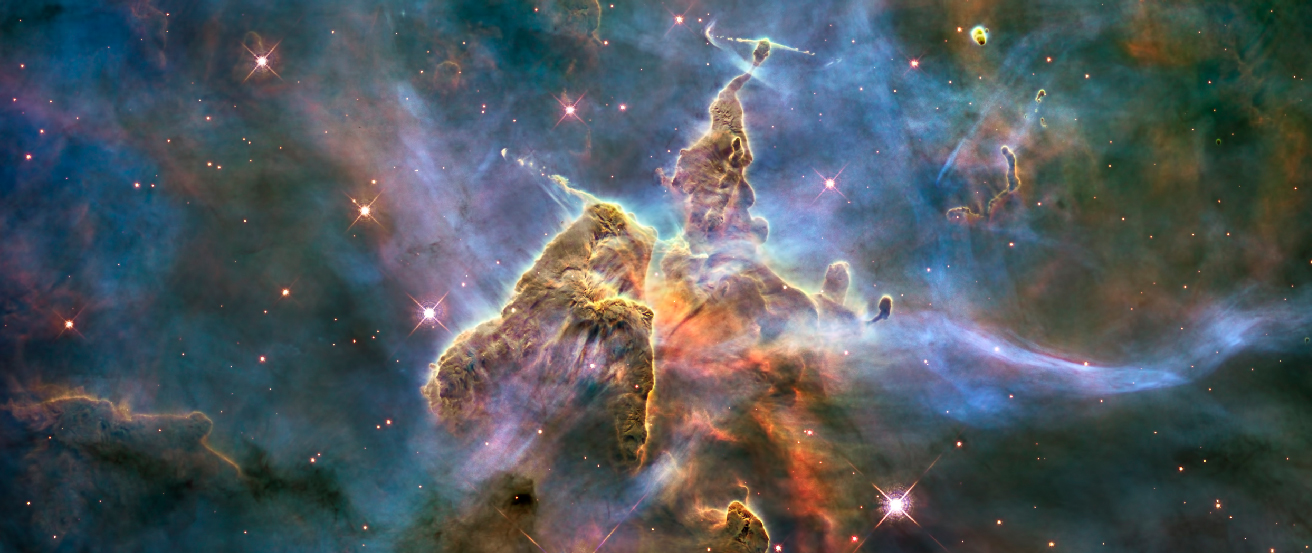
credit: modification of work by NASA, ESA, and M. Livio and the Hubble 20th Anniversary Team (STScI) · CC BY 4.0
Figure 21.1 We see a close-up of part of the Carina Nebula taken with the Hubble Space Telescope. This image reveals jets powered by newly forming stars embedded in a great cloud of gas and dust. Parts of the clouds are glowing from the energy of very young stars recently formed within them. (credit: modification of work by NASA, ESA, and M. Livio and the Hubble 20th Anniversary Team (STScI))
図21.1 ハッブル宇宙望遠鏡で撮影した、イータカリーナ星雲の一部の拡大画像。ガスと塵の巨大な雲に埋もれて形成されつつある星が、ジェットを駆動している様子がわかる。雲の一部は、その内部で最近生まれた非常に若い星のエネルギーを受けて輝いている。(クレジット:NASA, ESA, and M. Livio and the Hubble 20th Anniversary Team (STScI) の作品を改変)
This quotation is omitted for copyright reasons.
この引用は権利の関係で割愛。
Bruno was tried for heresy by the Roman Inquisition and burned at the stake in 1600.
英語のヒント
ブルーノはローマの異端審問所で異端の罪に問われ、1600年に火刑に処された。
We’ve discussed stars as nuclear furnaces that convert light elements into heavier ones. A star’s nuclear evolution begins when hydrogen is fused into helium, but that can only occur when the core temperature exceeds 10 to 12 million K. Since stars form from cold interstellar material, we must understand how they collapse and eventually reach this “ignition temperature” to explain the birth of stars. Star formation is a continuous process, from the birth of our Galaxy right up to today. We estimate that every year in our Galaxy, on average, three solar masses of interstellar matter are converted into stars. This may sound like a small amount of mass for an object as large as a galaxy, but only three new stars (out of billions in the Galaxy) are formed each year.
英語のヒント
これまで恒星を、軽い元素を重い元素へ変える核反応炉として説明してきた。恒星の核反応による進化は、水素が融合してヘリウムになるときに始まる。ただし、この反応が起きるには、中心核の温度が1000万〜1200万Kを超えなければならない。恒星は冷たい星間物質からできるので、その誕生を説明するには、この物質がどのように重力で収縮し、やがてこの「点火温度」に達するのかを理解する必要がある。星形成は、天の川銀河の誕生から今日に至るまで続いている過程である。天の川銀河では毎年、平均して太陽質量の3倍にあたる星間物質が恒星に変わっていると推定される。銀河ほど大きな天体にしては少量に聞こえるかもしれないが、毎年生まれる新しい星は、銀河内の何十億もの星のうち、わずか3個なのだ。
Do planets orbit other stars or is ours the only planetary system? In the past few decades, new technology has enabled us to answer that question by revealing more than 5800 exoplanets in over 4300 planetary systems. Even before planets were detected, astronomers had predicted that planetary systems were likely to be byproducts of the star-formation process. In this chapter, we look at how interstellar matter is transformed into stars and planets.
英語のヒント
惑星はほかの恒星の周りにも公転しているのだろうか。それとも、惑星系は私たちの太陽系だけなのだろうか。ここ数十年、新しい技術によって4300を超える惑星系で5800個以上の太陽系外惑星が明らかになり、この問いに答えられるようになった。惑星が検出される以前から、天文学者は、惑星系は星形成に伴って生じる副産物である可能性が高いと予測していた。この章では、星間物質がどのように恒星や惑星へと変わるのかを見ていく。