第21章星の誕生と太陽系外惑星の発見The Birth of Stars and the Discovery of Planets outside the Solar System
Winds and Jets恒星風とジェット
Recent observations suggest that T Tauri stars may actually be stars in a middle stage between protostars and hydrogen-fusing stars such as the Sun. High-resolution infrared images have revealed jets of material as well as stellar winds coming from some T Tauri stars, proof of interaction with their environment. A stellar wind consists mainly of protons (hydrogen nuclei) and electrons streaming away from the star at speeds of a few hundred kilometers per second (several hundred thousand miles per hour). When the wind first starts up, the disk of material around the star’s equator blocks the wind in its direction. Where the wind particles can escape most effectively is in the direction of the star’s poles.
英語のヒント
近年の観測から、おうし座T型星は実際には、原始星と、太陽のように水素を核融合させる恒星との中間段階にある星かもしれないと考えられている。高解像度の赤外線画像により、おうし座T型星の中には恒星風に加えて物質のジェットも出しているものがあるとわかり、周囲との相互作用の証拠が得られた。恒星風の主成分は陽子(水素原子核)と電子で、毎秒数百キロメートル、時速では数十万マイルという速さで星から流れ出す。恒星風が吹き始めた当初は、赤道を囲む物質の円盤が、その方向への風を遮る。風の粒子が最も効率よく逃げられるのは、星の極の方向である。
Astronomers have actually seen evidence of these beams of particles shooting out in opposite directions from the polar regions of newly formed stars. In many cases, these beams point back to the location of a protostar that is still so completely shrouded in dust that we cannot yet see it (Figure 21.9).
英語のヒント
天文学者は実際に、生まれたばかりの星の両極から、互いに反対方向へ飛び出す粒子の流れの証拠を見つけている。多くの場合、その流れを根元へたどると、塵に完全に包まれてまだ見えない原始星の位置がわかる(図21.9)。
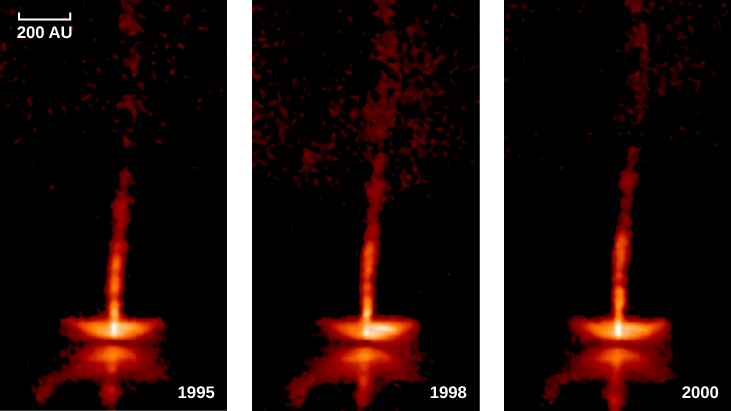
Gas Jets Flowing away from a Protostar.原始星から流れ出すガスのジェット。
credit: modification of work by Hubble Space Telescope, NASA, ESA · CC BY 4.0
Figure 21.9 Here we see the neighborhood of a protostar, known to us as HH 30 because it is a Herbig-Haro object. The star is about 450 light-years away and only about 1 million years old. Light from the star itself is blocked by a disk, which is larger than 60 billion kilometers in diameter and is seen almost edge-on. Jets are seen emerging perpendicular to the disk. The material in these jets is flowing outward at speeds up to 580,000 kilometers per hour. The series of three images shows changes during a period of 5 years. Every few months, a compact clump of gas is ejected, and its motion outward can be followed. The changes in the brightness of the disk may be due to motions of clouds within the disk that alternately block some of the light and then let it through. This image corresponds to the stage in the life of a protostar shown in part (c) of Figure 21.8. (credit: modification of work by Hubble Space Telescope, NASA, ESA)
図21.9 ハービッグ・ハロー天体であることからHH 30と呼ばれる原始星の周辺。この星は約450光年先にあり、年齢はわずか約100万年である。星自体の光は、ほぼ真横から見える、直径600億キロメートルを超える円盤に遮られている。ジェットは円盤に垂直に噴出している。ジェットの物質は、最大で時速58万キロメートルで外へ流れる。三枚の画像は5年間の変化を示す。数か月ごとに小さくまとまったガスの塊が放出され、外向きの移動を追跡できる。円盤の明るさが変わるのは、円盤内の雲の移動によって、光の一部が交互に遮られたり通り抜けたりするためかもしれない。この画像は、図21.8cの原始星の段階に対応する。(出典:ハッブル宇宙望遠鏡、NASA、ESAの作品を改変)
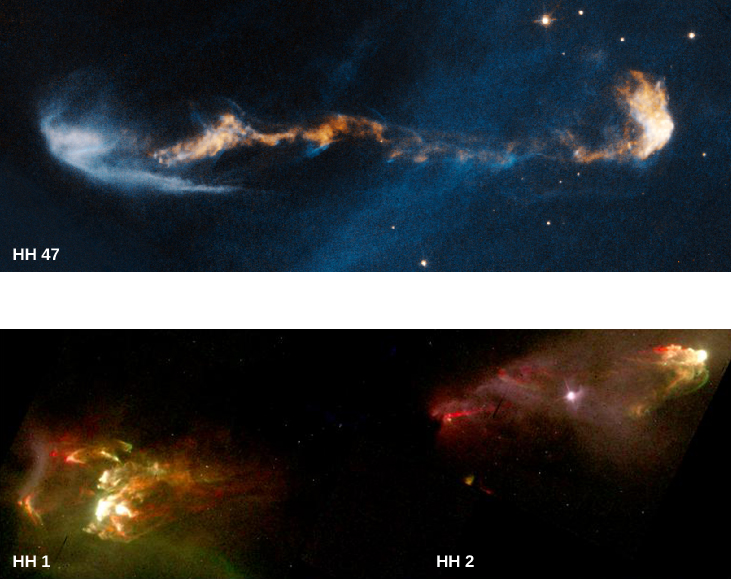
On occasion, the jets of high-speed particles streaming away from the protostar collide with a somewhat-denser lump of gas nearby, excite its atoms, and cause them to emit light. These glowing regions, each of which is known as a Herbig-Haro (HH) object after the two astronomers who first identified them, allow us to trace the progress of the jet to a distance of a light-year or more from the star that produced it. Figure 21.10 shows two spectacular images of HH objects.
英語のヒント
原始星から流れ出す高速粒子のジェットは、ときに、近くのやや密度の高いガスの塊に衝突する。するとガスの原子が励起され、光を放つ。こうして光る領域は、最初に見いだした二人の天文学者にちなんで、ハービッグ・ハロー(HH)天体と呼ばれている。この発光をたどることで、ジェットを生んだ星から1光年、あるいはそれ以上離れたところまで、その進行を追跡できる。図21.10は、HH天体の見事な画像を二つ示している。
Outflows from Protostars.原始星からの流出。
credit “HH 47”: modification of work by NASA, ESA, and P. Hartigan (Rice University); credit “HH 1 and HH 2: modification of work by J. Hester, WFPC2 Team, NASA · NASA media use guidelines
Figure 21.10 These images were taken with the Hubble Space Telescope and show jets flowing outward from newly formed stars. In the HH47 image, a protostar 1500 light-years away (invisible inside a dust disk at the left edge of the image) produces a very complicated jet. The star may actually be wobbling, perhaps because it has a companion. Light from the star illuminates the white region at the left because light can emerge perpendicular to the disk (just as the jet does). At right, the jet is plowing into existing clumps of interstellar gas, producing a shock wave that resembles an arrowhead. The HH1/2 image shows a double-beam jet emanating from a protostar (hidden in a dust disk in the center) in the constellation of Orion. Tip to tip, these jets are more than 1 light-year long. The bright regions (first identified by Herbig and Haro) are places where the jet is a slamming into a clump of interstellar gas and causing it to glow. (credit “HH 47”: modification of work by NASA, ESA, and P. Hartigan (Rice University); credit “HH 1 and HH 2: modification of work by J. Hester, WFPC2 Team, NASA)
図21.10 ハッブル宇宙望遠鏡が撮影した、生まれたばかりの星から外へ流れるジェット。HH 47では、1500光年先の原始星が非常に複雑なジェットを生み出している。原始星は画像左端の塵の円盤の中に隠れて見えない。伴星があるためか、この星は実際にふらついている可能性がある。星の光は、ジェットと同様、円盤に垂直な方向へ出られるため、左の白い領域を照らしている。右では、ジェットが既存の星間ガスの塊に突っ込み、矢じりに似た衝撃波を作っている。HH 1/2の画像では、オリオン座の原始星から両方向へ噴出するジェットが見える。原始星は中央の塵の円盤に隠れている。両端を合わせたジェットの長さは1光年を超える。ハービッグとハローが最初に見いだした明るい領域は、ジェットが星間ガスの塊に激突し、発光させている場所である。(出典「HH 47」:NASA、ESA、P. Hartigan〈ライス大学〉の作品を改変。出典「HH 1とHH 2」:J. Hester、WFPC2 Team、NASAの作品を改変)
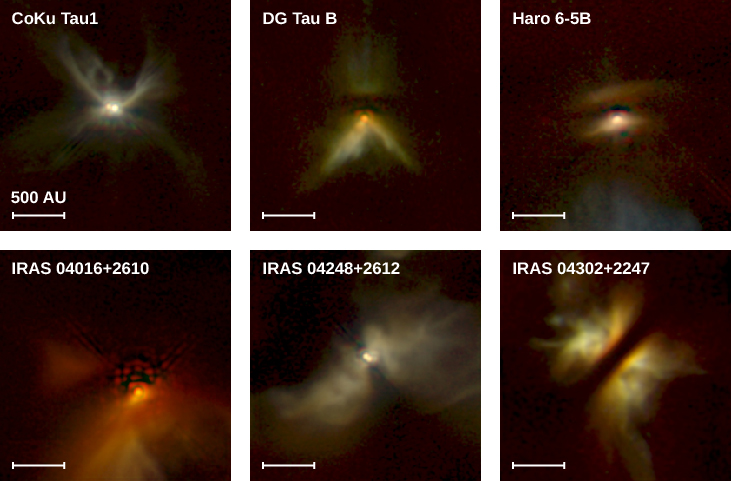
The wind from a forming star will ultimately sweep away the material that remains in the obscuring envelope of dust and gas, leaving behind the naked disk and protostar, which can then be seen with visible light. We should note that at this point, the protostar itself is still contracting slowly and has not yet reached the main-sequence stage on the H–R diagram (a concept introduced in the chapter The Stars: A Celestial Census). The disk can be detected directly when observed at infrared wavelengths or when it is seen silhouetted against a bright background (Figure 21.11).
英語のヒント
形成中の星からの恒星風は、最終的に、視界を遮っていたガスと塵のエンベロープの残りを吹き払う。むき出しの円盤と原始星が残り、可視光でも見えるようになる。ここで注意したいのは、原始星自体はまだゆっくり収縮しており、「恒星――星の世界の実態を調べる」の章で導入したHR図の主系列には、まだ達していないということである。円盤は赤外線で観測するか、明るい背景に対して影になっている場合に、直接検出できる(図21.11)。
Disks around Protostars.原始星の周囲の円盤。
Credit: modification of work by D. Padgett (IPAC/Caltech), W. Brandner (IPAC), K. Stapelfeldt (JPL) and NASA · JPL image use policy
Figure 21.11 These Hubble Space Telescope infrared images show disks around young stars in the constellation of Taurus, in a region about 450 light-years away. In some cases, we can see the central star (or stars—some are binaries). In other cases, the dark, horizontal bands indicate regions where the dust disk is so thick that even infrared radiation from the star embedded within it cannot make its way through. The brightly glowing regions are starlight reflected from the upper and lower surfaces of the disk, which are less dense than the central, dark regions. (Credit: modification of work by D. Padgett (IPAC/Caltech), W. Brandner (IPAC), K. Stapelfeldt (JPL) and NASA)
図21.11 ハッブル宇宙望遠鏡による赤外線画像。約450光年先、おうし座方向の若い星々の周囲の円盤を示す。中心の星が見える例もある。連星の場合には複数の星が見える。そのほかの例では、暗い横帯が、塵の円盤の非常に厚い領域を示す。内部に埋もれた星からの赤外線さえ、そこを通り抜けられない。明るく輝く領域は、円盤の上面と下面で反射した星の光である。そこは、中心の暗い領域より密度が低い。(出典:D. Padgett〈IPAC/Caltech〉、W. Brandner〈IPAC〉、K. Stapelfeldt〈JPL〉、NASAの作品を改変)
This description of a protostar surrounded by a rotating disk of gas and dust sounds very much like what happened in our solar system when the Sun and planets formed. Indeed, one of the most important discoveries from the study of star formation in the last decade of the twentieth century was that disks are an inevitable byproduct of the process of creating stars. The next questions that astronomers set out to answer was: will the disks around protostars also form planets? And if so, how often? We will return to these questions later in this chapter.
英語のヒント
回転するガスと塵の円盤に囲まれた原始星という説明は、太陽と惑星ができたときの太陽系で起きたことによく似ている。実際、20世紀最後の10年間における星形成研究の最も重要な発見の一つは、円盤が星を作る過程に必ず伴う副産物だということだった。そこで天文学者が次に答えを求めたのは、原始星の周囲の円盤も惑星を作るのだろうか、作るならどれほどの頻度だろうか、という問いだった。この章の後半で再び考える。
To keep things simple, we have described the formation of single stars. Many stars, however, are members of binary or triple systems, where several stars are born together. In this case, the stars form in nearly the same way. Widely separated binaries may each have their own disk; close binaries may share a single disk.
英語のヒント
話を簡単にするため、ここまでは単独の恒星が生まれる過程を説明した。しかし、多くの恒星は、複数の星が一緒に生まれる連星や三重星の一員である。その場合も形成過程はほぼ同じである。互いに大きく離れた連星なら、各星がそれぞれ円盤を持つことがあり、近接した連星なら、一つの円盤を共有することがある。