第21章星の誕生と太陽系外惑星の発見The Birth of Stars and the Discovery of Planets outside the Solar System
Transiting Planets恒星の手前を通過する惑星
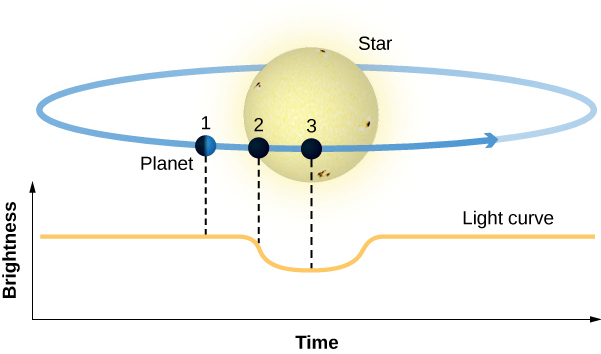
The second method for indirect detection of exoplanets is based not on the motion of the star but on its brightness. When the orbital plane of the planet is tilted or inclined so that it is viewed edge-on, we will see the planet cross in front of the star once per orbit, causing the star to dim slightly; this event is known as transit. Figure 21.19 shows a sketch of the transit at three time steps: (1) out of transit, (2) the start of transit, and (3) full transit, along with a sketch of the light curve, which shows the drop in the brightness of the host star. The amount of light blocked—the depth of the transit—depends on the area of the planet (its size) compared to the star. If we can determine the size of the star, the transit method tells us the size of the planet.
英語のヒント
系外惑星を間接的に検出する第二の方法は、恒星の運動ではなく明るさを使う。惑星の軌道面が、私たちから真横に見えるような傾きであれば、惑星は一周ごとに恒星の手前を横切り、星が少し暗く見える。この現象をトランジット、あるいは通過と呼ぶ。図21.19には、(1)通過の外、(2)通過の始まり、(3)惑星全体が恒星の手前に入った段階という三つの時点と、主星の明るさの低下を表す光度曲線の模式図を示している。遮られる光の量、すなわち通過の深さは、恒星に対する惑星の面積、大きさで決まる。恒星の大きさがわかれば、トランジット法で惑星の大きさがわかる。
Planet Transits.惑星のトランジット。
OpenStax / Rice University · CC BY 4.0
Figure 21.19 As the planet transits, it blocks out some of the light from the star, causing a temporary dimming in the brightness of the star. The top figure shows three moments during the transit event and the bottom panel shows the corresponding light curve: (1) out of transit, (2) transit ingress, and (3) the full drop in brightness.
図21.19 惑星が恒星の手前を通過すると、星の光の一部を遮り、一時的に星を暗くする。上の図は通過に関係する三つの時点、下は対応する光度曲線を示す。(1)通過の外、(2)通過の進入時、(3)明るさが十分低下した段階。
The interval between successive transits is the length of the year for that planet, which can be used (again using Kepler’s laws) to find its distance from the star. Larger planets like Jupiter block out more starlight than small earthlike planets, making transits by giant planets easier to detect, even from ground-based observatories. But by going into space, above the distorting effects of Earth’s atmosphere, the transit technique has been extended to exoplanets as small as Mars.
英語のヒント
連続するトランジットの間隔が、その惑星の1年の長さである。それを使えば、再びケプラーの法則によって、恒星からの距離が求まる。木星のような大きな惑星は、小さな地球型惑星より多くの星の光を遮るため、巨大惑星のトランジットは地上の天文台でも比較的容易に検出できる。さらに、地球大気による像の乱れの上、宇宙へ出ることで、トランジット法は火星ほど小さな系外惑星にも使えるようになった。
Transit Depthトランジットの深さ
In a transit, the planet’s circular disk blocks the light of the star’s circular disk. The area of a circle is πR2. The amount of light the planet blocks, called the transit depth, is then given by
トランジットでは、惑星の円盤が恒星の円盤の光を遮る。円の面積はπR²である。惑星が遮る光の割合、すなわちトランジットの深さは、次の式で与えられる。
Now calculate the transit depth for a star the size of the Sun with a gas giant planet the size of Jupiter.
太陽と同じ大きさの恒星の周囲に、木星と同じ大きさの巨大ガス惑星があるときの、トランジットの深さを計算しよう。
Solution解き方
The radius of Jupiter is 71,400 km, while the radius of the Sun is 695,700 km. Substituting into the equation, we get or 1%, which can easily be detected with the instruments on board the Kepler spacecraft.
木星の半径は71,400 km、太陽の半径は695,700 kmである。式へ代入すると、、すなわち1%となる。これはケプラー宇宙望遠鏡の搭載機器で容易に検出できる。
Check Your Learning理解を確かめよう
What is the transit depth for a star half the size of the Sun with a much smaller planet, like the size of Earth?
太陽の半分の大きさの恒星に、地球ほどの、ずっと小さな惑星があるとき、トランジットの深さはいくらか。
The Doppler method allows us to estimate the mass of a planet. If the same object can be studied by both the Doppler and transit techniques, we can measure both the mass and the size of the exoplanet. This is a powerful combination that can be used to derive the average density (mass/volume) of the planet. In 1999, using measurements from ground-based telescopes, the first transiting planet was detected orbiting the star HD 209458. The planet transits its parent star for about 3 hours every 3.5 days as we view it from Earth. Doppler measurements showed that the planet around HD 209458 has about 70% the mass of Jupiter, but its radius is about 35% larger than Jupiter’s. This was the first case where we could determine what an exoplanet was made of—with that mass and radius, HD 209458 must be a gas and liquid world like Jupiter or Saturn.
英語のヒント
ドップラー法では惑星の質量を推定できる。同じ天体をドップラー法とトランジット法の両方で調べられれば、系外惑星の質量と大きさの両方が測れる。これは強力な組み合わせで、惑星の平均密度、すなわち質量を体積で割った値を導ける。1999年、地上望遠鏡の測定から、HD 209458を回る、最初のトランジット惑星が検出された。地球から見ると、この惑星は3.5日ごとに、約3時間かけて主星の手前を通過する。ドップラー測定によれば、惑星の質量は木星の約70%であるが、半径は木星より約35%大きいものだった。これは系外惑星が何でできているかを初めて判断できた例である。この質量と半径を持つHD 209458の惑星は、木星や土星のような、ガスと液体の世界であるはずである。
It is even possible to learn something about the planet’s atmosphere. When the planet passes in front of HD 209458, the atoms in the planet’s atmosphere absorb starlight. Observations of this absorption were first made at the wavelengths of yellow sodium lines and showed that the atmosphere of the planet contains sodium; now, other elements can be measured as well.
英語のヒント
惑星の大気についても、ある程度のことがわかる。惑星がHD 209458の手前を通ると、大気の原子が恒星の光を吸収する。この吸収は最初、黄色いナトリウム線の波長で観測され、惑星の大気にナトリウムがあるとわかった。今ではほかの元素も測定できる。
Transiting planets reveal such a wealth of information that the French Space Agency (CNES) and the European Space Agency (ESA) launched the CoRoT space telescope in 2007 to detect transiting exoplanets. CoRoT discovered 32 transiting exoplanets, including the first transiting planet with a size and density similar to Earth. In 2012, the spacecraft suffered an onboard computer failure, ending the mission. Meanwhile, NASA built a much more powerful transit observatory called Kepler.
英語のヒント
トランジット惑星から得られる情報があまりに豊富なため、フランス国立宇宙研究センター(CNES)と欧州宇宙機関(ESA)は2007年、系外惑星のトランジットを検出するCoRoT宇宙望遠鏡を打ち上げた。CoRoTは32個のトランジット系外惑星を発見し、その中には、大きさと密度が地球に似た、初のトランジット惑星も含まれていた。2012年、搭載コンピューターの故障によってミッションは終わった。その間にNASAは、ケプラーと名付けた、はるかに高性能なトランジット観測衛星を建造した。
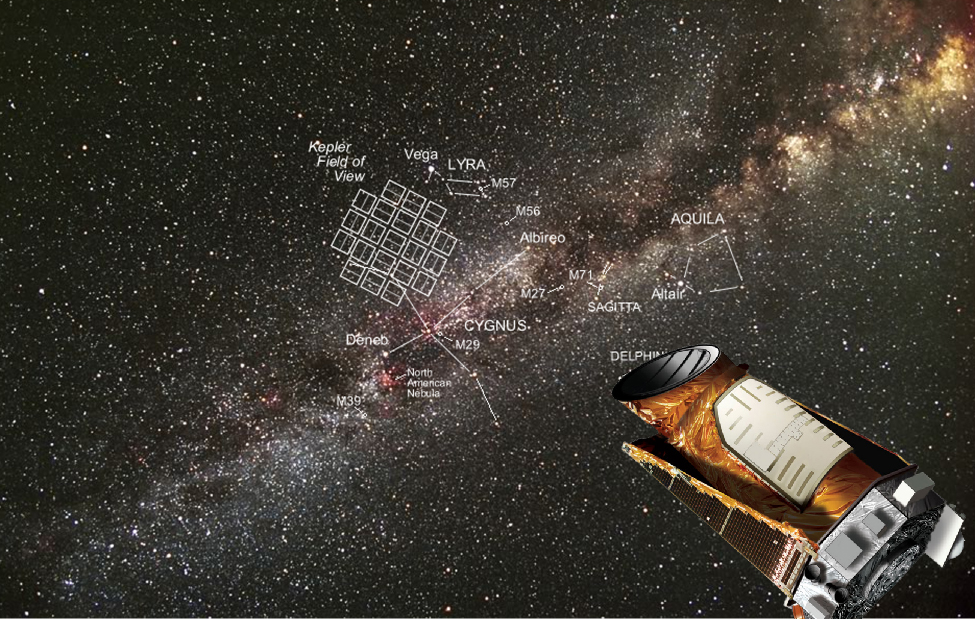
In 2009, NASA launched the Kepler space telescope, dedicated to the discovery of transiting exoplanets. This spacecraft stared continuously at more than 150,000 stars in a small patch of sky near the constellation of Cygnus—just above the plane of our Milky Way Galaxy (Figure 21.20). Kepler’s cameras and ability to measure small changes in brightness very precisely enabled the discovery of thousands of exoplanets, including many multi-planet systems. The spacecraft required three reaction wheels—a type of wheel used to help control slight rotation of the spacecraft—to stabilize the pointing of the telescope and monitor the brightness of the same group of stars over and over again. Kepler was launched with four reaction wheels (one a spare), but by May 2013, two wheels had failed and the telescope could no longer be accurately pointed toward the target area. Kepler had been designed to operate for 4 years, and ironically, the pointing failure occurred exactly 4 years and 1 day after it began observing.
英語のヒント
2009年、NASAはトランジット系外惑星の発見に専念する、ケプラー宇宙望遠鏡を打ち上げた。ケプラーは、はくちょう座付近、天の川銀河の銀河面のすぐ上の小さな空の領域で、15万個以上の恒星を絶えず見続けた(図21.20)。カメラと、微小な明るさの変化を非常に精密に測る能力により、複数の惑星を持つ系を多数含め、数千個の系外惑星の発見を可能にした。望遠鏡の向きを安定させ、同じ星の集団の明るさを繰り返し測るには、三つのリアクションホイールが必要だった。これは衛星のわずかな回転を制御するための回転体である。ケプラーには予備一つを含む四つが搭載されていたが、2013年5月までに二つが故障し、目標領域へ正確に向けられなくなった。ケプラーの設計上の運用期間は4年だった。皮肉にも、指向制御の故障は観測開始からちょうど4年と1日後に起きた。
However, this failure did not end the mission. The Kepler telescope continued to observe for two more years, looking for short-period transits in different parts of the sky. We discuss the Kepler results in the next section Exoplanets Everywhere: What We Are Learning. A new NASA mission called TESS (Transiting Exoplanet Survey Satellite) is now carrying out a transit survey of the nearer (and therefore brighter) stars all over the sky. As of the end of 2024, the TESS mission has reported almost 600 planet discoveries and about 7400 planet candidates that need further observations to confirm.
英語のヒント
しかし、この故障でミッションが終わったわけではない。ケプラー望遠鏡はさらに2年間、空の異なる領域で短周期のトランジットを探す観測を続けた。ケプラーの成果は、次の「系外惑星は至るところに――わかってきたこと」で扱う。現在はNASAの新しいミッションTESS(トランジット系外惑星探索衛星)が、全天の、より近く、したがってより明るい恒星のトランジット探査を進めている。2024年末時点で、TESSはほぼ600個の惑星の発見と、確認のための追加観測を要する約7400個の惑星候補を報告している。
Kepler’s Field of View.ケプラーの視野。
credit “field of view”: modification of work by NASA/Kepler mission; credit “spacecraft”: modification of work by NASA/Kepler mission/Wendy Stenzel · NASA media use guidelines
Figure 21.20 The boxes show the region where the Kepler spacecraft cameras took images of over 150,000 stars regularly, to find transiting planets. (credit “field of view”: modification of work by NASA/Kepler mission; credit “spacecraft”: modification of work by NASA/Kepler mission/Wendy Stenzel)
図21.20 枠は、トランジット惑星を探すために、ケプラーのカメラが15万個以上の恒星を定期的に撮影した領域を示す。(出典「視野」:NASA/Kepler missionの作品を改変。出典「衛星」:NASA/Kepler mission/Wendy Stenzelの作品を改変)
What do we mean, exactly, by “discovery” of transiting exoplanets? A single transit shows up as a very slight drop in the brightness of the star, lasting several hours. However, astronomers must be on guard against other factors that might produce a false transit, especially when working at the limit of precision of the telescope. We must wait for a second transit of similar depth. But when another transit is observed, we don’t initially know whether it might be due to another planet in a different orbit. The “discovery” occurs only when a third transit is found with similar depth and the same spacing in time as the first pair.
英語のヒント
トランジット系外惑星の「発見」とは、正確には何を意味するのだろうか。一回のトランジットは、数時間続く、ごくわずかな恒星の減光として現れる。しかし、特に望遠鏡の精度の限界で測定するときには、偽のトランジットを生みうる別の原因に警戒しなければならない。そこで、同じくらいの深さの二回目の通過を待つ必要がある。それでも別の通過が観測された時点では、違う軌道にある別の惑星のためかもしれず、すぐにはわからない。最初の二回と同じ時間間隔で、同じような深さの三回目が見つかって初めて、「発見」となるのだ。
Computers normally conduct the analysis, which involves searching for tiny, periodic dips in the light from each star, extending over 4 years of observation. But the Kepler mission also has a program in which non-astronomers—citizen scientists—can examine the data. These dedicated volunteers have found several transits that were missed by the computer analyses, showing that the human eye and brain sometimes recognize unusual events that a computer was not programmed to look for.
英語のヒント
解析は通常コンピューターが行い、4年間にわたる観測の中から、各星の光の微小で周期的な落ち込みを探す。しかしケプラー計画には、専門の天文学者ではない市民科学者がデータを調べるプログラムもある。熱心なボランティアたちは、コンピューター解析が見逃したトランジットをいくつも見つけた。コンピューターが探すようにプログラムされていない珍しい現象を、人間の目と脳がときに認識できることを示している。
Measuring three or four evenly spaced transits is normally enough to “discover” an exoplanet. But in a new field like exoplanet research, we would like to find further independent verification. The strongest confirmation happens when ground-based telescopes are also able to detect a Doppler shift with the same period as the transits. However, this is generally not possible for Earth-size planets. One of the most convincing ways to verify that a dip in brightness is due to a planet is to find more planets orbiting the same star—a planetary system. Multi-planet systems also provide alternative ways to estimate the masses of the planets, as we will discuss in the next section.
英語のヒント
等間隔のトランジットを三、四回測れば、通常は系外惑星を「発見」するのに十分である。しかし系外惑星研究のような新しい分野では、さらに独立した検証がほしいところである。最も強い確認は、地上望遠鏡でも、トランジットと同じ周期のドップラー偏移が検出されることである。ただし、地球サイズの惑星では一般にそれができない。減光が惑星によることを確かめる、特に説得力のある方法の一つは、同じ恒星を回る惑星をさらに見つけ、惑星系だと示すことである。複数の惑星がある系では、惑星の質量を推定する別の方法も使える。これについては次の節で説明する。
The selection effects (or biases) in the Kepler data are similar to those in Doppler observations. Large planets are easier to find than small ones, and short-period planets are easier than long-period planets. If we require three transits to establish the presence of a planet, we are of course limited to discovering planets with orbital periods less than one-third of the observing interval. Thus, it was only in its fourth and final year of operation that Kepler was able to find planets with orbits like Earth’s that require 1 year to go around their star.
英語のヒント
ケプラーのデータの選択効果、つまり偏りは、ドップラー観測と似ている。大きな惑星は小さな惑星より見つけやすく、短周期の惑星は長周期の惑星より見つけやすいのだ。惑星の存在確認に三回の通過を必要とするなら、発見対象は当然、観測期間の3分の1より短い公転周期の惑星に限られる。そのためケプラーが、恒星を一周するのに1年かかる、地球のような軌道の惑星を見つけられたのは、運用の最後の年である4年目になってからだった。