第21章星の誕生と太陽系外惑星の発見The Birth of Stars and the Discovery of Planets outside the Solar System
The Birth of a Star星の誕生
Although regions such as Orion give us clues about how star formation begins, the subsequent stages are still shrouded in mystery (and a lot of dust). There is an enormous difference between the density of a molecular cloud core and the density of the youngest stars that can be detected. Direct observations of this collapse to higher density are nearly impossible for two reasons. First, the dust-shrouded interiors of molecular clouds where stellar births take place cannot be observed with visible light. Second, the timescale for the initial collapse—thousands of years—is very short, astronomically speaking. Since each star spends such a tiny fraction of its life in this stage, relatively few stars are going through the collapse process at any given time. Nevertheless, through a combination of theoretical calculations and the limited observations available, astronomers have pieced together a picture of what the earliest stages of stellar evolution are likely to be.
英語のヒント
オリオンのような領域は、星形成がどう始まるかの手掛かりを与えてくれる。しかし、その後の段階は今も謎に、そして大量の塵に包まれている。分子雲のコアの密度と、検出できる最も若い恒星の密度との間には、とてつもない差がある。密度が高くなる収縮の過程を直接観測することは、二つの理由でほぼ不可能である。第一に、星が生まれる分子雲の内部は塵に覆われ、可視光では見えない。第二に、最初の収縮にかかる数千年という時間は、天文学的には非常に短いのだ。個々の恒星がこの段階にいる時間は一生のごく一部なので、ある時点で収縮の最中にある星は比較的わずかしかない。それでも天文学者は、理論計算と限られた観測を組み合わせ、恒星進化の最初期がどのようなものであるか、その見取り図を少しずつ組み立ててきた。
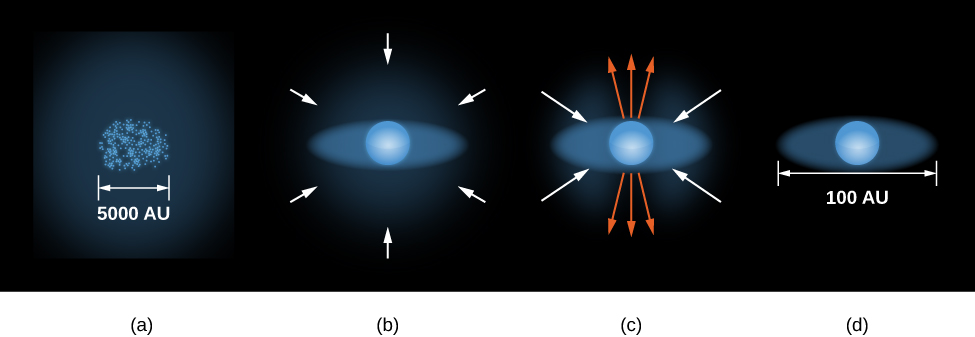
The first step in the process of creating stars is the formation of dense cores within a clump of gas and dust (Figure 21.8(a)). It is generally thought that all the material for the star comes from the core, the larger structure surrounding the forming star. Eventually, the gravitational force of the infalling gas becomes strong enough to overwhelm the pressure exerted by the cold material that forms the dense cores. The material then undergoes a rapid collapse, and the density of the core increases greatly as a result. During the time a dense core is contracting to become a true star, but before the fusion of protons to produce helium begins, we call the object a protostar.
英語のヒント
星を作る過程の第一歩は、ガスと塵のクランプの中に高密度のコアができることである(図21.8a)。恒星の材料はすべて、形成中の星を囲む、より大きな構造であるこのコアから供給されると一般に考えられている。やがて、落ち込むガスの重力が十分強くなり、高密度コアを構成する冷たい物質の圧力を上回る。すると物質は急激に収縮し、コアの密度が大幅に増す。高密度コアが真の恒星になるために収縮しているものの、陽子が核融合してヘリウムを作り始める前の天体を、原始星と呼ぶ。
Formation of a Star.恒星の形成。
OpenStax / Rice University · CC BY 4.0
Figure 21.8 (a) Dense cores form within a molecular cloud. (b) A protostar with a surrounding disk of material forms at the center of a dense core, accumulating additional material from the molecular cloud through gravitational attraction. (c) A stellar wind breaks out but is confined by the disk to flow out along the two poles of the star. (d) Eventually, this wind sweeps away the cloud material and halts the accumulation of additional material, and a newly formed star, surrounded by a disk, becomes observable. These sketches are not drawn to the same scale. The diameter of a typical envelope that is supplying gas to the newly forming star is about 5000 AU. The typical diameter of the disk is about 100 AU or slightly larger than the diameter of the orbit of Pluto.
図21.8 (a)分子雲の中に高密度のコアができる。(b)コアの中心に、物質の円盤を伴う原始星ができ、重力によって分子雲からさらに物質を集める。(c)恒星風が吹き出すが、円盤に妨げられるため、星の両極に沿う方向へ流れる。(d)やがて恒星風が雲の物質を吹き払い、さらなる物質の集積が止まる。円盤に囲まれた、生まれたばかりの星を観測できるようになる。各模式図の縮尺は同じではない。形成中の星にガスを供給するエンベロープの典型的な直径は約5000 AUである。円盤の典型的な直径は約100 AUで、冥王星の軌道の直径より少し大きい。
The natural turbulence inside a clump tends to give any portion of it some initial spinning motion (even if it is very slow). As a result, each collapsing core is expected to spin. According to the law of conservation of angular momentum (discussed in the chapter on Orbits and Gravity), a rotating body spins more rapidly as it decreases in size. In other words, if the object can turn its material around a smaller circle, it can move that material more quickly—like a figure skater spinning more rapidly as she brings her arms in tight to her body. This is exactly what happens when a core contracts to form a protostar: as it shrinks, its rate of spin increases.
英語のヒント
クランプ内部の自然な乱流によって、どの部分にも、たとえ非常にゆっくりであっても、初めから多少の回転運動が生じる傾向がある。そのため、収縮するコアはそれぞれ回転していると考えられる。「軌道と重力」の章で扱った角運動量保存則によると、回転する物体は小さくなるほど速く回る。言い換えれば、物質をより小さな円に沿って回せるようになれば、その物質をより速く動かせるのだ。フィギュアスケーターが腕を体に引き寄せると、回転が速くなるのと同じである。コアが収縮して原始星になるときにも、まさにこれが起こる。縮むにつれて回転速度が増すのだ。
But all directions on a spinning sphere are not created equal. As the protostar rotates, it is much easier for material to fall right onto the poles (which spin most slowly) than onto the equator (where material moves around most rapidly). Therefore, gas and dust falling in toward the protostar’s equator are “held back” by the rotation and form a whirling extended disk around the equator (part b in Figure 21.8). You may have observed this same “equator effect” on the amusement park ride in which you stand with your back to a cylinder that is spun faster and faster. As you spin really fast, you are pushed against the wall so strongly that you cannot possibly fall toward the center of the cylinder. Gas can, however, fall onto the protostar easily from directions away from the star’s equator.
英語のヒント
しかし、回転する球では、どの方向も同じというわけではない。原始星が回転しているとき、物質は、最も速く周回する赤道へ向かうより、最もゆっくり回る極へ直接落ち込むほうが、はるかに容易である。したがって赤道へ落ちようとするガスや塵は、回転によって「引き止められ」、赤道の周囲に回転する広い円盤を作る(図21.8b)。円筒の壁に背を付けて立ち、その円筒がどんどん速く回る遊園地の乗り物で、同じ「赤道の効果」を体験した人もいるだろう。非常に速く回ると、壁に強く押し付けられ、円筒の中心へ向かって落ちることはとてもできない。しかしガスは、赤道から外れた方向からなら、原始星へ容易に落ち込める。
The protostar and disk at this stage are embedded in an envelope of dust and gas from which material is still falling onto the protostar. This dusty envelope blocks visible light, but infrared radiation can get through. As a result, in this phase of its evolution, the protostar itself is emitting infrared radiation and so is observable only in the infrared region of the spectrum. Once almost all of the available material has been accreted and the central protostar has reached nearly its final mass, it is given a special name: it is called a T Tauri star, named after one of the best studied and brightest members of this class of stars, which was discovered in the constellation of Taurus. (Astronomers have a tendency to name types of stars after the first example they discover or come to understand. It’s not an elegant system, but it works.) Only stars with masses less than or similar to the mass of the Sun become T Tauri stars. Massive stars do not go through this stage, although they do appear to follow the formation scenario illustrated in Figure 21.8.
英語のヒント
この段階の原始星と円盤は、ガスと塵のエンベロープ、つまり周囲を包む物質に埋もれている。そこからは、まだ原始星へ物質が落ち込み続けている。塵の多いエンベロープは可視光を遮るが、赤外線は透過できる。そのため、この進化段階の原始星は赤外線を放射しており、スペクトルの赤外線領域でしか観測できない。利用できる物質のほとんどが降着し、中心の原始星が最終的な質量に近づくと、おうし座T型星という特別な名前で呼ばれるようになる。おうし座で発見された、この種類の星の中でも特に明るく、よく研究されている一例にちなんだ名前である。(天文学者は、最初に発見したり理解したりした天体をもとに、その種類の名前を付けがちである。洗練された命名法とはいえないが、役には立つ。)おうし座T型星になるのは、質量が太陽以下か、太陽と同程度の恒星だけである。大質量星はこの段階を経ないが、図21.8に示した形成過程には従うようである。