第21章星の誕生と太陽系外惑星の発見The Birth of Stars and the Discovery of Planets outside the Solar System
Planets with Known Densities密度がわかっている惑星
For several hundred exoplanets, we have been able to measure both the size of the planet from transit data and its mass from Doppler data, yielding an estimate of its density. Comparing the average density of exoplanets to the density of planets in our solar system helps us understand whether they are rocky or gaseous in nature. This has been particularly important for understanding the structure of the new categories of super-Earths and mini-Neptunes with masses between 3–10 times the mass of Earth. A key observation so far is that planets that are more than 10 times the mass of Earth have substantial gaseous envelopes (like Uranus and Neptune) whereas lower-mass planets are predominately rocky in nature (like the terrestrial planets).
英語のヒント
数百個の系外惑星では、トランジットのデータから大きさを、ドップラーのデータから質量を測ることができ、密度を推定できている。平均密度を太陽系の惑星と比べれば、岩石質かガス状かを理解する手掛かりになる。これは、地球の3〜10倍の質量を持つスーパーアースやミニネプチューンという、新しい分類の構造を理解するうえで、特に重要である。これまでの重要な観測結果は、地球の10倍を超える質量の惑星には、天王星や海王星のように相当量のガスの外層があり、それより軽い惑星は、地球型惑星のように主に岩石質だということである。
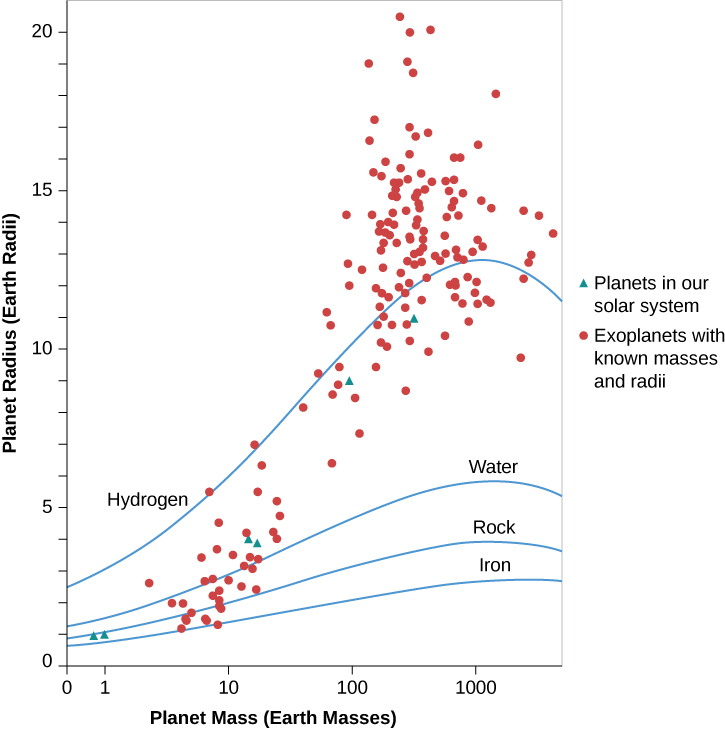
Figure 21.25 compares all the exoplanets that have both mass and radius measurements. The dependence of the radius on planet mass is also shown for a few illustrative cases—hypothetical planets made of pure iron, rock, water, or hydrogen.
英語のヒント
図21.25は、質量と半径の両方が測定された系外惑星をすべて比較したものだ。半径が惑星の質量によってどう変わるかも、説明のためのいくつかの仮想例、すなわち純粋な鉄、岩石、水、水素だけでできた惑星について示している。
Exoplanets with Known Densities.密度がわかっている系外惑星。
OpenStax / Rice University · CC BY 4.0
Figure 21.25 Exoplanets with known masses and radii (red circles) are plotted along with solid lines that show the theoretical size of pure iron, rock, water, and hydrogen planets with increasing mass. Masses are given in multiples of Earth’s mass. (For comparison, Jupiter contains enough mass to make 320 Earths.) The green triangles indicate planets in our solar system.
図21.25 質量と半径のわかっている系外惑星を赤い円で示す。実線は、純粋な鉄、岩石、水、水素の惑星について、質量が増したときの理論上の大きさを表す。質量は地球質量の倍数で示している。比較すると、木星の質量は地球320個分に相当する。緑の三角形は太陽系の惑星である。
At lower masses, notice that as the mass of these hypothetical planets increases, the radius also increases. That makes sense—if you were building a model of a planet out of clay, your toy planet would increase in size as you added more clay. However, for the highest mass planets (M > 1000 MEarth) in Figure 21.25, notice that the radius stops increasing and the planets with greater mass are actually smaller. This occurs because increasing the mass also increases the gravity of the planet, so that compressible materials (even rock is compressible) will become more tightly packed, shrinking the size of the more massive planet.
英語のヒント
低質量の範囲では、仮想惑星の質量が増すにつれて半径も増すことに注目しよう。これは納得できる。粘土で惑星の模型を作れば、粘土を加えるほど模型は大きくなるだろう。ところが図21.25で、最も質量が大きい惑星(M > 1000 M_Earth)を見ると、半径は増えなくなり、むしろ重い惑星ほど小さくなっている。質量が増すと惑星の重力も強くなり、圧縮できる物質、岩石でさえ圧縮できるが、それがより密に詰まるためである。その結果、より重い惑星の大きさが縮む。
In reality, planets are not pure compositions like the hypothetical water or iron planet. Earth is composed of a solid iron core, an outer liquid-iron core, a rocky mantle and crust, and a relatively thin atmospheric layer. Exoplanets are similarly likely to be differentiated into compositional layers. The theoretical lines in Figure 21.25 are simply guides that suggest a range of possible compositions.
英語のヒント
実際の惑星は、仮想的な水の惑星や鉄の惑星のように、一つの物質だけでできているわけではない。地球は、固体の鉄の核、その外側の液体の鉄の核、岩石のマントルと地殻、そして比較的薄い大気の層からできている。系外惑星も同様に、組成の異なる層へ分化している可能性が高いだろう。図21.25の理論曲線は、ありうる組成の範囲を示唆する目安にすぎない。
Astronomers who work on the complex modeling of the interiors of rocky planets make the simplifying assumption that the planet consists of two or three layers. This is not perfect, but it is a reasonable approximation and another good example of how science works. Often, the first step in understanding something new is to narrow down the range of possibilities. This sets the stage for refining and deepening our knowledge. In Figure 21.25, the two green triangles with roughly 1 MEarth and 1 REarth represent Venus and Earth. Notice that these planets fall between the models for a pure iron and a pure rock planet, consistent with what we would expect for the known mixed-chemical composition of Venus and Earth.
英語のヒント
岩石惑星の内部を複雑なモデルで研究する天文学者は、惑星が二層か三層で構成されるという単純化した仮定を置く。完全ではないが、妥当な近似であり、科学の進め方のよい例である。新しいことを理解する第一歩は、多くの場合、可能性の範囲を絞り込むことである。これが、知識をより精密にし、深めるための土台となる。図21.25で質量が約1 M_Earth、半径が約1 R_Earthの二つの緑の三角形は、金星と地球である。両惑星が、純粋な鉄の惑星と純粋な岩石の惑星のモデルの間にあることに注目しよう。これは、金星と地球が複数の物質の混合組成を持つという、既知の事実から予想されることと一致する。
In the case of gaseous planets, the situation is more complex. Hydrogen is the lightest element in the periodic table, yet many of the detected exoplanets in Figure 21.25 with masses greater than 100 MEarth have radii that suggest they are lower in density than a pure hydrogen planet. Hydrogen is the lightest element, so what is happening here? Why do some gas giant planets have inflated radii that are larger than the fictitious pure hydrogen planet? Many of these planets reside in short-period orbits close to the host star where they intercept a significant amount of radiated energy. If this energy is trapped deep in the planet atmosphere, it can cause the planet to expand.
英語のヒント
ガス惑星では事情がさらに複雑である。水素は周期表で最も軽い元素であるが、図21.25で質量が100 M_Earthを超える系外惑星の多くは、半径から考えると、純粋な水素の惑星より密度が低いようである。最も軽い元素が水素なのに、何が起きているのだろうか。なぜ一部の巨大ガス惑星は、仮想的な純水素の惑星より半径が膨らんでいるのだろうか。その多くは、主星に近い短周期の軌道にあり、大量の放射エネルギーを受ける。このエネルギーが惑星大気の深いところへ閉じ込められると、惑星を膨張させることがある。
Planets that orbit close to their host stars in slightly eccentric orbits have another source of energy: the star will raise tides in these planets that tend to circularize the orbits. This process also results in tidal dissipation of energy that can inflate the atmosphere. It would be interesting to measure the size of gas giant planets in wider orbits where the planets should be cooler—the expectation is that unless they are very young, these cooler gas giant exoplanets (sometimes called “cold Jupiters”) should not be inflated. But we don’t yet have data on these more distant exoplanets.
英語のヒント
主星の近くを、わずかに離心率のある軌道で回る惑星には、別のエネルギー源もある。恒星が惑星に潮汐を起こし、軌道を円形に近づけるのだ。この過程で潮汐によるエネルギーの散逸も起こり、大気を膨らませる可能性がある。惑星がもっと低温になるはずの、広い軌道の巨大ガス惑星の大きさを測れれば興味深いだろう。非常に若いものを除けば、こうした冷たい巨大ガス系外惑星、ときに「コールドジュピター」と呼ばれるものは、膨らんでいないはずだと予想される。しかし、このような遠い系外惑星のデータはまだない。
Exoplanetary Systems太陽系外の惑星系
As we search for exoplanets, we don’t expect to find only one planet per star. Our solar system has eight major planets, half a dozen dwarf planets, and millions of smaller objects orbiting the Sun. The evidence we have of planetary systems in formation also suggest that they are likely to produce multi-planet systems.
英語のヒント
系外惑星を探すとき、恒星一個につき惑星一個だけとは考えない。太陽系には八つの主要な惑星、六つほどの準惑星、そして数百万個の小天体が太陽を回っている。形成中の惑星系について得られた証拠からも、複数の惑星を持つ系が生まれる可能性が高いと考えられる。
The first planetary system was found around the star Upsilon Andromedae in 1999 using the Doppler method, and many others have been found since then. If such exoplanetary system are common, let’s consider which systems we expect to find in the Kepler transit data.
英語のヒント
最初の惑星系は1999年、ドップラー法によってアンドロメダ座ウプシロン星の周囲に見つかり、その後も多数見つかっている。このような太陽系外の惑星系が一般的なら、ケプラーのトランジットデータでは、どんな系を発見できると予想されるか考えてみよう。
A planet will transit its star only if Earth lies in the plane of the planet’s orbit. If the planets in other systems do not have orbits in the same plane, we are unlikely to see multiple transiting objects. Also, as we have noted before, Kepler was sensitive only to planets with orbital periods less than about 4 years. What we expect from Kepler data, then, is evidence of coplanar planetary systems confined to what would be the realm of the terrestrial planets in our solar system.
英語のヒント
惑星が主星の手前を通過して見えるのは、地球がその惑星の軌道面上にある場合だけである。ほかの惑星系で各惑星の軌道面がそろっていなければ、複数のトランジット天体が見える可能性は低くなる。また先ほど述べたように、ケプラーが検出できたのは、公転周期がおよそ4年より短い惑星だけだった。したがってケプラーのデータに期待するのは、太陽系なら地球型惑星の領域に当たる範囲へ収まり、軌道面を共有する惑星系の証拠である。
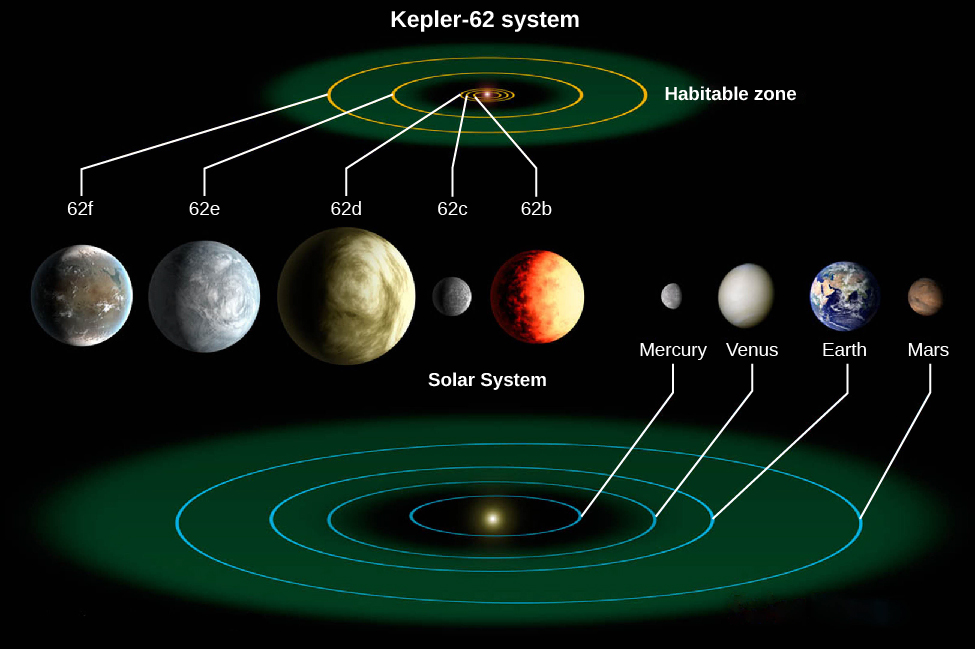
By the end of 2025, using data from Kepler and other search programs, astronomers gathered data on more than 1000 such exoplanet systems. Many have only two known planets, but a few have as many as five, and one has eight (the same number of planets as our own solar system). For the most part, these are very compact systems with most of their planets closer to their star than Mercury is to the Sun. The figure below shows one of the largest exoplanet systems: that of the star called Kepler-62 (Figure 21.26). Our solar system is shown to the same scale, for comparison (note that the Kepler-62 planets are drawn with artistic license; we have no detailed images of any exoplanets).
英語のヒント
2025年末までに、天文学者はケプラーやほかの探査計画のデータを用いて、1000を超えるこうした太陽系外惑星系の情報を集めた。知られている惑星が二つだけの系が多い一方、五つもある系もいくつかあり、太陽系と同じ八つの惑星を持つ系も一つある。大半は非常にコンパクトな系で、多くの惑星が、太陽に対する水星よりも主星に近い位置にある。図21.26は、最大級の系外惑星系の一つ、ケプラー62という恒星の系を示す。比較のため、太陽系も同じ縮尺で示している。ケプラー62の惑星の姿は想像を交えた表現であることに注意しよう。どの系外惑星にも、詳細な画像はない。
Exoplanet System Kepler-62, with the Solar System Shown to the Same Scale.ケプラー62惑星系と、同じ縮尺で示した太陽系。
credit: modification of work by NASA/Ames/JPL-Caltech · JPL image use policy
Figure 21.26 The green areas are the “habitable zones,” the range of distance from the star where surface temperatures are likely to be consistent with liquid water. (credit: modification of work by NASA/Ames/JPL-Caltech)
図21.26 緑の範囲は「ハビタブルゾーン」。恒星からの距離のうち、表面温度が液体の水の存在と両立しそうな範囲である。(出典:NASA/Ames/JPL-Caltechの作品を改変)
All but one of the planets in the K-62 system are larger than Earth. These are super-Earths, and one of them (62d) is in the size range of a mini-Neptune, where it is likely to be largely gaseous. The smallest planet in this system is about the size of Mars. The three inner planets orbit very close to their star, and only the outer two have orbits larger than Mercury in our system. The green areas represent each star’s “habitable zone,” which is the distance from the star where we calculate that surface temperatures would be consistent with liquid water. The Kepler-62 habitable zone is much smaller than that of the Sun because the star is intrinsically fainter.
英語のヒント
ケプラー62の系では、一つを除くすべての惑星が地球より大きいスーパーアースである。その一つ、62dはミニネプチューンの大きさの範囲にあり、大部分がガスである可能性が高いだろう。この系の最小の惑星は、火星ほどの大きさである。内側の三つは主星のごく近くを回り、太陽系の水星より大きな軌道を持つのは、外側の二つだけである。緑の領域は、各恒星の「ハビタブルゾーン」を示す。表面温度が液体の水の存在と両立すると計算される、恒星からの距離の範囲である。ケプラー62のハビタブルゾーンが太陽のものよりずっと小さいのは、恒星自体の光度が低いためである。
With closely spaced systems like this, the planets can interact gravitationally with each other. The result is that the observed transits occur a few minutes earlier or later than would be predicted from simple orbits. These gravitational interactions have allowed the Kepler scientists to calculate masses for the planets, providing another way to learn about exoplanets.
英語のヒント
このように間隔の狭い系では、惑星同士が重力で相互作用できる。その結果、実際のトランジットは、単純な軌道から予測する時刻より数分早く、あるいは遅く起こる。この重力相互作用によって、ケプラーの科学者たちは惑星の質量を計算でき、系外惑星を調べる別の方法が得られた。
Kepler has discovered some interesting and unusual planetary systems. For example, most astronomers expected planets to be limited to single stars. But we have found planets orbiting close double stars, so that the planet would see two suns in its sky, like those of the fictional planet Tatooine in the Star Wars films. At the opposite extreme, planets can orbit one star of a wide, double-star system without major interference from the second star.
英語のヒント
ケプラーはいくつかの興味深く珍しい惑星系も発見した。たとえば、天文学者の多くは、惑星があるのは単独の恒星だけだと予想していた。しかし、近接した連星を取り巻く惑星が見つかっている。その空には、『スター・ウォーズ』の架空の惑星タトゥイーンのように、二つの太陽が見えるだろう。反対の極端な例として、間隔の広い連星では、もう一方の星から大きな影響を受けずに、一方の星だけを惑星が回ることもできる。