第21章星の誕生と太陽系外惑星の発見The Birth of Stars and the Discovery of Planets outside the Solar System
21.3 Evidence That Planets Form around Other Stars21.3 ほかの恒星の周囲で惑星ができる証拠
Learning Objectives学習の目標
By the end of this section, you will be able to:
この節を学ぶと、次のことができるようになる。
Trace the evolution of dust surrounding a protostar, leading to the development of rocky planets and gas giants
原始星を取り巻く塵が進化し、岩石惑星や巨大ガス惑星になる過程をたどる。
Estimate the timescale for growth of planets using observations of the disks surrounding young stars
若い恒星の周囲の円盤の観測を使い、惑星の成長にかかる時間を見積もる。
Evaluate evidence for planets around forming stars based on the structures seen in images of the circumstellar dust disks
星を取り巻く塵の円盤の画像に見られる構造をもとに、形成中の恒星の周囲に惑星があるという証拠を評価する。
Having developed on a planet and finding it essential to our existence, we have a special interest in how planets fit into the story of star formation. Yet planets outside the solar system are extremely difficult to detect. Recall that we see planets in our own system only because they reflect sunlight and are close by. When we look to the other stars, we find that the amount of light a planet reflects is a depressingly tiny fraction of the light its star gives off. Furthermore, from a distance, planets are lost in the glare of their much-brighter parent stars.
英語のヒント
私たちは惑星の上で発達し、惑星なしには生きていけない。そのため、恒星形成の物語の中で惑星がどのような位置を占めるかに、特別な関心を持っている。しかし、太陽系の外の惑星を検出することは非常に困難である。太陽系の惑星が見えるのは、太陽光を反射しており、しかも近くにあるからだということを思い出してほしい。ほかの恒星を見ると、その惑星が反射する光は、恒星が放つ光に比べて、気が遠くなるほどわずかな割合にすぎない。さらに、遠くからは、惑星よりはるかに明るい主星のまぶしさの中に、惑星が埋もれてしまう。
Disks around Protostars: Planetary Systems in Formation原始星の周囲の円盤――形成中の惑星系
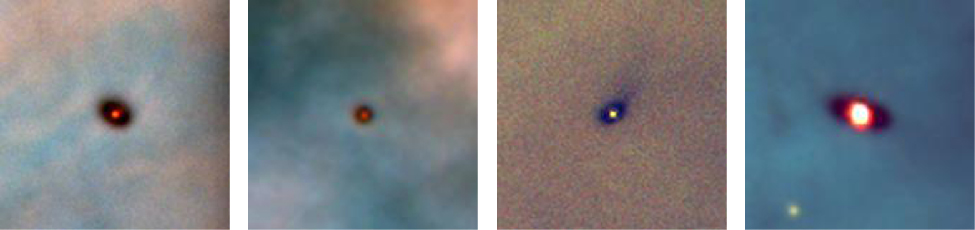
It is a lot easier to detect the spread-out raw material from which planets might be assembled than to detect planets after they are fully formed. From our study of the solar system, we understand that planets form by the gathering together of gas and dust particles in orbit around a newly created star. Each dust particle is heated by the young protostar and radiates in the infrared region of the spectrum. Before any planets form, we can detect such radiation from all of the spread-out individual dust particles that are destined to become parts of planets. We can also detect the silhouette of the disk if it blocks bright light coming from a source behind it (Figure 21.13).
英語のヒント
完成した惑星を検出するより、惑星の材料となる、広く散らばった物質を検出するほうがずっと簡単である。太陽系の研究から、新しく生まれた恒星の周囲を回るガスや塵の粒子が集まって、惑星ができるとわかっている。塵の粒子は一つ一つが若い原始星によって加熱され、赤外線を放射する。まだ惑星ができていない段階なら、やがて惑星の一部となる、ばらばらに広がった個々の塵の粒子すべてからの放射を検出できる。また、円盤が背後の光源から来る明るい光を遮れば、その影を検出することもできる(図21.13)。
Disks around Protostars.原始星の周囲の円盤。
credit: modification of work by Mark McCaughrean (Max-Planck-Institute for Astronomy), C. Robert O’Dell (Rice University), and NASA · NASA media use guidelines
Figure 21.13 These Hubble Space Telescope images show four disks around young stars in the Orion Nebula. The dark, dusty disks are seen silhouetted against the bright backdrop of the glowing gas in the nebula. The size of each image is about 30 times the diameter of our planetary system; this means the disks we see here range in size from two to eight times the orbit of Pluto. The red glow at the center of each disk is a young star, no more than a million years old. These images correspond to the stage in the life of a protostar shown in part (d) of Figure 21.8. (credit: modification of work by Mark McCaughrean (Max-Planck-Institute for Astronomy), C. Robert O’Dell (Rice University), and NASA)
図21.13 ハッブル宇宙望遠鏡による、オリオン大星雲の若い星の周囲の四つの円盤。塵を含む暗い円盤は、星雲のガスの明るい輝きを背景に、影となって見える。各画像の大きさは太陽系の直径の約30倍である。したがって、ここで見える円盤の大きさは冥王星の軌道の2〜8倍になる。各円盤の中心の赤い輝きは、年齢が100万年以下の若い星である。これらの画像は、図21.8dの原始星の段階に対応する。(出典:Mark McCaughrean〈マックス・プランク天文学研究所〉、C. Robert O’Dell〈ライス大学〉、NASAの作品を改変)
Once the dust particles gather together and form a few planets (and maybe some moons), the overwhelming majority of the dust is hidden in the interiors of the planets where we cannot see it. All we can now detect is the radiation from the outside surfaces, which cover a drastically smaller area than the huge, dusty disk from which they formed. The amount of infrared radiation is therefore greatest before the dust particles combine into planets. For this reason, our search for planets begins with a search for infrared radiation from the material required to make them.
英語のヒント
塵の粒子が集まっていくつかの惑星、そして場合によっては衛星ができると、塵の圧倒的大部分は惑星の内部へ隠れ、見えなくなる。検出できるのは外側の表面からの放射だけである。その表面積は、惑星を生み出した巨大な塵の円盤に比べて、桁違いに小さくなっている。したがって赤外線の放射量は、塵の粒子が合体して惑星になる前に最も多くなる。このため、惑星探しは、惑星を作るのに必要な物質の赤外線を探すことから始まる。
A disk of gas and dust appears to be an essential part of star formation. Observations show that nearly all very young protostars have disks and that the disks range in size from 10 to 1000 AU. (For comparison, the average diameter of the orbit of Pluto, which can be considered the rough size of our own planetary system, is 80 AU, whereas the outer diameter of the Kuiper belt of smaller icy bodies is about 100 AU.) The mass contained in these disks is typically 1–10% of the mass of our own Sun, which is more than the mass of all the planets in our solar system put together. Such observations already demonstrate that a large fraction of stars begin their lives with enough material in the right place to form a planetary system.
英語のヒント
ガスと塵の円盤は、星形成に欠かせない要素のようである。観測によれば、ごく若い原始星はほぼすべて円盤を持ち、その大きさは10〜1000 AUである。比較すると、太陽系のおおよその大きさとみなせる冥王星の軌道の平均直径は80 AUで、小さな氷天体が分布するカイパーベルトの外径は約100 AUである。円盤に含まれる質量は通常、太陽質量の1〜10%である。これは太陽系の全惑星の質量を合計したものを上回る。こうした観測だけでも、多くの恒星が、惑星系を作るのに十分な量の物質を、適切な場所に伴って一生を始めるとわかる。
We should also note that observations of these disks around the youngest stars, carried out in the infrared, can reveal the presence of the kinds of interstellar molecules we discussed in Interstellar Gas. The James Webb Space Telescope is being used by several teams of astronomers to discover such molecules, and their work has already found evidence for such interesting molecules as benzene, ethane, acetic acid (the key ingredient in vinegar), and formaldehyde (“embalming fluid”) in the disks.
英語のヒント
また、最も若い恒星の周囲の円盤を赤外線で観測すると、「星間ガス」で扱ったような星間分子の存在もわかる。複数の天文学者のチームがジェイムズ・ウェッブ宇宙望遠鏡を使ってこのような分子を探しており、円盤の中で、ベンゼン、エタン、酢の主要成分である酢酸、そして防腐処理液の成分であるホルムアルデヒドなど、興味深い分子の証拠をすでに見つけている。
The Timing of Planet Formation and Growth惑星が形成・成長する時期
We can use observations of how the disks change with time to estimate how long it takes for planets to form. If we measure the temperature and luminosity of a protostar, then, as we saw, we can place it in an H–R diagram like the one shown in Figure 21.12. By comparing the real star with our models of how protostars should evolve with time, we can estimate its age. We can then look at how the disks we observe change with the ages of the stars that they surround.
英語のヒント
円盤が時間とともにどう変わるかを観測すれば、惑星ができるまでの時間を見積もれる。原始星の温度と光度を測れば、先ほど見たように、図21.12のようなHR図に位置を定められる。時間とともに原始星がどう進化するはずかを示すモデルと、実際の星を比較することで、年齢を推定できる。そのうえで、観測した円盤が、取り囲んでいる恒星の年齢によってどう変わるかを調べられる。
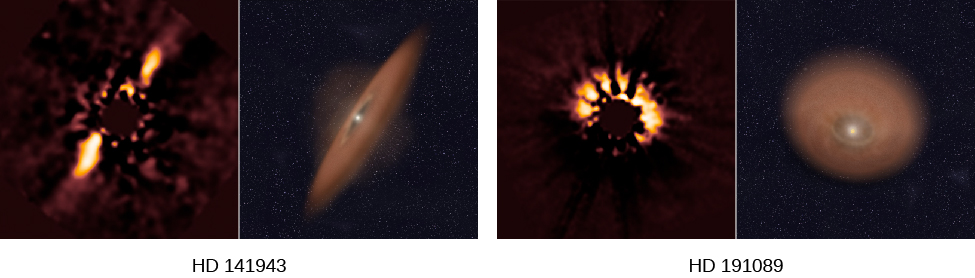
What such observations show is that if a protostar is less than about 1 to 3 million years old, its disk extends all the way from very close to the surface of the star out to tens or hundreds of AU away. In older protostars, we find disks with outer parts that still contain large amounts of dust, but the inner regions have lost most of their dust. In these objects, the disk looks like a donut, with the protostar centered in its hole. The inner, dense parts of most disks have disappeared by the time the stars are 10 million years old (Figure 21.14).
英語のヒント
この種の観測でわかるのは、年齢が約100万〜300万年未満の原始星では、円盤が星の表面のすぐ近くから数十〜数百AU先まで連続して広がっているということである。より年を取った原始星では、外側にはまだ大量の塵を含むものの、内側では塵の大部分を失った円盤が見つかる。こうした天体では、円盤はドーナツ状で、穴の中心に原始星がいる。星が1000万歳になるころまでには、ほとんどの円盤で内側の密度の高い部分が消えている(図21.14)。
Protoplanetary Disks around Two Stars.二つの恒星の周囲の原始惑星系円盤。
credit: modification of work by NASA, ESA, R. Soummer and M. Perrin (STScI), L. Pueyo (STScI/Johns Hopkins University), C. Chen and D. Golimowski (STScI), J.B. Hagan (STScI/Purdue University), T. Mittal (University of California, Berkeley/Johns Hopkins University), E. Choquet, M. Moerchen, and M. N’Diaye (STScI), A. Rajan (Arizona State University), S. Wolff (STScI/Purdue University), J. Debes and D. Hines (STScI), and G. Schneider (Steward Observatory/University of Arizona) · CC BY 4.0
Figure 21.14 The left view of each star shows infrared observations by the Hubble Space Telescope of their protoplanetary disks. The central star is much brighter than the surrounding disk, so the instrument includes a coronagraph, which has a small shield that blocks the light of the central star but allows the surrounding disk to be imaged. The right image of each star shows models of the disks based on the observations. The star HD 141943 has an age of about 17 million years, while HD 191089 is about 12 million years old. (credit: modification of work by NASA, ESA, R. Soummer and M. Perrin (STScI), L. Pueyo (STScI/Johns Hopkins University), C. Chen and D. Golimowski (STScI), J.B. Hagan (STScI/Purdue University), T. Mittal (University of California, Berkeley/Johns Hopkins University), E. Choquet, M. Moerchen, and M. N’Diaye (STScI), A. Rajan (Arizona State University), S. Wolff (STScI/Purdue University), J. Debes and D. Hines (STScI), and G. Schneider (Steward Observatory/University of Arizona))
図21.14 各恒星の左側は、ハッブル宇宙望遠鏡による原始惑星系円盤の赤外線観測。中心星は周囲の円盤よりはるかに明るいため、観測装置にはコロナグラフがある。その小さな遮光板で中心星の光を遮り、周囲の円盤を撮影できるようにしている。各恒星の右側は、観測に基づく円盤のモデルである。HD 141943は約1700万歳、HD 191089は約1200万歳である。(出典:NASA、ESA、R. Soummer、M. Perrin〈STScI〉、L. Pueyo〈STScI/ジョンズ・ホプキンズ大学〉、C. Chen、D. Golimowski〈STScI〉、J. B. Hagan〈STScI/パデュー大学〉、T. Mittal〈カリフォルニア大学バークレー校/ジョンズ・ホプキンズ大学〉、E. Choquet、M. Moerchen、M. N’Diaye〈STScI〉、A. Rajan〈アリゾナ州立大学〉、S. Wolff〈STScI/パデュー大学〉、J. Debes、D. Hines〈STScI〉、G. Schneider〈スチュワード天文台/アリゾナ大学〉の作品を改変)
Calculations show that the formation of one or more planets could produce such a donut-like distribution of dust. Suppose a planet forms a few AU away from the protostar, presumably due to the gathering together of matter from the disk. As the planet grows in mass, the process clears out a dust-free region in its immediate neighborhood. Calculations also show that any small dust particles and gas that were initially located in the region between the protostar and the planet, and that are not swept up by the planet, will then fall onto the star very quickly in about 50,000 years.
英語のヒント
計算によると、一つ以上の惑星ができることで、このようなドーナツ状の塵の分布が生じえる。原始星から数AUの場所で、おそらく円盤の物質が集まって、惑星ができたとしよう。惑星の質量が増すにつれ、そのすぐ周囲から塵が取り除かれ、塵のない領域が作られる。また計算から、もともと原始星と惑星の間にあった小さな塵の粒子やガスで、惑星に取り込まれなかったものは、約5万年という非常に短い時間で恒星へ落ち込むこともわかる。
Matter lying outside the planet’s orbit, in contrast, is prevented from moving into the hole by the gravitational forces exerted by the planet. (We saw something similar in Saturn’s rings, where the action of the shepherd moons keeps the material near the edge of the rings from spreading out.) If the formation of a planet is indeed what produces and sustains holes in the disks that surround very young stars, then planets must form in 3 to 30 million years. This is a short period compared with the lifetimes of most stars and shows that the formation of planets may be a quick byproduct of the birth of stars.
英語のヒント
それに対し、惑星の軌道の外側にある物質は、惑星の重力に妨げられ、穴の中へ移動できない。土星の環でも似たことを見た。羊飼い衛星の働きによって、環の縁近くの物質が広がるのを防いでいるのだ。非常に若い恒星を取り巻く円盤の穴を作り、保ち続ける原因が本当に惑星形成であるなら、惑星は300万〜3000万年でできるはずである。大半の恒星の寿命に比べれば短い時間であり、惑星形成が、恒星の誕生に伴ってすばやく生じる副産物でありうることを示している。
Calculations show that accretion can drive the rapid growth of planets—small, dust-grain-size particles orbiting in the disk collide and stick together, with the larger collections growing more rapidly as they attract and capture smaller ones. Once these clumps grow to about 10 centimeters in size or so, they enter a perilous stage in their development. At that size, unless they can grow to larger than about 100 meters in diameter, they are subject to drag forces produced by friction with the gas in the disk—and their orbits can rapidly decay, plunging them into the host star. Therefore, these bodies must rapidly grow to nearly 1 kilometer in size in diameter to avoid a fiery fate. At this stage, they are considered planetesimals (the small chunks of solid matter—ice and dust particles—that you learned about in Other Worlds: An Introduction to the Solar System). Once they survive to those sizes, the largest survivors will continue to grow by accreting smaller planetesimals; ultimately, this process results in a few large planets.
英語のヒント
計算によると、降着は惑星を急速に成長させられる。円盤を回る塵の粒ほどの小さな粒子が衝突してくっつき、大きくなった集まりほど、小さな集まりを引き付けて取り込むことで、より速く成長する。塊が10センチメートルほどになると、発達の危険な段階へ入る。その大きさでは、直径約100メートルを超えるまで育てないと、円盤のガスとの摩擦が生む抵抗力を受ける。軌道が急速に縮み、主星へ落ち込んでしまう可能性があるのだ。焼け落ちる運命を避けるには、天体は直径が1キロメートル近くになるまで、急いで成長しなければならない。この段階の天体は微惑星とみなされる。「ほかの世界――太陽系入門」で学んだ、氷や塵の粒子という固体物質の小さな塊である。その大きさまで生き残れば、最大のものは小さな微惑星を取り込んで成長を続ける。最終的には、この過程によっていくつかの大きな惑星ができる。
If the growing planets reach a mass bigger than about 10 times the mass of Earth, their gravity is strong enough to capture and hold on to hydrogen gas that remains in the disk. At that point, they will grow in mass and radius rapidly, reaching giant planet dimensions. However, to do so requires that the rapidly evolving central star hasn’t yet driven away the gas in the disk with its increasingly vigorous wind (see the earlier section on Star Formation). From observations, we see that the disk can be blown away within 10 million years, so growth of a giant planet must also be a very fast process, astronomically speaking.
英語のヒント
成長する惑星の質量が地球の約10倍を超えると、円盤に残る水素ガスを捕らえて保持できるほど重力が強くなる。そうなると質量と半径が急増し、巨大惑星の大きさに達する。ただしそのためには、急速に進化する中心星が、ますます強まる恒星風によって円盤のガスをまだ吹き払っていない必要がある(先の「星形成」の節参照)。観測から、円盤は1000万年以内に吹き払われうるとわかっている。したがって、巨大惑星の成長も、天文学的には非常に速い過程でなければならない。