第21章星の誕生と太陽系外惑星の発見The Birth of Stars and the Discovery of Planets outside the Solar System
21.1 Star Formation21.1 星形成
Learning Objectives学習の目標
By the end of this section, you will be able to:
この節を学ぶと、次のことができるようになる。
Identify the sometimes-violent processes by which parts of a molecular cloud collapse to produce stars
分子雲の一部が収縮して恒星を生む、ときに激しい過程を説明する。
Recognize some of the structures seen in images of molecular clouds like the one in Orion
オリオン座にあるもののような分子雲の画像に見られる構造を、いくつか見分ける。
Explain how the environment of a molecular cloud enables the formation of stars
分子雲の環境が、どのように恒星の形成を可能にするのかを説明する。
Describe how advancing waves of star formation cause a molecular cloud to evolve
広がっていく星形成の波によって、分子雲がどのように変化するかを説明する。
As we begin our exploration of how stars are formed, let’s review some basics about stars discussed in earlier chapters:
恒星がどのように形成されるかを探り始めるにあたり、前の章までに扱った恒星についての基本事項を振り返ろう。
Stable (main-sequence) stars such as our Sun maintain equilibrium by producing energy through nuclear fusion in their cores. The ability to generate energy by fusion defines a star.
太陽のような安定した恒星、すなわち主系列星は、中心核の核融合でエネルギーを作り出すことによって平衡を保っている。核融合でエネルギーを生み出す能力が、恒星を特徴づける。
Each second in the Sun, approximately 600 million tons of hydrogen undergo fusion into helium, with about 4 million tons turning into energy in the process. This rate of hydrogen use means that eventually the Sun (and all other stars) will run out of central fuel.
英語のヒント
太陽では毎秒、約6億トンの水素が核融合によってヘリウムになり、その過程で約400万トンがエネルギーに変わる。このような速さで水素を消費するということは、太陽もほかのすべての恒星も、やがて中心部の燃料を使い果たすということである。
Stars come with many different masses, ranging from 1/12 solar masses (MSun) to roughly 100–200 MSun. There are far more low-mass than high-mass stars.
恒星の質量はさまざまで、太陽質量(M_Sun)の1/12から、およそ100〜200 M_Sunまでにわたる。質量の小さい恒星は、質量の大きい恒星よりはるかに多い。
The most massive main-sequence stars (spectral type O) are also the most luminous and have the highest surface temperature. The lowest-mass stars on the main sequence (spectral type M or L) are the least luminous and the coolest.
最も質量の大きな主系列星、すなわちスペクトル型Oの星は、光度も最も大きく、表面温度も最も高い。主系列上で質量が最も小さいスペクトル型MまたはLの星は、光度が最も小さく、温度も最も低い。
A galaxy of stars such as the Milky Way contains enormous amounts of gas and dust—enough to make billions of stars like the Sun.
天の川銀河のような星の集まりには、太陽のような恒星を何十億個も作れるほどの、膨大な量のガスと塵が含まれている。
If we want to find stars still in the process of formation, we must look in places that have plenty of the raw material from which stars are assembled. Since stars are made of gas, we focus our attention (and our telescopes) on the dense and cold clouds of gas and dust that dot the Milky Way (see Figure 21.1 and Figure 21.2).
英語のヒント
まだ形成の途中にある恒星を見つけたいなら、恒星を組み立てる材料が豊富にある場所を探さなければならない。恒星はガスからできるので、天の川銀河のあちこちに点在する、密度の高い冷たいガスと塵の雲に、注意を向け、望遠鏡を向けるのだ(図21.1、図21.2参照)。
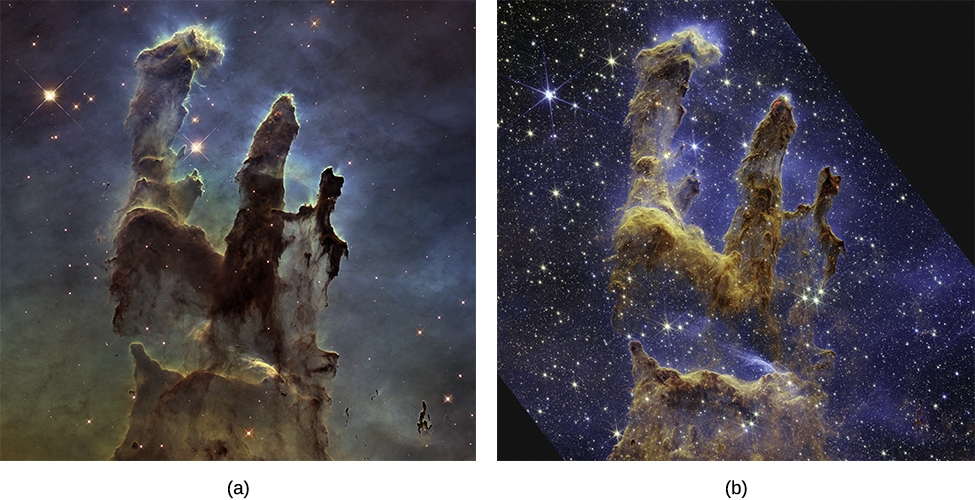
Pillars of Dust and Young Stars in the Eagle Nebula.わし星雲の塵の柱と若い恒星。
credit a: modification of work by NASA, ESA, and the Hubble Heritage Team (STScI/AURA); credit b: modification of work by NASA, ESA, CSA, STScI; J. DePasquale, A. Koekemoer, A. Pagan (STScI) · CC BY 4.0
Figure 21.2 (a) This Hubble Space Telescope visible-light image of the central regions of the Eagle Nebula shows huge columns of cool gas (including molecular hydrogen, H2) and dust. These columns or pillars are of higher density than the surrounding regions and have resisted evaporation by the ultraviolet radiation from a cluster of hot stars just beyond the upper-right corner of this image. Note that even around the pillars, very few stars are visible because of the background dust. (b) In contrast, the James Webb Space Telescope image on the right shows the same region in near-infrared light. Here we penetrate more of the dust and see many more stars, some of them freshly born from the material of the nebula. (credit a: modification of work by NASA, ESA, and the Hubble Heritage Team (STScI/AURA); credit b: modification of work by NASA, ESA, CSA, STScI; J. DePasquale, A. Koekemoer, A. Pagan (STScI))
図21.2 (a)ハッブル宇宙望遠鏡で撮影したわし星雲の中心部の可視光画像。冷たいガス(水素分子H₂を含む)と塵からなる巨大な柱が見える。これらの柱は周囲より密度が高く、画像の右上のすぐ外側にある高温の星の集団が放つ紫外線による蒸発に耐えている。柱の周囲でも、背景の塵のため、見える星がごく少ないことに注目しよう。(b)対照的に、右側のジェイムズ・ウェッブ宇宙望遠鏡の画像は、同じ領域を近赤外線でとらえている。こちらでは、より多くの塵を見通せるため、はるかに多くの星が見える。その中には、星雲の物質から生まれたばかりの星もある。(クレジットa:NASA, ESA, and the Hubble Heritage Team (STScI/AURA) の作品を改変。クレジットb:NASA, ESA, CSA, STScI; J. DePasquale, A. Koekemoer, A. Pagan (STScI) の作品を改変)
Molecular Clouds: Stellar Nurseries分子雲――星のゆりかご
As we saw in Between the Stars: Gas and Dust in Space, the most massive reservoirs of interstellar matter—and some of the most massive objects in the Milky Way Galaxy—are the giant molecular clouds. These clouds have cold interiors with characteristic temperatures of only 10–20 K; most of their gas atoms are bound into molecules. These clouds turn out to be the birthplaces of most stars in our Galaxy.
英語のヒント
「星と星の間――宇宙のガスと塵」で見たように、星間物質の最大の貯蔵庫は巨大分子雲である。これは天の川銀河にある天体の中でも、とりわけ質量の大きいものだ。雲の内部は冷たく、代表的な温度はわずか10〜20 Kである。ガスを構成する原子の大半は、結びついて分子になっている。天の川銀河の星のほとんどは、こうした雲の中で生まれることがわかっている。
The masses of molecular clouds range from a thousand times the mass of the Sun to about 3 million solar masses. Molecular clouds have a complex filamentary structure, similar to cirrus clouds in Earth’s atmosphere, but much less dense. The molecular cloud filaments can be up to 1000 light-years long. Within the clouds are cold, dense regions with typical masses of 50 to 500 times the mass of the Sun; we give these regions the highly technical name clumps. Within these clumps, there are even denser, smaller regions called cores. The cores are the embryos of stars. The conditions in these cores—low temperature and high density—are just what is required to make stars. Remember that the essence of the life story of any star is the ongoing competition between two forces: gravity and pressure. The force of gravity, pulling inward, tries to make a star collapse. Internal pressure produced by the motions of the gas atoms, pushing outward, tries to force the star to expand. When a star is first forming, low temperature (and hence, low pressure) and high density (hence, greater gravitational attraction) both work to give gravity the advantage. In order to form a star—that is, a dense, hot ball of matter capable of starting nuclear reactions deep within—we need a typical core of interstellar atoms and molecules to shrink in radius and increase in density by a factor of nearly 1020. It is the force of gravity that produces this drastic collapse.
英語のヒント
分子雲の質量は、太陽質量の1000倍から約300万倍に及ぶ。地球大気の巻雲に似た複雑なフィラメント状の構造をしているが、密度は巻雲よりはるかに低いものだ。分子雲のフィラメントは、長さが1000光年に達することもある。雲の中には、代表的な質量が太陽の50〜500倍という、低温で高密度の領域がある。この領域には「クランプ(塊)」という、いかにも専門的な名前を付けている。そのクランプの中には、さらに密度が高く小さい「コア」と呼ばれる領域がある。コアはいわば星の胚である。コアの低温・高密度という条件こそ、星を作るために必要なものだ。どんな恒星の一生も、根本にあるのは重力と圧力という二つの力の絶え間ない競争だったことを思い出してほしい。内向きに引く重力は、恒星を収縮させようとする。一方、ガスの原子の運動によって生じる内部の圧力は、外向きに押して恒星を膨張させようとする。星が生まれ始める段階では、低い温度とそれに伴う低い圧力、そして高い密度とそれに伴う強い引力が、どちらも重力を有利にする。恒星、つまり中心部で核反応を始められるほど高温で高密度の物質の球を作るには、星間空間の原子や分子からなる普通のコアを、半径が小さくなり密度がほぼ10²⁰倍になるまで収縮させる必要がある。この桁違いの収縮を引き起こすのが重力である。
The Orion Molecular Cloudオリオン分子雲
Let’s discuss what happens in regions of star formation by considering a nearby site where stars are forming right now. One of the best-studied stellar nurseries is in the constellation of Orion, The Hunter, about 1500 light-years away (Figure 21.3). The pattern of the hunter is easy to recognize by the conspicuous “belt” of three stars that mark his waist. The Orion molecular cloud is much larger than the star pattern and is truly an impressive structure. In its long dimension, it stretches over a distance of about 100 light-years. The total quantity of molecular gas is about 200,000 times the mass of the Sun. Most of the cloud does not glow with visible light but betrays its presence by the radiation that the dusty gas gives off at infrared and radio wavelengths.
英語のヒント
星形成領域で何が起きるのかを、今まさに星が生まれている近くの場所を例に考えよう。よく調べられている星のゆりかごの一つが、約1500光年先の、狩人の姿を表すオリオン座にある(図21.3)。腰の位置に目立つ三つ星の「ベルト」があるので、狩人の星の並びは簡単に見つけられる。オリオン分子雲は、この星の並びよりずっと大きい、実に壮大な構造である。長い方向には約100光年にわたって広がり、分子ガスの総質量は太陽の約20万倍である。雲の大部分は可視光では輝かないが、塵を含んだガスが赤外線や電波を放つことで、その存在がわかる。
Orion in Visible and Infrared.可視光と赤外線で見たオリオン座。
Figure 21.3 (a) The Orion star group was named after the legendary hunter in Greek mythology. Three stars close together in a link mark Orion’s belt. The ancients imagined a sword hanging from the belt; the object at the end of the blue line in this sword is the Orion Nebula. (b) This wide-angle, infrared view of the same area was taken with the Infrared Astronomical Satellite. Heated dust clouds dominate in this false-color image, and many of the stars that stood out on part (a) are now invisible. An exception is the cool, red-giant star Betelgeuse, which can be seen as a yellowish point at the left vertex of the blue triangle (at Orion’s left armpit). The large, yellow ring to the right of Betelgeuse is the remnant of an exploded star. The infrared image lets us see how large and full of cooler material the Orion molecular cloud really is. On the visible-light image at left, you see only two colorful regions of interstellar matter—the two, bright yellow splotches at the left end of and below Orion’s belt. The lower one is the Orion Nebula and the higher one is the region of the Horsehead Nebula. (credit: modification of work by NASA, visible light: Akira Fujii; infrared: Infrared Astronomical Satellite)
図21.3 (a)オリオン座の星の集まりは、ギリシャ神話の伝説的な狩人にちなんで名付けられた。近接して一列に並ぶ三つの星がオリオンのベルトを示す。古代の人々は、そこから剣が下がっていると考えた。この剣を示す青い線の先端にある天体がオリオン大星雲である。(b)同じ領域を広角で撮影した赤外線画像。赤外線天文衛星IRASによる。この疑似カラー画像では、加熱された塵の雲が目立ち、(a)で際立っていた星の多くは見えなくなっている。例外は低温の赤色巨星ベテルギウスで、青い三角形の左の頂点、オリオンの左脇の位置に黄色がかった点として見える。ベテルギウスの右の大きな黄色い環は、爆発した恒星の残骸である。赤外線画像からは、オリオン分子雲が実際にはどれほど大きく、低温の物質で満たされているかがわかる。左の可視光画像で色の付いた星間物質の領域は、オリオンのベルトの左端とその下にある、明るい黄色の二か所だけである。下がオリオン大星雲、上が馬頭星雲の領域に当たる。(出典:NASAの作品を改変。可視光:藤井旭、赤外線:赤外線天文衛星IRAS)
The stars in Orion’s belt are typically about 5 million years old, whereas the stars near the middle of the “sword” hanging from Orion’s belt are only 300,000 to 1 million years old. The region about halfway down the sword where star formation is still taking place is called the Orion Nebula. About 2200 young stars are found in this region, which is only slightly larger than a dozen light-years in diameter. The Orion Nebula also contains a tight cluster of stars called the Trapezium (Figure 21.5). The brightest Trapezium stars can be seen easily with a small telescope.
英語のヒント
オリオンのベルトの星はおおむね約500万歳であるが、ベルトから下がる「剣」の中央付近の星は、まだ30万〜100万歳にすぎない。剣のほぼ中ほどにある、今も星形成が続いている領域をオリオン大星雲と呼ぶ。直径は12光年ほどを少し超えるだけであるが、約2200個の若い星が見つかっている。オリオン大星雲には、トラペジウムと呼ばれる密集した星の集まりもある(図21.5)。トラペジウムの最も明るい星は、小さな望遠鏡でも簡単に見える。
Orion Nebula.オリオン大星雲。
Figure 21.4 (a) The Orion Nebula is shown in visible light. (b) With near-infrared radiation, we can see more detail within the dusty nebula since infrared can penetrate dust more easily than can visible light. (credit a: modification of work by Filip Lolić; credit b: modification of work by NASA/JPL-Caltech/T. Megeath (University of Toledo, Ohio))
図21.4 (a)可視光で見たオリオン大星雲。(b)近赤外線を使うと、塵の多い星雲の内部がより詳しく見える。赤外線は可視光より塵を透過しやすいためである。(出典a:Filip Lolićの作品を改変。出典b:NASA/JPL-Caltech/T. Megeath〈オハイオ州・トレド大学〉の作品を改変)
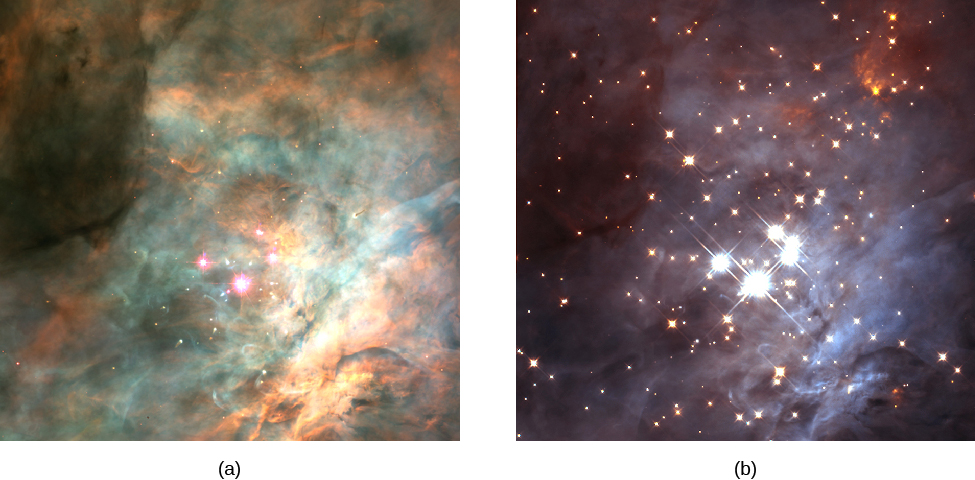
Compare this with our own solar neighborhood, where the typical spacing between stars is about 3 light-years. Only a small number of stars in the Orion cluster can be seen with visible light, but infrared images—which penetrate the dust better—detect the more than 2000 stars that are part of the group (Figure 21.5).
英語のヒント
これを、星同士の間隔が通常は約3光年ある太陽近傍と比べてみよ。オリオン星団の星のうち、可視光で見えるのはごく一部である。しかし塵をよく透過する赤外線を使った画像では、この集団に属する2000個以上の星が検出される(図21.5)。
Central Region of the Orion Nebula.オリオン大星雲の中心部。
credit a: modification of work by NASA, C.R. O’Dell and S.K. Wong (Rice University); credit b: modification of work by NASA; K.L. Luhman (Harvard-Smithsonian Center for Astrophysics); and G. Schneider, E. Young, G. Rieke, A. Cotera, H. Chen, M. Rieke, R. Thompson (Steward Observatory, University of Arizona) · NASA media use guidelines
Figure 21.5 The Orion Nebula harbors some of the youngest stars in the solar neighborhood. At the heart of the nebula is the Trapezium cluster, which includes four very bright stars that provide much of the energy that causes the nebula to glow so brightly. In these images, we see a section of the nebula in (a) visible light and (b) infrared. The four bright stars in the center of the visible-light image are the Trapezium stars. Notice that most of the stars seen in the infrared are completely hidden by dust in the visible-light image. (credit a: modification of work by NASA, C.R. O’Dell and S.K. Wong (Rice University); credit b: modification of work by NASA; K.L. Luhman (Harvard-Smithsonian Center for Astrophysics); and G. Schneider, E. Young, G. Rieke, A. Cotera, H. Chen, M. Rieke, R. Thompson (Steward Observatory, University of Arizona))
図21.5 オリオン大星雲には、太陽近傍でも特に若い星々が含まれている。星雲の中心にあるトラペジウムの星の集まりには、とても明るい四つの星があり、星雲を明るく輝かせるエネルギーの多くを供給している。ここでは星雲の一部を、(a)可視光と(b)赤外線で見ている。可視光画像の中心にある四つの明るい星が、トラペジウムの星である。赤外線で見える星の大半が、可視光では塵に完全に隠されていることに注目しよう。(出典a:NASA、C. R. O’Dell、S. K. Wong〈ライス大学〉の作品を改変。出典b:NASA、K. L. Luhman〈ハーバード・スミソニアン天体物理学センター〉、G. Schneider、E. Young、G. Rieke、A. Cotera、H. Chen、M. Rieke、R. Thompson〈アリゾナ大学スチュワード天文台〉の作品を改変)
Studies of Orion and other star-forming regions show that star formation is not a very efficient process. In the region of the Orion Nebula, about 1% of the material in the cloud has been turned into stars. That is why we still see a substantial amount of gas and dust near the Trapezium stars. The leftover material is eventually heated, either by the radiation and winds from the hot stars that form or by explosions of the most massive stars. (We will see in later chapters that the most massive stars go through their lives very quickly and end by exploding.)
英語のヒント
オリオンやほかの星形成領域の研究から、星形成はあまり効率のよい過程ではないことがわかる。オリオン大星雲の領域で恒星になったのは、雲の物質の約1%である。だからこそ、トラペジウムの星々の近くには、今も大量のガスと塵が見られる。残った物質はやがて、生まれた高温の星からの放射や恒星風、あるいは最も大質量の星の爆発によって加熱される。(後の章で見るように、最も大質量の恒星は一生を非常に速く駆け抜け、最後は爆発する。)
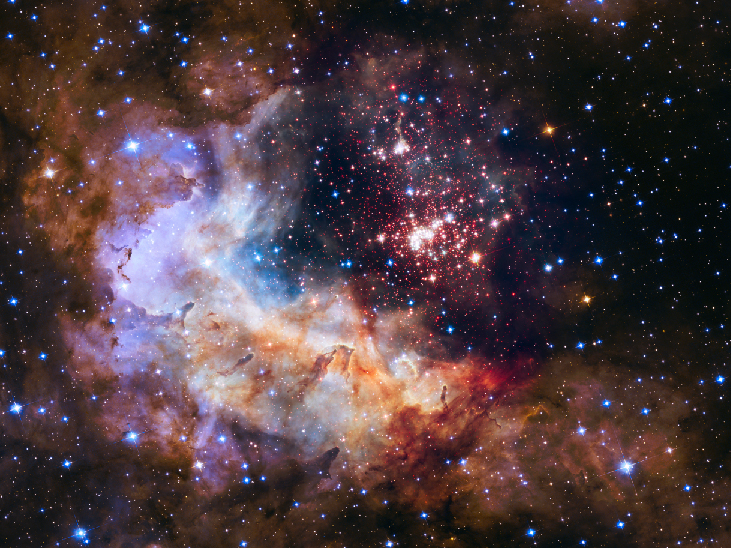
Whether gently or explosively, the material in the neighborhood of the new stars is blown away into interstellar space. Older groups or clusters of stars can now be easily observed in visible light because they are no longer shrouded in dust and gas (Figure 21.6).
英語のヒント
穏やかにせよ爆発的にせよ、新しく生まれた星の周囲の物質は、星間空間へ吹き飛ばされる。すると、それより古い星の集団や星団は、もはや塵やガスに包まれていないため、可視光で容易に観測できるようになる(図21.6)。
Westerlund 2.ウェスタールンド2。
credit: NASA, ESA, the Hubble Heritage Team (STScI/AURA), A. Nota (ESA/STScI), and the Westerlund 2 Science Team · CC BY 4.0
Figure 21.6 This young cluster of stars known as Westerlund 2 formed within the Carina star-forming region about 2 million years ago. Stellar winds and pressure produced by the radiation from the hot stars within the cluster are blowing and sculpting the surrounding gas and dust. The nebula still contains many globules of dust. Stars are continuing to form within the denser globules and pillars of the nebula. This Hubble Space Telescope image includes near-infrared exposures of the star cluster and visible-light observations of the surrounding nebula. Colors in the nebula are dominated by the red glow of hydrogen gas, and blue-green emissions from glowing oxygen. (credit: NASA, ESA, the Hubble Heritage Team (STScI/AURA), A. Nota (ESA/STScI), and the Westerlund 2 Science Team)
図21.6 ウェスタールンド2として知られるこの若い星団は、約200万年前に、りゅうこつ座方向の星形成領域内で生まれた。星団の高温の星から出る恒星風と、放射が及ぼす圧力が、周囲のガスや塵を吹き払い、その形を彫り上げている。星雲には、塵のグロビュールがまだ多数残っている。密度の高いグロビュールや柱の内部では、星が引き続き形成されている。このハッブル宇宙望遠鏡の画像には、星団の近赤外線撮影と、周囲の星雲の可視光観測が組み合わされている。星雲の色は、主に水素ガスの赤い輝きと、酸素の青緑色の発光である。(出典:NASA、ESA、Hubble Heritage Team〈STScI/AURA〉、A. Nota〈ESA/STScI〉、Westerlund 2 Science Team)
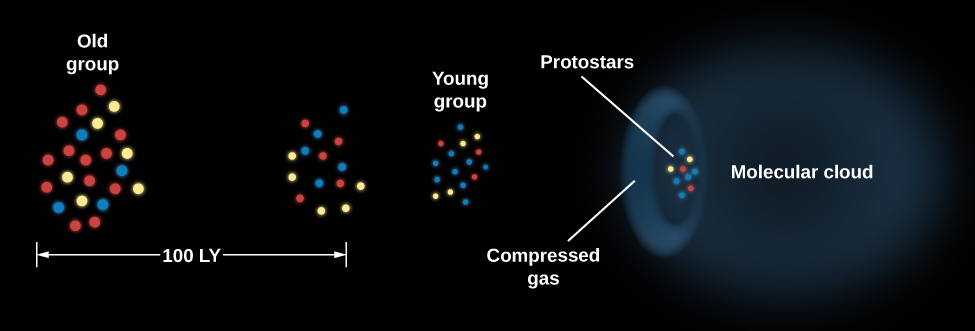
Although we do not know what initially caused stars to begin forming in Orion, there is good evidence that the first generation of stars triggered the formation of additional stars, which in turn led to the formation of still more stars (Figure 21.7).
英語のヒント
オリオンで最初に星が生まれ始めた原因はわかっていない。しかし、最初の世代の恒星が次の星形成を引き起こし、それがさらに多くの星の形成へつながったことには、有力な証拠がある(図21.7)。
Propagating Star Formation.次々に広がる星形成。
OpenStax / Rice University · CC BY 4.0
Figure 21.7 Star formation can move progressively through a molecular cloud. The oldest group of stars lies to the left of the diagram and has expanded because of the motions of individual stars. Eventually, the stars in the group will disperse and no longer be recognizable as a cluster. The youngest group of stars lies to the right, next to the molecular cloud. This group of stars is only 1 to 2 million years old. The pressure of the hot, ionized gas surrounding these stars compresses the material in the nearby edge of the molecular cloud and initiates the gravitational collapse that will lead to the formation of more stars.
図21.7 星形成は分子雲の内部を順々に進んでいくことがある。図の左には最も古い星の集団があり、個々の星の運動によって広がっている。やがて星々は散らばり、星団として見分けられなくなる。最も若い集団は右側、分子雲の隣にある。この星々の年齢はわずか100万〜200万年である。周囲の高温で電離したガスの圧力が、近接する分子雲の縁の物質を圧縮し、さらに星を生み出す重力収縮を開始させる。
The basic idea of triggered star formation is this: when a massive star is formed, it emits a large amount of ultraviolet radiation and ejects high-speed gas in the form of a stellar wind. This injection of energy heats the gas around the stars and causes it to expand. When massive stars exhaust their supply of fuel, they explode, and the energy of the explosion also heats the gas. The hot gases pile into the surrounding cold molecular cloud, compressing the material in it and increasing its density. If this increase in density is large enough, gravity will overcome pressure, and stars will begin to form in the compressed gas. Such a chain reaction—where the brightest and hottest stars of one area become the cause of star formation “next door”—seems to have occurred not only in Orion but also in many other molecular clouds.
英語のヒント
誘発的星形成の基本的な考え方は、次のようなものだ。大質量星が生まれると、大量の紫外線を放射し、恒星風として高速のガスを放出する。このエネルギーの注入が周囲のガスを加熱し、膨張させる。大質量星は燃料を使い果たすと爆発し、その爆発のエネルギーもガスを加熱する。高温のガスは周囲の冷たい分子雲へ押し寄せ、雲の物質を圧縮して密度を高める。密度の増加が十分大きければ、重力が圧力に打ち勝ち、圧縮されたガスの中で星が生まれ始める。ある領域で最も明るく高温の星が、「隣」の星形成の原因になるわけだ。こうした連鎖反応は、オリオンだけでなく、多くの分子雲でも起きたと考えられる。
There are many molecular clouds that form only (or mainly) low-mass stars. Because low-mass stars do not have strong winds and do not die by exploding, triggered star formation cannot occur in these clouds. There are also stars that form in relative isolation in small cores. Therefore, not all star formation is originally triggered by the death of massive stars. However, there are likely to be other possible triggers, such as spiral density waves and other processes we do not yet understand.
英語のヒント
低質量の恒星だけを、あるいは主に低質量の恒星を作る分子雲も多数ある。低質量星は強い恒星風を出さず、最期に爆発することもないため、このような雲では誘発的星形成は起こらない。また、小さなコアの中で、ほかの星から比較的孤立して形成される恒星もある。したがって、すべての星形成が大質量星の死を最初のきっかけにしているわけではない。もっとも、渦巻構造の密度波や、まだ理解できていない過程など、ほかにも引き金となりうるものがありそうである。