第21章星の誕生と太陽系外惑星の発見The Birth of Stars and the Discovery of Planets outside the Solar System
21.2 The H–R Diagram and the Study of Stellar Evolution21.2 HR図と恒星進化の研究
Learning Objectives学習の目標
By the end of this section, you will be able to:
この節を学ぶと、次のことができるようになる。
Determine the age of a protostar using an H–R diagram and the protostar’s luminosity and temperature
HR図と原始星の光度・温度を使い、原始星の年齢を求める。
Explain the interplay between gravity and pressure, and how the contracting protostar changes its position in the H–R diagram as a result
重力と圧力の相互作用、およびその結果、収縮する原始星のHR図上の位置がどう変わるかを説明する。
One of the best ways to summarize all of these details about how a star or protostar changes with time is to use a Hertzsprung-Russell (H–R) diagram. Recall from The Stars: A Celestial Census that, when looking at an H–R diagram, the temperature (the horizontal axis) is plotted increasing toward the left. As a star goes through the stages of its life, its luminosity and temperature change. Thus, its position on the H–R diagram, in which luminosity is plotted against temperature, also changes. As a star ages, we must replot it in different places on the diagram. Therefore, astronomers often speak of a star moving on the H–R diagram, or of its evolution tracing out a path on the diagram. In this context, “tracing out a path” has nothing to do with the star’s motion through space; this is just a shorthand way of saying that its temperature and luminosity change as it evolves.
英語のヒント
恒星や原始星が時間とともにどう変化するか、ここまでの詳しい話を整理する最もよい方法の一つが、ヘルツシュプルング・ラッセル図(HR図)を使うことである。「恒星――星の世界の実態を調べる」で学んだように、HR図の横軸の温度は、左へ行くほど高くなるように描く。恒星は一生の各段階を進むにつれ、光度と温度が変わる。そのため、温度に対して光度を描いたHR図での位置も変わる。恒星が年を取るごとに、図の別の位置に点を打ち直す必要があるわけだ。そこで天文学者は、恒星がHR図上を「移動する」とか、その進化が図の上で「道筋を描く」とよく言う。ここでいう「道筋を描く」は、恒星が宇宙空間を移動することとは無関係である。進化につれて温度と光度が変わる、と短く表現しているだけである。
To estimate just how much the luminosity and temperature of a star change as it ages, we must resort to calculations. Theorists compute a series of models for a star, with each successive model representing a later point in time. Stars may change for a variety of reasons. Protostars, for example, change in size because they are contracting, and their temperature and luminosity change as they do so. After nuclear fusion begins in the star’s core (see Stars from Adolescence to Old Age), main-sequence stars change because they are using up their nuclear fuel.
英語のヒント
恒星の年齢とともに光度や温度がどれほど変わるかを見積もるには、計算に頼る必要がある。理論家は一つの恒星について、時間を順に進めた一連のモデルを計算する。各モデルは、一つ前のモデルより後の時点を表す。恒星はさまざまな理由で変化する。たとえば原始星は収縮するため大きさが変わり、それに伴って温度や光度も変わる。中心核で核融合が始まった後の主系列星は、核燃料を使っていくために変化する(「恒星の青年期から老年期まで」参照)。
Given a model that represents a star at one stage of its evolution, we can calculate what it will be like at a slightly later time. At each step, the model predicts the luminosity and size of the star, and from these values, we can figure out its surface temperature. A series of points on an H–R diagram, calculated in this way, allows us to follow the life changes of a star and hence is called its evolutionary track.
英語のヒント
進化のある段階の恒星を表すモデルがあれば、少し後の時点でどのような姿になるかを計算できる。各段階のモデルは恒星の光度と大きさを予測し、そこから表面温度を求められる。こうして計算した一連の点をHR図に描けば、恒星の一生にわたる変化をたどれる。このため、その点列が描く道筋を進化トラックと呼ぶ。
Evolutionary Tracks進化トラック
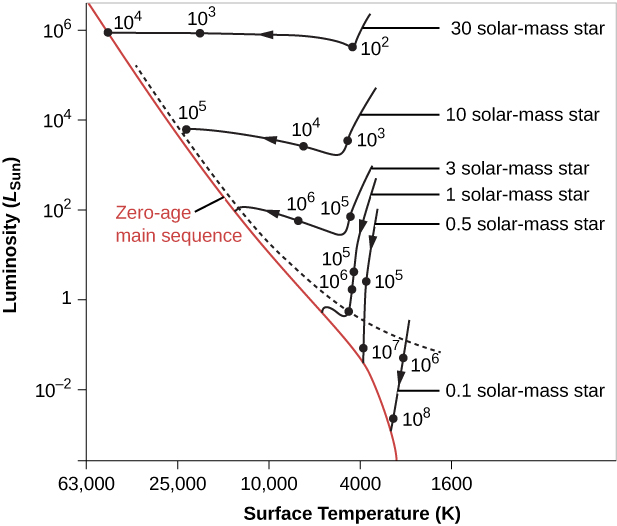
Let’s now use these ideas to follow the evolution of protostars that are on their way to becoming main-sequence stars. The evolutionary tracks of newly forming stars with a range of stellar masses are shown in Figure 21.12. These young stellar objects are not yet producing energy by nuclear reactions, but they derive energy from gravitational contraction—through the sort of process proposed for the Sun by Helmholtz and Kelvin in this last century (see the chapter on The Sun: A Nuclear Powerhouse).
英語のヒント
では、この考え方を使って、主系列星になる途中の原始星の進化をたどろう。図21.12には、さまざまな質量の、形成中の星の進化トラックを示している。これらの若い天体は、まだ核反応でエネルギーを生み出していない。エネルギーを得ているのは重力収縮からである。これは、ヘルムホルツとケルヴィンが前世紀に太陽について提案したのと同種の過程である(「太陽――核エネルギーの源」の章参照)。
Evolutionary Tracks for Contracting Protostars.収縮する原始星の進化トラック。
OpenStax / Rice University · CC BY 4.0
Figure 21.12 Tracks are plotted on the H–R diagram to show how stars of different masses change during the early parts of their lives. The number next to each dark point on a track is the rough number of years it takes an embryo star to reach that stage (the numbers are the result of computer models and are therefore not well known). Note that the surface temperature (K) on the horizontal axis increases toward the left. You can see that the more mass a star has, the shorter time it takes to go through each stage. Stars above the dashed line are typically still surrounded by infalling material and are hidden by it.
図21.12 質量の異なる恒星が、一生の初期にどう変化するかをHR図上のトラックで示す。各トラックの黒い点の横の数値は、星の胚がその段階に達するまでのおおよその年数である。数値はコンピューターモデルによるもので、十分確実な値ではない。横軸の表面温度(K)が左ほど高いことに注意しよう。恒星の質量が大きいほど、各段階を通過する時間が短いとわかる。破線より上の星は通常、落ち込む物質にまだ囲まれ、その物質に隠されている。
Initially, a protostar remains fairly cool with a very large radius and a very low density. It is transparent to infrared radiation, and the heat generated by gravitational contraction can be radiated away freely into space. Because heat builds up slowly inside the protostar, the gas pressure remains low, and the outer layers fall almost unhindered toward the center. Thus, the protostar undergoes very rapid collapse, a stage that corresponds to the roughly vertical lines at the right of Figure 21.12. As the star shrinks, its surface area gets smaller, and so its total luminosity decreases. The rapid contraction stops only when the protostar becomes dense and opaque enough to trap the heat released by gravitational contraction.
英語のヒント
初めの原始星は、半径が非常に大きく、密度が非常に低く、比較的冷たいままである。赤外線に対して透明なので、重力収縮で生じた熱は自由に宇宙へ放射される。内部への熱の蓄積が遅いため、ガス圧は低いままで、外層はほとんど妨げられずに中心へ落ち込む。そのため、原始星は非常に急激に収縮する。図21.12の右側にある、ほぼ鉛直の線がこの段階に対応する。星が縮むと表面積が小さくなり、総光度も減少する。原始星が十分高密度で不透明になり、重力収縮で放出される熱を閉じ込められるようになって初めて、この急収縮は止まる。
When the star begins to retain its heat, the contraction becomes much slower, and changes inside the contracting star keep the luminosity of stars like our Sun roughly constant. The surface temperatures start to build up, and the star “moves” to the left in the H–R diagram. Stars first become visible only after the stellar wind described earlier clears away the surrounding dust and gas. This can happen during the rapid-contraction phase for low-mass stars, but high-mass stars remain shrouded in dust until they end their early phase of gravitational contraction (see the dashed line in Figure 21.12).
英語のヒント
星が熱を保ち始めると収縮はずっと遅くなり、収縮中の内部の変化によって、太陽のような星の光度はほぼ一定に保たれる。表面温度は上がり始め、星はHR図で左へ「移動」する。星が初めて見えるようになるのは、先ほど説明した恒星風が周囲のガスと塵を取り除いてからである。低質量星では急収縮の段階でそうなる場合がある。しかし大質量星は、初期の重力収縮段階を終えるまで塵に隠されたままである(図21.12の破線参照)。
To help you keep track of the various stages that stars go through in their lives, it can be useful to compare the development of a star to that of a human being. (Clearly, you will not find an exact correspondence, but thinking through the stages in human terms may help you remember some of the ideas we are trying to emphasize.) Protostars might be compared to human embryos—as yet unable to sustain themselves but drawing resources from their environment as they grow. Just as the birth of a child is the moment it is called upon to produce its own energy (through eating and breathing), so astronomers say that a star is born when it is able to sustain itself through nuclear reactions (by making its own energy.)
英語のヒント
恒星が一生で通る段階を整理するには、人間の成長と比べると役立つことがある。(当然、ぴったり対応するわけではない。それでも人間の成長段階になぞらえて考えると、ここで強調したい考え方を覚えやすくなるだろう。)原始星は、人間の胚にたとえられるかもしれない。まだ自分で自分を支えられず、周囲から資源を取り入れて成長しているからである。子どもの誕生が、食べたり呼吸したりして自分のエネルギーを作り始める時点であるのと同じように、天文学者は、核反応によって自力でエネルギーを生み、自己を維持できるようになったときに、恒星が誕生したと言う。
When the star’s central temperature becomes high enough (about 12 million K) to fuse hydrogen into helium, we say that the star has reached the main sequence (a concept introduced in The Stars: A Celestial Census). It is now a full-fledged star, more or less in equilibrium, and its rate of change slows dramatically. Only the gradual depletion of hydrogen as it is transformed into helium in the core slowly changes the star’s properties.
英語のヒント
中心温度が、水素を核融合させてヘリウムを作れるほど高くなると、約1200万Kであるが、その星は主系列に達したと言う。主系列は「恒星――星の世界の実態を調べる」で導入した概念である。星は今や一人前の恒星で、ほぼ平衡状態にあり、変化の速さは大幅に遅くなる。中心核で水素がヘリウムへ変換され、少しずつ減っていくことだけが、恒星の性質をゆっくり変えていく。
The mass of a star determines exactly where it falls on the main sequence. As Figure 21.12 shows, massive stars on the main sequence have high temperatures and high luminosities. Low-mass stars have low temperatures and low luminosities.
英語のヒント
主系列のどこに位置するかを決めるのは、恒星の質量である。図21.12のとおり、主系列上の大質量星は高温・高光度で、低質量星は低温・低光度である。
Objects of extremely low mass never achieve high-enough central temperatures to ignite nuclear reactions. The lower end of the main sequence stops where stars have a mass just barely great enough to sustain nuclear reactions at a sufficient rate to stop gravitational contraction. This critical mass is calculated to be about 0.075 times the mass of the Sun. As we discussed in the chapter on Analyzing Starlight, objects below this critical mass are called either brown dwarfs or planets. At the other extreme, the upper end of the main sequence terminates at the point where the energy radiated by the newly forming massive star becomes so great that it halts the accretion of additional matter. The upper limit of stellar mass is between 100 and 200 solar masses.
英語のヒント
質量が極端に小さい天体は、中心温度が核反応を始められるほど高くならない。主系列の下端は、重力収縮を止めるのに十分な速さで核反応を維持できる、ぎりぎりの質量のところで途切れる。この境界の質量は、太陽の約0.075倍と計算されている。「星の光を分析する」の章で述べたように、これより軽い天体は褐色矮星か惑星と呼ばれる。反対の側では、形成中の大質量星が放射するエネルギーが非常に大きくなり、さらなる物質の降着を止めるところで、主系列の上端に達する。恒星質量の上限は、太陽の100〜200倍の間にある。