第1章科学と宇宙――ひとめぐりScience and the Universe: A Brief Tour
Introductionはじめに
Distant Galaxies.遠くの銀河。
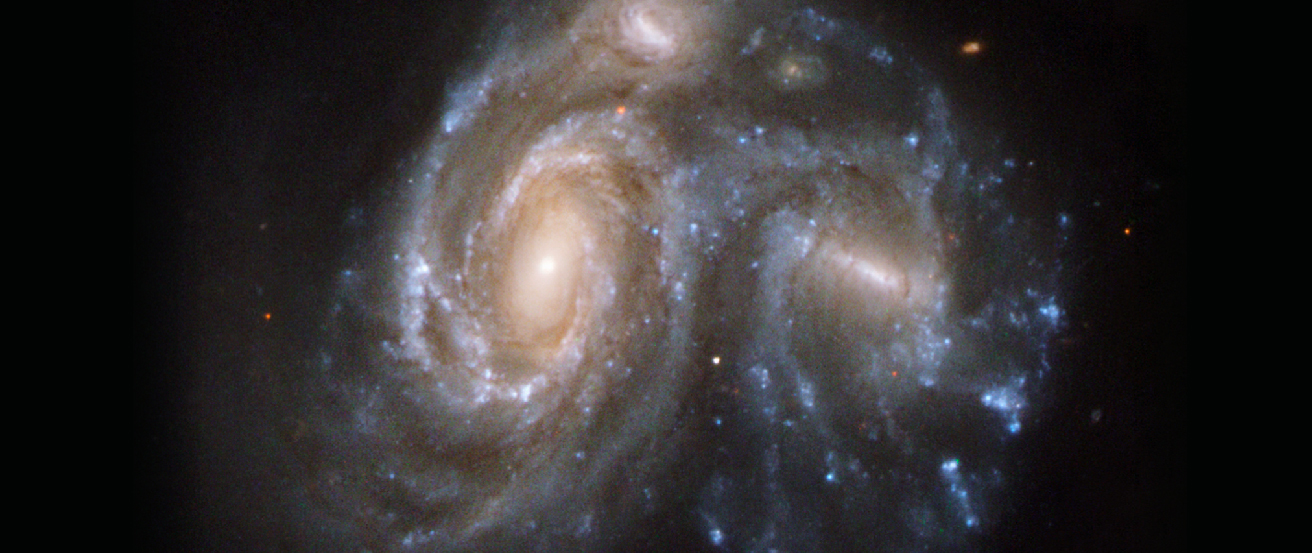
credit: modification of work by NASA, ESA, the Hubble Heritage (STScl/AURA)-ESA/Hubble Collaboration, and K. Noll (STScl) · CC BY 4.0
Figure 1.1 These two interacting islands of stars (galaxies) are so far away that their light takes hundreds of millions of years to reach us on Earth (photographed with the Hubble Space Telescope). (credit: modification of work by NASA, ESA, the Hubble Heritage (STScl/AURA)-ESA/Hubble Collaboration, and K. Noll (STScl))
図1.1 この二つの星の島(銀河)は互いに作用を及ぼし合っている。あまりに遠いため、その光が地球の私たちに届くには数億年もかかる。ハッブル宇宙望遠鏡で撮影。(クレジット:NASA、ESA、Hubble Heritage(STScl/AURA)-ESA/Hubble Collaboration、K. Noll(STScl)による作品を改変)
We invite you to come along on a series of voyages to explore the universe as astronomers understand it today. Beyond Earth are vast and magnificent realms full of objects that have no counterpart on our home planet. Nevertheless, we hope to show you that the evolution of the universe has been directly responsible for your presence on Earth today.
英語のヒント
天文学者が今日理解している宇宙を探る、いくつもの旅へご案内しよう。地球の外には、私たちの故郷であるこの惑星には対応するもののない天体に満ちた、広大で壮麗な領域がある。それでも、宇宙の進化こそが、今日あなたが地球上に存在することを直接もたらしたのだと、本書を通して示したい。
Along your journey, you will encounter:
この旅では、次のようなものに出会う。
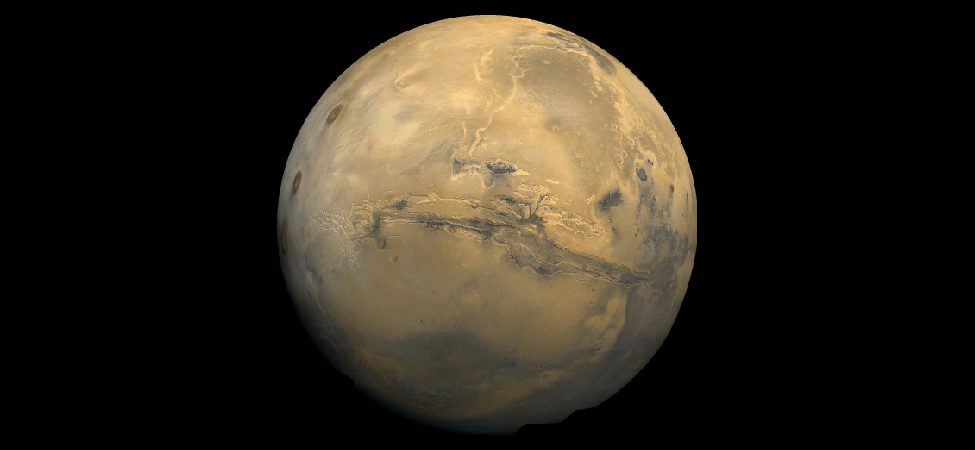
a canyon system so large that, on Earth, it would stretch from Los Angeles to Washington, DC (Figure 1.2).
地球に置けばロサンゼルスからワシントンDCまで延びるほど巨大な、一連の峡谷(図1.2)。
Mars Mosaic.火星のモザイク画像。
credit: modification of work by NASA · NASA media use guidelines
Figure 1.2 This image of Mars is centered on the Valles Marineris (Mariner Valley) complex of canyons, which is as long as the United States is wide. (credit: modification of work by NASA)
図1.2 この火星の画像は、マリネリス峡谷(マリナー峡谷)と呼ばれる複合的な峡谷地形を中心に捉えている。その長さは、アメリカ合衆国を横断する幅に匹敵する。(クレジット:NASAによる作品を改変)
a crater and other evidence on Earth that tell us that the dinosaurs (and many other creatures) died because of a cosmic collision.
恐竜と多くのほかの生物が、宇宙からの天体の衝突によって死に絶えたことを物語る、地球上のクレーターやほかの証拠。
a tiny moon whose gravity is so weak that one good throw from its surface could put a baseball into orbit.
重力があまりに弱いため、地表から野球のボールを力強く一投するだけで、そのボールを周回軌道に乗せられる小さな衛星。
a collapsed star so dense that to duplicate its interior we would have to squeeze every human being on Earth into a single raindrop.
内部と同じ密度を再現するには、地球上のすべての人間をたった一滴の雨粒に押し込まなければならないほど高密度の、重力でつぶれた恒星。
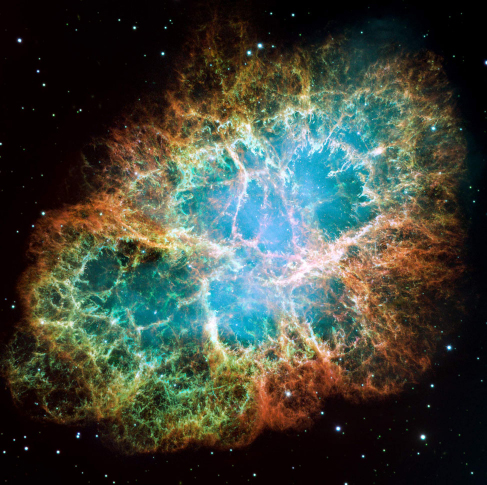
exploding stars whose violent end could wipe clean all of the life-forms on a planet orbiting a neighboring star (Figure 1.3).
その激しい最期によって、隣の恒星のまわりを公転する惑星上の生命を、すべて消し去ってしまう可能性のある爆発する恒星(図1.3)。
a “cannibal galaxy” that has already consumed a number of its smaller galaxy neighbors and is not yet finished finding new victims.
周囲の小さな銀河をすでにいくつも飲み込み、なお新たな犠牲者を探し続けている「共食い銀河」。
a radio echo that is the faint but unmistakable signal of the creation event for our universe.
私たちの宇宙が生まれた出来事を伝える、かすかながら疑いようのない信号である電波のこだま。
Stellar Corpse.恒星の亡骸。
credit: NASA, ESA, J. Hester (Arizona State University) · NASA media use guidelines
Figure 1.3 We observe the remains of a star that was seen to explode in our skies in 1054 (and was, briefly, bright enough to be visible during the daytime). Today, the remnant is called the Crab Nebula and its central region is seen here. Such exploding stars are crucial to the development of life in the universe. (credit: NASA, ESA, J. Hester (Arizona State University))
図1.3 1054年に空で爆発する姿が目撃された恒星の残骸を、私たちは観測している。この星は短い間、昼間でも見えるほど明るかった。現在、この残骸はかに星雲と呼ばれ、ここにはその中心部が写っている。こうした恒星の爆発は、宇宙における生命の発展に欠かせない。(クレジット:NASA、ESA、J. Hester〔アリゾナ州立大学〕)
Such discoveries are what make astronomy such an exciting field for scientists and many others—but you will explore much more than just the objects in our universe and the latest discoveries about them. We will pay equal attention to the process by which we have come to understand the realms beyond Earth and the tools we use to increase that understanding.
英語のヒント
こうした発見があるからこそ、天文学は科学者にも、科学者以外の多くの人にも、これほど心を躍らせる分野となっている。しかし、本書で探るのは、宇宙の天体とそれらについての最新の発見だけではない。私たちが地球の外の領域をどのような過程で理解するようになったのか、そして、その理解を深めるためにどのような道具を使っているのかにも、同じだけ目を向ける。
We gather information about the cosmos from the messages the universe sends our way. Because the stars are the fundamental building blocks of the universe, decoding the message of starlight has been a central challenge and triumph of modern astronomy. By the time you have finished reading this text, you will know a bit about how to read that message and how to understand what it is telling us.
英語のヒント
私たちは、宇宙がこちらへ送ってくるメッセージから、宇宙についての情報を集める。恒星は宇宙を形づくる基本的な構成要素なので、星の光のメッセージを読み解くことは、近代天文学にとって中心的な課題であり、大きな成果でもあった。本書を読み終えるころには、そのメッセージを読み取り、それが何を伝えているのかを理解する方法が、少しわかるようになっているはずだ。