第1章科学と宇宙――ひとめぐりScience and the Universe: A Brief Tour
1.6 A Tour of the Universe1.6 宇宙をひとめぐり
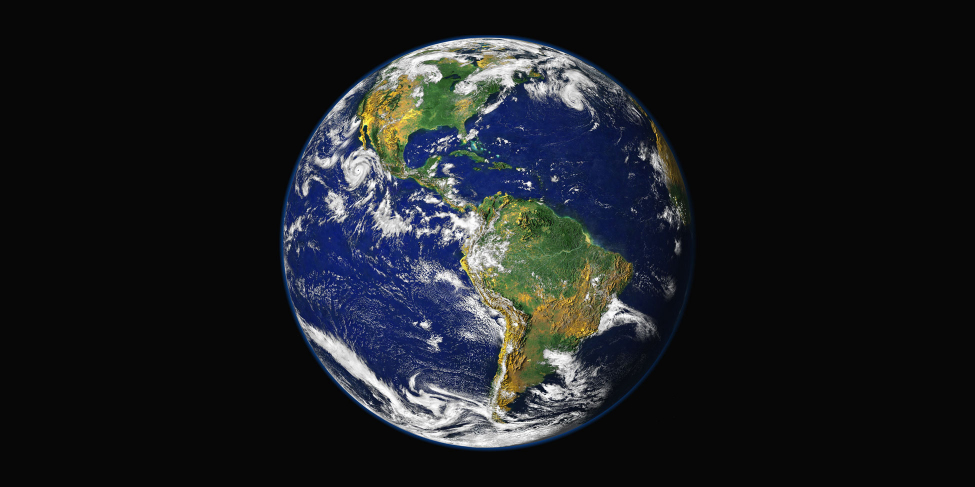
We can now take a brief introductory tour of the universe as astronomers understand it today to get acquainted with the types of objects and distances you will encounter throughout the text. We begin at home with Earth, a nearly spherical planet about 13,000 kilometers in diameter (Figure 1.6). A space traveler entering our planetary system would easily distinguish Earth from the other planets in our solar system by the large amount of liquid water that covers some two thirds of its crust. If the traveler had equipment to receive radio or television signals, or came close enough to see the lights of our cities at night, she would soon find signs that this watery planet has sentient life.
英語のヒント
ここで、天文学者が今日理解している宇宙を、入門として簡単にひとめぐりしてみよう。本書の各所で出会う天体の種類や距離に、親しんでもらうためである。出発点は私たちの故郷、地球だ。地球は直径約13,000キロメートルの、ほぼ球形の惑星である(図1.6)。私たちの惑星系へ入ってきた宇宙旅行者は、地殻のおよそ3分の2を覆う大量の液体の水によって、地球を太陽系のほかの惑星からたやすく見分けられるだろう。ラジオやテレビの信号を受信できる装置をもっているか、夜の都市の明かりが見えるほど近づけば、この水に満ちた惑星に、感覚や意識をもつ生命がいる兆候をすぐに見つけるだろう。
Humanity’s Home Base.人類の故郷。
credit: modification of work by R. Stockli, A. Nelson, F. Hasler, NASA/ GSFC/ NOAA/ USGS · NASA media use guidelines
Figure 1.6 This image shows the Western hemisphere as viewed from space 35,400 kilometers (about 22,000 miles) above Earth. Data about the land surface from one satellite was combined with another satellite’s data about the clouds to create the image. (credit: modification of work by R. Stockli, A. Nelson, F. Hasler, NASA/ GSFC/ NOAA/ USGS)
図1.6 地球の上空35,400キロメートル(約22,000マイル)の宇宙空間から見た西半球を示す画像。一つの衛星による地表のデータと、別の衛星による雲のデータを組み合わせて作成した。(クレジット:R. Stockli、A. Nelson、F. Hasler、NASA/GSFC/NOAA/USGSによる作品を改変)
Our nearest astronomical neighbor is Earth’s satellite, commonly called the Moon. Figure 1.7 shows Earth and the Moon drawn to scale on the same diagram. Notice how small we have to make these bodies to fit them on the page with the right scale. The Moon’s distance from Earth is about 30 times Earth’s diameter, or approximately 384,000 kilometers, and it takes about a month for the Moon to revolve around Earth. The Moon’s diameter is 3476 kilometers, about one fourth the size of Earth.
英語のヒント
天体のなかで私たちに最も近い隣人は、地球の衛星、ふつう月と呼ばれる天体である。図1.7は、地球と月を同じ図に、縮尺をそろえて描いている。正しい縮尺で同じページに収めるには、二つの天体をどれほど小さく描かなければならないかに注目してほしい。地球から月までの距離は地球の直径の約30倍、約384,000キロメートルで、月が地球のまわりを一周するには約1か月かかる。月の直径は3476キロメートルで、地球の約4分の1である。
Earth and Moon, Drawn to Scale.縮尺をそろえた地球と月。

credit: modification of work by NASA · NASA media use guidelines
Figure 1.7 This image shows Earth and the Moon shown to scale for both size and distance. (credit: modification of work by NASA)
図1.7 地球と月の大きさも、両者の距離も、同じ縮尺で表した画像。(クレジット:NASAによる作品を改変)
Light (or radio waves) takes 1.3 seconds to travel between Earth and the Moon. If you’ve seen videos of the Apollo flights to the Moon, you may recall that there was a delay of about 3 seconds between the time Mission Control asked a question and the time the astronauts responded. This was not because the astronauts were thinking slowly, but rather because it took the radio waves almost 3 seconds to make the round trip.
英語のヒント
光、あるいは電波が地球と月の間を進むには、1.3秒かかる。アポロ計画の月飛行の映像を見たことがあれば、管制センターが質問してから宇宙飛行士が返答するまで、約3秒の間があったことを覚えているかもしれない。これは宇宙飛行士がゆっくり考えていたからではない。電波が往復するのに、ほぼ3秒かかったからである。
Earth revolves around our star, the Sun, which is about 150 million kilometers away—approximately 400 times as far away from us as the Moon. We call the average Earth–Sun distance an astronomical unit (AU) because, in the early days of astronomy, it was the most important measuring standard. Light takes slightly more than 8 minutes to travel 1 astronomical unit, which means the latest news we receive from the Sun is always 8 minutes old. The diameter of the Sun is about 1.5 million kilometers; Earth could fit comfortably inside one of the minor eruptions that occurs on the surface of our star. If the Sun were reduced to the size of a basketball, Earth would be a small apple seed about 30 meters from the ball.
英語のヒント
地球は、私たちの恒星である太陽のまわりを公転している。太陽までの距離は約1億5000万キロメートルで、月までの距離のおよそ400倍である。天文学の初期には最も重要な測定の基準だったことから、地球と太陽の平均距離を1天文単位(AU)と呼ぶ。光が1天文単位を進むには8分強かかる。つまり、太陽から受け取る最新のニュースは、いつも8分前のニュースなのだ。太陽の直径は約150万キロメートルもあり、その表面で起こる小さな噴出現象の一つにも、地球はすっぽり収まる。太陽をバスケットボールの大きさに縮めたら、地球はそのボールから約30メートル離れた、小さなリンゴの種ほどになる。
It takes Earth 1 year ( seconds) to go around the Sun at our distance; to make it around, we must travel at approximately 110,000 kilometers per hour. (If you, like many students, still prefer miles to kilometers, you might find the following trick helpful. To convert kilometers to miles, just multiply kilometers by 0.6. Thus, 110,000 kilometers per hour becomes 66,000 miles per hour.) Because gravity holds us firmly to Earth and there is no resistance to Earth’s motion in the vacuum of space, we participate in this extremely fast-moving trip without being aware of it day to day.
英語のヒント
地球が現在の距離で太陽を一周するには、1年(秒)かかる。一周するために、私たちは時速約110,000キロメートルで移動しなければならない。多くの学生と同じように、キロメートルよりマイルのほうがなじみ深ければ、次の方法が便利だろう。キロメートルをマイルに換算するには、キロメートルの値に0.6を掛ければよい。したがって、時速110,000キロメートルは時速66,000マイルとなる。重力が私たちを地球にしっかりつなぎとめ、宇宙の真空中には地球の運動を妨げる抵抗がないため、私たちは日々意識することなく、このきわめて速い旅に参加している。
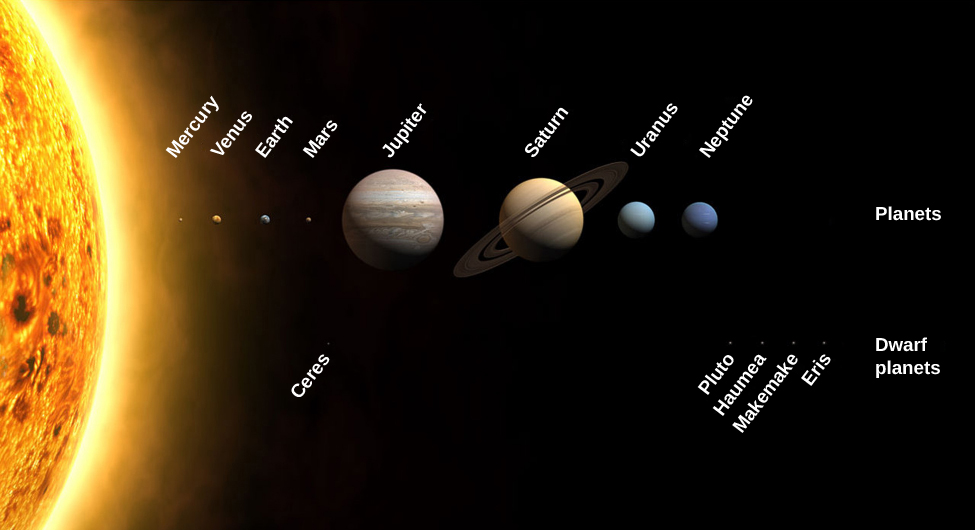
Earth is only one of eight planets that revolve around the Sun. These planets, along with their moons and swarms of smaller bodies such as dwarf planets, make up the solar system (Figure 1.8). A planet is defined as a body of significant size that orbits a star and does not produce its own light. (If a large body consistently produces its own light, it is then called a star.) Later in the book this definition will be modified a bit, but it is perfectly fine for now as you begin your voyage.
英語のヒント
地球は、太陽のまわりを公転する八つの惑星の一つにすぎない。これらの惑星とその衛星、そして準惑星などのより小さな天体の群れが、太陽系を構成する(図1.8)。惑星は、恒星のまわりを公転し、自ら光を生み出さない、ある程度以上の大きさをもつ天体と定義される。大きな天体が自ら光を生み出し続けるなら、それは恒星と呼ばれる。本書の後の部分で、この定義は少し修正するが、旅を始めたばかりの今の段階では、これで十分である。
Our Solar Family.太陽を中心とする私たちの家族。
credit: modification of work by NASA · NASA media use guidelines
Figure 1.8 The Sun, the planets, and some dwarf planets are shown with their sizes drawn to scale. The orbits of the planets are much more widely separated than shown in this drawing. Notice the size of Earth compared to the giant planets. (credit: modification of work by NASA)
図1.8 太陽、惑星、いくつかの準惑星の大きさを、同じ縮尺で示している。実際の惑星の軌道は、この図で描かれているよりもずっと広く離れている。巨大惑星と比べた地球の大きさに注目しよう。(クレジット:NASAによる作品を改変)
We are able to see the nearby planets in our skies only because they reflect the light of our local star, the Sun. If the planets were much farther away, the tiny amount of light they reflect would usually not be visible to us. The planets we have so far discovered orbiting other stars were found from the pull their gravity exerts on their parent stars, or from the light they block from their stars when they pass in front of them. We can’t see most of these planets directly, although a few are now being imaged with advanced instruments.
英語のヒント
近くの惑星を空に見ることができるのは、それらが私たちの近くにある恒星、太陽の光を反射するからにほかならない。惑星がもっと遠くにあれば、その反射するわずかな光は、ふつう私たちには見えなくなる。これまでに見つかった、ほかの恒星のまわりを公転する惑星は、惑星の重力が親の恒星に及ぼす引き寄せる力や、恒星の前を通過するときに遮る光から発見された。これらの惑星の大部分を直接見ることはできないが、現在では、高性能の装置によって画像が得られているものも少数ある。
The Sun is our local star, and all the other stars are also enormous balls of glowing gas that generate vast amounts of energy by nuclear reactions deep within. We will discuss the processes that cause stars to shine in more detail later in the book. The other stars look faint only because they are so very far away. If we continue our basketball analogy, Proxima Centauri, the nearest star beyond the Sun, which is 4.25 light-years away, would be almost 7000 kilometers from the basketball.
英語のヒント
太陽は私たちの近くにある恒星であり、ほかの恒星もすべて、内部の深いところでの核反応によって膨大なエネルギーを生み出す、巨大な輝くガスの球である。星が光る仕組みは、本書の後の部分でさらに詳しく説明する。ほかの恒星が暗く見えるのは、ただ非常に遠く離れているからだ。バスケットボールのたとえを続けるなら、太陽の次に近い恒星で、4.25光年離れたプロキシマ・ケンタウリは、そのボールからほぼ7000キロメートルも離れたところにあることになる。
When you look up at a star-filled sky on a clear night, all the stars visible to the unaided eye are part of a single collection of stars we call the Milky Way Galaxy, or simply the Galaxy. (When referring to the Milky Way, we capitalize Galaxy; when talking about other galaxies of stars, we use lowercase galaxy.) The Sun is one of hundreds of billions of stars that make up the Galaxy; its extent, as we will see, staggers the human imagination. Within a sphere 10 light-years in radius centered on the Sun, we find roughly ten stars. Within a sphere 100 light-years in radius, there are roughly 10,000 stars—far too many to count or name—but we have still traversed only a tiny part of the Milky Way Galaxy. Within a 1000-light-year sphere, we find some ten million stars; within a sphere of 100,000 light-years, we finally encompass the entire Milky Way Galaxy.
英語のヒント
晴れた夜に星で埋め尽くされた空を見上げると、肉眼で見える恒星はすべて、天の川銀河、あるいは単に銀河系と呼ばれる、一つの星の集まりに属している。英語では、天の川銀河を指すときは大文字のGalaxyを使い、ほかの星の集まりである銀河をいうときは小文字のgalaxyを使う。太陽は、この銀河を構成する数千億個の恒星の一つである。その広がりは、これから見るように、人間の想像力を圧倒する。太陽を中心とする半径10光年の球内には、およそ10個の恒星がある。半径100光年の球内には、およそ10,000 個の恒星がある。数えたり名前を付けたりするには多すぎるが、それでも、天の川銀河のほんの一部を横切っただけである。半径1000光年の球内には、約1000万個の恒星がある。半径100,000光年の球にまで広げて、ようやく天の川銀河全体を包み込める。
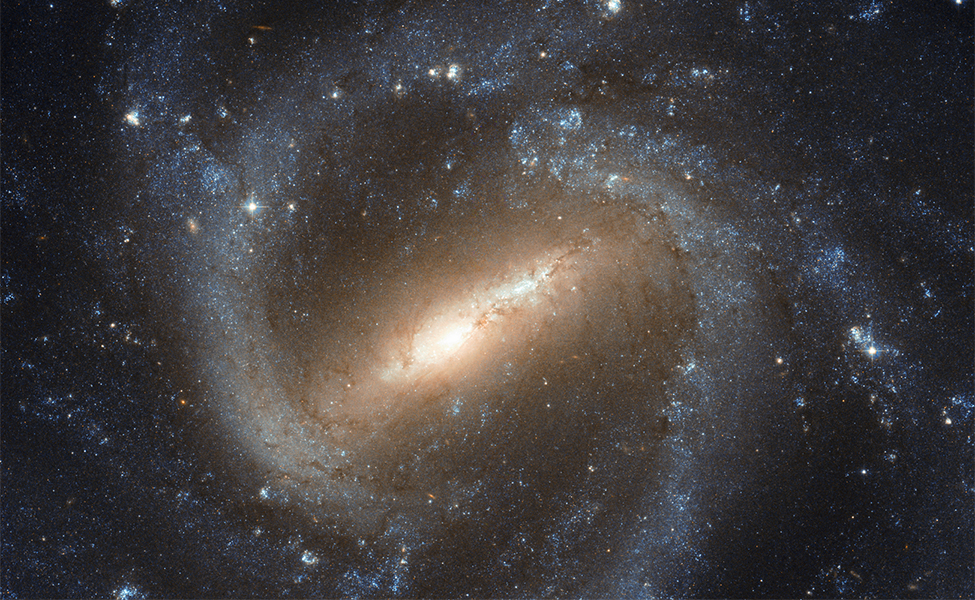
Our Galaxy looks like a giant disk with a small ball in the middle. If we could move outside our Galaxy and look down on the disk of the Milky Way from above, it would probably resemble the galaxy in Figure 1.9, with its spiral structure outlined by the blue light of hot adolescent stars.
英語のヒント
私たちの銀河は、中央に小さな球を置いた巨大な円盤のような形をしている。もし銀河の外へ出て、天の川銀河の円盤を上から見下ろせたなら、おそらく図1.9の銀河に似て見えるだろう。高温の若い恒星が放つ青い光が、渦巻構造を浮かび上がらせるはずだ。
Spiral Galaxy.渦巻銀河。
credit: NASA, ESA · NASA media use guidelines
Figure 1.9 This galaxy of billions of stars, called by its catalog number NGC 1073, is thought to be similar to our own Milky Way Galaxy. Here we see the giant wheel-shaped system with a bar of stars across its middle. (credit: NASA, ESA)
図1.9 カタログ番号NGC 1073で呼ばれる、数十億個の恒星からなるこの銀河は、私たちの天の川銀河に似ていると考えられている。中央を星の棒が横切る、巨大な車輪のような系が見える。(クレジット:NASA、ESA)
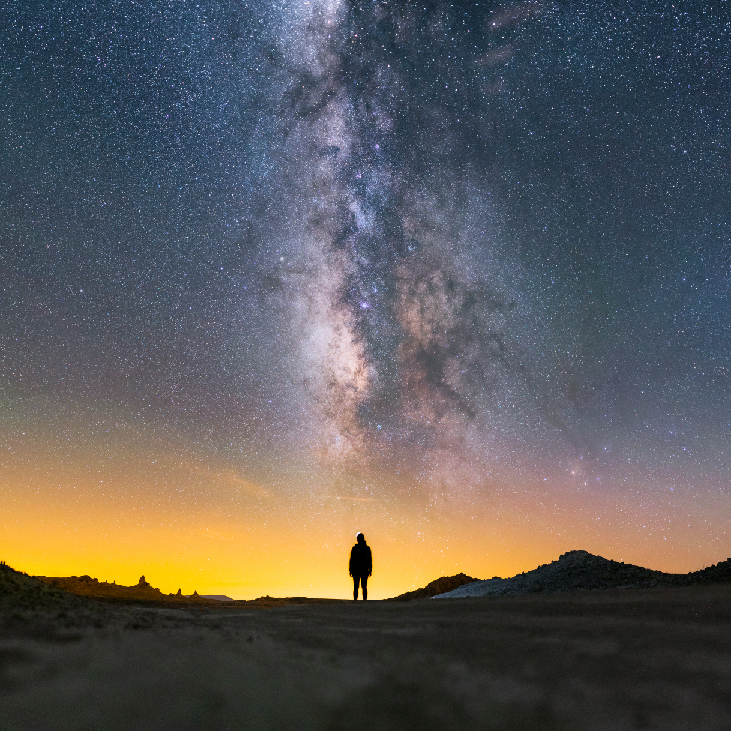
The Sun is somewhat less than 30,000 light-years from the center of the Galaxy, in a location with nothing much to distinguish it. From our position inside the Milky Way Galaxy, we cannot see through to its far rim (at least not with ordinary light) because the space between the stars is not completely empty. It contains a sparse distribution of gas (mostly the simplest element, hydrogen) intermixed with tiny solid particles that we call interstellar dust. This gas and dust collect into enormous clouds in many places in the Galaxy, becoming the raw material for future generations of stars. Figure 1.10 shows an image of the disk of the Galaxy as seen from our vantage point.
英語のヒント
太陽は銀河の中心から3万光年弱の距離にあり、とりたてて目立った特徴のない場所に位置する。天の川銀河の内側にいる私たちの位置からは、少なくとも普通の光では、銀河の向こう側の縁まで見通せない。恒星の間の空間は、完全に空っぽではないからだ。そこには、主に最も単純な元素である水素からなるガスがまばらに分布し、星間塵と呼ばれる微小な固体粒子が混ざっている。このガスと塵は銀河の多くの場所で巨大な雲をつくり、次の世代の恒星の材料となる。図1.10は、私たちの観測位置から見た銀河円盤の画像である。
Milky Way Galaxy.天の川銀河。
credit: Ian Norman · CC BY-SA 2.0
Figure 1.10 Because we are inside the Milky Way Galaxy, we see its disk in cross-section flung across the sky like a great milky white avenue of stars with dark “rifts” of dust. In this dramatic image, part of it is seen above Trona Pinnacles in the California desert. (credit: Ian Norman)
図1.10 私たちは天の川銀河の内側にいるため、その円盤を横から見ている。それは空を大きく横切る乳白色の星の道のように見え、塵による暗い「裂け目」が入っている。この印象的な画像では、カリフォルニアの砂漠にあるトロナ・ピナクルズの上に、その一部が見える。(クレジット:Ian Norman)
Typically, the interstellar material is so extremely sparse that the space between stars is a much better vacuum than anything we can produce in terrestrial laboratories. Yet, the dust in space, building up over thousands of light-years, can block the light of more distant stars. Like the distant buildings that disappear from our view on a smoggy day in Los Angeles, the more distant regions of the Milky Way cannot be seen behind the layers of interstellar smog. Luckily, astronomers have found that stars and raw material shine with various forms of light, some of which do penetrate the smog, and so we have been able to develop a pretty good map of the Galaxy.
英語のヒント
ふつう、星間物質はきわめてまばらで、星と星の間の空間は、地上の実験室でつくれるどんな真空よりも、ずっと真空に近い。それでも、宇宙の塵が数千光年にわたって積み重なると、さらに遠い恒星の光を遮ることがある。ロサンゼルスでスモッグの多い日に、遠くの建物が見えなくなるように、天の川銀河の遠い領域は、星間のスモッグの層に隠されて見えない。幸い、恒星やその材料はさまざまな形の光で輝き、その一部はスモッグを通り抜けることがわかった。そのため、私たちは銀河のかなりよい地図をつくることができた。
Recent observations, however, have also revealed a rather surprising and disturbing fact. There appears to be more—much more—to the Galaxy than meets the eye (or the telescope). From various investigations, we have evidence that much of our Galaxy is made of material we cannot currently observe directly with our instruments. We therefore call this component of the Galaxy dark matter. We know the dark matter is there by the pull its gravity exerts on the stars and raw material we can observe, but what this dark matter is made of and how much of it exists remain a mystery. Furthermore, this dark matter is not confined to our Galaxy; it appears to be an important part of other star groupings as well.
英語のヒント
しかし最近の観測では、かなり意外で、困惑させられる事実も明らかになった。銀河には、目や望遠鏡で捉えられるよりも多くのものが、はるかに多くのものが、存在するらしいのである。さまざまな調査から、銀河の大部分が、現在の装置では直接観測できない物質でできているという証拠が得られている。そこで、この銀河の成分をダークマターと呼ぶ。観測できる恒星やその材料に、ダークマターの重力が引き寄せる力を及ぼすため、その存在がわかる。しかし、ダークマターが何からできているのか、どれだけ存在するのかは、依然として謎である。さらに、ダークマターは私たちの銀河だけに限られず、ほかの星の集まりにとっても重要な成分であるらしい。
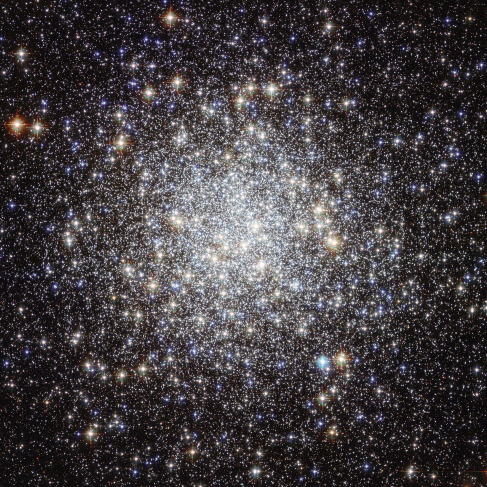
By the way, not all stars live by themselves, as the Sun does. Many are born in double or triple systems with two, three, or more stars revolving about each other. Because the stars influence each other in such close systems, multiple stars allow us to measure characteristics that we cannot discern from observing single stars. In a number of places, enough stars have formed together that we recognized them as star clusters (Figure 1.11). Some of the largest of the star clusters that astronomers have cataloged contain hundreds of thousands of stars and take up volumes of space hundreds of light-years across.
英語のヒント
ところで、すべての恒星が、太陽のように一人で暮らしているわけではない。多くの恒星は、二つ、三つ、あるいはそれ以上の星が互いのまわりを回る、二重や三重の系で生まれる。このように接近した系では恒星同士が影響を及ぼし合うため、多重星を調べると、単独の恒星の観測からは見分けられない性質を測定できる。多くの場所では、十分な数の恒星がまとまって生まれ、星団として認識されている(図1.11)。天文学者がカタログに記録した最大級の星団には、数十万個の恒星が含まれ、数百光年の幅の空間を占めるものもある。
Star Cluster.星団。
credit: NASA, ESA · NASA media use guidelines
Figure 1.11 This large star cluster is known by its catalog number, M9. It contains some 250,000 stars and is seen more clearly from space using the Hubble Space Telescope. It is located roughly 25,000 light-years away. (credit: NASA, ESA)
図1.11 この大きな星団は、カタログ番号M9で知られている。約25万個の恒星を含み、宇宙空間のハッブル宇宙望遠鏡を使うと、よりはっきりと見える。距離はおよそ25,000光年である。(クレジット:NASA、ESA)
You may hear stars referred to as “eternal,” but in fact no star can last forever. Since the “business” of stars is making energy, and energy production requires some sort of fuel to be used up, eventually all stars run out of fuel. This news should not cause you to panic, though, because our Sun still has at least 5 or 6 billion years to go. Ultimately, the Sun and all stars will die, and it is in their death throes that some of the most intriguing and important processes of the universe are revealed. For example, we now know that many of the atoms in our bodies were once inside stars. These stars exploded at the ends of their lives, recycling their material back into the reservoir of the Galaxy. In this sense, all of us are literally made of recycled “star dust.”
英語のヒント
恒星が「永遠のもの」と呼ばれるのを耳にすることがあるかもしれないが、実際には、どの恒星も永遠には続かない。恒星の「仕事」はエネルギーをつくることであり、エネルギーの生産には何らかの燃料を使い切っていく必要があるため、やがてすべての恒星は燃料を使い果たす。とはいえ、この知らせに慌てる必要はない。太陽には、まだ少なくとも50億年から60億年が残されている。最終的には太陽もすべての恒星も死を迎える。そして、宇宙のなかでも特に興味深く重要な過程のいくつかが明らかになるのは、その死の苦闘のさなかである。たとえば現在では、私たちの体をつくる多くの原子が、かつて恒星の内部にあったとわかっている。その恒星は生涯の終わりに爆発し、物質を銀河の蓄えへと戻し、再び使われるようにした。この意味で、私たちは皆、文字どおり、再利用された「星屑」でできている。