第1章科学と宇宙――ひとめぐりScience and the Universe: A Brief Tour
1.4 Numbers in Astronomy1.4 天文学で使う数
In astronomy we deal with distances on a scale you may never have thought about before, with numbers larger than any you may have encountered. We adopt two approaches that make dealing with astronomical numbers a little bit easier. First, we use a system for writing large and small numbers called scientific notation (or sometimes powers-of-ten notation). This system is very appealing because it eliminates the many zeros that can seem overwhelming to the reader. In scientific notation, if you want to write a number such as 500,000,000, you express it as . The small raised number after the 10, called an exponent, keeps track of the number of places we had to move the decimal point to the left to convert 500,000,000 to 5. If you are encountering this system for the first time or would like a refresher, we suggest you look at Appendix C and Example 1 for more information. The second way we try to keep numbers simple is to use a consistent set of units—the metric International System of Units, or SI (from the French Système International d’Unités). The metric system is summarized in Appendix D (see Example 2).
英語のヒント
天文学では、これまで考えたこともないような規模の距離や、出会ったこともないような大きな数を扱う。天文学的な数を少しでも扱いやすくするため、本書では二つの方法を採用する。第一に、大きな数や小さな数を書くために、科学的記数法、あるいは10の累乗を使う表記法と呼ばれる方法を使う。この方法は、読者を圧倒しかねない大量のゼロを省けるので、とても便利である。科学的記数法では、たとえば500,000,000という数をと表す。10の右上に小さく書かれた数は指数と呼ばれ、500,000,000を5に変えるために、小数点を左へ何桁移動させたかを表している。この表記に初めて出会う場合や、復習したい場合は、付録Cと例題1で詳しく確認してほしい。数を簡単に扱うための第二の方法は、一貫した単位の体系を使うことである。本書ではメートル法に基づく国際単位系、すなわちSIを使う。SIはフランス語のSystème International d’Unitésに由来する。メートル法は付録Dにまとめてある(例題2も参照)。
A common unit astronomers use to describe distances in the universe is a light-year, which is the distance light travels during one year. Because light always travels at the same speed, and because its speed turns out to be the fastest possible speed in the universe, it makes a good standard for keeping track of distances. You might be confused because a “light-year” seems to imply that we are measuring time, but this mix-up of time and distance is common in everyday life as well. For example, when your friend asks where the movie theater is located, you might say “about 20 minutes from downtown.”
英語のヒント
天文学者が宇宙の距離を表すときによく使う単位が、光年である。これは、光が1年間に進む距離を意味する。光は常に同じ速さで進み、その速さが宇宙で可能な最大の速さでもあるため、距離を表すのに適した基準となる。「光年」という語から、時間を測っているように感じて戸惑うかもしれない。しかし、このように時間と距離を取り交ぜることは、日常生活でもよくある。たとえば、友人に映画館の場所を尋ねられたら、「街の中心から20分くらい」と答えることがあるだろう。
So, how many kilometers are there in a light-year? Light travels at the amazing pace of kilometers per second (km/s), which makes a light-year kilometers. You might think that such a large unit would reach the nearest star easily, but the stars are far more remote than our imaginations might lead us to believe. Even the nearest star (other than the Sun) is 4.25 light-years away—more than 40 trillion kilometers. Other stars visible to the unaided eye are hundreds to thousands of light-years away (Figure 1.4).
英語のヒント
では、1光年は何キロメートルだろうか。光は毎秒キロメートル(km/s)という驚くべき速さで進むため、1光年はキロメートルとなる。これほど大きな単位なら、一番近い恒星まで簡単に届くと思うかもしれない。だが恒星は、私たちの想像以上にはるか遠くにある。太陽を除いて最も近い恒星でさえ、4.25光年、つまり40兆キロメートル以上も離れている。肉眼で見えるほかの恒星は、数百から数千光年のかなたにある(図1.4)。
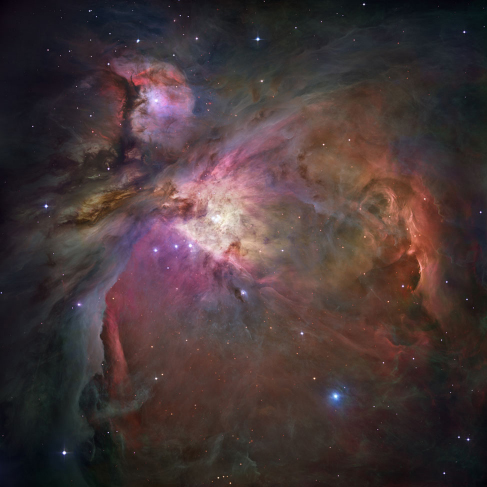
Orion Nebula.オリオン星雲。
credit: NASA, ESA, M. Robberto (Space Telescope Science Institute/ESA) and the Hubble Space Telescope Orion Treasury Project Team · CC BY 4.0
Figure 1.4 This beautiful cloud of cosmic raw material (gas and dust from which new stars and planets are being made) called the Orion Nebula is about 1400 light-years away. That’s a distance of roughly kilometers—a pretty big number. The gas and dust in this region are illuminated by the intense light from a few extremely energetic adolescent stars. (credit: NASA, ESA, M. Robberto (Space Telescope Science Institute/ESA) and the Hubble Space Telescope Orion Treasury Project Team)
図1.4 オリオン星雲と呼ばれるこの美しい雲は、新しい恒星や惑星の材料となるガスと塵からできており、約1400光年の距離にある。これはおよそキロメートルという、実に大きな距離である。この領域のガスと塵は、きわめて活発な若い恒星数個からの強烈な光に照らされている。(クレジット:NASA、ESA、M. Robberto〔宇宙望遠鏡科学研究所/ESA〕、Hubble Space Telescope Orion Treasury Project Team)
Scientific Notation科学的記数法
In 2015, the richest human being on our planet had a net worth of $79.2 billion. Some might say this is an astronomical sum of money. Express this amount in scientific notation.
2015年、地球上で最も裕福な人物の純資産は792億ドルだった。天文学的な金額だと言う人もいるだろう。この金額を科学的記数法で表しなさい。
Solution解き方
$79.2 billion can be written $79,200,000,000. Expressed in scientific notation it becomes
792億ドルは、79,200,000,000ドルと書ける。科学的記数法で表すと、となる。
Getting Familiar with a Light-Year光年に慣れる
How many kilometers are there in a light-year?
1光年は何キロメートルか。
Solution解き方
Light travels km in 1 s. So, let’s calculate how far it goes in a year:
光は1秒間に km進む。そこで、1年間にどれだけ進むかを計算しよう。
There are 60 s in 1 min, and min in 1 h.
1分は60 秒で、1時間は分である。
Multiply these together and you find that there are s/h.
この二つを掛け合わせると、1時間当たり秒となる。
Thus, light covers
したがって、光が進む距離はとなる。
There are 24 or h in a day, and 365.25 days in 1 y.
1日は24、すなわち時間で、1年は365.25 日である。
The product of these two numbers is h/y.
この二つの数の積は、1年当たり時間となる。
Multiplying this by km/h gives km/light-year.
これに km/hを掛けると、1光年当たり kmとなる。
That’s almost 10,000,000,000,000 km that light covers in a year. To help you imagine how long this distance is, we’ll mention that a string 1 light-year long could fit around the circumference of Earth 236 million times.
英語のヒント
光は1年間に、ほぼ10,000,000,000,000 kmも進むのである。この距離の長さを想像する手がかりとして、長さ1光年のひもがあれば、地球の周囲に2億3600万回巻きつけられる、と言っておこう。